

A generic supplier search won’t tell you whether an offer fits your business. In African food staples wholesale, unclear product details and inconsistent quotes can make even a promising option difficult to assess. Start with a precise buyer brief that defines the product, form, intended use, volume, and destination.
It’s understandable to begin with a broad list of staples and request prices. But poundo yam flour, ground dried pepper, peeled egusi, soybeans, and sesame seeds each call for different product details. Without a clear brief, questions about packaging, units, shipment arrangements, and supporting documents may surface only after discussions are underway.
This checklist will help you define the products and quantities you need, request relevant information from suppliers, and evaluate offers against consistent criteria. You’ll also learn how to flag unanswered questions before committing to an order. Use it to prioritize suitable staples, organize your sourcing process, and approach each supplier conversation with a clearer plan.
Key Takeaways
- Clarify your buyer type, sales channel, and intended use to prioritize which staples belong in your sourcing brief.
- Build product specific specifications that help you compare supplier replies on consistent terms.
- Assess suppliers using current, product specific information and clear written communication.
- Use a structured African food staples wholesale inquiry to request details, compare offers, and identify unanswered questions before committing.
- Compare AgriVerse-X’s listed staple range with your requirements, then verify current availability and order specific details.
African Food Staples Wholesale: Define What Your Business Needs First
Vague requirements produce vague offers. If suppliers quote different product forms, intended uses, or order volumes, comparing prices alone won’t show which offer fits your business. Before starting an African food staples wholesale search, define who you serve, how you sell, and what each staple needs to do.
Start with your buyer type and sales channel. A retailer, food service business, and processor may have different priorities, even when sourcing the same staple. Then clarify the end use: will you sell the product as packaged food, use it as an ingredient, or handle it as a bulk commodity? These choices determine which product details and commercial terms you need to compare.
Which African staples fit your channel and customers?
Map customer demand to specific products instead of sourcing from a broad category. Poundo yam flour may suit a packaged staple range, while honey beans may be considered for retail sale or ingredient use, depending on your business. Those uses call for different questions about product form, presentation, and required information.
Separate packaged staples from bulk commodities in your sourcing plan. AgriVerse-X’s listed range includes packaged staples such as semovita, ground dried pepper, and peeled egusi, alongside bulk commodities such as soybeans and sesame seeds. Treat each product individually: don’t assume one staple’s demand, use, or specifications apply to another. For context on the variety of staple foods across Africa, consider regional differences in grains, tubers, and other foods when selecting products for your customers.
What belongs in a wholesale buying brief?
Prepare a short brief for each product. Record the product name, intended use, preferred form, and the quality characteristics that matter to your business. Be specific about what you need suppliers to quote, such as the requested product form and volume unit. Identify what product information or evidence you need to assess each reply.
- Demand: Note expected purchasing frequency and estimated volume based on your sales or production needs, not generic benchmarks.
- Destination: State the destination market and receiving location so suppliers can respond with relevant order information.
- Timing: Include your required delivery window for discussion, without treating it as an agreed shipment term.
- Compliance questions: Identify the food safety and import requirements you need to confirm for the product and destination. Requirements can vary, so verify them with authoritative sources rather than assuming one rule applies to every staple or market.
A precise brief gives suppliers a consistent basis for responding and helps you spot missing details early. Confirm current availability and order specific specifications before making a commitment.
Build Clear Specifications for African Food Staples Wholesale
A shared specification turns supplier replies into comparable offers. Without one, a supplier may quote a packaged product while another describes a bulk commodity, or they may use quality terms differently. Send the same questions to each supplier and record the answers rather than relying on broad descriptions.
Separate your preferences from mandatory requirements. Your preferred form, intended use, and purchasing needs help define the offer you want. Food safety and import requirements, by contrast, depend on the product and destination market. Verify those requirements with authoritative sources, and ask suppliers for relevant product specific documents. Don’t treat a buyer preference as a legal rule, or a supplier’s general claim as proof of compliance.
Compare packaged staples with bulk commodities
Specifications should reflect the product’s commercial form. For poundo yam flour or semovita, identify the product clearly, explain its intended use, and state the commercial format you’re seeking. If you need a particular package format or unit for your business, include that in your inquiry rather than assuming the product name communicates it.
For bulk sesame seeds or soybeans, describe the intended use and ask which measurable commodity parameters the supplier can document for that use. For roasted cashews, confirm that the offer matches the stated W320 description and request clarification of any additional quality terms. These examples guide the questions to ask, not fixed specifications or a universal standard.
Choose comparison criteria without assuming a universal grade
Ask suppliers to explain each grade, quality term, or certification claim, including what it means and what evidence supports it. Confirm claims about origin and shelf life with current, product specific information. Don’t assume a grade or document has the same basis across suppliers or products.
Use a comparison sheet with one row per product and fields for the following:
- Product and form: Record the exact product identity and whether it’s packaged or bulk.
- Intended use: Note the application your specification is designed to serve.
- Requested evidence: List the product details, documents, or supporting information you asked each supplier to provide.
- Offer basis: Record units and specification documents so comparisons are like for like.
- Open questions: Mark details as missing, conflicting, or unverified instead of filling gaps with assumptions.
This structure keeps uncertainty visible and makes follow up more targeted. Buyers can also review AgriVerse-X’s African staple product range against their specifications, then confirm current availability and order specific details directly.
Assess Wholesale Suppliers Using Evidence, Not Broad Promises
A polished profile or confident sales message is only a starting point. In African food staples wholesale, assess a supplier’s ability to answer product specific questions clearly and consistently. Request current information for the exact item you’re considering, then compare it with your buying brief before weighing the offer.
Look for practical signs of a useful procurement conversation: relevant responses, clear explanations of product specifications, and consistent details across messages and documents. A supplier should be able to distinguish information about packaged poundo yam flour from details for bulk sesame seeds. Broad claims about quality or compliance aren’t a substitute for evidence tied to the product and order.
What should buyers request from a potential supplier?
Ask for a product specification sheet and check that its product name and form match your request. Then ask which supporting documents are available for that specific product and your destination market. The documents you need may depend on the product and destination, so verify applicable requirements with authoritative sources.
Clarify commercial details directly with the supplier before treating an offer as complete. Confirm proposed packaging details, order terms, and which party is responsible for each shipment arrangement. Don’t infer these from a listing or assume general terms apply to your order. A written response gives you a record to review alongside the specification and any supporting documents.
How can buyers spot gaps before placing an order?
Check each written reply against your original brief. Mark every unanswered item, then ask for clarification before comparing offers or proceeding. In particular, verify claims about origin, grades, shelf life, and certification rather than treating them as confirmed because they appear in promotional material. If a document makes a claim, confirm that it applies to the product being offered.
- Match identities: Confirm product names and forms are consistent across the offer, specification sheet, and supporting documents.
- Align units: Check that quoted quantities and specification measurements use clear, comparable units.
- Record uncertainty: Mark missing, conflicting, or unverified details for follow up instead of filling gaps with assumptions.
- Escalate requirements: Seek qualified local advice if you’re unsure how food safety or import requirements apply to your product and destination.
Online listings and digital tools can help buyers discover suppliers or organize information, but they don’t verify product claims on their own. Keep due diligence grounded in current, product specific evidence and written confirmations. Resolve open questions before committing to an order.
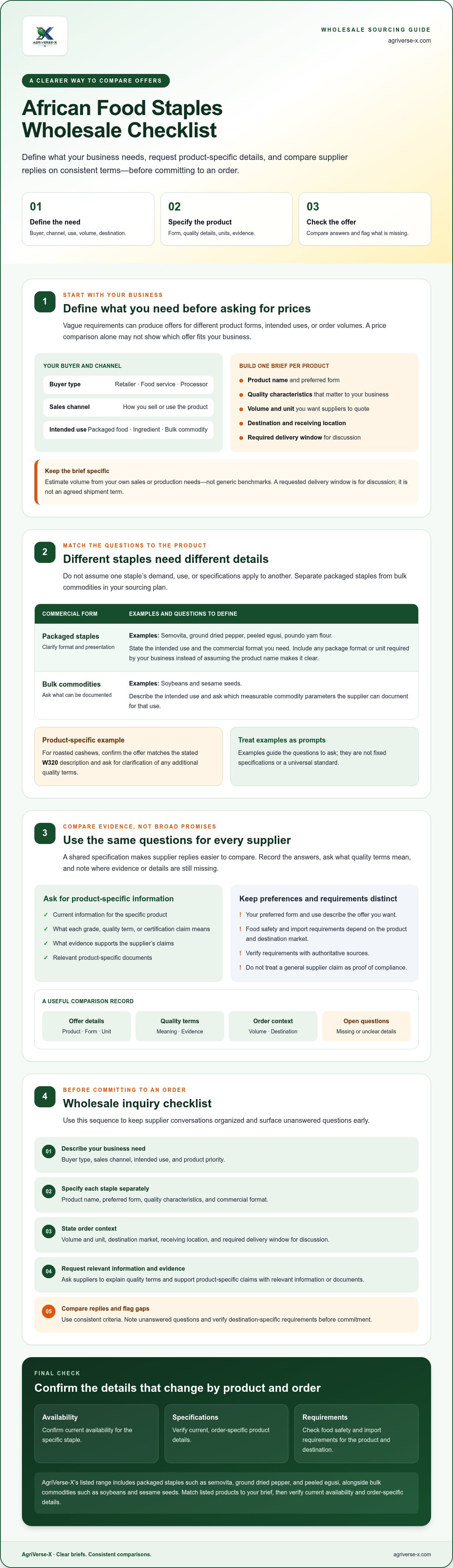
Use This African Food Staples Wholesale Inquiry Checklist
Turn your buying brief into a repeatable supplier inquiry. Use the same steps and questions for each supplier, then save the checklist and revisit it before every sourcing cycle. This keeps product needs, commercial terms, and destination market checks distinct.
- 1. Define needs: Identify the staple, buyer channel, intended use, purchasing frequency, and business based volume estimate.
- 2. Prepare specifications: State the product form and buyer defined quality preferences. Separate preferences from food safety or import requirements you must verify for the destination.
- 3. Contact suppliers: Send the same product specific inquiry to each potential supplier. Request available specifications and supporting documents.
- 4. Compare replies: Record answers using the same units and questions. Distinguish confirmed details from estimates, proposals, and unanswered items.
- 5. Resolve gaps: Follow up on material differences, missing information, and unclear responsibilities before making a purchasing decision.
What information should your supplier inquiry include?
Copy and adapt this brief. Replace every bracketed field with information you’ve confirmed for your business. Don’t insert assumed quantities, packaging formats, shipment terms, or compliance requirements.
Product: [Staple name]
Product form: [Packaged or bulk; specify the form required]
Intended use: [Retail, food service, processing, or other use]
Buyer defined preferences: [Quality characteristics or other preferences]
Requested volume and frequency: [Business based estimate and purchasing frequency]
Delivery destination: [Destination market and receiving location]
Commercial questions: Please share available specifications, packaging details, applicable order terms, and shipment responsibilities for this order.
Compliance questions: Which supporting documents are available for this product? Please identify information relevant to the stated destination. I will verify destination market requirements with authoritative sources.
How should you compare supplier responses?
Keep the inquiry consistent across suppliers, including the requested product form, units, and questions. In your comparison notes, label each answer as confirmed, estimated, proposed, or unanswered. This prevents a provisional statement from being mistaken for an agreed term.
Pause before deciding if product names differ, documents describe another form, or a supplier’s response conflicts with the brief. Ask for clarification and keep the written answer with your sourcing records. For another option to assess against your inquiry, explore AgriVerse-X’s staple range, then confirm current availability and order specific details directly.
Turn Your Sourcing Checklist Into a Confident Next Step
A reliable sourcing decision follows a clear sequence: define demand, document product specifications, verify supplier information, and resolve logistics before commitment. Your brief gives supplier conversations a consistent starting point. Next, check whether a potential product and supplier can meet the needs you’ve documented.
That discipline matters in African food staples wholesale because a relevant product listing is a reason to ask questions, not confirmation of current stock, specifications, or order terms. Assess each response against your brief and destination needs.
Which AgriVerse-X products may fit your sourcing brief?
AgriVerse-X’s listed range includes packaged staples such as poundo yam flour, semovita, ground dried pepper, and peeled egusi. Its listed commodities include soybeans, sesame seeds, honey beans, and W320 oven roasted cashews. The range spans different product types, so match each item to your intended use and required form instead of treating the list as one interchangeable category.
Product names are a starting point for your inquiry. Before proceeding, confirm current availability and the exact specifications for the order you’re considering. Ask for relevant supporting information, and check that it describes the same product and form as your request. Don’t assume a listing establishes packaging, origin, certification, shipment arrangements, or destination suitability.
What should you confirm before moving forward?
Review the proposed order against your brief. Confirm that the product fits your intended use, the proposed quantity reflects your business needs, and available supporting information addresses your questions. Recheck destination requirements with authoritative sources, and clarify commercial terms and shipment responsibilities directly with the supplier.
Keep unresolved items visible. If a product detail, document, destination requirement, or proposed term is unclear or inconsistent, request a clear written response before making a commitment. This final check helps separate confirmed information from assumptions and shows what still needs attention.
Use your checklist again with each sourcing cycle, updating it as business needs or destination requirements change. To review the listed staples against your brief, explore AgriVerse-X and confirm current product and order details before proceeding.
Make Your Next Sourcing Decision With Confidence
Reliable African food staples wholesale procurement starts with a clear brief. Define what your business needs, specify each product and intended use, then ask suppliers the same questions so their responses are easier to compare. Keep unverified claims and open questions visible rather than treating them as confirmed.
Before committing, check that product information fits your request, verify destination requirements with authoritative sources, and clarify quantities, supporting documents, and commercial terms directly with the supplier. Resolve important gaps in writing. This gives your team a more consistent basis for each sourcing decision.
AgriVerse-X’s listed range includes packaged staples such as poundo yam flour, semovita, ground dried pepper, and peeled egusi, as well as bulk commodities such as soybeans, sesame seeds, honey beans, and W320 oven roasted cashews. Confirm current availability and order specific details as you assess whether an item fits your brief.
Explore AgriVerse-X’s agricultural marketplace to review listed products against your requirements and confirm current product and order details.
Frequently Asked Questions
What are African food staples?
African food staples are foods commonly used as the foundation of meals across the continent. They vary by region and cuisine and can include grains, roots and tubers, legumes, seeds, and processed foods. Examples relevant to wholesale buyers include yam flour, beans, semolina, and sesame seeds. Define the specific product and form you need rather than assuming a staple has the same use or specification across different markets.
Which African food staples can businesses buy wholesale?
Wholesale options can include packaged foods and bulk agricultural commodities. AgriVerse-X’s listed range includes poundo yam flour, semovita or semolina, ground dried pepper, peeled egusi, soybeans, sesame seeds, honey beans, and W320 oven roasted cashew nuts. Confirm product availability, order quantities, packaging, and specifications directly before proceeding. Match each item to your channel and intended use, since requirements for a packaged staple may differ from those for a bulk commodity.
How do I find a reliable African food staples wholesale supplier?
Assess suppliers by the clarity, relevance, and consistency of their product specific information. Request details for the exact staple and form you need, check that written responses match any specification documents, and ask which supporting documents are available for your product and destination. Verify claims about origin, quality, or certification instead of relying on broad promises. For African food staples wholesale, compare suppliers using the same questions and resolve unclear answers before committing.
What information should I request when buying African staples in bulk?
Request the product name, form, intended use, available specification details, and supporting documents relevant to the item and destination. State your business based volume requirement and receiving location, then ask the supplier to clarify packaging, order terms, and shipment responsibilities. Keep buyer preferences separate from destination market requirements, which you should verify with authoritative sources. Record whether each response is confirmed, proposed, estimated, or unanswered so assumptions don’t become part of the order by mistake.
Do African food staples need to meet import requirements?
Import requirements depend on the product and destination market. Before placing an order, check applicable food safety, documentation, and import requirements with authoritative sources for the specific staple and receiving country. Ask the supplier what product specific supporting documents are available, but don’t treat a supplier’s general statement as proof that your shipment meets destination rules. If requirements are unclear, seek qualified local advice before confirming the order or arranging shipment.
How can I compare wholesale offers for different African staples?
First compare offers for the same product form, intended use, and unit of measure. Use a consistent table to record product identity, specifications, available evidence, proposed quantities, and commercial terms. Ask suppliers to explain any grade or quality wording rather than assuming terms mean the same thing. Mark missing or conflicting information clearly, then request clarification. Don’t rank offers on price alone if the products or specification bases aren’t comparable.
Can I buy packaged African food staples and bulk commodities from one supplier?
Some suppliers list both packaged staples and bulk commodities, but confirm the current product range and order specific details before assuming they can meet your full requirement. AgriVerse-X’s listed offerings include packaged poundo yam flour, semovita, ground dried pepper, and peeled egusi, as well as soybeans, sesame seeds, honey beans, and W320 oven roasted cashews. Ask for separate specifications, availability, packaging details, and terms for each product you’re considering.


