

Choosing a bulk agro food products supplier starts with defining the product, its intended use, and the details you need to compare offers. AgriVerse-X supplies packaged staples such as poundo yam flour, semovita, ground dried pepper, and peeled egusi, as well as bulk commodities including soybeans, sesame seeds, honey beans, and W320 oven-roasted cashew nuts.
Product specifications and commercial terms depend on the sourcing request. Before comparing offers, decide which product attributes matter to your operation, what supporting information you need, and how packaging and fulfilment should be handled.
This guide covers common product categories and practical ways to prepare a sourcing request. AgriVerse-X’s agricultural marketplace connects participants around agricultural products and related opportunities. A marketplace listing can help start a discussion, while product details and transaction terms need to be aligned by the participants.
Key Takeaways
- Name the specific product and intended use so a bulk agro food products supplier can respond to a focused request.
- Compare offers against the same requirements, including relevant product details, supporting information, packaging, and fulfilment.
- Tailor your questions to the commodity. The useful specifications for a packaged staple may differ from those for a product intended for processing.
- Use marketplace discovery to begin supplier discussions, then align the product and transaction details directly.
- Keep a written record of your requirements, open questions, and agreed terms.
What a bulk agro food products supplier provides, and what buyers should expect
A bulk agro food products supplier supplies agricultural commodities or food products for larger purchasing needs. “Bulk” describes the buyer’s sourcing context, rather than a fixed order size. The quantity, product requirements, and commercial terms should be set out for the specific transaction.
Supply is one part of the process. A marketplace can help buyers discover products and connect with participants, while logistics coordination concerns the movement and storage of agricultural goods. These activities sit within a broader agricultural value chain, which links production with processing and consumption. The participants still need to agree on product details and fulfilment arrangements.
For a general look at buying food in bulk, watch this video:
Before comparing offers, define the product, intended use, relevant specifications, and fulfilment expectations. Separate essential requirements from preferences, and record the commercial details the parties agree on. This gives supplier discussions a clear basis without assuming that different products share the same requirements.
Which buyers commonly source agricultural food products in bulk?
Food businesses, distributors, processors, and institutional purchasers may source agricultural products for resale, food preparation, or further processing. The intended use shapes the request. A processor may need a product in a form suited to its operation, while a food business may focus on how the product will be used in its menu or finished goods. State the application and handling expectations upfront.
What product categories can a bulk supplier cover?
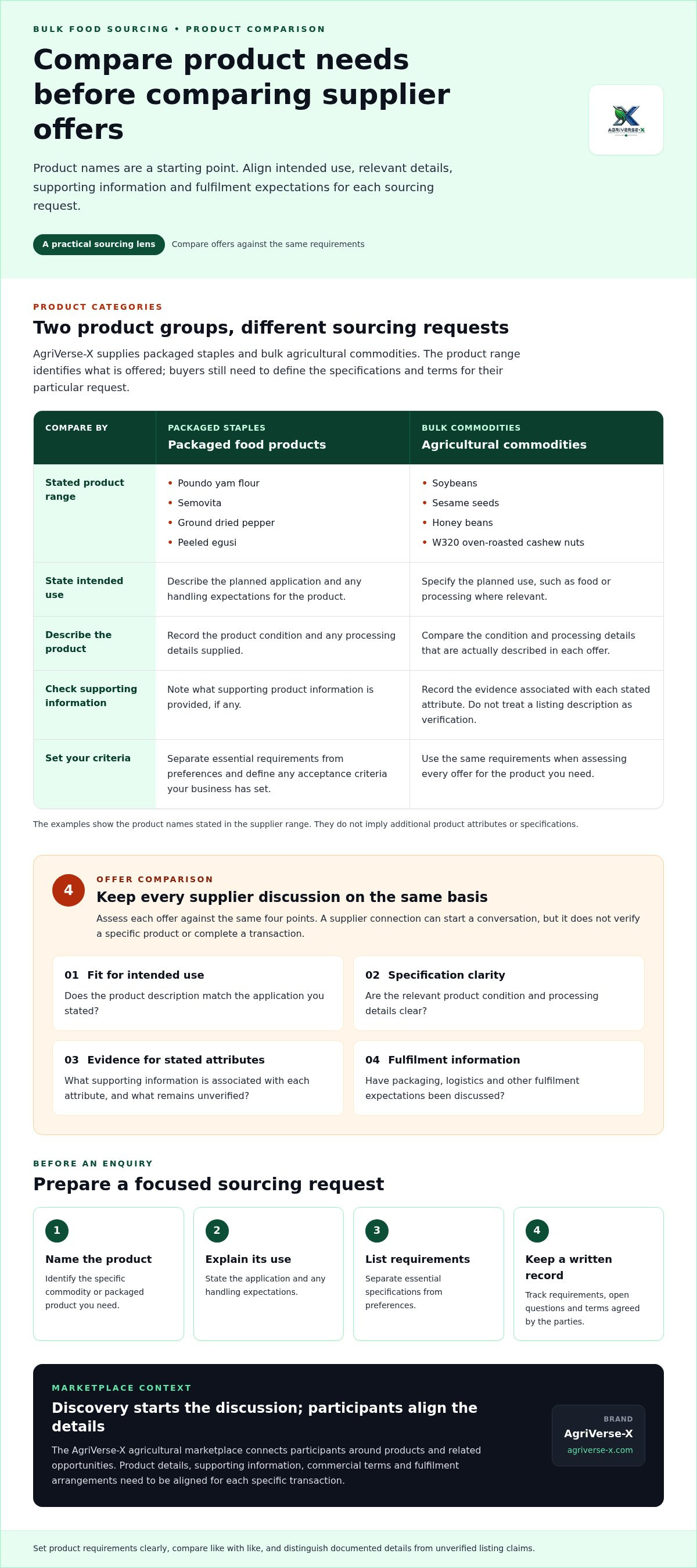
AgriVerse-X supplies packaged staples including poundo yam flour and semovita, as well as ground dried pepper and peeled egusi. Its bulk agricultural commodities include soybeans, sesame seeds, honey beans, and W320 oven-roasted cashew nuts. These product names identify the stated range, not every specification a buyer may need. Define the relevant requirements for each sourcing request.
AgriVerse-X’s agricultural marketplace connects participants around products and related opportunities. Use it to explore relevant categories and begin a focused buyer-supplier discussion, then align product details and commercial terms for the specific transaction. Service availability and commercial terms may change as the platform develops and completes legal, technical, and market validation.
Bulk agro-food product specifications: details that make offers comparable
Comparable offers need clearly aligned product specifications. A product name alone may not give a buyer enough information to assess fit. Define the intended use, identify the attributes that matter for that application, and compare each offer against the same requirements.
Useful information varies by commodity and use. A packaged staple and a commodity intended for processing may call for different descriptions. Broader food and agriculture context is available from the Food and Agriculture Organization of the United Nations, but buyers should define criteria that suit their own requirements.
| Product name | Intended use | Condition or processing details | Available specification evidence |
|---|---|---|---|
| Poundo yam flour | State the buyer’s intended application. | Record the product condition and any processing details supplied. | Note what supporting information is provided, if any. |
| Soybeans | Specify the intended use, such as food or processing. | Compare the condition described in each offer. | Record the evidence associated with each stated attribute. |
| Sesame seeds | Describe the planned application. | Compare only the condition details supplied. | Separate documented details from unverified listing claims. |
| W320 oven-roasted cashews | State how the product will be used. | Retain the stated product description; don’t infer extra attributes. | Record any supporting product information provided. |
How should buyers describe the product they need?
Name the specific commodity or packaged product rather than asking for a broad category such as “staples.” State its intended use, relevant quality attributes, and any acceptance criteria your business has defined. Label each item as a requirement or preference. This helps a bulk agro food products supplier respond to the actual need.
What product information should buyers compare?
Compare the product condition, processing description, and other relevant details supplied for each offer. Keep a record of the evidence or documents associated with each stated attribute, and distinguish those materials from descriptions in a listing. Information about processing, for example, should not be treated as evidence for a different product attribute. For broader context on food and agriculture, see the Food and Agriculture Organization of the United Nations.
Use the AgriVerse-X agricultural marketplace as a connection point for product discussions, then align the requirements and supporting details in the sourcing conversation.
How to compare bulk agro food suppliers without relying on listing claims
Compare each offer against the same four points: fit for your intended use, clarity of product specifications, evidence supporting stated attributes, and fulfilment information. A supplier connection can begin a conversation, but it does not verify a specific product or complete a transaction.
Assess the information for the particular offer you are considering. A bulk agro food products supplier may provide product records or other documents, but each item supports only the details it actually covers. Due diligence helps clarify questions, but it does not guarantee product quality or delivery.
| Stated claim | Supporting evidence to record | Open buyer question |
|---|---|---|
| Product name and intended use | Product description or record supplied for the offer | Does the described product match the buyer’s required application? |
| Condition or processing description | Documentation that relates to the stated condition or processing | Which buyer-defined acceptance criteria remain unaddressed? |
| Packaging expectations | Written details supplied for the specific transaction | Are the packaging format and handling expectations aligned? |
| Fulfilment arrangement | Written record of agreed responsibilities and terms | Who is responsible for each fulfilment step, and what remains open? |
What evidence can help clarify a supplier’s product claims?
Record the information or documents the seller provides, then match each item to the attribute it is meant to support. For example, a processing description should not be treated as proof of another quality attribute. Note gaps plainly and distinguish evidence from claims. Marketplace visibility or matching is not the same as independent verification, certification, or a guarantee.
How should buyers assess fulfilment expectations?
Put the order scope, packaging expectations, delivery responsibilities, communication process, and commercial terms in writing. Treat timelines and transport arrangements as specific to the transaction. Before proceeding, make sure both parties have a shared record of what has been agreed and what remains unresolved.
This review helps buyers compare offers fairly while keeping product assessment separate from marketplace discovery. AgriVerse-X’s agricultural marketplace connects participants around products and related opportunities. Buyers should assess the details and terms of each individual transaction.
A practical bulk food sourcing request: what to prepare before making an enquiry
A clear enquiry gives a bulk agro food products supplier a practical basis for responding. It can reduce avoidable ambiguity by separating the product need from preferences and unresolved terms.
Prepare your request in sequence:
- Name the product. Use the specific commodity or packaged food product, not only a broad category.
- State the intended use. Explain whether it is for resale, food preparation, or processing.
- Set product requirements. Identify essential specifications and buyer-defined acceptance criteria. Mark preferences separately.
- Describe evidence needs. List relevant records or supporting information you want to review.
- Set fulfilment expectations. State packaging expectations and ask about delivery responsibilities, timelines, and other commercial terms.
- Record the outcome. Keep the final product description, evidence reviewed, open questions, and agreed transaction details together.
What should a bulk food sourcing brief include?
Keep the brief focused: product, intended use, essential specifications, evidence requested, packaging expectations, and fulfilment questions. Label each requirement as either non-negotiable or preferred. That distinction helps both parties see where an offer fits and where discussion is still needed.
For additional buyer-side prompts, refer to the companion guide African Food Staples Wholesale: A Buyer’s Sourcing Checklist. Use it to organise your request, then tailor the details to the product and application at hand.
How can buyers keep supplier discussions organised?
Use one comparison record for each offer. Track the stated product details, evidence received, unanswered questions, specification changes, and fulfilment terms. Share updates with the relevant participants so everyone works from the same version. For semolina-specific considerations, consult Semolina Bulk Supplier: A Practical Wholesale Buying Guide.
A shared record makes differences visible before details are finalised. It also helps distinguish an initial enquiry from terms both parties have actually agreed to.
To explore how AgriVerse-X connects participants around agricultural products, visit the AgriVerse-X agricultural marketplace.
How AgriVerse-X connects buyers with agricultural food products
AgriVerse-X’s agricultural marketplace provides a connection point for participants exploring agricultural products and related opportunities. It can help buyers discover product categories and begin supplier discussions. A clear sourcing request keeps those conversations focused on intended use, relevant specifications, and fulfilment expectations.
Discovery is a starting point. Buyers and suppliers still need to align product details and commercial terms for each transaction. Service availability and terms may change as the platform develops and completes legal, technical, and market validation.
Which food products are included in AgriVerse-X’s stated range?
The stated range covers packaged staples and bulk agricultural commodities. Packaged staples include:
- Poundo yam flour and semovita
- Ground dried pepper and peeled egusi
Bulk commodities include soybeans, sesame seeds, honey beans, and W320 oven-roasted cashew nuts. These examples describe the product range, not specific stock, packaging formats, grades beyond the stated product name, or other specifications. Define the details relevant to your intended application during the sourcing discussion.
What should buyers understand about marketplace connections?
A marketplace brings participants together around products and opportunities. It can support product discovery and buyer-supplier communication, but visibility or a connection does not independently verify a product or confirm that a purchase, fulfilment arrangement, or transaction has been completed. Treat each offer according to its details and agreements.
For buyers approaching a bulk agro food products supplier, the platform can provide a place to explore relevant categories and start a focused enquiry. Align the product description, required supporting information, and fulfilment expectations with the other transaction participants.
Learn how AgriVerse-X connects agricultural participants.
Make Your Next Sourcing Request Clearer
A productive bulk enquiry starts with a precise product name, intended use, and buyer-defined specifications. Compare offers against the same criteria, note what evidence supports each stated attribute, and put packaging and fulfilment expectations in writing. These steps give a bulk agro food products supplier a clearer picture of your needs.
AgriVerse-X supplies packaged staples and bulk agricultural commodities, with an agricultural marketplace that connects participants around products and related opportunities. Specific product details and transaction terms should be aligned between the parties.
Prepare your sourcing request, clarify open questions, and keep agreed details organised. Learn how AgriVerse-X connects agricultural participants and explore agricultural marketplace discussions.
Frequently Asked Questions
What does a bulk agro food products supplier do?
A bulk agro food products supplier provides agricultural commodities or food products for business purchasing needs. Buyers should define the product, intended use, specifications, and supporting information they need to review. A marketplace can help buyers and suppliers connect, while the participants align the details and fulfilment terms for each transaction.
Which products does AgriVerse-X supply in bulk?
AgriVerse-X supplies packaged poundo yam flour, semovita, ground dried pepper, and peeled egusi, as well as bulk commodities including soybeans, sesame seeds, honey beans, and W320 oven-roasted cashew nuts. Define the product details and requirements that matter to your intended use when preparing a sourcing request.
How can buyers evaluate a bulk food supplier?
Check whether the product description fits your intended use and whether its important specifications are clear. Compare supporting information with the claims it relates to, then align packaging and fulfilment expectations in writing. Keep listing descriptions separate from evidence, and assess the details of each offer.
What information should I include in a bulk food sourcing request?
Identify the exact product and intended use first. List essential specifications, buyer-defined acceptance criteria, and any evidence you want to review. Include packaging expectations and fulfilment questions relevant to your operation. Separate non-negotiable requirements from preferences so responses are easier to compare.
How do I compare offers for agricultural food products?
Compare each offer against the same product requirements rather than relying on headline descriptions. Review stated attributes, relevant supporting information, packaging expectations, and fulfilment details side by side. Record unanswered questions and distinguish evidence from claims. The checks that matter can vary by product and transaction, so use your comparison as part of your own due diligence.
Does an agricultural marketplace guarantee bulk food quality or delivery?
No. A marketplace can help buyers and sellers discover products or connect, but that connection does not itself guarantee product quality, availability, supply, delivery, or transaction completion. Buyers and sellers need to align product specifications, supporting information, and fulfilment terms for each transaction. AgriVerse-X’s service availability and commercial terms may change as the platform develops and completes legal, technical, and market validation.


