
The biggest course catalogue won’t necessarily teach you what your farm needs next. The right online agricultural courses start with a specific decision or skill you want to work on, then connect the learning to your crops, region, experience, and available resources.
Choosing can feel difficult when listings blur the difference between a broad introduction and practical training. Course level, teaching format, credentials, and regional examples can also be hard to compare. Training in precision agriculture, soil or water management, or farm business skills is most useful when it fits your goals and circumstances.
Use this guide to choose a topic and level, assess how well a course fits your farming context, and compare its curriculum, instruction, practical work, format, and credential details. You’ll also find a framework for turning lessons into realistic next steps, whether you’re building farm skills or exploring an agricultural career.
AgriVerse-X offers specialized farming courses through its agricultural education portal, which is part of its broader digital agriculture platform. Start with the farm or career decision you want to support, rather than the size of a course catalogue.
Key Takeaways
- Start with a specific farm, business, or career goal, then choose online agricultural courses that match the skill you want to build.
- Compare course level, syllabus, format, learner support, assessment, and time commitment using the same criteria.
- Check whether course examples fit your region and circumstances. Treat online learning as a complement to locally appropriate technical advice.
- Set a learning objective, record useful insights, and plan a suitable way to apply and review what you learn.
- AgriVerse-X offers specialized farming courses through its agricultural education portal, part of a broader digital agriculture platform.
Online Agricultural Courses: Match Your Learning Goal to the Right Topic
Online agricultural courses are structured digital learning programmes covering farming, agribusiness, and related subjects. Choose a topic by naming the decision you want to approach: planning a farm, improving an existing operation, or exploring a career in agriculture. A clear goal helps you avoid choosing a broad introduction when you need focused learning, or advanced material before you have the foundations.
Your best fit depends on what you already know and the agricultural context you work in. Someone exploring agriculture as a career may need a broad introduction to the sector. A grower working through a specific production question may benefit more from focused study. Agricultural education includes different ways of learning, including distance learning, so let your priorities guide where you begin.
For a glimpse of how technology is entering farm decision-making, watch this video:
Which agricultural course topics align with your goal?
Match the subject to the work or decision ahead. Crop production, soil health, and pest management suit crop-focused learning, while livestock training relates to animal production and care. Sustainability courses examine resource use and long-term farm practices. Agricultural technology can introduce digital tools and equipment, while agribusiness topics focus on planning, operations, and commercial decisions.
Use these subject areas as a map for your search, then narrow the choice to a task you want to understand. “Learn about soil health” is a broad interest. “Understand which soil indicators to monitor before changing a field practice” gives you a more useful direction. Check whether the course examples reflect your crops, climate, production system, and available resources.
Should you choose beginner, intermediate, or advanced training?
Read the course description for prerequisites and assumed experience. A beginner course may suit someone building foundational agricultural knowledge. Intermediate or advanced training may fit learners who already understand the basics and want to study a narrower subject. Don’t choose by the level label alone. Compare the stated expectations with what you already know.
Experienced growers may get more value from focused training than from repeating a broad introduction. Keep career exploration separate from operational learning, too. If you’re considering agriculture as a career, start with material that helps you understand roles and areas of work. If you’re responsible for farm decisions, define the decision first and look for learning that can inform it. A course can build understanding, but it does not replace locally appropriate technical advice.
How to Compare Online Agricultural Courses Before You Enroll
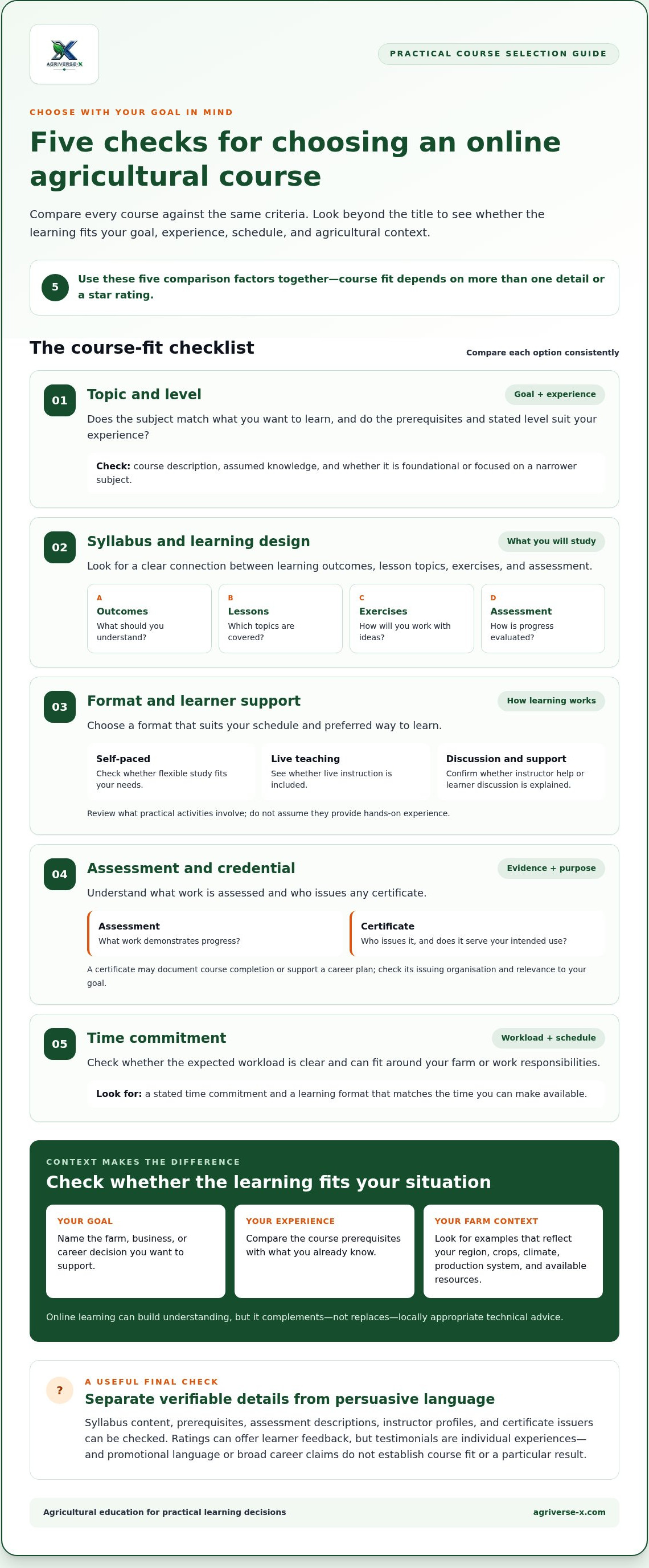
Compare each option against the same criteria instead of relying on a polished title or star rating. A consistent checklist makes differences easier to see and helps you judge whether the training suits your objective, experience, and farm context.
| Compare | What to look for |
|---|---|
| Topic and level | Does the subject match your goal, and does the stated level suit your experience? |
| Syllabus | Are learning outcomes, lesson topics, exercises, and assessments described? |
| Format and support | Is learning self-paced or live? Are discussion, instructor support, or practical activities explained? |
| Assessment and credential | What work is assessed, who issues any certificate, and does it fit your intended use? |
| Time commitment | Is the expected workload clear, and can you fit it around farm or work responsibilities? |
What should an agricultural course syllabus include?
Look for more than a list of broad themes. A useful syllabus links learning outcomes to lesson topics, exercises, and assessment methods, so you can tell what you’ll study and how progress is evaluated. Practical assignments or examples can help connect ideas to farm decisions, such as comparing approaches to a production challenge. Check whether the stated content reflects your crops, production system, and operating scale.
How can you assess instructors, credentials, and format?
Review published information about instructors’ relevant experience and credentials. Compare the format with your needs: self-study offers flexibility, while live teaching or discussion can provide interaction when those features are included. Look at what practical activities involve instead of assuming they provide hands-on experience. For a certificate, identify the issuing organisation and decide whether it serves your goal, such as documenting course completion or supporting a career plan.
Separate details you can inspect from persuasive language. Syllabus content, prerequisites, assessment descriptions, instructor profiles, and certificate issuers are checkable. Testimonials reflect individual experiences, while promotional language and broad career claims don’t establish that a course will fit your circumstances or produce a particular result.
Ratings can reveal learner feedback, but they don’t replace reviewing the syllabus, instructor information, or credential details. Choose the format that fits your schedule and preferred way to learn rather than assuming one approach works for everyone. AgriVerse-X’s agricultural education portal offers specialized farming courses as part of a broader digital agriculture platform. Explore AgriVerse-X’s agricultural education portal.
Are Online Agricultural Courses Practical and Relevant to Your Region?
Online learning can make agricultural knowledge easier to access, support flexible study, and help learners build a foundation before making operational decisions. A lesson’s usefulness also depends on how well its examples match local conditions. Digital learning can build knowledge, but it doesn’t replace locally appropriate technical advice or supervised practice where these are needed.
Agricultural learning travels best when you adapt its principles to your region’s crops, climate, infrastructure, and production system. Make regional fit a key test when assessing online agricultural courses. A method shown in one setting may need adjustment where rainfall patterns, soil conditions, equipment access, farm scale, or available services differ.
How do you check whether course content fits your location?
Start with the course description and syllabus. Look for regions, climate conditions, crops, and production systems identified in examples, assignments, or learning outcomes. If a course describes an approach without saying where or under what conditions it applies, note what you would need to investigate locally before using it.
- Climate and crops: Compare the examples with the growing conditions and crops relevant to your farm or intended work.
- Infrastructure and scale: Consider whether the production system assumes access to equipment, connectivity, inputs, or facilities similar to yours.
- Local context: For learners in Nigeria and elsewhere in Africa, assess whether examples reflect relevant local farming conditions. Don’t assume guidance from another region transfers directly.
- Safety and rules: If a course covers safety-sensitive work or regulated activities, consider whether its guidance addresses your jurisdiction. Seek appropriate local expertise when requirements or conditions vary.
Regional fit isn’t all or nothing. A course can teach useful concepts while leaving you to adapt the examples. Separate what the lesson explains generally from what depends on local soil, weather, crops, equipment, or requirements.
When is online learning enough, and when is field support useful?
Online lessons can help you understand concepts, compare planning approaches, and build structured knowledge at your own pace. They can also help you frame questions before changing a farm practice. That foundation is valuable, but it may not teach every hands-on skill.
Equipment operation, site-specific assessment, and other practical tasks may require supervised experience. For decisions that affect safety or depend on local conditions, use qualified local guidance. Before applying a course idea, identify what fits, what needs adaptation, and what requires practical or expert input.
How to Turn an Online Agriculture Course into a Practical Learning Plan
Study is more useful when it connects to a real question. Before starting, write down one learning objective: what do you want to understand, decide, or improve? A focused objective helps you choose relevant lessons, capture useful details, and judge whether the learning applies to your situation.
What should you do before starting an agricultural course?
Define the farm or career decision you want to approach with better knowledge. Then review the course requirements, schedule, regional scope, and access details so you can plan around your responsibilities. Set a realistic study routine and a specific outcome, such as being able to compare options or explain a process. Don’t expect a course alone to guarantee a farm or career result.
Use this sequence to carry learning into practice:
- Define a question: State the decision or knowledge gap you want to address.
- Choose training: Select a course whose stated content supports your objective and fits your context.
- Record insights: Keep concise notes on useful principles, assumptions, and questions to investigate.
- Test appropriately: Identify a suitable, responsible way to apply a relevant idea, with qualified guidance where needed.
- Review: Compare what you observed with your starting point, and note what still needs further learning or local advice.
How can you apply lessons without overgeneralizing?
Turn each useful lesson into a question before turning it into an action. Ask whether the conditions described match your crops, production system, resources, and local environment. Record relevant starting conditions and observations in farm notes or existing records. This gives you context for reviewing what happened without assuming one lesson caused every change.
For safety-critical or location-dependent recommendations, seek guidance from qualified local professionals before acting. Course material can help you understand concepts and prepare questions, but it may not account for every feature of your site or the requirements that apply where you work.
Learning may also support decisions beyond production. If your objective involves agricultural markets or sourcing, use a focused reference alongside your course, such as the African food staples wholesale sourcing checklist. Treat it as a relevant example for market-related learning, then assess its guidance against your own needs and circumstances.
AgriVerse-X offers specialized farming courses through its agricultural education portal, part of its digital agriculture platform. Explore AgriVerse-X’s agricultural education portal as you plan your next learning step.
Explore AgriVerse-X Online Agricultural Courses and Assess Their Fit
AgriVerse-X is a digital agriculture platform with an education portal offering specialized farming courses. To decide whether a course fits, apply the same practical criteria you’d use for any training: connect its subject to your goal, review the level and learning expectations, and consider whether the examples suit your region and agricultural context.
A title alone can’t tell you whether a course will help with your next farm or career decision. Read the available course information with a specific objective in mind. Look for details that explain what it covers and who it is intended to serve, then note any questions you need to resolve before applying what you learn.
How should learners assess AgriVerse-X agricultural courses?
Start with the course description. Does its subject connect to the skill or decision you want to address? Review published information about the level and learning expectations, then consider whether the scope matches your experience. Compare the stated content with your crops, production system, operating scale, or career interests.
Use the information published for each course when assessing credentials, instructors, and outcomes. Don’t assume a certificate, particular instructor background, or guaranteed result based on general promotional language. Ground your comparison in what the course actually describes.
What is a sensible next step after comparing courses?
Choose a course whose published information aligns with your goal and context. Before you begin, write one learning objective, such as understanding a process or preparing to evaluate a farm decision. Use that objective to guide your notes and reflect on how the lessons apply to your circumstances.
Keep expectations realistic. Training can build knowledge and help you prepare for informed decisions, but it can’t guarantee farm performance, employment, or career outcomes. Results depend on many factors beyond a course, including local conditions and how you apply what you learn.
AgriVerse-X’s agricultural education offering is part of a broader digital agriculture ecosystem. Explore AgriVerse-X’s agricultural education offering and assess the available course information against the goal, level, and regional fit that matter to you. This content is for general informational purposes only and isn’t professional agricultural advice.
Choose Training That Moves Your Next Step Forward
The strongest course choice starts with a real learning goal. Compare the subject, level, syllabus, teaching format, assessment, and time commitment. Then check whether the examples fit your crops, region, experience, and resources. A clear objective helps you focus your study and identify practical next steps.
Online agricultural courses can build knowledge, but lessons may need to be adapted to local conditions. Use course notes and farm records to reflect on what applies, and seek qualified local guidance for safety-sensitive or site-specific decisions. Training supports learning, but it can’t guarantee farm, business, or career results.
AgriVerse-X offers specialized farming courses through its agricultural education portal, part of a broader digital agriculture ecosystem. Explore AgriVerse-X’s agricultural education portal and review the course information against your goals and context. Set a practical learning objective and take the next step in building skills that support your work.
This article is for general informational purposes only and is not professional agricultural, financial, legal, or career advice.
Frequently Asked Questions
What can you learn in an online agricultural course?
An online agricultural course can cover farming, agribusiness, or a related subject, depending on its syllabus. Possible topic areas include crop production, soil health, pest management, livestock, sustainability, agricultural technology, and farm business. These are examples of learning areas, not a description of every provider’s catalogue. AgriVerse-X offers specialized farming courses through its agricultural education portal, part of its broader digital agriculture ecosystem.
Are online agricultural courses worth taking?
They can be worthwhile when the subject, level, and examples match your learning goal. Before enrolling, review the syllabus, teaching format, expected time commitment, assessment, and credential details. Consider whether you can use the learning to explore a career or inform a farm decision. Online study can build knowledge, but it doesn’t guarantee better farm results, employment, or business outcomes.
Can I learn farming online without practical experience?
Yes. Online learning can help you build foundational knowledge and understand agricultural concepts before gaining practical experience. Start with a course whose stated level suits a beginner, and check whether it includes exercises or other practical learning activities. Digital lessons can’t provide every hands-on skill or site-specific insight. For equipment use and safety-sensitive tasks, seek suitable supervised practice and qualified local guidance.
How do I choose an online agricultural course?
Start with a specific goal, such as exploring a career in agriculture or building knowledge for a farm decision. Compare the course topic, level, syllabus, format, support, assessment, and time commitment. Check whether examples fit your crops, production system, and region. Review published instructor and credential information, and distinguish checkable details from testimonials or broad promotional claims.
Do online agricultural courses provide certificates?
Some courses may provide a certificate, while others may not. Review the course information to see whether a credential is offered, who issues it, and what it represents. A certificate of completion may document study, but it doesn’t automatically establish a professional qualification or practical competence. For AgriVerse-X courses, rely on the information published for the specific course rather than assuming a credential is included.
Can I take an online agricultural course from another country?
Access depends on the provider and course. Review regional access details, language and technology requirements, schedule, and any location-specific limitations stated in the course information. Also consider whether examples reflect your local crops, climate, infrastructure, and production system. If lessons discuss safety-sensitive or regulated activities, use guidance relevant to your jurisdiction.
How can I apply what I learn in an agriculture course?
Set one learning objective before you begin, then record useful ideas, questions, and assumptions as you study. Compare relevant lessons with your farm or career context, including local conditions and available resources. Before acting, record your starting conditions and decide how you’ll review any observations. Don’t apply safety-critical or site-dependent recommendations without suitable qualified local guidance. Treat course learning as support for decisions, not a guarantee of results.


