

Choosing a semolina bulk supplier starts with defining the product your business needs, how you plan to use it, and the order details that matter. Semolina and semovita are names buyers may encounter in staple-food sourcing, so make the product identity clear before comparing offers.
For wholesalers, retailers, distributors, and food businesses, a broad product description may not answer every purchasing question. AgriVerse-X distributes packaged food staples, including semovita or semolina. A written buying brief helps you discuss the product and your order requirements clearly, without assuming specifications or terms that have not been stated.
This guide shows how to prepare that brief, compare offers on a like-for-like basis, and keep requests distinct from agreed details. Use it to organize product information, quantity, packaging preferences, destination, and timing before moving ahead with a wholesale purchase discussion.
Key Takeaways
- Identify whether you intend to source semolina or semovita, and state its planned use.
- Put your quantity, packaging preference, destination, and requested timing in writing.
- Compare offers only when they address the same product and order requirements.
- Separate documented product details from unanswered questions and requested terms.
- AgriVerse-X distributes packaged semovita or semolina for buyers preparing a focused sourcing request.
What Should a Bulk Semolina Supplier Help You Source?
Start with product identity, intended use, and the quantity your business is planning to purchase. A listing that says only “semolina” or “semovita” may not cover all the information you need, so treat the name as the start of your sourcing brief rather than a complete product specification.
Write down the exact product name you intend to buy and its planned application, such as resale or use in food preparation. For general background on the term, see What is Semolina. Keep the product description consistent in your enquiries, internal purchasing notes, and offer comparisons.
A product video can show how one semolina-labelled product is presented. It does not establish the specifications of other products or offers, so use written product information when assessing a particular purchase.
Bulk supplier: A source that provides products for business-scale purchasing. Buyers define the product and order requirements, then use the supplier’s written product and commercial information to assess the purchase.
Semolina and semovita: clarify the product before comparing suppliers
Product names and buyer expectations can vary across markets and listings. Don’t assume that two offers describe identical products because they use similar wording. In your purchasing brief, use the exact name you intend to source and state how your business plans to use it. Apply that same description when reviewing each offer.
If composition, grade, origin, or another characteristic affects your decision, record it as a requirement that needs supporting product information. Avoid treating an assumed equivalence between semolina and semovita as a confirmed specification.
Who benefits from a bulk sourcing approach?
Retailers, distributors, food businesses, and other commercial buyers benefit from setting requirements before comparing offers. A shared description gives your team a consistent reference point and makes it easier to distinguish information that has been documented from questions that are still open. For a wider framework covering staple purchases, see African Food Staples Wholesale: A Buyer’s Sourcing Checklist.
AgriVerse-X distributes packaged food staples, including semovita or semolina. Buyers can use a written brief to keep a sourcing discussion focused on the product and their purchasing requirements, without assuming product specifications that have not been provided.
How to Evaluate a Semolina Bulk Supplier Before Ordering
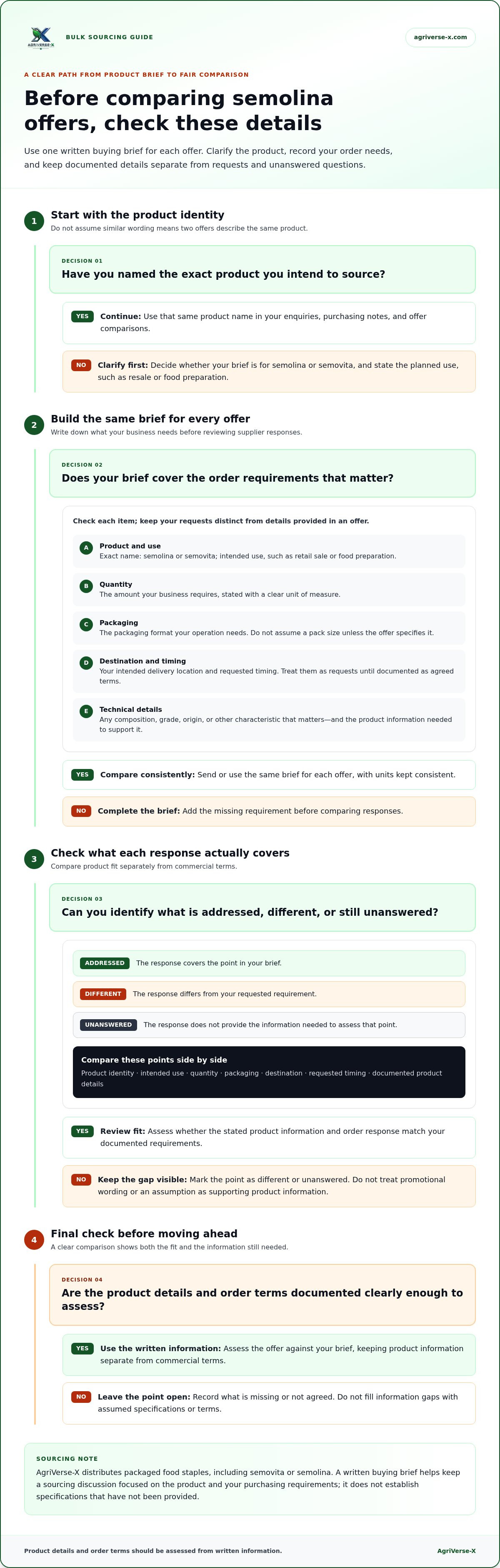
Use the same written buying brief to assess each offer. This makes it easier to identify what the product information and order response actually cover, rather than relying on a broad listing or filling gaps with assumptions.
Which product and order details belong in a buying brief?
Begin with the product name and intended commercial use. Then set out what your business needs, keeping your requests separate from the information provided in response:
- Product: Name semolina or semovita as intended and state the planned use, such as retail sale or food preparation.
- Quantity: State the amount your business requires and use a clear unit of measure.
- Packaging: Describe the packaging format your operation needs. Do not assume a particular pack size unless it is specified in the offer.
- Destination and timing: Write down the intended delivery location and the timing you are planning around. Keep these as requested conditions until they are documented as agreed terms.
- Technical details: List composition, grade, origin, or other product characteristics that matter to your decision, and identify the documentation needed to support them.
Technical definitions can depend on the market and jurisdiction. For purchases governed by U.S. requirements, the eCFR provides official U.S. standards for semolina. Apply that reference only in its relevant context; it does not establish requirements for every destination.
How to compare supplier responses fairly
Use one version of your buying brief for every offer. Keep units consistent and compare the product name, intended use, quantity, packaging, destination, and requested timing side by side. Mark each item as addressed, different from your request, or unanswered. This gives you a clearer picture of how each response fits your requirements.
Separate what the product description or documentation explicitly states from what remains unverified. This is particularly useful for characteristics such as composition, grade, and origin. Promotional wording can introduce an offer, but it does not establish that the product meets your stated requirements.
A written brief helps keep the product and order discussion aligned with the needs your business has documented.
What Should You Compare Across Bulk Semolina Offers?
Compare offers against the same requirements, not against broad claims or descriptions of different products. Review product fit separately from commercial terms. That way, you can see whether the stated product information suits your intended use and whether the order response addresses your purchasing needs.
Use a comparison sheet with one row per offer and these columns:
- Product identity: The exact name and description stated in the offer.
- Intended use: Your planned application and the information provided about product suitability.
- Quantity: Your requested amount and the unit used in the response.
- Packaging: Your stated requirements and any packaging details provided.
- Delivery: Your destination and requested timing, alongside the response to each point.
- Documented details: Product and order information supported by written documentation, with gaps clearly marked.
Compare product fit and information quality
First, check whether each offer clearly identifies the product. Compare its stated description with your intended use, but do not infer characteristics that are not specified. For background on qualities associated with durum wheat, durum wheat quality attributes is a reference; it does not establish the specifications of an individual offer.
Assess product suitability separately from the quality of the supporting information. Record what the description or accompanying documents state, then note any missing or unclear details. Do not turn an unanswered question into an assumed product feature or a quality ranking.
Compare order planning and communication
Next, compare the commercial terms with your requirements. Check whether the response addresses quantity, packaging expectations, destination, and timing. For each point, note whether it is covered, differs from your request, or remains unresolved. This keeps requested conditions distinct from agreed terms.
Keep a dated record of changes as the discussion develops. If the quantity or destination changes, update your comparison sheet and related written records so all offers are assessed against the same requirements. For broader context on digital sourcing, see Global agriculture marketplace.
Use your comparison to organize a focused discussion about the product and the order requirements you have documented.
How to Prepare a Clear Bulk Semolina Purchase
A clear purchase begins with a defined product and written order requirements. Identify the product, describe its intended use, compare the available information, and document the terms agreed for the order. This sequence helps keep product selection and procurement decisions distinct as you move from evaluating an offer to recording a purchase.
Build a reusable semolina purchasing brief
Make the brief specific to your business. Write the product name and intended use first, then add the required quantity, preferred packaging, destination, and requested schedule. These details describe your purchasing needs; record separately which terms have been agreed.
Keep technical questions in their own section. If composition, grade, origin, or another product characteristic matters to your decision, state what documentation you need to review. This makes it less likely that an assumption will be mistaken for an order requirement or confirmed product fact.
- Product: Exact name and intended commercial use.
- Order needs: Required quantity and packaging preference.
- Planning: Destination and requested schedule.
- Open details: Technical questions and the supporting documentation needed.
Move from shortlist to documented order
Review each response against the same version of your brief. Note which requirements are addressed, which differ, and which are still open. Before proceeding, confirm that the selected product description and documented order details match the purchase you intend to make.
Record the agreed product identity and commercial terms in the order documentation. If a requirement changes during the discussion, update the written record so the product selection and procurement details reflect the same decision. Buyers applying this process to other staples can also explore Poundo Yam Flour Online: Compare Listings and Choose with Confidence for a related purchasing framework.
Reusable order-readiness check:
- Have you named the exact product and its intended use?
- Are quantity, packaging preference, destination, and requested schedule written down?
- Are technical details documented or clearly marked as open questions?
- Do the agreed product and commercial details appear in the order record?
Use this brief to prepare a focused purchase discussion with AgriVerse-X, which distributes packaged food staples including semovita or semolina. Discuss your semolina order requirements with your product and purchasing details organized.
Source Semolina or Semovita Through AgriVerse-X
For buyers searching for a semolina bulk supplier, this provides a clear starting point for discussing the product and the purchasing requirements their business has defined.
What AgriVerse-X’s semolina and semovita offer means for buyers
AgriVerse-X’s packaged food-staples range includes semovita or semolina. Use your written brief to describe the product you intend to source and its planned use. Keep details such as composition, grade, origin, packaging format, price, and delivery terms tied to information documented for the purchase rather than assumptions.
Keep product selection and order planning distinct. Name the product, state its intended use, and set out the order requirements that matter to your business. These details give the sourcing discussion a shared reference and help separate stated information from points that still need to be addressed.
The practical sequence is straightforward: identify the product, define its intended use, state your quantity and packaging requirements, compare the information provided, and record the agreed terms. Clear written details help carry your decision from product selection into the order documentation.
Take the next step with a defined sourcing request
Before making an enquiry, bring your requirements together in one concise request. Include:
- The product name, semovita or semolina, and intended commercial use.
- Your required quantity and packaging preference.
- The destination and requested timing for the purchase.
- Any product details you need documented.
Describe destination and timing as your requirements until they are recorded as agreed arrangements. List technical questions separately, so requested information remains distinct from established product details.
A focused request keeps the product and order discussion on the same terms. Visit the AgriVerse-X homepage to make a business enquiry about semovita or semolina, using your written requirements to guide the discussion.
Make Your Next Semolina Purchase Clear and Confident
A sound wholesale purchase begins with a clear match between product identity, intended use, and order requirements. Define those needs in writing, compare offers on a like-for-like basis, and record agreed product and commercial details. This gives your sourcing discussion a practical foundation and keeps assumptions about product specifications or delivery separate from documented information.
When assessing a semolina bulk supplier, focus on the information that supports your decision: a clearly named product, details relevant to its intended use, and order terms that address your business requirements. Keep unanswered questions visible so they are not mistaken for confirmed product or purchase details.
AgriVerse-X distributes semovita or semolina among its packaged food-staple offerings. Prepare your product name, intended use, quantity, packaging preference, destination, and requested timing to make your enquiry focused.
Discuss your semolina or semovita sourcing requirements with AgriVerse-X and take the next step with a clear brief. A well-defined request helps keep the purchasing discussion specific and organized.
Frequently Asked Questions
What should I look for in a semolina bulk supplier?
Start by defining the exact product you need and how your business plans to use it. Then compare product descriptions and documented order details against that brief, including quantity, packaging expectations, destination, and preferred timing. Compare like-for-like offers, and treat claims about certification, grade, origin, price, or delivery as unconfirmed unless they are documented for the offer.
Is semolina the same as semovita?
Not necessarily. Product names and buyer expectations can differ across markets and listings, so do not assume semolina and semovita have identical composition or specifications based on the names alone. Use the exact product name you intend to buy in your purchasing documents and state its planned use. For AgriVerse-X products, rely on documented product information rather than inferring ingredients, processing, grain type, or equivalence.
How do I compare bulk semolina suppliers?
Compare every offer against one written brief covering product identity, intended use, quantity, packaging, destination, and requested schedule. Check whether each description and response addresses those points, and mark unanswered details clearly. This helps you assess how each offer fits your needs without treating promotional language or unverified quality statements as evidence of suitability.
Can I order semolina in bulk for a food business?
Food businesses can prepare a sourcing request around their operational needs, including product name, intended use, requested quantity, and packaging preference. Use a clear written brief to structure a business purchase discussion around the product and order requirements.
What information should a bulk semolina enquiry include?
Include the product name, intended use, requested quantity, packaging expectations, destination, and preferred timing. If composition, grade, or another technical characteristic matters, list it as a detail that needs supporting documentation. A structured request gives the purchasing discussion a clear reference point and keeps agreed terms separate from requests and open questions.
Does AgriVerse-X supply semolina or semovita?
Use a sourcing brief to set out your intended product and order requirements. Product details such as composition, grade, packaging size, origin, price, and delivery terms should be based on information documented for the purchase, not inferred from the product category.
How can I avoid confusion when purchasing semolina wholesale?
Use one consistent product name throughout your sourcing brief and define the intended application. Record your quantity and packaging expectations, then compare each offer against those requirements rather than relying on broad descriptions. Keep uncertain details separate from confirmed facts, and document the product and commercial terms agreed for the purchase so changes or unresolved points are not mistaken for settled terms.


