

A low quote is not a complete sourcing decision. When comparing ground dried pepper wholesale offers, product descriptions may omit details you need to plan purchasing, storage, and production consistently.
Start by defining the product your business needs and the information required to assess each offer fairly. Then compare ready-ground pepper with processing dried pepper in-house, considering the equipment, handling steps, and internal capacity each option requires.
This guide gives you a repeatable way to set requirements, compare offers, and choose the purchasing route that fits your operation. AgriVerse-X distributes ground dried pepper as part of its packaged food products and agricultural commodity offering, and its marketplace supports connections between agricultural products and buyers. Use the steps below to prepare a sourcing brief and make a practical procurement decision.
Key Takeaways
- Define how you will use ground dried pepper before comparing wholesale offers, so your requirements reflect your workflow and distribution needs.
- Compare ready-ground pepper with in-house processing by considering equipment, handling stages, and the work your team would manage.
- Use the same checklist for each offer, separating documented specifications from supplier descriptions and assumptions.
- Prepare a sourcing brief that states the intended use, product requirements, packaging needs, and documentation your business needs to review.
- AgriVerse-X distributes ground dried pepper and supports buyer connections through its agricultural marketplace.
Ground dried pepper wholesale: define the buying need before comparing offers
Ground dried pepper wholesale sourcing means purchasing pepper that has been dried and ground for commercial use. The right specification depends on what happens after the product arrives, not just the name on an offer. Food preparation, further processing, storage, and distribution all shape the information a buyer needs.
Begin with the product’s intended use. A foodservice business may use it in kitchen preparation, a retailer may package it for sale, and a processor may incorporate it into another product. These uses call for different receiving, storage, and handling plans. Set requirements around your own workflow rather than assuming one description suits every buyer.
For background on black pepper specifically, see Black Pepper: History, Cultivation, and Processing. This reference describes black pepper and should not be treated as a specification for every ground dried pepper product.
The video below shows a wholesale dried-chilli supply context. Use it as general background, not as confirmation of any product’s specifications.
Which commercial buyers typically source ground dried pepper?
Foodservice businesses, retailers, food processors, and importers may all buy ground pepper, but their handling needs differ. A kitchen using it in recipes, a retailer preparing packaged goods, and a processor blending it into a product each need information suited to their operation. Consider how often your business purchases the ingredient too. Recurring procurement benefits from a consistent written specification, while occasional purchases still need clear requirements for handling and use.
Which product details should buyers define first?
Separate known product information from the details your business needs to assess. The product may be described as ground dried pepper, but do not assume a specific variety, origin, grind size, pack format, shelf life, or certification unless the product information states it.
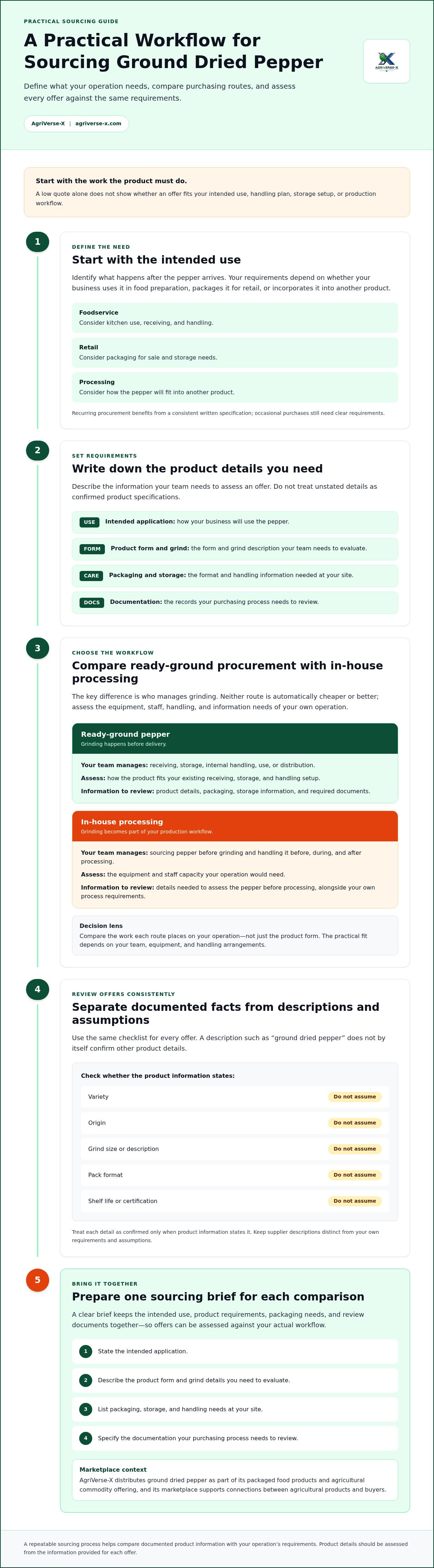
Set out your requirements in a sourcing brief. Include:
- Intended application: how your business will use the pepper.
- Product form and grind: the form required and the grind description your team needs to evaluate.
- Packaging and storage: the format and handling information needed at your site.
- Documentation: the records your purchasing process needs to review.
AgriVerse-X distributes ground dried pepper as part of its packaged food products and agricultural commodity offering. Defining these fields first helps you compare product information against your operating needs without turning unstated details into product claims.
Compare ground dried pepper procurement and in-house processing
The main operational difference is who manages grinding: ready-ground procurement places that step before delivery, while in-house processing makes it part of your own workflow. Neither route is automatically cheaper or better. The fit depends on your equipment, staff, handling arrangements, and the information you need to assess before purchasing.
Use this comparison to identify the work your business would manage under each approach:
Workflow ownership
Ready-ground: Your team receives ground pepper and manages the steps that follow, such as storage, internal handling, use, or distribution.
In-house processing: Your team sources pepper before grinding and plans the processing stage as part of its production workflow.
Equipment and staff
Ready-ground: Consider how the product fits your existing receiving, storage, and handling setup.
In-house processing: Assess the equipment and staff capacity your operation would need for processing. The requirements depend on your setup.
Handling stages
Ready-ground: Your workflow begins with a product that has already been ground. Plan for handling after receipt.
In-house processing: Your workflow includes handling pepper before and during grinding, as well as managing the resulting ground product.
Information to compare
Ready-ground: Define the product details, packaging, storage information, and documents your purchasing process needs.
In-house processing: Consider the information needed to assess the pepper before processing, alongside your own process requirements.
When can ready-ground pepper simplify procurement?
Buying an already-ground product removes grinding from the buyer’s production steps. This may suit a business whose workflow is set up to receive and use or distribute ground pepper rather than process pepper internally. The practical effect depends on your team, equipment, and handling arrangements. It does not establish lower costs, faster operations, or a particular result, so assess the fit against your own process.
What changes when a business processes pepper in-house?
In-house processing puts responsibility for the grinding workflow and related product handling with the buyer. Before choosing this route, compare your internal capacity with the information available for a ready-ground product. Consider which process details your team can manage and what product facts it needs to assess before purchase. Keep confirmed product information separate from assumptions.
For a ground dried pepper wholesale decision, compare the work each route places on your operation, not just the product form. AgriVerse-X distributes ground dried pepper and supports an agricultural marketplace connecting products with buyers. Explore AgriVerse-X’s agricultural marketplace as a connection point for commercial sourcing.
Evaluate wholesale ground dried pepper offers with a consistent checklist
Compare each offer using the same fields. A consistent record makes differences visible and helps distinguish documented product facts from assumptions or sales language. A blank field identifies information your team still needs to assess. It does not, by itself, establish the product’s quality or suitability.
How can buyers compare product descriptions fairly?
Build a side-by-side record for every offer. Keep product statements distinct from your own requirements, and note whether each detail is supported by documentation or appears only in descriptive wording.
- Product identity: record the product name and any stated pepper type or origin. Do not infer either from a general description.
- Form and specifications: note whether the product is described as ground, along with any declared grind description or other specifications relevant to your use.
- Packaging: capture the stated pack format and details you need for receiving, storage, or distribution.
- Supporting information: list the documents supplied and identify information your purchasing process still needs.
- Handling details: record stated storage guidance, shelf-life information, labelling details, allergen information, and transport conditions where relevant to your product and market.
Use consistent wording in your comparison. Terms such as “fine grind” or “food grade” are supplier-provided descriptions unless accompanied by the specific detail or evidence your business requires. Do not turn promotional language into a verified specification.
Which records support responsible food procurement?
Documentation needs depend on the product, how it will be handled, and its destination market. Identify the records your process calls for, such as product descriptions, label information, storage guidance, shelf-life details, or other relevant supporting documents. Include transport information if it affects how your business plans to receive and handle the goods.
Food safety, labelling, storage, and transport requirements can vary by market. Build applicable requirements for your intended destination into the comparison. Do not assume a certification, test result, approval, or traceability record exists unless the information has been supplied and can be reviewed.
A structured comparison makes ground dried pepper wholesale procurement more repeatable than choosing from catalogue wording alone. AgriVerse-X distributes ground dried pepper and supports agricultural marketplace connections between products and buyers. Explore agricultural marketplace connections with AgriVerse-X.
Prepare a practical ground dried pepper wholesale sourcing brief
A written brief turns purchasing needs into clear fields that suppliers and internal teams can review consistently. It also helps align procurement with receiving and storage, so requirements are easier to carry from the initial evaluation through to product handling.
Build your brief in five steps:
- Define the use. State how the pepper will be used and identify its intended market or destination.
- Specify requirements. Describe the product identity, required form, any grind description, and packaging needs.
- Gather documents. List the supporting product and handling information your business needs to review.
- Compare fit. Assess each offer against the same essential requirements and record unanswered questions.
- Plan procurement. Align the selected option with your internal receiving, storage, and distribution process.
What should a buyer include in a pepper sourcing brief?
Make the brief specific enough to guide a useful comparison without treating preferences as confirmed product facts. Include:
- Product identity and intended use: name the product and describe its planned application.
- Required form: state that you need ground product and describe any grind characteristics your team needs to assess.
- Packaging and destination: explain the packaging requirements and intended market.
- Documents to review: identify the product, labelling, storage, shelf-life, or other supporting information your process needs.
- Receiving and storage needs: record internal handling conditions relevant to accepting and storing the product.
Separate must-have conditions from optional preferences. For example, a label detail belongs among essential conditions if your process depends on it. A preferred format that can be adjusted should be marked as an option, not a fixed requirement.
How should teams compare offers and record decisions?
Use the same fields for every offer under consideration. Record what the product information states, which documents support those details, what remains unanswered, and how each option fits the brief. Keep evidence separate from assumptions so a descriptive claim is not accidentally treated as a verified specification.
Document why an option was selected in relation to your business requirements. Revisit the brief if the intended use, destination market, packaging needs, or receiving process changes. This gives purchasing and operations teams a shared reference for future decisions without assuming order quantities, timelines, payment terms, or delivery commitments.
AgriVerse-X distributes ground dried pepper and supports connections between agricultural products and buyers. Explore ground dried pepper sourcing through AgriVerse-X as a practical next step for commercial procurement.
Source ground dried pepper through AgriVerse-X’s agricultural marketplace
AgriVerse-X distributes ground dried pepper and supports an agricultural marketplace that connects agricultural products with buyers. For commercial sourcing, the marketplace provides a relevant place to explore product opportunities and buyer connections. A clear sourcing brief helps you assess the details of each offer against your business needs.
How does the marketplace fit into commercial sourcing?
A marketplace can help buyers discover agricultural products and connect with relevant supply opportunities. If you are assessing ground dried pepper wholesale, bring a clear sourcing brief to the process. Define the intended use, product form, packaging needs, destination market, and documents to review, then compare the available information against your operational requirements.
Keep the distinction clear: a marketplace is a discovery and connection point, while product suitability depends on the details provided for a specific offer and your own assessment. Treat product information as a basis for evaluation, and record any details your team still needs to establish before making a purchasing decision.
For broader context on the platform, read the Global agriculture marketplace article. It can help place product discovery within AgriVerse-X’s wider agricultural marketplace approach.
What should a buyer do next?
Put the sourcing process into practice. Use the brief and comparison checklist in this guide to organize requirements, review product information, and record unanswered questions. If your business also sources other food staples, the African Food Staples Wholesale buyer checklist offers a related framework for structuring procurement decisions.
AgriVerse-X’s marketplace supports connections between agricultural products and buyers, while AgriVerse-X distributes ground dried pepper as part of its packaged food products and agricultural commodity offering. Match the product information to its intended use, assess the documented details, and keep procurement consistent as business needs evolve.
Explore AgriVerse-X’s agricultural marketplace as a next step in your commercial sourcing process.
Build a More Repeatable Pepper Sourcing Process
Strong procurement starts with fit, not catalogue wording. Define how your business will use the pepper, compare ready-ground purchasing with in-house processing, and assess offers against the same product, packaging, handling, and documentation fields.
A written sourcing brief gives purchasing and receiving teams a shared reference. Separate confirmed product details from assumptions, record unanswered questions, and revisit requirements when your intended use or market changes. This makes ground dried pepper wholesale decisions easier to assess consistently without treating unverified claims as facts.
AgriVerse-X’s food products distribution offering includes ground dried pepper, and its agricultural marketplace supports connections between agricultural products and buyers. Explore the marketplace as a connection point, while assessing each product offer against your own requirements.
Explore AgriVerse-X’s agricultural marketplace and take your next sourcing step with clear requirements and a process your team can repeat.
Frequently Asked Questions
What should I check when buying ground dried pepper wholesale?
Check the product identity, stated form, declared specifications, packaging details, and supporting information against your intended use. Include the grind description, storage guidance, shelf-life information, and labelling details your operation needs in your evaluation. Record which details are documented, which are descriptive statements, and which remain unanswered before making a purchasing decision.
How do I compare wholesale ground pepper suppliers?
Compare offers using the same fields for every supplier. Record the product name, stated pepper type and form, declared specifications, packaging, available documents, and handling information relevant to your market. Separate evidence from marketing language, and note missing details. Then assess how each offer fits your workflow, storage arrangements, and distribution needs. A consistent comparison helps your team explain its decision and repeat the process.
Is ground dried pepper the same as chilli powder?
Not necessarily. “Ground dried pepper” can refer to different products, while chilli powder commonly refers to dried ground chilli and may also describe a seasoning blend in some markets. Ground black pepper is made from peppercorns, so it is not interchangeable with chilli powder. Names can vary, so check the stated product identity and composition rather than relying on a broad label when specifying a purchase.
Can I buy ground dried pepper in bulk for foodservice or retail?
Foodservice operators and retailers can include ground dried pepper in commercial purchasing plans, but “bulk” needs to be defined by the buyer. State the quantity and packaging format your operation needs, along with the intended use, destination market, and relevant handling information. Do not assume a particular pack size or order quantity from a general product description. AgriVerse-X distributes ground dried pepper as part of its food products offering.
How should wholesale ground pepper be stored?
Use the storage instructions provided for the specific product and follow the food-handling procedures relevant to your business. Include storage information in your comparison, along with packaging and any stated shelf-life details. Plan how the product will be received and stored within your operation. Do not assume a shelf life or storage condition from the words “ground pepper” alone, since requirements depend on product information and handling.
What documents should I request when sourcing ground dried pepper?
Review the product information your purchasing process and destination market require. This may include a product description, declared specifications, label details, storage guidance, shelf-life information, and relevant supporting food documentation. Requirements vary with the product and market, so identify the records your business needs before comparing offers. Review supplied documents directly, and do not treat a claim of certification, testing, approval, or traceability as verified unless supporting evidence is provided.
Is AgriVerse-X a ground dried pepper supplier?
Yes. AgriVerse-X distributes ground dried pepper as part of its packaged food products and agricultural commodity offering. Its digital agricultural marketplace supports connections around agricultural products and buyers. Use the marketplace as a connection point, then assess the information available for a specific offer against your sourcing brief. Base procurement decisions on documented product details and your business needs.


