

The lowest quote isn’t always the best wholesale choice. Before you buy semovita wholesale, define the product and package your business needs, estimate how much you can sell or use, and review the stated order terms. Price matters, but so do product details, quantity, storage capacity, and delivery arrangements.
Comparing offers is difficult when listings leave key details unclear. Start by estimating demand from your own records, checking stock on hand, and noting what information you need before placing a bulk order. This guide explains how to assess an offer without relying on assumptions.
You’ll learn which product and package details to establish, how to align order size with sales and storage, and what ordering and delivery information to review. AgriVerse-X supplies packaged semovita as part of its food staples offering, giving commercial and bulk buyers a sourcing option to consider. Use the steps below to prepare for an informed purchase.
Key Takeaways
- Before you buy semovita wholesale, define the product and package details your business needs instead of relying on a low quote alone.
- Use sales or consumption records to estimate demand, then match the order size to current stock and available storage.
- Compare stated product information and order conditions, keeping confirmed details separate from assumptions.
- When stock arrives, check the quantity, package condition, product identification, and order records. Document any discrepancies.
- AgriVerse-X supplies packaged food staples, including semovita, as a sourcing option for commercial and bulk buyers.
Why Buy Semovita Wholesale? Start with Your Business Demand
To buy semovita wholesale sensibly, start with what your business expects to sell or use, then choose an order quantity that fits that demand. A larger purchase is not automatically a better fit. The right quantity and buying frequency depend on customer demand, consumption patterns, current stock, and storage capacity.
Retailers, food-service businesses, distributors, and institutional buyers may all purchase in bulk, but their needs differ. Retailers plan for shelf replenishment, food-service businesses for menu use, distributors for onward supply, and institutions for planned consumption. For general background on the semolina category, see What is Semolina?
This video shows an example of how a wholesale foodstuff offer may be presented. Treat it as general context, not confirmation of a particular product’s details or commercial terms.
Which businesses may benefit from bulk semovita purchasing?
Build an order plan from your own sales, usage, and stock records. A retailer can review sales over a relevant period alongside shelf stock. A food-service business can use menus, meal counts, and consumption records to estimate kitchen use. A distributor can check recent customer orders and remaining inventory before deciding what quantity to purchase for onward supply.
These records help you avoid copying another business’s order size or purchasing frequency. Demand varies by operation, so base your estimate on actual sales or usage and account for stock already on hand.
What should buyers clarify before placing a wholesale order?
Set your requirements before comparing offers: product identity, package information, order quantity, and commercial terms. Keep stated product facts separate from assumptions or generic descriptions of semolina. If an offer omits a detail, treat it as unknown rather than guessing.
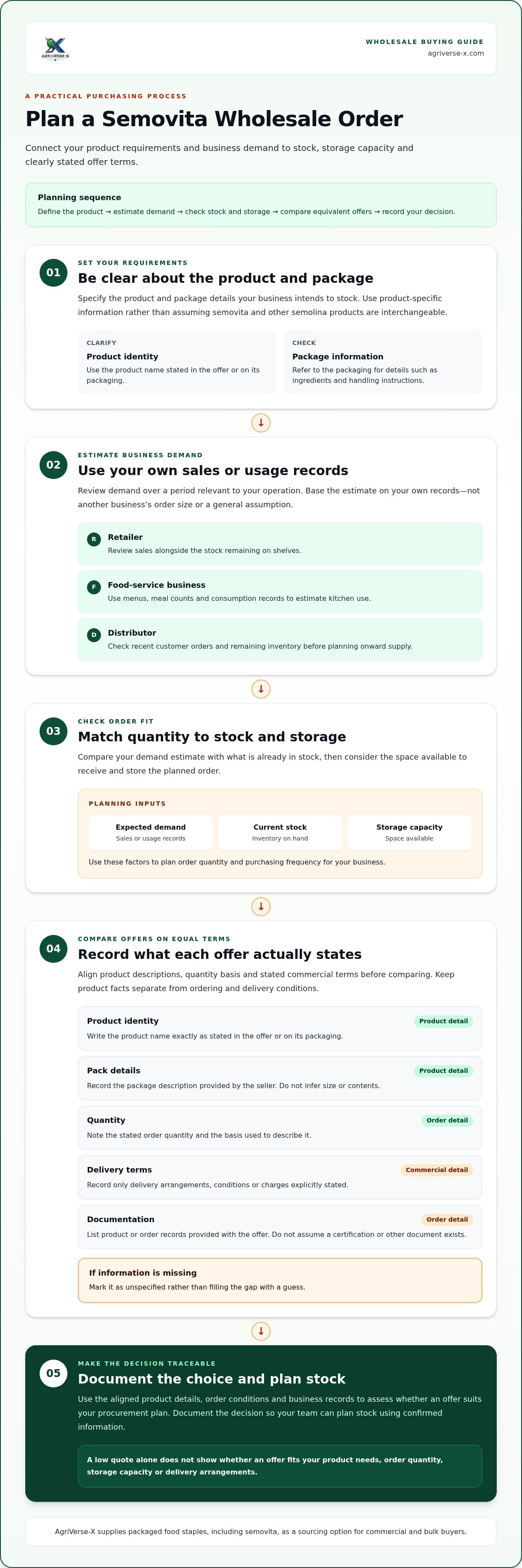
Compare offers on an equivalent basis. Align the product and package descriptions, then review the stated order conditions. This gives your team a clearer way to assess suitability, document the decision, and plan stock.
Wholesale decisions are clearer when product details and order terms are explicit. Set your requirements first, compare like with like, and use your own demand and stock records to plan the order. This keeps the decision grounded in how your business operates, rather than an assumed ideal order size.
What to Check When You Buy Semovita Wholesale
A wholesale offer is useful to compare only when its product and order details are clear. Before deciding where to buy semovita wholesale, separate information stated by the seller from assumptions based on general descriptions of semolina. A broad category label alone may not identify the exact product or package on offer.
Which product and package details matter?
Match the product name and package description to what your business intends to stock. Don’t treat semovita and other semolina products as interchangeable without checking their product-specific information. Use the package details for ingredients and handling instructions instead of assuming them from a general description.
For a specific food-safety concern, NAFDAC has published Semovita Food Safety and Quality. This reference addresses the stated concern. For information about a particular offer, rely on the product’s own packaging and documentation.
How can buyers compare wholesale offers fairly?
Align the product description, quantity basis, and stated commercial terms before comparing offers. Record product information separately from ordering and delivery conditions. If a detail is missing, mark it as unspecified rather than filling the gap with a guess.
| Comparison point | What to record |
|---|---|
| Product identity | The product name exactly as stated in the offer or on its packaging. |
| Pack details | The package description provided by the seller. Don’t infer size or contents. |
| Quantity | The stated order quantity and the basis used to describe it. |
| Delivery terms | Any delivery arrangements, conditions, or charges explicitly stated. |
| Documentation | Product or order records provided with the offer. Don’t assume a certification or other document exists. |
Compare wholesale offers only after aligning product details and order terms. This makes differences easier to identify. One offer may describe the product more precisely, while another may state delivery conditions more clearly. It also helps a procurement team keep product facts distinct from commercial arrangements.
AgriVerse-X supplies packaged food staples, including semovita, for commercial and bulk buyers. Use the same comparison points to assess the product information and order terms relevant to your procurement plan.
How to Plan a Semovita Wholesale Order
A workable order plan connects expected demand to stock on hand, storage capacity, and the purchase terms. Before deciding how much to buy, use your own sales or consumption records rather than a general estimate. This makes the quantity relevant to your business instead of relying on a standard order size.
Estimate quantity and purchasing frequency
Review semovita sales over the period that matters to your business, then compare them with current inventory. A supermarket might check recent sales and remaining shelf stock; a food-service buyer might review usage records and planned menus. Use those figures to estimate what needs replenishing, while accounting for stock that can still be sold or used.
Then compare the planned order with the space available to receive and store it. If the quantity exceeds expected use or practical storage capacity, reconsider the order size or purchasing frequency. There is no single minimum or schedule that suits every buyer.
Review order terms before committing
Product requirements and commercial terms serve different purposes, so review them separately. Check the stated ordering process, payment terms, delivery arrangements, and any documentation provided. Record what each term says, and don’t treat assumptions about the product or seller as confirmed conditions.
Use this sequence to organise the decision:
- Estimate demand: Review internal sales or consumption records for the period you’re planning to cover.
- Review stock: Check current inventory and identify what is available for sale or use.
- Define requirements: Set the product and package details your business needs, along with an order quantity that fits demand and storage.
- Assess terms: Review the stated ordering, payment, delivery, and documentation conditions separately from product information.
- Place the order: Proceed when the proposed quantity and stated conditions fit your operational plan, and keep the order record for receiving checks.
For example, if sales records show that stock is moving more slowly than expected, repeating an order based on an older sales period may leave more inventory than your current plan requires. If usage is steady, current stock and available space still matter when setting the next order quantity.
A buyer planning to buy semovita wholesale can use this sequence as a repeatable procurement check, adjusting it as sales, usage, and inventory change. Base the plan on your own operating requirements, not an assumed demand pattern or an unverified promise about stock or fulfilment.
Receiving and Managing Wholesale Semovita Stock
Stock control continues after an order is placed. On arrival, match the delivery against the order record and product description, document any differences, and add the received quantity to your inventory records. A consistent process helps your team spot discrepancies and make better-informed replenishment decisions.
What should buyers check when stock arrives?
Use your normal receiving process to check the shipment. Compare the product identification and quantity with the order documents, then inspect the packages for visible issues. Record any mismatch or damage, and follow the seller’s stated process for raising and resolving order concerns.
Keep the check factual. Appearance alone does not establish a product’s quality, safety, or shelf life. If a detail needs assessment beyond the receiving check, use the product’s own documentation and appropriate professional guidance.
- Order records: Keep the purchase record and any accompanying documents together.
- Product identification: Compare the information on the received packages with the order description.
- Quantity: Record what arrived and compare it with the quantity ordered.
- Package condition: Note visible damage or other concerns through your usual receiving procedure.
- Discrepancies: Document differences and follow the seller’s stated process for order issues.
How can inventory records support repeat purchasing?
Record incoming quantities, sales or usage, and remaining stock consistently. For a supermarket, these records can show how quickly semovita moves through inventory. For another business, usage data can help identify when stock needs replenishing. Use actual records to inform reorder timing instead of relying on a fixed schedule or assumed demand.
Base storage and handling decisions on the instructions on the product package and relevant professional guidance. Don’t apply a universal storage rule or assume a shelf life that the product information doesn’t state. Clear records can also help staff connect a stock issue with the relevant order and product identification.
If you’re preparing to buy semovita wholesale, make receiving and inventory checks part of your purchasing routine. AgriVerse-X supplies packaged food staples, including semovita, for commercial and bulk buyers. Explore AgriVerse-X packaged semovita as a sourcing option, and use clear product and order records to support your stock-management process.
Explore AgriVerse-X Packaged Semovita for Wholesale Sourcing
AgriVerse-X supplies packaged food staples, including semovita, for commercial and bulk buyers. For supermarkets planning distribution, it is a sourcing option to consider after defining the intended product, package requirements, order quantity, and purchasing conditions. A clear brief keeps the decision tied to your store’s needs rather than assumptions about pack formats, stock, or terms.
How AgriVerse-X fits a wholesale sourcing decision
AgriVerse-X’s food-product distribution includes packaged semovita. This makes the offering relevant to buyers who have identified what they need for their purchasing plan. Use the product details and commercial terms stated for the purchase to assess how it fits your requirements. Don’t infer fixed stock, pack sizes, delivery coverage, or prices.
Keep the evaluation practical. A supermarket team can use procurement requirements and internal demand records to define the order it is considering, then compare the product information and stated conditions against that plan. The buyer’s requirements and the stated terms guide the decision.
What buyers can do next
Before proceeding, bring together the details that guide the decision: product identity, package information, required quantity, and your business’s purchasing needs. Review the stated commercial terms alongside the product details so your team can judge the offer on a clear basis. This keeps the sourcing discussion focused without assuming a particular ordering feature or fulfilment outcome.
If packaged semovita fits your procurement needs, explore AgriVerse-X packaged semovita as a sourcing option. Use your demand and stock records to frame the order, and base your decision on explicit product information and transparent commercial terms. A defined plan helps bulk buyers move from sourcing consideration to procurement.
Make Your Next Semovita Purchase with Clarity
A sound bulk purchase starts with your business, not an assumed order size. Use sales or consumption records and current stock to plan quantity, then compare product identity, package information, and stated commercial terms on an equivalent basis. When the order arrives, record quantities and package condition so inventory decisions reflect what your business receives and uses.
If you plan to buy semovita wholesale, keep product details, order conditions, and operational requirements aligned. This supports clearer procurement decisions without relying on price alone.
AgriVerse-X supplies packaged semovita as part of its distribution of packaged food staples and agricultural commodities. Explore the offering as a sourcing option for your business: Explore AgriVerse-X packaged semovita.
Set your requirements, review the stated terms, and plan your stock with care. Explore AgriVerse-X packaged semovita as a sourcing option for your business.
Frequently Asked Questions
What is semovita?
Semovita is a packaged food staple. For purchasing, identify the specific product by its name and package information rather than assuming every product described as semolina is identical. Check the product’s own packaging for details such as ingredients and handling instructions. AgriVerse-X supplies packaged semovita as part of its food-product distribution, making it a sourcing option for commercial and bulk buyers.
How can I buy semovita wholesale?
Start by defining the product and package information your business needs, then estimate an order quantity using sales or consumption records and current stock. Compare the stated product details and commercial terms before proceeding. AgriVerse-X supplies packaged semovita for bulk buyers. To buy semovita wholesale, base your decision on your requirements and the terms stated for the offer, not assumptions about stock or fulfilment.
What should I check before ordering semovita in bulk?
Check the product name, package information, order quantity, ordering process, payment terms, delivery arrangements, and any documentation stated for the purchase. Compare offers on the same product and quantity basis, and keep product details separate from commercial conditions. Use the product’s own packaging for ingredient and handling information. Don’t infer specifications, quality grades, shelf life, or certifications from a general semolina description.
How much does semovita wholesale cost?
Wholesale cost depends on the specific offer and its stated commercial terms. There isn’t a single price that applies to every product, quantity, or purchasing arrangement. Compare offers using the same product description and quantity basis, and account for delivery charges or other costs only when they are explicitly stated. Use current written terms for your decision, not old quotes or unrelated retail examples.
How do I choose the right semovita order quantity?
Use your business’s sales or consumption records, current inventory, and available storage to plan quantity. A supermarket can review recent sales and remaining stock; a food-service buyer can use its own usage records. Then consider how the proposed order fits your operational needs. Don’t rely on a standard wholesale quantity or another buyer’s schedule. The appropriate order depends on your demand and stock position.
How should wholesale semovita be stored?
Follow the storage and handling instructions on the product’s own packaging, along with relevant professional guidance for your business. Avoid assuming a universal storage condition or shelf life when the product information doesn’t state one. Keep inventory records that connect received quantities with sales or usage and remaining stock. These records can help your team plan replenishment without relying on unsupported shelf-life assumptions.
Can I compare semovita and other semolina products as the same item?
Don’t assume they are interchangeable. Compare the exact product name and package description, then use each product’s own label for ingredients and handling information. Generic descriptions may not provide enough detail to establish that two products are the same. For a fair wholesale comparison, align product information, quantity basis, and commercial terms. Treat details that aren’t stated as unknown rather than filling gaps with assumptions.


