

When comparing peeled egusi wholesale options, start with a clear product specification. A quantity and quoted unit are not enough if you still need to understand the product description, packaging, handling information, or order terms. Setting those requirements before browsing makes it easier to compare listings and plan a purchase.
Write down your intended use, required quantity and unit, receiving arrangements, and the product details your business needs to review. Then assess each listing against the same criteria. Do not assume that appearance, a product name, or a photograph confirms details that the seller has not stated.
This guide explains how to prepare a buyer brief, review listings consistently, compare options, and plan for receiving. AgriVerse-X supplies peeled egusi and provides an agricultural marketplace for discovering products and connecting with marketplace participants. Use the marketplace for product discovery, then follow your organisation’s procurement and receiving procedures to assess an offer. Platform programmes, token functions, service availability, and commercial terms may change as the platform develops and completes legal, technical, and market validation.
Key Takeaways
- Set your intended use, purchasing requirements, quantity, and order unit before reviewing listings.
- Compare peeled egusi wholesale listings using the same criteria for product description, quantity, packaging, handling information, and order terms.
- Separate details the listing states from questions that remain unanswered.
- Record your selection and prepare your receiving team to check the order against the purchasing documents.
- Explore peeled egusi through the AgriVerse-X agricultural marketplace, which connects participants around agricultural products.
Peeled egusi wholesale: what bulk buyers need to define first
A useful wholesale specification identifies the product and records the details that matter to your business. “Peeled egusi” names the product category, but does not, by itself, explain how it was processed, how it is packaged, what quantity is offered, or which order terms apply. Treat those as listing-specific details and assess them from the information provided.
Wholesale sourcing, defined: Planned procurement of a product in quantities intended for business use, guided by the buyer’s requirements for use, ordering, receiving, and recordkeeping.
Egusi is used in West African cooking, including soups and stews. The name can refer to seeds from different gourds, so the category alone may not answer every question about a particular listing. For a broader overview of the food and its context, see Egusi - Wikipedia.
For a commercial buyer, the aim is to match the product information to the needs of the operation, not to fill gaps with assumptions. Define your requirements first, then check whether each listing gives enough detail to assess fit. This makes peeled egusi wholesale options easier to compare and helps your team identify questions before approving an order.
Which businesses source peeled egusi in bulk?
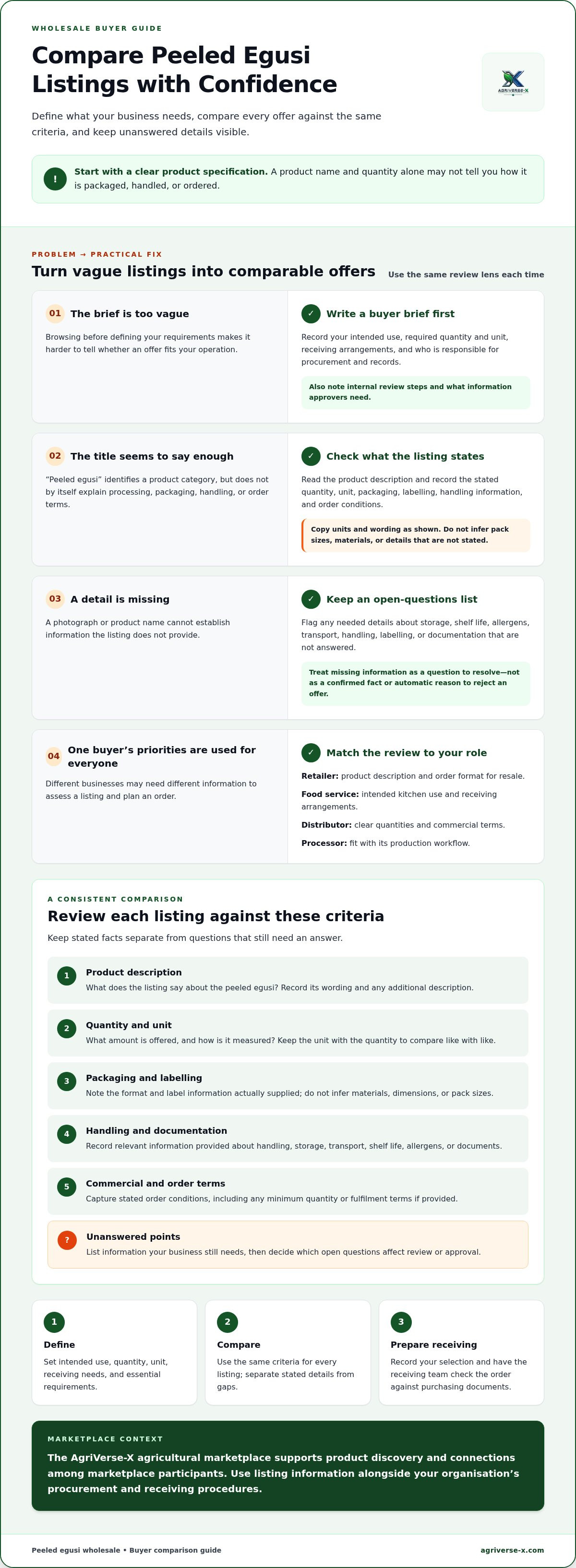
Different buyers need different information. A retailer may focus on a product description and order format that suit resale. A food-service business may prioritise intended kitchen use and receiving arrangements, while a distributor may need clear quantities and commercial terms to coordinate supply. A processor may have requirements linked to its own production workflow.
State your role and intended use in the buyer brief. This gives the seller context for responding and helps your procurement team record why a listing appears suitable. It also makes it easier to flag details that are missing or need review before a decision.
Build a buyer brief before comparing listings
Write down the requirements that shape the purchase before reviewing options. Include the intended use, required quantity and unit, receiving arrangements, and the person responsible for procurement decisions and records. If your business has internal approval steps, note who needs to review the listing and what information they need.
- Product description: What does the listing say about the peeled egusi? Record the wording and note any details it does not provide.
- Quantity and packaging: What amount and packaging information are stated? Copy the units exactly so you can compare like with like.
- Commercial terms: Record the order conditions provided, including any minimum quantity or fulfilment terms if stated.
- Handling and documentation: Note relevant information about food handling, storage, labelling, shelf life, allergens, or transport.
- Open questions: List the details your business needs that the listing does not answer. Do not treat an unstated detail as a fact.
Keep the brief specific, but distinguish essential requirements from preferences. For example, a receiving team may need packaging information to plan intake, while a buyer making an initial comparison may first need a clear quantity and unit. Mark gaps as questions for that listing and decide which ones affect approval. This gives your team a practical basis for comparing offers and documenting purchasing decisions.
How to evaluate a peeled egusi listing for wholesale purchase
Review a listing by separating what it states from what your procurement team still needs to know. A product title may identify peeled egusi, but the description, quantity, packaging information, handling notes, and order terms help determine whether the offer fits your buyer brief. In peeled egusi wholesale, clear information supports comparison. A missing detail is a question to resolve, not proof that the product is unsuitable.
A useful wholesale listing gives decision-relevant product information, so a buyer can assess fit, identify gaps, and plan the order.
What product and packaging details should a listing explain?
Start with the product identity and stated order quantity. Then check how the listing describes packaging, labelling, and handling. These details may affect storage planning, intake procedures, and how your team records the purchase. Do not assume a standard pack size or format; record the units and packaging terms the listing actually provides.
- Product description: Does the listing identify peeled egusi? Record any additional description exactly as written.
- Quantity: What quantity is offered, and how is it measured? Include the unit in your comparison.
- Packaging: Are packaging details stated? Note the described format without inferring materials, dimensions, or pack sizes.
- Labelling and handling: What information is supplied about the label, handling, or storage?
- Order terms: Record the stated order conditions, including any minimum quantity or fulfilment details provided.
- Unanswered points: Keep a separate list of missing information your business needs before making a decision.
Photographs can provide visual context for a listing, but they do not establish details that have not been stated, such as handling history, shelf life, allergens, or compliance status. Treat images as supporting material, not as a substitute for written product information or relevant documentation.
How can buyers assess documentation and handling information?
Review the listing and any accompanying documents for information relevant to food safety, hygiene, inspection, labelling, allergens, shelf life, storage, and transport. Which details matter depends on the product, transaction, and applicable requirements. Base your review on the available evidence and your organisation’s procedures rather than treating a general statement as proof of every condition.
If a decision depends on a formal compliance question, use relevant documentation and guidance from qualified or authorised parties. A marketplace description can help with initial screening, but it should not be treated as a certification unless the evidence explicitly establishes that status. Record the document name, date, and any point that still needs review in your procurement file.
Use a simple status for each requirement: stated, documented, or unanswered. This helps purchasing, quality, and receiving teams share the same understanding of what has been reviewed. To discover agricultural products and connect with marketplace participants, explore the AgriVerse-X agricultural marketplace.
Compare peeled egusi suppliers by fit, clarity, and order requirements
Use the same buyer brief for every listing. Without consistent criteria, a longer description can seem more suitable simply because it gives you more information to review. For peeled egusi wholesale, separate facts stated in the listing, preferences in your brief, and questions that remain open. That keeps the comparison grounded in evidence rather than assumptions.
Use a comparison grid with one row per listing and these core columns:
- Stated product details: Record the product description, quantity and unit, and any packaging or handling information provided.
- Order terms: Capture the commercial conditions actually stated, such as order requirements or fulfilment terms.
- Unanswered questions: Note missing details that matter to your buyer brief.
Add a fit status for each requirement: meets stated need, needs clarification, or not assessed. Missing information is not automatically a negative product claim. It means the listing does not provide enough evidence to assess that point.
How should buyers compare supplier listings fairly?
Apply identical criteria to each option. If quantity, packaging, handling, and order terms matter to your team, assess every listing against those points. First consider whether the stated information fits your intended use and receiving process. Then assess whether the relevant details are clear enough for your purchasing decision. No listing is automatically the best fit for every buyer; the right choice depends on your requirements and the information available.
Keep preferences separate from requirements. A preferred packaging format, for example, may help guide your selection without being essential to every purchase. Label each point so colleagues can see whether a decision rests on a stated fact, an internal preference, or information that remains unknown.
Peeled versus unpeeled egusi: what changes in the buying decision?
“Peeled” identifies the requested product category, but it does not establish how peeling was carried out or confirm other processing details. Compare the listing’s exact description with your preparation workflow. If your operation needs specific processing or handling information, record it as a question for that listing and include the response in your assessment.
Unpeeled egusi may suit a different preparation process. Do not assume either form offers a universal advantage in quality, yield, convenience, or cost. Assess the product form against your operation’s steps, equipment, and purchasing requirements. Keep the comparison focused on the description and documented terms, rather than claims the listing does not make.
Before ranking options, review the unanswered-question column. Resolve gaps that affect your ability to assess fit or plan the order. If a gap does not affect your stated requirements, record why it does not change your decision. This creates a clear basis for selecting a listing without making unsupported claims about price, origin, grade, certification, or delivery performance.
Plan a peeled egusi bulk order from requirements to receiving
A clear order process links the buyer brief to the product received. For peeled egusi wholesale, assign responsibility at each stage: define the need, review listing information, assess the stated terms, record the decision, and prepare the receiving team. This sequence helps purchasing records support inventory planning without relying on assumptions about product details or delivery arrangements.
A practical bulk-order workflow for procurement teams
Start by recording the intended use, required quantity and unit, procurement contact, and receiving constraints. List the information your business needs to approve a purchase, such as the product description, packaging details, stated order terms, and relevant handling or documentation details.
Next, assess each listing against the same requirements. Separate stated facts from unanswered questions, and resolve any gaps that affect the decision before proceeding. Review the available order terms, then document the selected listing and the reasons for the decision. Keep the order record with relevant purchasing and inventory files so the receiving team can refer to the same product description and quantity.
Before the order arrives, prepare for receiving using your organisation’s procedures. Make sure responsible staff know which documents to compare, where to record intake information, and how to document a discrepancy. This helps purchasing and inventory teams work from a consistent record.
What should buyers review when an order arrives?
Use the order documentation as your reference. Compare the received product description, quantity, and packaging information with what was agreed and recorded. Follow the food-handling, storage, allergen, and receiving procedures that apply to your operation. Requirements can vary by product, transaction, and jurisdiction, so use relevant internal guidance and consult qualified or authorised parties on compliance questions.
- Match the order: Compare the received product and quantity with the purchase record.
- Review packaging information: Check it against the details stated in the order documents.
- Follow handling procedures: Use the receiving and storage steps that apply to your operation and the available product information.
- Record discrepancies: Document differences through your organisation’s established process. Do not assume a particular remedy or outcome.
- Update inventory records: Enter the receipt using the product description and units in your procurement documents.
Keep records consistent from selection through receipt. Purchasing, receiving, and inventory teams can then refer to the same information, making internal review more straightforward.
AgriVerse-X supplies peeled egusi among its packaged food staples and agricultural commodities. Explore the AgriVerse-X agricultural marketplace to discover agricultural products and connect with marketplace participants.
Source peeled egusi through the AgriVerse-X agricultural marketplace
Make your next sourcing step specific. Instead of browsing without a clear goal, use the requirements your team has already defined to guide product discovery. A focused search directs attention to descriptions and order information that matter to your decision, while keeping unanswered details visible for review.
Use the marketplace as a starting point for discovery, then assess each opportunity through your normal procurement process. A listing provides product information, but it does not replace a review of the details relevant to your order. Base your decision on documented information and your organisation’s requirements.
How the agricultural marketplace supports product discovery
Let your buyer brief shape the search. Identify the product category and the details your team needs to assess, then use those criteria to guide your review. A retailer may prioritise information needed for resale records, while a processor may focus on details relevant to its workflow. Start with the buyer’s purpose rather than assuming that every listing suits every operation.
As you review potential options, separate information that is stated from points that need further assessment. This makes product discovery more practical and helps your team decide which opportunities merit closer procurement review.
Next steps for wholesale buyers
Prepare your requirements before exploring. Include the intended use, preferred quantity and unit, receiving considerations, and product information your team needs to make a decision. Distinguish required details from preferences so you can assess opportunities consistently without assuming product attributes or order terms.
- Set your brief: Record the requirements that shape your purchase.
- Focus your review: Look for product descriptions relevant to your intended use.
- Assess each opportunity: Note what is stated and what needs further review.
- Use your process: Apply your organisation’s purchasing and receiving procedures before proceeding.
A clear brief gives your team a practical starting point for exploring agricultural products and assessing sourcing opportunities. Explore AgriVerse-X to continue your product discovery and consider relevant marketplace participation.
Make your next sourcing decision more deliberate
Use each procurement decision to improve your internal process. If your team repeatedly needs information that listings do not provide, make that requirement clearer in future buyer briefs. If purchasing and receiving records do not align, adjust the handoff so staff can refer to the same product description, quantity, and order terms.
For buyers exploring peeled egusi wholesale, bring those requirements into product discovery. AgriVerse-X supplies peeled egusi and provides an agricultural marketplace for exploring agricultural products and marketplace connections.
Explore AgriVerse-X to take a practical next step in connecting your purchasing needs with agricultural marketplace opportunities.
Frequently Asked Questions
What is peeled egusi used for?
Peeled egusi is used as a food ingredient, with preparation methods varying across households and businesses. A food business might use it in a planned menu, while a retailer may sell it for customers to prepare at home. Match the product category to your intended use, and do not infer a particular preparation method or product attribute from the name alone.
How do I buy peeled egusi wholesale?
Follow your organisation’s purchasing controls from initial sourcing to an approved transaction. Decide who reviews the product information, who authorises the purchase, and where the final order record will be kept. For peeled egusi wholesale, record the agreed product description and transaction details so purchasing and finance teams can refer to the same order.
Is peeled egusi the same as melon seed?
The terms may be related in food markets, but a buyer should not assume that differently named products are identical. Names can vary, so use the listing’s own description as the basis for assessing the offer. If your business uses a specific ingredient name in menus, product records, or purchasing systems, keep that wording consistent in your review and transaction records.
What should a wholesale egusi listing include?
A listing should give buyers enough information to understand the offer and assess whether it fits their purchasing process. Beyond the product name, useful details include the order quantity and unit, packaging information, and the terms that apply to the transaction. Retain a dated copy or reference to the listing you reviewed so your team can connect its internal approval to the information available at the time.
How should I store bulk peeled egusi?
Follow the product-specific storage instructions supplied with the order rather than relying on a general rule for all egusi. Keep available product identifiers and storage instructions connected to the relevant stock record so staff can refer to the correct information during handling. Do not assign a shelf-life period or storage condition unless it is supported by product information or applicable procedures.
Can I compare peeled and unpeeled egusi suppliers using the same criteria?
You can apply the same broad purchasing controls, such as recording the business purpose and reviewing transaction terms, while assessing each product form against its role in your operation. The preparation steps may differ, so keep acceptance criteria clear in internal product records. Do not treat one form as interchangeable with the other unless your process supports that decision.
What food safety information should bulk egusi buyers review?
Assign responsibility for reviewing food-related documents to staff familiar with your organisation’s procedures. Keep records relevant to the specific product and transaction together, and note who reviewed them and when. If a document raises a question about requirements in the applicable jurisdiction, refer it to an appropriate qualified party. Do not treat a listing or document as proof of a status it does not explicitly establish.


