

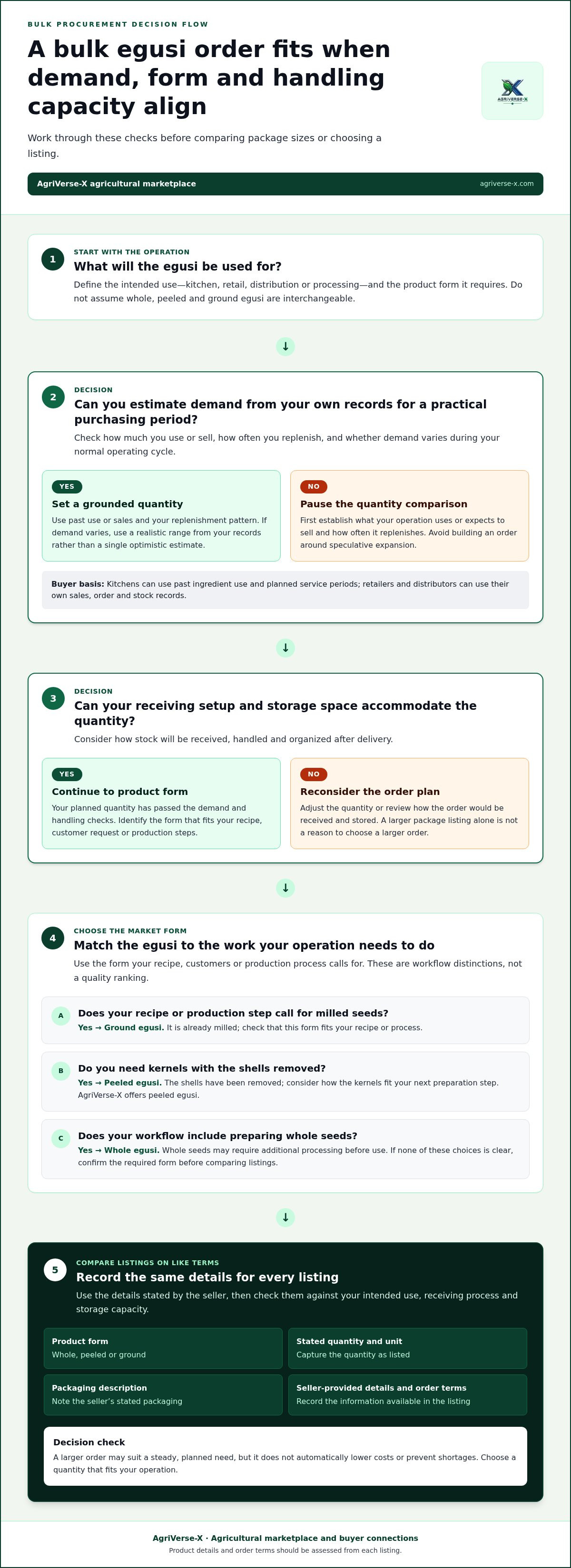
If you plan to buy egusi in bulk, start with how your operation will use it, then compare product form, quantity and order details. Whole, peeled and ground egusi involve different preparation steps, so package size alone won’t tell you whether a listing suits your kitchen, processing line or resale plan.
For a useful comparison, record the same details for every listing: product form, stated quantity and unit, packaging description, seller-provided information and order terms. Then check those details against your expected use, receiving process and storage capacity. This guide explains how to make that assessment without relying on assumed quality or savings claims.
AgriVerse-X supports an agricultural marketplace for products and buyer connections, and offers peeled egusi among its food staples. Use the guidance below to match that product form to your needs and make a considered bulk-buying decision.
Key Takeaways
- Check whether a larger order fits your planned use and purchasing interval before comparing package sizes.
- Choose between whole, peeled and ground egusi based on the preparation work your operation can handle.
- Compare listings consistently, noting product form, stated quantity, packaging and seller-provided details.
- Before you buy egusi in bulk, estimate demand and plan how your team will receive, inspect and store the order.
- Explore the AgriVerse-X agricultural marketplace to discover food staples, including peeled egusi, and connect with buyers.
Buying Egusi in Bulk: When Does a Larger Order Fit Your Needs?
Bulk buying is most useful when it matches planned, repeat use. Before you buy egusi in bulk, compare the amount you expect to use over a practical purchasing period with your receiving and storage capacity. An order that exceeds either can create inventory and handling challenges instead of meeting a supply need.
Start with your own records. Note how much egusi you use or sell, how often you replenish it, and whether demand changes during your normal operating cycle. This gives you an estimate grounded in your operation rather than assumed growth. It also helps distinguish a suitable order quantity from one chosen simply because a larger package is listed.
Egusi is used in West African cuisine. Egusi (also spelled egushi) refers to the protein-rich seeds of certain cucurbitaceous plants, primarily used in West African cuisine. For procurement, the next step is to match the product form to your preparation or resale process.
Which buyers may benefit from bulk egusi procurement?
Kitchens with recurring menus can estimate requirements from past ingredient use and planned service periods. Retailers and distributors need a different basis: their own sales, order and stock records. Don’t assume that the same quantity or purchasing interval will suit every buyer.
Separate procurement planning from menu design or resale decisions. First establish what your operation uses or expects to sell, then plan sourcing around that need. Avoid building an order around speculative expansion.
What should buyers decide before comparing listings?
Define the intended use and the form it requires. Whole, peeled and ground are common market forms, but each involves different preparation needs. A kitchen may need a specific form for its recipes, while a retailer or distributor may base its choice on what customers request. Don’t treat the forms as interchangeable just because each is egusi.
Next, set a purchasing period using your own demand records. Write down the quantity you expect to use or move during that period, then check whether your receiving setup and storage space can accommodate it. Consider how stock will be handled and organized after delivery.
These decisions give you a clear baseline for comparing listings. If your usage varies, use a realistic range from your records rather than a single optimistic estimate. A larger order may suit a steady, planned need, but it doesn’t automatically lower costs or prevent shortages. Choose a quantity that fits your operation.
Whole, Peeled, or Ground Egusi: Compare Product Forms for Your Use
Choose an egusi form by matching it to the work your operation needs to do. Whole, peeled and ground describe different market forms, not a universal quality ranking. Each may suit a different recipe, retail format or production process. AgriVerse-X offers peeled egusi, so the comparison below is a general buyer reference for understanding the forms.
| Market form | Preparation consideration | May suit |
|---|---|---|
| Whole | May require additional processing before use. | Buyers whose workflow includes preparation of whole seeds. |
| Peeled | Shells have been removed; consider how the kernels fit your next preparation step. | Operations that want peeled kernels as an ingredient or resale product. |
| Ground | Already milled; review whether this form fits the recipe or process. | Buyers whose recipes or production steps call for ground egusi. |
How does product form affect preparation?
Whole seeds may need processing before they can be used in a recipe or production line. That adds a task, equipment need and labour step to the workflow. Peeled egusi, the form offered by AgriVerse-X, has had its shells removed. Ground egusi is a separate market form that may suit recipes calling for milled seeds. Match the form to the steps your team performs.
Demand also varies by use. An IntechOpen discussion of the egusi value chain reports that over 50% of households consume egusi regularly. This provides context about household use, but it doesn’t determine which form a commercial kitchen, retailer or processor should source.
How can buyers match form to their operation?
Map the product to the process before comparing listings. A kitchen can check which form its recipes require and whether its preparation routine accommodates it. A retailer can consider the format customers request. A processor can assess which form fits its production steps and available equipment. Keep those decisions separate from supplier selection.
Then consider the workflow trade-offs. Whole seeds may add a processing step; peeled kernels may suit a process that calls for kernels; ground egusi may fit recipes specifying a milled form. These are planning distinctions, not promises about cooking results, product performance or labour savings.
If you plan to buy egusi in bulk, specify the required form in your purchasing notes so you can compare listings on like terms. AgriVerse-X’s agricultural marketplace supports product discovery and buyer connections, including for its peeled egusi offering. Use the form as a starting point, then assess the details stated in each listing.
How to Compare Bulk Egusi Listings Before Choosing a Supplier
Compare listings using the same fields, not just the headline or package presentation. A useful egusi listing identifies the product and its form, states the quantity and packaging description, and provides the seller’s available product details and order terms. Recording these details consistently makes gaps visible and helps you judge whether an offer fits your operation.
Which product and seller details should buyers record?
Make a record for every listing you’re considering. Capture the product name and form as written, any stated ingredient or product description, the listed quantity and unit, packaging information, seller-provided details and the order conditions shown. Keep seller statements distinct from information your business has independently established. If a field is missing or unclear, mark it “unknown” rather than filling it with an assumption.
How can buyers compare listings consistently?
Use one comparison table and record the same fields for every listing. This keeps the review focused on fit and clarity instead of whichever description looks most complete. Check suitability for your intended use first. Presentation and convenience matter after the product form and order details make sense for your process.
| Comparison field | Listing A | Listing B |
|---|---|---|
| Product form and description | Record as stated, or mark unknown | Record as stated, or mark unknown |
| Quantity and unit | Record as stated, or mark unknown | Record as stated, or mark unknown |
| Packaging description | Record as stated, or mark unknown | Record as stated, or mark unknown |
| Seller-provided product details | Separate statements from verified details | Separate statements from verified details |
| Order conditions and transaction terms | Record stated terms; note omissions | Record stated terms; note omissions |
| Fit for intended use | Suitable, unsuitable, or unclear | Suitable, unsuitable, or unclear |
Review each listing’s transaction terms as written. Note any stated conditions that affect how an order is placed or completed, such as payment arrangements, order limits, delivery details or cancellation terms, where provided. These are comparison fields, not standard requirements. Don’t assume one seller’s conditions apply to another, and don’t treat missing information as agreement.
Next, apply your operational criteria. A listing may name a form that doesn’t match your recipe or process, even if its quantity and packaging appear convenient. Record that mismatch clearly. If a detail could change your decision, mark it as unresolved rather than treating an assumption as confirmed.
Use the completed comparison to identify listings that fit your requirements and those that need further review. Keep the record with your purchasing notes so colleagues who approve, receive or use the order can see the basis for your decision.
Plan a Bulk Egusi Order: Demand, Receiving, and Storage
A sound bulk order starts with the quantity your operation expects to use or sell during its chosen purchasing period. It also depends on whether your team can receive, check and store that quantity using its normal procedures. Plan all three before committing. A bulk order should fit both expected use and available storage.
There’s no universal order size for every buyer. A kitchen can use recorded ingredient consumption or planned production; a retailer can review product movement; a distributor can use its own order and stock records. Treat these as separate demand signals, not interchangeable forecasts.
How can a buyer estimate a practical order quantity?
Use an established record as your starting point. Select a period that reflects how your operation buys and uses or sells egusi, then estimate the quantity associated with it. If demand varies, account for the patterns in your own records rather than assuming every period will be identical.
Include your internal purchasing process in the plan. Note when purchasing decisions are made and how that schedule relates to your replenishment interval. Avoid adding speculative growth or choosing an order quantity based on a supposed standard minimum. Your estimate should explain why the quantity fits your operation.
What should the receiving plan cover?
Before placing an order, assign responsibility for receiving and checking it. The designated person can compare the delivered product with the order description, including the named form, stated quantity and packaging description. Plan suitable storage space according to the product and your own procedures, rather than assuming one storage method or condition suits every operation.
Make the process clear. Decide who records the receipt, where the product will be placed, and how any difference from the order description will be documented through your normal supplier communication process. This makes receiving a defined operating step rather than an informal handoff.
- Set the expected-use period from consumption, production or retail records.
- Relate the estimate to your purchasing and replenishment interval.
- Confirm your team can receive and check the order.
- Allocate suitable storage space under your established procedures.
- Record and communicate discrepancies through your usual process.
Keep the record practical: note the basis for the quantity, the person responsible for receiving, and the planned storage location or capacity. Revisit the estimate when your usage or purchasing interval changes. These steps won’t guarantee savings or prevent shortages, but they give your decision a clear operational basis.
For your next procurement step, explore the AgriVerse-X agricultural marketplace.
Find Peeled Egusi Through the AgriVerse-X Agricultural Marketplace
AgriVerse-X offers peeled egusi among its agricultural food staples. Its agricultural marketplace supports product discovery and connections between buyers and agricultural participants. For a commercial buyer, it provides a place to explore egusi within a wider agricultural product environment.
A marketplace can bring product information and potential buyers into a shared setting. A listing alone doesn’t establish that a particular quantity is available, determine whether an order suits your process or guarantee a transaction outcome. Use it as a discovery point, then assess the stated details against your purchasing needs.
What role can an agricultural marketplace play in sourcing?
Marketplace discovery can help buyers find agricultural products relevant to their sourcing needs and connect with participants offering them. AgriVerse-X’s egusi offering is peeled. Whole and ground egusi are separate market forms, so don’t assume they are part of this offering.
Keep the marketplace’s role specific: it supports product discovery and buyer connections. A listing is a starting point for review, not a substitute for checking whether the product and stated terms suit your operation.
What is the next step for bulk buyers?
Bring your procurement plan to the listing review. Check the product identity and form, stated quantity and packaging details, and purchasing terms. Compare those details with your intended use, expected demand, receiving plan and storage capacity. If a detail isn’t stated, leave it as unknown instead of treating an assumption as fact.
- Look for the product form that matches your operational requirement.
- Review the stated quantity and packaging description.
- Read the listing details and applicable purchasing terms.
- Use your demand and handling plan to assess fit before proceeding.
This approach separates product discovery from the final purchasing decision. It gives your team a clear basis for deciding whether a listing meets its requirements, without assuming that a marketplace listing guarantees stock, a minimum order, shipping availability or particular transaction terms.
If you’re preparing to buy egusi in bulk, explore the AgriVerse-X agricultural marketplace to discover peeled egusi and agricultural buyer connections. Compare the listing information with your operation’s needs, then use that assessment to guide your next procurement step.
Turn Your Egusi Buying Plan Into a Repeatable Process
Make procurement decisions easier to review by keeping a simple record of the intended use, quantity basis, listing details and receiving plan for each order. When purchasing needs change, update the record before placing the next order. This gives your team a consistent reference without assuming demand will stay fixed or that a larger purchase will automatically deliver savings.
If you’re ready to buy egusi in bulk, use criteria that fit your operation and assess each opportunity using its stated details and terms. AgriVerse-X’s agricultural marketplace supports discovery of agricultural products and buyer connections, including peeled egusi among its food-staple offerings.
Explore the AgriVerse-X agricultural marketplace and plan your next sourcing step around your operation’s requirements. A clear record of what you need and how you’ll handle the order helps your team make an informed decision.
Frequently Asked Questions
Is egusi the same as melon seed?
Egusi commonly refers to edible seeds from certain cucurbit plants and is often called melon seed, but the terms don’t make every melon seed interchangeable. Egusi is associated with several gourd species, including a relative of watermelon. For purchasing, rely on the listing’s stated product identity and intended food use rather than assuming that any seed from a melon is egusi.
Is egusi used only for Nigerian soup?
No. Egusi is used in West African cuisine, including soups and stews, and Nigerian soup is one familiar preparation. A food business can consider its own recipes and customer preferences when deciding how egusi fits its menu. For a new dish, assess the ingredient form and recipe requirements separately; the product name alone doesn’t establish how a particular kitchen will use it.
Can whole egusi seeds be ground before cooking?
Yes, whole egusi seeds can be ground before cooking if that suits the recipe and the kitchen’s equipment. Include this preparation step in production planning: consider who will do it, when it fits the workflow, and how the prepared ingredient will be handled under the kitchen’s procedures. A buyer whose recipes require ground egusi should account for this work before choosing a product form.
What does peeled egusi mean?
Peeled egusi means the seed’s outer shell has been removed, leaving the kernel. It isn’t the same as ground egusi, which refers to milled seeds. That distinction can help a buyer interpret a product name, but it doesn’t establish other details such as grade, cleanliness, quantity or packaging. Evaluate those as separate attributes rather than inferring them from the word “peeled.”
Can a food business test egusi before making a larger purchase?
A food business can assess a smaller quantity before making a larger commitment if the listing’s purchasing terms provide for it. Don’t assume a sample or trial quantity is available when the listing doesn’t say so. Follow your kitchen’s normal product review process, such as checking whether the form fits a recipe and whether staff can incorporate it into the intended preparation workflow.
What should I do if an egusi listing does not state a product detail I need?
Mark the missing detail as unknown and decide whether it affects your purchase decision. If it is essential to your recipe, receiving plan or internal purchasing approval, don’t treat an assumption as a confirmed specification. You can still compare the other stated details, but keep the unresolved point visible in your records. This makes it easier to decide whether to proceed, defer or exclude the listing.


