

The pressure on farm hiring is structural, not just seasonal. The farm labour shortage in 2026 reflects an ageing workforce, fewer young people entering agricultural work and recruitment challenges that can leave farms short of workers when needed. Understanding the farm labour shortage in 2026 means looking beyond vacancies to the wider forces shaping who enters agriculture and stays. When crews are hard to hire and retain, harvest schedules, food supply chains and deliveries to buyers can all come under pressure.
That strain is real for employers, but it also affects workers weighing agricultural careers, including opportunities in Queensland, Australia. Mechanisation and smart technology can ease some tasks, but they don’t remove the need for skilled people. Wages, practical benefits and a better day-to-day work experience matter too. These pressures help explain why the farm labour shortage in 2026 involves more than seasonal recruitment.
This article explains the main drivers of declining US farm labour, how workforce gaps affect food security and where technology can help without replacing human workers. It also looks at hiring, retention, wages and benefits, alongside the wider global outlook and the role of farm logistics in getting produce to buyers. The goal is a clearer view of the pressures and practical choices facing farms and agricultural workers.
Key Takeaways
- Separate long-term demographic pressures from seasonal hiring challenges to better understand why farm recruitment is difficult.
- Identify where mechanisation and smart technologies can reduce repetitive work while keeping skilled people central to farm operations.
- Turn retention into a practical priority by connecting pay, benefits, recognition and employees’ day-to-day needs.
- Consider how agricultural industries and state-level conditions shape workforce demand, alongside changes that could affect H-2A hiring.
- Explore how AgriVerse-X can connect agricultural employers with workers and support logistics coordination for delivering produce to buyers.
1. Factors contributing to a declining US farm labor supply
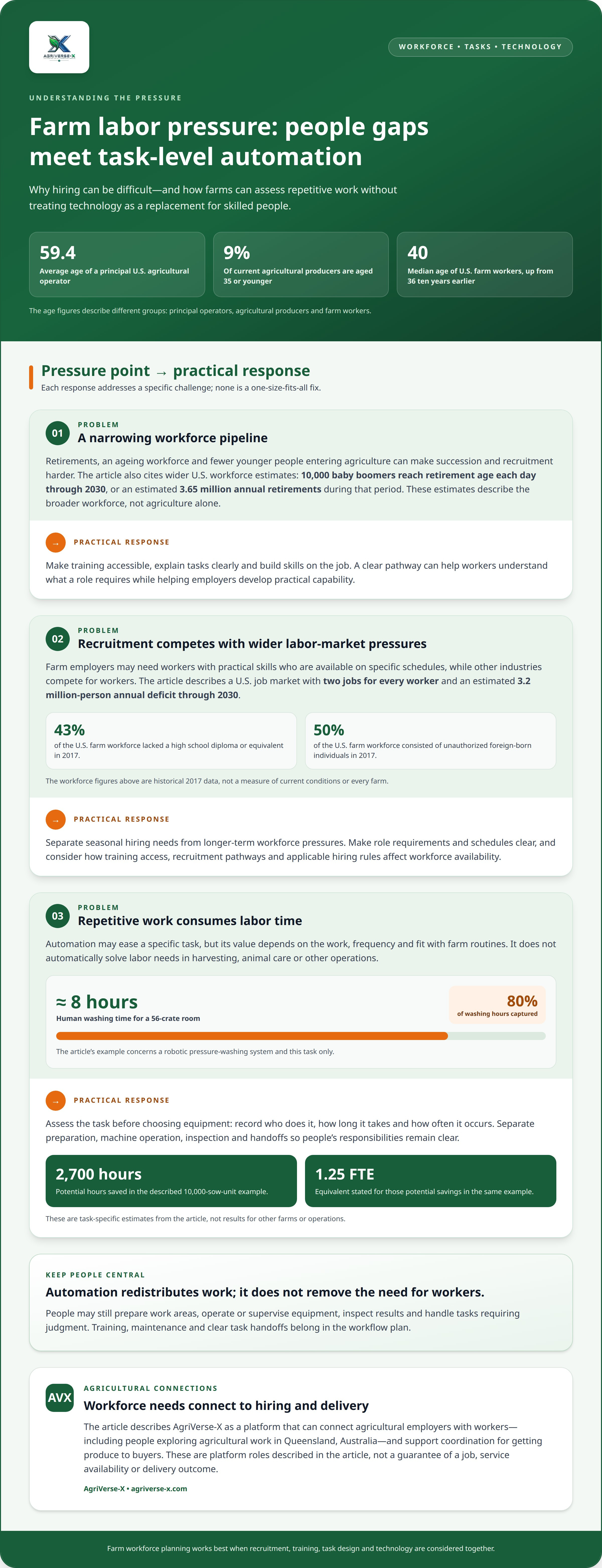
The US farm labor supply faces pressure from an ageing workforce and a smaller incoming generation. An estimated 10,000 baby boomers reach retirement age each day through 2030. Another estimate puts annual retirements at 3.65 million people during that period. These figures describe the wider US workforce, but agriculture competes for workers within it.
Farm ownership and farm employment are distinct, yet both show an ageing trend. The average age of a principal agricultural operator is 59.4 years. Producers aged 35 or younger account for 9% of current agricultural producers. Those figures point to a succession challenge: experienced operators leave, while fewer younger people are positioned to take over farms or build agricultural careers.
The age profile of US farm workers also shifted over time. Their median age was 40 years, compared with 36 years ten years earlier. In 2017, 16% of farm workers were under 25. Census.gov data indicates fewer than 425,000 people will turn 22 between the period described and 2030. That smaller cohort may intensify competition for entry-level workers across industries.
Education and recruitment pathways add another layer. In 2017, 43% of the US farm workforce lacked a high school diploma or equivalent. That figure does not measure workers’ practical ability; it highlights a potential mismatch between job requirements and available training pathways. Farm employers may need to make training accessible, explain tasks clearly, and build skills on the job.
Immigration is another factor in workforce availability. In 2017, 50% of the US farm workforce consisted of unauthorized foreign-born individuals. This historical figure does not describe every farm or current workforce conditions. It does show why employers and workers can be affected by immigration policy, recruitment rules, and access to seasonal labor programs.
Broader labor-market competition compounds these pressures. The US job market was described as having two jobs for every worker, alongside an estimated annual deficit of 3.2 million people through 2030. Agriculture accounted for 11% of jobs in related fields in 2017. NASDA identifies critical labor shortages, high H-2A program costs, and regulatory barriers as constraints across American agriculture.
The causes reinforce one another: retirements reduce experience, a smaller youth cohort narrows recruitment, and other sectors compete for the same workers. A farm seeking seasonal harvest crews, for example, may be competing with non-farm employers while needing people available on specific schedules and with practical skills. These combined pressures help explain why hiring challenges can extend beyond a single crop or season.
3. Mechanization, robotics and smart technologies
Mechanization, robotics and smart technologies can ease labour pressure, but they cannot replace people entirely. Their clearest value is reducing repetitive tasks and supporting consistent workflows. A robotic pressure washer, for instance, can take on part of livestock-room cleaning. Workers still prepare the area, operate or supervise equipment, inspect the result and handle tasks requiring judgment. Because automation redistributes tasks, managers should plan responsibilities alongside equipment.
A 56-crate room takes approximately eight human hours to wash. That makes room cleaning a specific task to assess, rather than treating automation as a farm-wide solution. The described robotic pressure-washing system can capture 80% of washing hours. These estimates relate to this task and should not be treated as results for other operations.
Scale affects the total time involved. For a productive 10,000-sow unit, the described pressure-washing efficiency gains could save 2,700 hours, or 1.25 full-time equivalents. The example shows how repeated work can make modest task-level savings add up. It also illustrates why managers should assess the number of rooms, cleaning frequency and output before judging whether a system fits.
Start by assessing the work itself. Record the task, who is involved, how long it takes and how often it occurs. Then identify steps that are repetitive, physically demanding or prone to delays. For pressure washing, separate preparation, washing and inspection. This makes it easier to see which steps automation might handle and where workers remain essential.
Plan people’s responsibilities around the equipment. Employees may need to operate, monitor or maintain a system while continuing other duties. Build training, task handoffs and inspection into the workflow. Automated washing may change who cleans, for example, but someone still needs to confirm the room is ready for its next use.
Mechanization has limits. Equipment designed for one task may not address shortages in harvesting, animal care or other work. Its value depends on how often the task occurs, the labour time involved, operating requirements and fit with existing routines. Comparing these factors helps distinguish a focused labour-saving tool from a broader workforce solution.
Employers can pair technology planning with workforce connections, particularly when implementation requires workers with relevant skills. Explore agricultural workforce connections as part of that wider planning.
4. Wages and employee benefits
Pay and benefits influence whether workers accept agricultural jobs and stay. Some leave after a few days or move to higher-paying non-farm work. Employers can review compensation and ask workers what makes the role difficult to sustain. Higher wages may help, while practical support can also address barriers affecting attendance, daily work and family responsibilities.
Make retention conversations specific. Employers can regularly ask employees about their work, interests and useful support. A manager might learn, for example, that transport or communication tools affect a worker’s ability to complete assigned duties. Follow up on concerns and explain which changes the operation can make. Regular conversations can surface problems before they become reasons to leave.
Benefits work best when they fit the job. Some farm operations provide uniforms, fuel and mobile phones. These examples address practical needs connected with work, rather than relying only on generic perks. Employers can explain what support comes with a role during recruitment and apply the arrangement consistently. Clear details help candidates understand the offer and give current staff a shared understanding of available benefits.
Family needs can affect whether a job is workable. One greenhouse operation arranged for a local school bus to pick up employees’ children at the greenhouse in the morning and return them there in the afternoon. This addressed a specific transport challenge. It also shows why employers should listen before choosing a benefit: another operation may face different constraints and need a different solution.
Recognition is another practical tool. Employers can acknowledge employees who meet a performance goal or mark a work milestone. Gift cards or time off may help workers attend family, school or sporting events. These gestures connect recognition with work and personal commitments. They can complement fair wages and clear expectations, but should not replace them.
Training and involvement can support employees who want to develop. Ask about workers’ interests and offer those who are interested the opportunity to attend a workshop or conference. Employers can also include employees and their families in meals with the employer’s family. These steps show interest beyond assigned tasks and create opportunities for conversation and learning.
Use a straightforward review: identify why employees leave, ask what support would help, then compare possible changes. Consider wages, uniforms, fuel, mobile phones, recognition and time off. Better pay and benefits can help attract and retain staff. Track whether changes address the needs employees raised, and keep expectations clear for applicants and current employees.
5. Which states and agricultural industries face the greatest farm labor shortages in 2026?
The available state-level signal highlights Montana: around 400 producers requested workers through H-2A in 2026. This indicates notable demand among producers using that program. It does not establish a definitive state ranking. A request count measures employers seeking workers through a particular channel, not every vacancy, unfilled position or hiring difficulty across a state.
Historical data adds context, but not a complete 2026 comparison. U.S. H-2A positions certified by state are charted for fiscal years 2005-24. That series can show how certified seasonal positions have varied across states over time. It should be read as program data, rather than as a direct measure of current shortages across all agricultural employers.
Different measures answer different questions. Producer requests show employers seeking workers. Certified positions record approvals through H-2A. Neither figure alone establishes how many jobs were ultimately filled or how long recruitment took. Montana’s 2026 requests and the state-level certification chart therefore provide useful signals, but they describe distinct aspects of workforce demand.
Workforce needs vary by operation. Seasonal crop production concentrates labour demand around planting, harvesting or related handling periods. Dairy farms need staff year-round, creating a different pattern from a short seasonal hiring window. A state-wide total can obscure these differences. Employers should consider not only how many workers they need, but when jobs arise and whether staffing must be continuous.
Livestock operations have their own policy and staffing questions. The Montana Stockgrowers Association called for expanding H-2A access to livestock auction markets and feedlots. That request identifies industries seeking a pathway to host workers. It is evidence of an industry concern, not proof that every auction market or feedlot faces the same shortage.
To assess local pressure, separate information by state, sector and hiring channel. Compare seasonal crop positions with year-round dairy roles, and distinguish requests from certified positions. Record which jobs remain open and when staffing gaps affect operations. This gives employers a more useful internal picture than treating a single programme measure as a complete shortage index.
Workers can use the same distinctions when considering agricultural jobs. Seasonal field work and year-round dairy work differ in timing and continuity. Employers can make recruitment clearer by describing duties, work periods and whether staffing needs recur through the production cycle. In Queensland, Australia, workers should assess local job details rather than assume U.S. programme patterns apply to another labour market.
Montana’s producer requests make it a visible example in 2026, while the available figures do not support a definitive ranking of every state or industry. Better comparisons combine state-level program data with sector-specific hiring records. That approach helps identify where recruitment pressure is concentrated and which staffing patterns need attention.
5. What labor and immigration policy changes could affect U.S. farm labor availability in 2026?
In 2026, U.S. farm labor availability depends partly on seasonal worker policy, wage rules and congressional reform. The H-2A program is the largest source of temporary or seasonal farm workers in the United States, and most H-2A workers are from Mexico. According to the U.S. Department of Labor, the program allows foreign nationals to fill agricultural jobs for up to a year.
Timing matters because agricultural employers have different staffing needs. A crop farm may need workers during a defined planting or harvest period, while dairy farms need year-round staff. Most current U.S. visa programmes are designed primarily for seasonal employment, creating a mismatch for businesses that need continuous coverage.
Proposals to expand H-2A could affect which agricultural roles employers may fill through the program. The Montana Stockgrowers Association called on federal lawmakers to expand H-2A so livestock auction markets and feedlots could host workers. That request highlights a policy question: whether temporary agricultural labor pathways should cover more types of livestock work.
Wage policy is another point to watch. Changes to H-2A wage rates were being considered. Any change can affect employers’ labor planning and the terms attached to seasonal hiring. Employers may need to account for updated wage requirements when estimating staffing needs, setting recruitment timelines and planning production.
Industry groups have also urged broader federal action. NASDA’s federal policy focus for 2026 was announced on February 3, 2026. NASDA calls on Congress and federal agencies to reform agricultural labor policies, strengthen food security and support the competitiveness of U.S. agricultural products abroad.
Those calls have continued across multiple years. NASDA members urged U.S. agencies to collaborate on labor-shortage strategies on February 7, 2024. Members urged Congress to initiate agricultural labor reform on February 26, 2025. These steps show sustained advocacy, not proof that any requested policy has already changed.
On June 30, 2026, NASDA applauded the introduction of the Securing Agriculture’s Workforce Act. Introduction is a legislative step, not enactment. Employers should distinguish a bill’s introduction from an approved change when planning staffing and recruitment.
Farms should distinguish current programme rules from policy proposals. Map roles by season and duration, identify whether work is seasonal or year-round, and follow relevant federal developments. This matters especially for dairy farms, livestock auction markets and feedlots, where policy discussions address workforce needs beyond seasonal crop labour.
The H-2A program currently allows foreign nationals to fill agricultural jobs for up to a year, and proposals could expand the types of agricultural roles it covers, including livestock auction and feedlot work. Wage-rate changes were under consideration, which could affect employers’ labor costs and recruitment planning; no specific application-timeline change is established.
AgriVerse-X: Digital Agricultural Ecosystem
AgriVerse-X is designed to connect agricultural employers, workers, producers and service providers through digital profiles and marketplace tools. These services may be in development or depend on partner delivery; availability should be confirmed with AgriVerse-X. The platform is intended to support employers seeking agricultural workers and people looking for agricultural jobs, including in Queensland, Australia. Education courses in farming, technology, safety and business skills may also depend on programme development and delivery partners.
Where available, verified profiles may showcase products, services, skills and certifications. Marketplace connections for goods, equipment, logistics and other services may depend on local requirements and participating providers. For example, a producer preparing grain for buyers may be able to coordinate product and delivery needs through relevant platform listings, subject to availability. Profile verification does not itself certify products, skills or qualifications.
Explore AgriVerse-X agricultural connections to learn how employers, workers or logistics providers can get involved. Contact AgriVerse-X to discuss workforce or agricultural partnership needs.
Build a More Connected Agricultural Workforce
The farm labour shortage in 2026 is a prompt to make workforce planning continuous, not seasonal. Farms can connect hiring needs with skills development, technology adoption and the movement of produce to buyers. Clear digital profiles also help agricultural participants present their skills and services across changing operational needs.
AgriVerse-X brings employers, workers, training providers and logistics participants into a shared agricultural ecosystem. Use it to explore workforce connections and practical ways to coordinate agricultural services. For a focused discussion about farm labour needs, contact AgriVerse-X.
Stronger agricultural operations rely on useful connections. Build them deliberately, support people as work changes, and plan ahead for the next season.
Frequently Asked Questions
Why are there labor shortages?
Farm labour shortages arise when worker supply and job requirements do not align. Agricultural employers compete with other industries for workers, while seasonal roles may offer less continuity than year-round jobs. Immigration pathways, training access and the timing of labour demand also shape recruitment. A harvest crew, for example, is needed during a limited work period, while dairy operations require ongoing staffing. These pressures can overlap, making vacancies difficult to fill.
What are current U.S. farmworker wages and labor costs in 2026?
Farm workers’ actual pay varies with the role, location, season, experience and required skills. Employers can use task-time and staffing records to understand their own labour costs.
Can automation and agricultural robots help address farm labor shortages, and what do they cost?
Yes. Automation can reduce repetitive work, but people are still needed to supervise equipment and handle other duties. The quoted saving is an estimate, not the robot’s purchase price. Equipment costs depend on the system, installation, integration, maintenance and operating requirements, so farms should assess the specific task and workload.


