

Start with nearby farmers, local agricultural groups, farm-link programs, and your state or regional agriculture department to identify prospective tenants. If you’re deciding how to find a farmer to lease my land, use several routes at once: request referrals, publicize the opportunity through farm networks, and consider an online listing or local newspaper notice. A farmland professional can coordinate these channels and shape the search around your property’s location, intended use, and preferred lease arrangement.
Finding the right farmer involves more than collecting names. Share clear details about the property, then compare candidates’ farming plans, references, and fit with your priorities as a landowner. Agricultural organizations and professionals may help you reach potential tenants, while different cash rent structures affect how lease payments work. This guide explains where to find farmers, how to assess candidates, and what to consider when choosing lease terms, so you can move from an open opportunity toward a well-matched farming relationship.
Key Takeaways
- Combine local referrals, agricultural organizations, and farm opportunity listings to reach prospective tenants.
- Use Cooperative Extension offices and state agriculture departments to connect with local farming networks and agricultural professionals.
- Compare fixed and variable cash rent structures to identify an arrangement that fits the property and the farming operation.
- Look beyond the rent amount by considering the tenant’s plans, references, and fit with the land.
- Explore farmland and lease listings on AgriVerse-X to connect landowners with prospective agricultural tenants.
How farmland professionals help landowners find prospective tenants
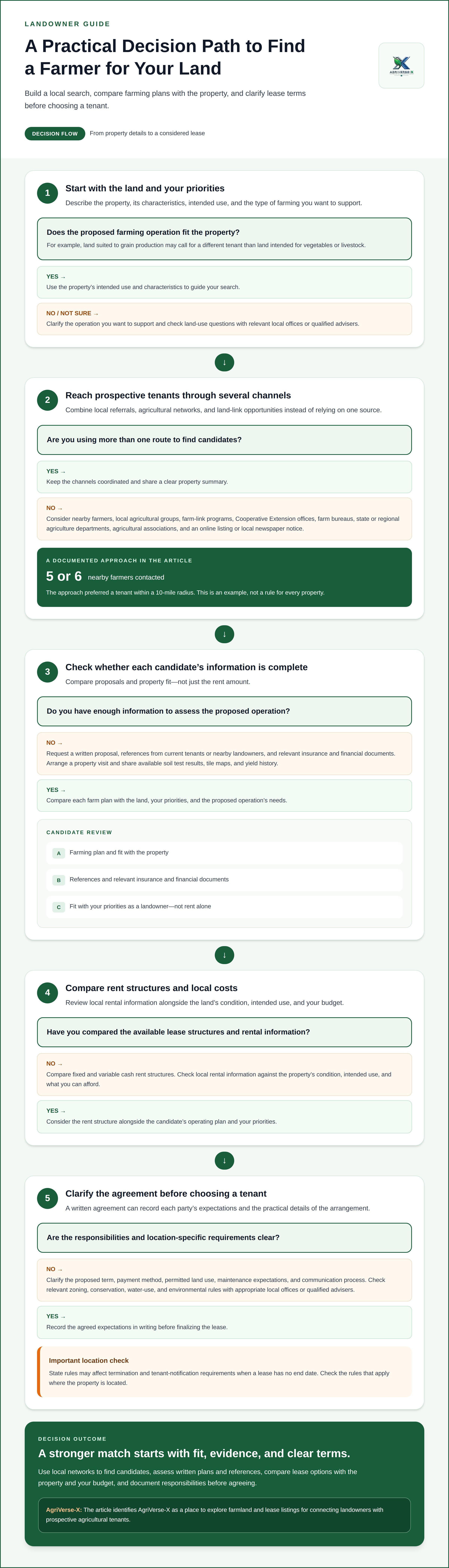
Start with your goals, the property’s characteristics, and the type of farming you want to support. Focus on operators whose plans suit the land rather than simply collecting inquiries. A property suited to grain production, for example, may need a different tenant than land intended for vegetables or livestock. To find a farmer to lease your land, match the proposed operation to the property.
Farm-link programs match landholders with farmers seeking land. A professional can search these directories, then combine their reach with local referrals and agricultural networks. The USDA recommends connecting with the local farming community and publicizing a search for leased land. One documented approach contacted 5 or 6 nearby farmers and preferred a tenant within a 10-mile radius.
Rent needs to reflect both the property and your budget. Compare local rental information with the farm’s condition, intended use, and lease structure. The USDA recommends comparing farmland purchase and rental costs, then checking land values and rental rates against what you can afford. This can help you decide whether leasing better fits your goals than buying.
Clarify responsibilities before agreeing to a lease. Set out the proposed term, payment method, permitted land use, maintenance expectations, and communication process. A written agreement can record each party’s expectations. State rules may affect termination and tenant-notification requirements if the lease has no end date.
Leasing, renting, and purchasing involve different commitments. Compare ongoing rental payments and operating arrangements with the costs and responsibilities of owning farmland. The USDA recommends weighing purchase and rental costs against your budget. The right option depends on whether you want to retain ownership, earn rental income, or transfer the property.
To check which zoning, conservation, water-use, and environmental rules may apply in your state, a professional identifies the property’s location and intended farm activity. They can direct the review to relevant county, municipal, or state offices and qualified advisers before lease terms are finalized.
Screen prospective tenants by requesting proposals, references from current tenants or nearby landowners, and relevant insurance and financial documents. Compare each candidate’s operating plan with the property and your priorities. Consider the insurance needs and financial capacity required for the proposed operation.
Property and rental databases help organize the search. Farm-link directories connect landowners with land seekers, while USDA resources help frame rental-versus-purchase comparisons. A professional can prepare a listing with location, land characteristics, intended use, and proposed lease terms, then place it on agricultural land marketplaces where opportunities are listed.
Organized property records can also help you find a farmer to lease your land. Before selecting a tenant, coordinate property visits and share available soil test results, tile maps, and yield history. Ask candidates for written proposals so you can compare farm plans and focus on fit with the land and the tenant’s approach, not rent alone.
How farmland professionals work with Cooperative Extension and state agriculture departments
Use Cooperative Extension offices, farm bureaus, and state agriculture departments to build a local referral network. These organizations can connect landowners with agricultural communities, practical information, and potential tenant leads. Their roles vary by location, so identify relevant county or state contacts before promoting the property.
Farm bureaus and Extension offices may help landowners reach farmers through community networks and referrals. Land-link programs focus on matching landholders with people seeking farmland. Farm organizations, including the Cattlemen’s Association, Farm Bureau, National Farmers Union, National Sustainable Agriculture Coalition, Wheat Growers Association, and Young Farmers Coalition, may also help people find farmland rental assistance.
Coordinate outreach across several channels instead of relying on just one. Share a property summary with a county Extension office, seek suitable referrals from agricultural professionals, and approach a relevant farm organization. Loan officers and agricultural retailers may also know local operators or be able to provide tenant references.
Useful tools include county Extension directories for finding local agriculture contacts, state agriculture department websites for area policies, and land-link directories for connecting landowners with prospective farmers. Farm bureau and association networks can circulate an opportunity among members. Contact directories help you find people, policy pages inform location-specific questions, and land-link programs connect landowners with potential tenants.
The USDA recommends checking state, county, or municipal websites for policies that may support a farming operation in the area. A farmland professional can identify the property’s jurisdiction, review relevant public information, and route questions about land use or water access to appropriate local offices. This helps keep leasing discussions grounded in the location and proposed agricultural activity.
Cooperative Extension can help you frame practical questions about a prospective operation. Consider which crops suit local growing conditions, whether the tenant’s plan fits the parcel, and what records could help assess the land. A vegetable grower and a grain operator, for example, may need different field access, water arrangements, or land-use plans.
Local referrals work best when the opportunity is clearly described. A professional can prepare a concise property profile with its location, intended rental arrangement, available land details, and contact process. They can then adapt that summary for an Extension contact, a farm bureau network, or a land-link directory, while keeping the information consistent.
For landowners widening their search beyond local referrals, farmland and lease opportunity listings offer another way to present available land to agricultural participants. A professional can coordinate that channel with local outreach, so prospective tenants can discover the opportunity through more than one route.
These connections help at different stages. Extension offices and farm groups provide local context, while land-link programs focus on matching. Use each for its intended purpose to identify potential tenants and give every inquiry a clear next step.
Fixed and variable cash rent leases
With cash rent, a landowner and tenant agree on payment terms. Under fixed cash rent, the tenant pays an agreed amount for the lease period regardless of the farm’s eventual revenue. This makes the payment structure clear in advance, while placing more production and market risk on the tenant.
A variable cash rent lease combines elements of fixed cash rent and crop-share arrangements. It sets a base payment, then adjusts additional rent using a measure such as gross revenue. The landowner receives a defined base, while the variable portion responds to the farm’s results.
Treat this as an illustration of how a formula can work, not a standard rate for every farm. Actual terms depend on the agreement and the operation.
Crop-specific revenue can shape a variable formula. Corn-specific revenue assumptions can be used when setting a variable rent formula. For soybeans, the described range is 35% to 40%. Those figures illustrate different crop assumptions, not universal rates for every location or season.
A farmland professional can model the alternatives with a rent comparison worksheet. This tool places fixed rent beside variable scenarios, making payment differences easier to review. A gross-revenue worksheet can show how the formula changes when crop revenue rises or falls, using the same base and percentage assumptions.
Before comparing offers, define the formula’s inputs with both parties. These may include the base payment, revenue measure, calculation period, and payment due date. Clear definitions matter because a percentage cannot be applied consistently if the lease leaves its revenue basis unclear.
Payment timing also matters. Collecting cash rent before the lease term or planting can reduce the landowner’s risk. Include the due date and payment method in the written lease alongside the rent calculation, so the tenant understands the commitment before farming begins.
Cash rent is just one lease structure. Other options include custom farm lease operation, custom blend lease, crop share lease, net share lease, and bushel lease. Compare who pays operating costs, how rent is calculated, and how production risk is shared under each proposed arrangement.
Choose terms by comparing your income priorities with the tenant’s operating plan. Fixed rent prioritizes predictability; a variable formula ties part of the rent to revenue. Review the assumptions together, document the calculation method, and state the agreed terms clearly in the lease.
How a farmland professional can support a lasting relationship with your tenant
A durable lease begins with a good fit, not simply the highest rent. A farmland professional compares each farmer’s proposal with your land, ownership priorities, and plans for the property. For example, a tenant seeking a short-term growing opportunity may not suit an owner prioritizing long-term soil stewardship.
References can help you assess how a candidate has worked with landowners. Request references from a current farm tenant, nearby landowners, or agricultural contacts. Invite interested farmers to submit proposals explaining their operation and how it supports your goals. This makes selection more consistent than relying on informal conversations alone.
Property visits give both parties a shared view of the land. A professional can coordinate multiple visits and walk the property with prospective tenants, noting access, field conditions, boundaries, and areas needing discussion. A visit log records observations and follow-up items. If soil or water quality matters to the planned operation, test results can inform those conversations.
Clear records can help prevent disagreements. A lease preparation checklist can capture your priorities, the tenant’s proposed use, payment terms, maintenance expectations, and the agreed communication process. Write responsibilities in plain language so both parties can refer to the same terms when questions arise during farming.
Land history can support practical decisions. A property file may include available soil test results, tile maps, and yield history, giving prospective tenants useful context about the fields. Organize these records alongside visit notes and the tenant’s proposal to assess whether the proposed farming plan fits the land.
Regular communication gives small concerns a clear route to resolution. A professional can help establish agreed check-in points around relevant farm activities, such as planting, field access, or maintenance work. A simple issue log records the concern, the person responsible, and the agreed next step. This approach keeps discussions focused on specific matters rather than assumptions.
Start renewal discussions before the lease ends. Use a lease calendar to track the end date, review dates, and any notice periods in the agreement. Review the tenant’s plans, the property’s condition, and each party’s experience. Local requirements may affect termination and notification, so check the rules that apply.
Long relationships can span decades, but succession still needs planning. A tenant may retire after 40 years of farming, making a transition plan useful. A professional can help document the plan, identify the owner’s priorities, and organize a search for a successor. That preparation can clarify access, records, and the farm’s future use.
Choose a tenant whose operation fits the property and whose expectations align with yours. A proposal review, property file, visit log, and lease calendar can support the relationship from selection through renewal.
How can a farmland professional help me find farmers looking to lease farmland near me?
A farmland professional can build a local search around your property’s location, suitable farm use, and preferred lease structure. They can combine direct outreach, agricultural listings, and community channels instead of relying on one advertisement. For example, one landowner search contacted 5 or 6 nearby farmers and prioritized a tenant within a 10-mile radius.
That radius is a search preference, not a universal boundary. Start with nearby operators, then widen the search if their farming plans or timing do not fit. Local knowledge can also help shape a useful listing, such as highlighting field access for a grain grower or water access for a vegetable operation.
Several tools help reach prospective tenants:
- Farm-link programs: These directories are designed to match landholders with farmers seeking farmland.
- Farm organization listings: Local agriculture groups and farm bureaus can circulate a property opportunity through farming networks.
- State Department of Agriculture channels: A department may offer a place to post a farmland opportunity or direct inquiries to relevant local resources.
- Farm trade newspapers and local newspapers: Print notices can reach readers following regional agriculture and land opportunities.
- Online listings and virtual cash rent auctions: These formats can present the property remotely and invite interested farmers to submit offers.
A professional can prepare one consistent property profile for these channels. It can describe the location, land characteristics, suitable farming uses, access details, and proposed rental terms. For instance, a listing for crop production can explain which fields are available and identify relevant property records for discussion.
Each channel has a different purpose. Farm-link directories focus on matching landholders with land seekers, while newspapers can raise local awareness. An online auction can collect competing rent proposals in one place, helping you compare offers using consistent terms.
Outreach can extend beyond formal listings. Contact nearby farmers, ask local agriculture groups to share the opportunity, and seek referrals from agricultural professionals. If the initial candidates lack a suitable operating plan, expand the search to adjoining communities or broader farm networks.
Make the next step clear in every listing. State how farmers can express interest, what information their proposals should include, and how property visits will be arranged. Then compare proposals for operating fit, lease terms, and alignment with your priorities.
Keep outreach organized with an inquiry log recording each channel, response, and follow-up step. This helps show which audiences are engaging and where more outreach may help. When candidates respond, coordinate discussions using the same property details and proposed terms.
AgriVerse-X
AgriVerse-X is an agricultural technology platform. The availability of farmland listings and farmer or agribusiness profiles is not confirmed, so landowners should contact AgriVerse-X to ask whether these options are available. Employers and agricultural workers can also explore whether AgriVerse-X can support their recruitment or job-search needs. Logistics providers can enquire about getting farm produce delivered to buyers through the platform; availability may depend on local services and arrangements.
If you are considering a farmland or lease opportunity, keep information focused on the property and proposed terms. Landowners and prospective tenants can discuss intended use directly and involve qualified local professionals where needed. Job opportunities, logistics services, and any platform features are subject to availability and applicable requirements.
Contact AgriVerse-X to ask about farmland and lease opportunities, agricultural jobs, or logistics involvement.
Move your land opportunity forward
Turn your priorities into a clear opportunity for the right farming partner. Decide what kind of operation fits the property, what relationship you want with a tenant, and which questions need professional input before an agreement takes shape. A focused brief gives prospective farmers a practical starting point for discussing their plans.
If you’re planning how to find a farmer to lease your land, make the search serve your long-term goals, not just the immediate vacancy. Consider how the proposed use, communication expectations, and lease arrangement support the future you want for the property. Local requirements and lease terms vary, so consult qualified professionals for advice specific to your circumstances.
AgriVerse-X can help you present a farmland or lease opportunity to agricultural participants. Explore the platform when you’re ready to give prospective tenants another way to discover your listing.
Employers, agricultural workers, and logistics providers are invited to get involved with AgriVerse-X. Set a clear direction, start the right conversations, and move toward a tenant relationship that fits your land.
Frequently Asked Questions
How can a farmland professional help me find a new tenant or farm operator?
A farmland professional can coordinate inquiries and organize candidate information around your property’s needs. For example, they can compare each operator’s proposed start date, intended crops, equipment needs, and experience managing similar land. A consistent shortlist helps you spot practical differences between applicants. It also gives you a clearer basis for discussing access, farm operations, and lease expectations before choosing a tenant.
How much is farmland lease rent per acre in my county or state?
There is no single rent figure that applies to every property in a county or state. Soil quality, drainage, access, parcel size, intended crop, and lease structure can all affect rental value. Compare local rental evidence for similar properties, distinguishing fixed cash rent from arrangements tied to farm revenue or production. This helps frame a budget without treating unlike properties as equivalent.
What types of farm leases are common, and how do cash rent and crop-share leases compare?
Common options include fixed cash rent, variable cash rent, crop share, net share, bushel leases, custom farm lease operations, and custom blend leases. Fixed cash rent sets a payment amount in advance. Crop-share arrangements tie rent to production or crop returns, so the parties share more production risk. The written terms determine how inputs, records, and calculations work for the specific operation.
What should a farmland lease agreement include, and should it be written or recorded?
A written lease can identify the parties and parcel, permitted farm use, lease term, payment method and dates, maintenance duties, access, and renewal or termination process. It should also explain how the parties will document field conditions and handle disagreements. A written agreement helps keep expectations clear. Whether to formally record the lease depends on local requirements and circumstances, so seek qualified local legal advice.
What risks should landowners consider when leasing farmland, including liability, soil damage, and nonpayment?
Consider payment default, property damage, changes in soil condition, unclear repair responsibilities, and potential liability connected with farm activities. A useful lease file can include baseline field observations, available soil records, payment dates, permitted land uses, and each party’s maintenance duties. Address insurance responsibilities in the agreement. Local legal and insurance professionals can explain how relevant requirements apply to your property and lease.


