

In 2022, 39% of agricultural land in the United States was rented. For a young farmer, leasing agricultural land to young farmers can offer a route into production without first buying property. The key decision is how to structure the agreement: fixed cash rent gives the landowner an agreed payment, while crop sharing connects returns to harvest results and the terms both parties set.
Choosing a payment model is only part of leasing agricultural land to young farmers. The lease also determines how the land can be used, who maintains it, how repairs and improvements are handled, and how long the farmer can plan around the property. Clear communication helps landowners and farmers address operational changes before they become disputes.
This guide explains how cash rent and crop shares work, which lease terms to review, and how to assess soil, water access, permitted uses, and infrastructure. It also covers insurance, liability, taxes, and relevant government programmes. Use these points to evaluate a potential lease before committing.
Key Takeaways
- Compare fixed rent with crop sharing by weighing who carries input costs, crop risk, and price changes.
- Set clear terms for equipment, routine upkeep, major repairs, and the cost of lasting improvements.
- Put responsibilities, insurance expectations, liability, lease duration, and any relevant programme conditions in writing.
- Agree on regular communication about farm operations, expenses, repairs, and harvest plans to reduce misunderstandings.
- Assess soil, water access, permitted uses, and essential infrastructure as part of deciding whether a parcel fits the farm plan.
Lease responsibilities for equipment, maintenance, repairs, and improvements
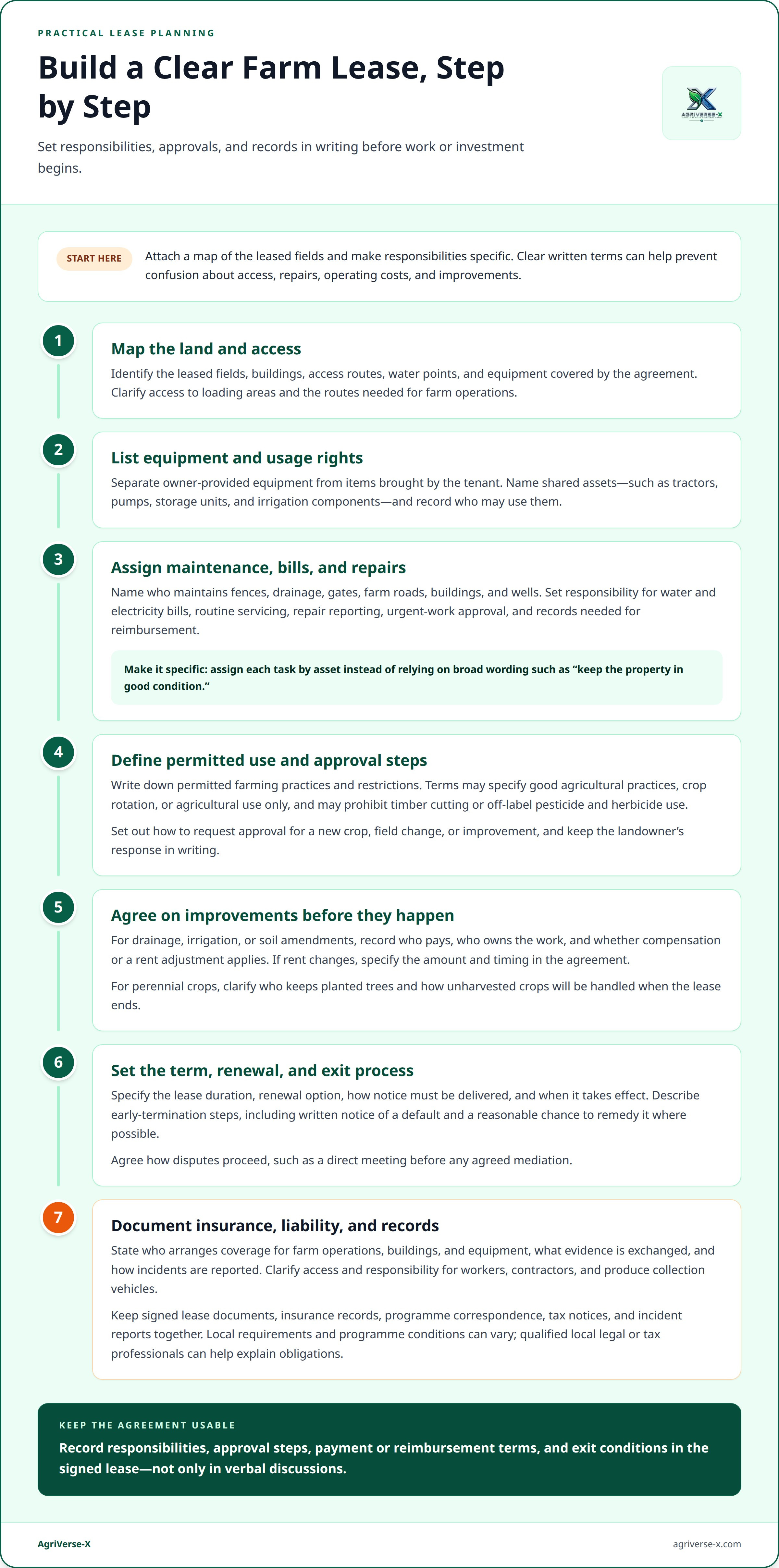
Common risks include unclear repair duties, restricted access, unexpected termination, and disputes over investments. A tenant can reduce these risks by recording responsibilities, approval steps, and exit terms in a signed lease before work begins. Describe the leased fields on an attached map, then identify buildings, access routes, water points, and equipment covered by the agreement.
Distinguish owner-provided equipment from items the tenant brings. List shared tractors, pumps, storage units, and irrigation components, and state who may use them. Assign routine servicing, operating costs, and repair reporting to named parties. For example, the tenant could report a pump failure promptly while the owner arranges major repairs. Specify who approves urgent work and what records are needed for reimbursement.
Assign maintenance by asset and task instead of using broad phrases such as “keep the property in good condition.” State who maintains fences, drainage, gates, farm roads, buildings, and wells. Clarify responsibility for water and electricity bills, as well as access to service points. A tenant who needs harvest access should also have clear rights to use loading areas and agreed routes.
Define permitted farming practices and any restrictions on land use. A lease may require good agricultural practices, crop rotation, or agricultural use only. It may also prohibit timber cutting or off-label pesticide and herbicide use. Explain how the tenant can request approval for a new crop, field change, or improvement. A written response records what the landowner has approved.
Set separate terms for permanent improvements. For drainage, irrigation, or soil amendments, specify who pays, who owns the work, and whether compensation or a rent adjustment applies. If the landowner funds an improvement and rent changes, record the amount and timing in the agreement. A tenant planning perennial crops should also clarify who keeps planted trees and how unharvested crops will be handled when the lease ends.
Specify the lease term, renewal option, and notice method. Explain how notice must be delivered and when it takes effect. Include an early-termination process for events such as non-payment of rent, with written steps for identifying a default and allowing a reasonable chance to remedy it where possible. State how disputes proceed, such as a direct meeting before any agreed mediation. Clear terms help both parties manage changes without relying on verbal assumptions.
Legal advice, liability, insurance, and government programs
Farm tenants and landowners should set out insurance, tax-record, and maintenance responsibilities in the lease. Their actual obligations depend on the agreement and applicable local requirements.
Legal Advice and Government Programs
Legal advice can help each party understand how lease terms interact with local land rules and programme conditions. An agricultural lawyer can review the duration, renewal, land access, and any recording requirements before the tenant invests in the property. This is especially important when the lease supports a long-term crop plan or substantial improvements.
Government programmes may affect land-use requirements, records, or tax assessment. Maine’s farmland current-use assessment program requires at least $2,000 in annual gross income from farming activities, according to the Maine Legislature. The lease can assign responsibility for keeping farm-income records and sharing documents needed for an application. Programme eligibility and obligations depend on the relevant local rules.
Insurance, Liability, and Taxes
Insurance terms clarify who arranges coverage for farm operations, buildings, equipment, and other identified risks. The lease can specify what evidence of coverage the parties exchange and how they report incidents. For example, if a contractor damages a gate while using farm equipment, the agreement can set out how to give notice and which records to preserve.
Tax responsibilities also need clear treatment. Identify who receives property assessment notices, who maintains business tax records, and who provides information for any land-use programme. A qualified local tax or legal professional can explain jurisdiction-specific obligations without relying on assumptions about how a particular lease is classified.
Liability terms should cover people entering the leased property, including workers, contractors, and produce collection vehicles. State who controls access, who reports injury or damage, and how the parties document an incident. If workers use a shared access road, describe the route and any operating limits to reduce uncertainty about site access and responsibility.
Keep signed lease documents, insurance records, programme correspondence, tax notices, and incident reports together. A simple file organized by season can help the parties find the relevant record when a renewal or claim arises. AgriVerse-X lists farmland and leases, which can help prospective tenants explore agricultural land opportunities before discussing terms directly.
Cash-rent and crop-share arrangements
Cash rent gives the landowner an agreed payment, while a crop-share lease divides production risk, costs, or proceeds. The right choice when leasing agricultural land to young farmers depends on available working capital, expected harvest variability, and each party’s contributions. A flexible lease can adjust rent using an agreed formula tied to production or market conditions. Whichever structure you choose, specify payment dates and records.
With cash rent, the tenant owes the agreed amount even if a crop fails or market conditions cause a loss. The lease can state rent per acre for a defined production season or another agreed term. This gives the landowner predictable payments, while the farmer carries the risk of lower yields or falling commodity prices.
For a tenant with limited working capital, the timing of cash-rent payments can matter as much as the total amount. State when payment is due, whether before planting, after harvest, or on another agreed date. Define the acreage used to calculate rent, especially if the parcel includes unusable ground, shared access, or areas excluded from production.
A crop-share lease ties the landowner’s return to production or crop-sale proceeds. The owner typically provides the land, while the farmer supplies equipment, pays input costs, and manages the operation. The landowner may receive cash based on net crop-sale proceeds or an agreed share of the harvest. Lower yields can reduce both parties’ returns, while stronger harvests or prices may increase them.
Write the sharing formula before planting. Specify whether shares are based on harvested quantity, gross sales, or net proceeds, and identify allowable deductions. If the landlord contributes seed, fertilizer, storage, or machinery, explain how that affects the calculation. State who arranges transport and storage, since these can affect when crops are sold and how proceeds are recorded.
A flexible lease can combine base rent with a variable component. The parties might link that component to documented yields or crop prices, using a named data source and defined calculation period. Explain how the formula applies if harvest records are incomplete or prices change between sale dates. This shares some market movement without leaving the final payment open to interpretation.
Before choosing, compare each arrangement with the farm’s cash-flow plan and expected crop cycle. Leasing agricultural land to young farmers with fixed rent can suit a tenant prepared to carry production risk; crop sharing may better fit parties contributing different resources. Keep input receipts, weights, sales records, and deductions together so both parties can trace each settlement to its supporting information.
Communication between landowners and farmers
A clear communication routine turns lease terms into practical decisions. Name each party’s main contact, preferred channel, and backup contact in the agreement. For example, the tenant could report a blocked access track by text, then send photographs and a written repair request by email. A shared record helps both sides track what was reported and agreed.
Use the crop calendar to organise operational updates. At planting, the tenant can share the intended crop, field location, and access needs. Before harvest, both parties can coordinate machinery movements, storage access, and expected deliveries. These updates help landowners plan around activity on the property and give the farmer a clear way to raise changes.
Make approval requests specific. If a tenant wants to add drainage, change a field entrance, or install irrigation, describe the location, proposed work, expected disruption, and who will manage it. The landowner can respond in writing with approval, conditions, or reasons for declining. Keeping the decision with the request prevents later confusion about what was authorised.
Record important conversations soon after they happen. A brief note can capture the date, participants, decision, and next action. For example, after discussing water access, the tenant could record which pump serves the leased field and when it may be used. Email or a shared document can preserve the same details, provided both parties can retrieve them.
Coordinate access for people working on or visiting the property. Before a contractor repairs a fence, the tenant can notify the owner of the work area and expected vehicle route. Before produce collection, both parties can confirm the loading point and keep farm traffic clear of buildings. These practical notices reduce disruption and clarify who is entering the land.
When a disagreement arises, address the specific issue rather than making broad accusations. A tenant disputing a repair charge can share the invoice, photographs, and relevant lease clause. The owner can respond with the records supporting the charge. If direct discussion does not resolve the matter, follow the dispute process in the agreement, such as a meeting followed by mediation if both parties agree.
Communication also supports continuity when plans change. If weather delays planting or a buyer changes collection timing, the farmer should promptly explain the operational impact and suggest a revised plan. Before renewal discussions, both parties can review written notices, completed work, and unresolved items. This record gives the landowner and tenant a factual basis for deciding whether to continue the rental relationship.
How can a young farmer evaluate soil quality, water access, zoning, and infrastructure before leasing?
Assess the land against the farm plan before agreeing to lease terms. A vegetable grower needs different conditions from a livestock operator or orchard business. Walk each field with a map and mark wet areas, slopes, access routes, and existing structures. Compare these features with the intended crops and equipment, and tie observations to specific field locations.
Start assessing the soil by identifying differences across the parcel. A low-lying section may drain differently from an elevated field, while compacted ground can affect cultivation. Arrange testing through a qualified laboratory, using samples representative of the areas intended for production. Review results for pH, texture, nutrients, and other indicators relevant to the proposed crop. Record sampling locations so the results can guide field-specific planning.
Water access requires both a source and a workable delivery plan. Identify whether the property uses a well, borehole, surface water, stored rainwater, or another supply. Note the location of pumps, pipes, tanks, and irrigation connections, then check whether they serve the fields planned for cultivation. Ask how access is managed during dry periods and establish which local permissions or water-use rules apply before relying on the supply.
Land-use zoning determines whether the planned activity meets local rules. Contact the relevant local planning authority about permitted agricultural uses, structures, access, and any limits affecting the proposed operation. A plan for a greenhouse, livestock housing, or produce processing may face different requirements from open-field cropping. Record the authority’s guidance and state the intended use clearly in the lease.
Inspect infrastructure under operating conditions. Test gates and access tracks with the type of vehicle expected to reach the fields. Examine fences, drainage channels, storage areas, electricity connections, and irrigation equipment. A produce grower who relies on regular collection needs a route suitable for loading and delivery. List damaged or missing items, photograph their locations, and document who will maintain or repair them.
Finally, compare the land’s condition with the lease period and investment plan. Soil amendments, irrigation upgrades, and orchard establishment may take time to support production. Match planned work to the agreement’s duration, permitted improvements, and exit terms. Attach a field map and written condition notes to the lease, then use them to clarify access, approved work, and responsibilities before operations begin.
AgriVerse-X: Verified Digital Agricultural Ecosystem
AgriVerse-X helps farmers and landowners connect through digital profiles and farmland lease listings. Farmers can showcase their skills, services, and certifications, while landowners can list farmland and leases for prospective tenants. Listings are a starting point, not a substitute for land inspections, written agreements, or local professional advice.
After assessing a parcel, a young farmer can use the platform to explore lease opportunities and related agricultural resources. The marketplace also supports listings for equipment, inputs, logistics, and agricultural services, helping connect land plans with practical operating needs. Listings and requirements may vary by location and applicable rules.
Contact AgriVerse-X to discuss how its agricultural platform may support your next step.
Turn a Lease Plan Into a Strong Start
A thoughtful approach to leasing agricultural land to young farmers can create room to build a viable operation and a lasting working relationship. Treat the lease as the start of that relationship, not merely a document to sign. Agreeing on how decisions will be made helps both sides adapt as the farm’s needs develop.
Before committing, shape the proposed arrangement around the crops, resources, and operating plan. Then take a deliberate next step: explore suitable agricultural opportunities and focus the conversation on a workable path forward. AgriVerse-X helps landowners and aspiring farmers connect through its agricultural platform. Employers and job seekers, including in Queensland, Australia, can also explore agricultural workforce connections.
Start with clear expectations, practical planning, and room for the farm to grow. A considered beginning gives young farmers a firmer foundation for the work ahead.
Frequently Asked Questions
Agricultural Land: To Own or To Rent?
Renting can suit a farmer who needs operational flexibility or wants to test a production plan before buying. Ownership can offer greater control over long-term land decisions, but ties more capital to the property. Compare your time horizon, financing capacity, improvement plans, and business risks. For example, a new grower planning annual vegetable crops may prioritise access and manageable commitments over ownership.
How can a young farmer find agricultural land to lease in the United States?
Define the operation first: crop or livestock type, required facilities, access needs, and preferred lease structure. Then search agricultural land listings and ask local farming networks about landowners seeking tenants. AgriVerse-X lists farmland and leases, giving prospective tenants another place to find opportunities. Treat each listing as a starting point, then assess the parcel, terms, and local requirements before agreeing.
What is the difference between cash rent, crop-share, and flexible farm leases?
Cash rent sets the payment the tenant owes under the lease, while a crop share divides crops, sales, or agreed production costs between the parties. A flexible lease adjusts rent through a mutually agreed formula, often linking part of the payment to production or market conditions. Put the formula, data source, calculation timing, and any limits in writing so both parties can reproduce the calculation.
What terms should an agricultural land lease include?
Include the parties’ names, a parcel description or map, lease dates, permitted uses, payment terms, access arrangements, and renewal or termination provisions. Add schedules for shared equipment, utilities, crop records, and approved improvements where relevant. For example, an attached field map can distinguish leased acreage from a shared driveway. State how amendments become valid so an informal conversation does not silently change the contract.
Are there government programs or grants that help beginning farmers lease farmland?
Programmes vary by location, and not every land-related programme provides a grant for rent. Some support may involve agricultural training, financing through eligible partners, or tax treatment for land kept in qualifying agricultural use. Before relying on a programme, identify who can apply, whether leased land qualifies, what records are required, and whether continued eligibility depends on land use. Confirm the conditions with qualified local advisers.
What legal rules apply to agricultural leases, including lease length and termination notice?
Lease rules depend on the state, agreement type, and term. For example, Wisconsin requires an agricultural lease lasting more than one year to be in writing to be enforceable; written termination notice must be given within 90 days of the lease end date. Other jurisdictions have different rules. Specify the term and notice process in the contract, then obtain local legal guidance before signing or ending a lease.
Where can beginning farmers find land-link programs, incubator farms, and lease listings locally?
Search using the state or county name alongside terms such as “farmland access,” “land-link,” “farm incubator,” or “beginning farmer.” Local agricultural organisations, land trusts, cooperatives, and extension networks may know of programmes or property opportunities. Ask whether a programme offers leased plots, mentoring, shared facilities, or a route to a private lease. Keep notes on eligibility and application steps for each option.


