

More land for crops isn't always the best answer. What to do with idle agricultural land depends on its condition, location and community needs: it may be leased to a farmer, used for a suitable alternative crop, managed for tree cover and carbon storage, or reused for local food production. The right choice puts land to work without assuming every field should return to intensive cultivation.
Unused land can reflect practical barriers, from limited access to changing farm plans. You may want to put it to productive use, support soil and habitat recovery, or create a shared community resource. This article explains how to weigh those aims, what alternatives such as cropping and carbon sequestration involve, and how leasing or community reuse can work. It also covers why ownership, site conditions, local rules and clear agreements matter before a new use begins.
Key Takeaways
- Classify land by how long it has been unused and whether it is resting, abandoned or temporarily out of production; definitions can vary across studies.
- Compare leasing, alternative crops and tree cover against the land’s condition, access, ownership arrangements and intended use.
- Look beyond crop expansion: carbon storage and community food projects can offer different ways to put suitable land to work.
- Trace underuse to its practical causes, such as speculative holding or weak land-use enforcement, before choosing a reuse plan.
- For U.S. land, weigh potential income against time and management needs: leasing and pine growing follow very different timelines.
Defining and classifying idle land
Idle agricultural land is farmland that is unused or producing below its potential. It may be resting between crops, abandoned, difficult to access, or held without active production. These situations call for different responses: a field resting between planned crops is not the same as a parcel left idle because its access route is unusable.
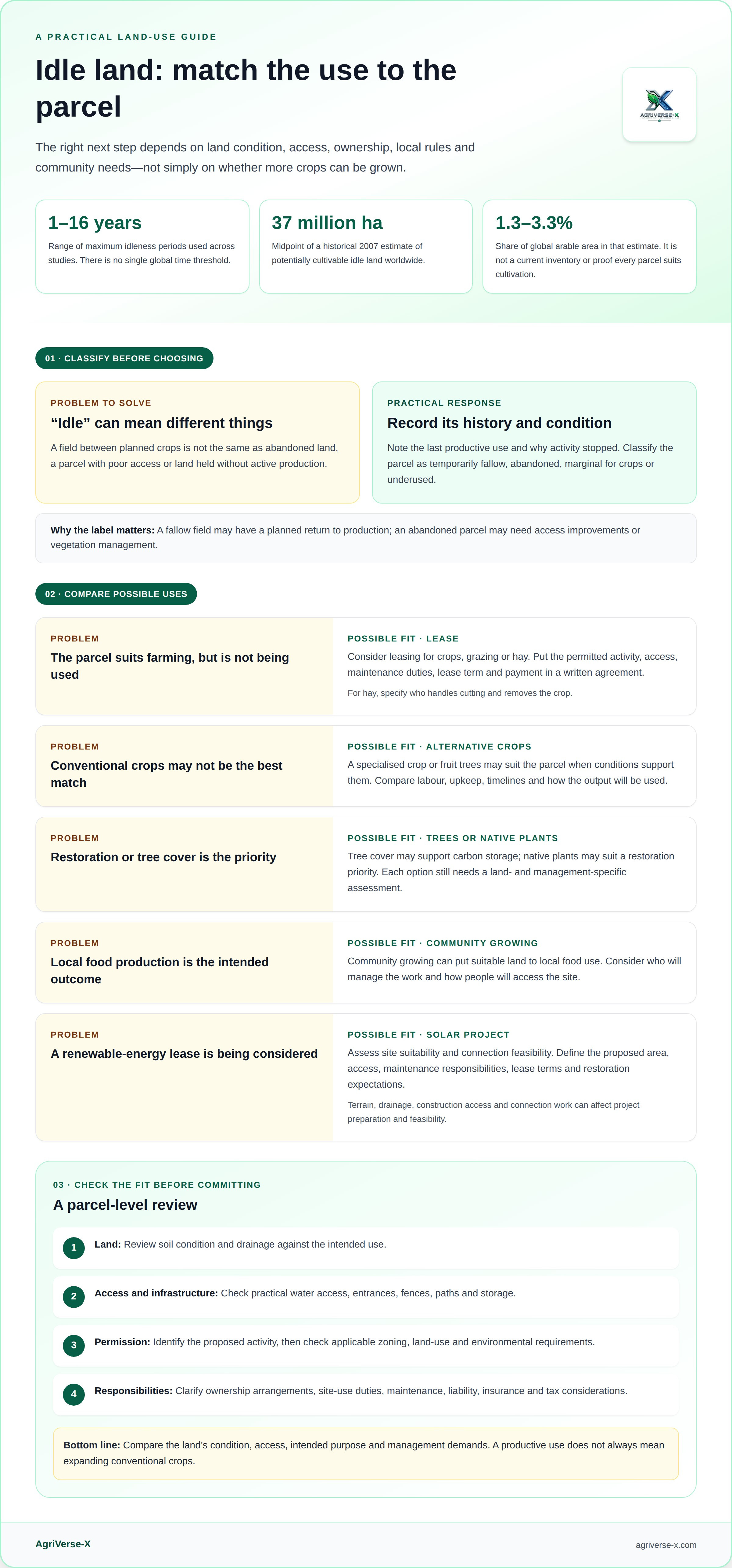
There is no single global time threshold for calling cropland idle. Studies used maximum idleness periods ranging from 1 to 16 years. A field unused for one season could count under one definition, while another measure may require a longer gap. Record the last productive use and reason for inactivity before classifying a parcel.
Historical estimates also depend on what “available” means. A global estimate based on agricultural data put potentially cultivable idle land at 19-48 million hectares in 2007, or 1.3-3.3% of global arable area. The study’s midpoint was 37 million hectares. These figures describe a historical estimate, not a current inventory or proof that every parcel suits cultivation.
Classify the parcel by its condition and current purpose: temporarily fallow, abandoned, marginal for crops or underused. A fallow field may have a planned return to production; an abandoned parcel may need vegetation management or access improvements. A marginal field may suit a different use better than intensive cropping. This distinction helps separate a temporary pause from a longer-term land-use decision.
What zoning, land-use and environmental rules apply when changing agricultural land use? Local zoning, land-use controls and environmental requirements determine which activities are permitted on a parcel. Switching from crops to trees, grazing or community use may involve different conditions, so identify the proposed activity before planning a transition.
What are typical farmland lease rates per acre by state and land type? There is no single rate for every state or parcel. Rental values vary with field size, soil type, location, irrigation access and other factors. An irrigated field and a dry parcel are not directly comparable.
How can I lease unused farmland for crops, grazing or hay production? Set out the permitted activity, access, maintenance duties, lease term and payment in a written agreement. For hay production, for example, specify who handles cutting and removes the crop.
How do I evaluate soil quality, water access and infrastructure before putting land to use? Review soil condition and drainage, confirm practical water access, and inspect entrances, fences, paths and storage. A crop field without reliable water or workable access may not suit the intended operation.
What liability, insurance and property-tax risks should landowners consider when leasing or repurposing farmland? Consider how the agreement assigns responsibility for site use, damage and maintenance, along with insurance needs and the tax treatment of the chosen activity. Local requirements and the planned land use shape these considerations.
Alternatives to expanding cropland
Idle land can support uses beyond food crops, including tree cover, renewable energy, habitat restoration and community growing. Compare each option with the parcel’s condition, access and intended purpose.
Profitable Uses for Idle Agricultural Land
A profitable use generates value that fits the land and its management demands. The best fit may be a lease, a specialised crop, tree cover or another productive use, rather than expanding conventional cultivation.
For example, an owner could consider planting fruit trees where conditions support an orchard, or native plants where restoration is the priority. Tree cover may support carbon storage, while community growing can put land to local food use. Each option involves different labour, upkeep and timelines, so consider who will manage the work and how the land’s output will be used.
A well-defined use also helps make an opportunity legible to potential participants. Farmland and lease opportunities can connect landowners and prospective agricultural tenants. Set out the intended activity, access arrangements and responsibilities so that interested parties can assess whether the parcel fits their plans.
Solar Farms and Renewable Energy Leases
A solar lease allows a renewable-energy developer to use suitable farmland for an energy project. Project costs vary with site conditions, equipment, land preparation and connection requirements, so no single cost applies to every parcel.
The process typically starts by assessing site suitability and connection feasibility. The parties then define the proposed area, access, maintenance responsibilities, lease terms and restoration expectations. Local land-use and environmental requirements may also shape the project, so factor them into planning.
Connection access can affect feasibility as much as the land itself. A site that requires extensive connection work presents different cost considerations from one with practical access to infrastructure. Terrain, drainage and construction access also affect project design and preparation.
Compare the lease with other land uses by considering the commitment period, affected areas and responsibilities in the agreement. For example, a project using part of a property may leave other areas available for agricultural activity, depending on its layout and terms. Let the landowner’s priorities and site conditions guide the comparison.
Other options can keep land productive without expanding conventional crops. A study estimated that EU27 idle land could provide 44% of the land required to support the European Commission's 2020 renewable transport-energy target. For idle North Carolina land of about twenty acres or more, renting the land to a farmer or growing pine trees may be options. A farmer renting land may also help the owner monitor the property, maintain field edges and maintain access paths, linking the use of the parcel with practical upkeep.
Pine-stand management may involve occasional expenses for thinning and hazard-reduction burns, and programs may help offset those costs. The U.S. Conservation Reserve was expected to hold roughly 25.3 million acres of land on October 1. These examples point to the value of comparing a parcel’s potential uses alongside its condition and management needs, including the work and costs that continue after an alternative use begins.
Causes of land underutilisation
Idle land often reflects barriers to production rather than a lack of agricultural potential. Owners may struggle to coordinate access, investment, labour or a workable route to buyers. Identifying the underlying obstacle matters: repairing an entrance will not resolve unclear use rights, and adding equipment will not settle a disagreement over who can operate the parcel.
Speculative holding can leave land unused when an owner waits for future value instead of arranging active use. A vacant parcel may remain idle even when nearby growers could use it, because the owner delays decisions about leasing or development. Unclear expectations about future plans can prolong the pause. The practical barrier is then a decision about timing and access, not necessarily a problem with the land itself.
Operational constraints can also interrupt production. A farmer may lack workers for planting and harvest, machinery for the available acreage, or dependable transport to move produce to buyers. Employers may need to hire agricultural workers, while people seeking farm work, including in Queensland, Australia, may need a way to connect with suitable opportunities. For example, a grower facing a short harvest window may avoid expanding if there are not enough workers to gather and move the crop. Here, the obstacle is coordinating labour and logistics around the production cycle.
Infrastructure gaps can make an otherwise useful parcel difficult to operate. A remote field with a damaged entrance, limited storage or unreliable water access may need extra planning before cultivation begins. For example, a buyer may be ready to receive produce, but poor road access can disrupt collection. The burden of solving several practical problems at once may lead an owner or operator to leave land unused.
Fragmented ownership can stall decisions even when the land has an obvious possible use. Several relatives may share an inherited parcel but disagree about a lease, maintenance or who can approve operations. Until responsibilities and decision-making are settled, a prospective grower may lack a clear basis for planning. In this case, coordination between owners is the first barrier to address.
Land condition may also limit which uses make practical sense. For example, erosion, poor drainage or seasonal water constraints can make a parcel unsuitable for a particular crop or intensive production. Repeating the same approach despite those limits can discourage continued use. Another activity may fit better, but the underlying issue is a mismatch between site conditions and the planned operation.
Separate the visible problem from its root cause before choosing a response. Note whether inactivity stems from delayed ownership decisions, labour coordination, transport, infrastructure, shared control or land condition. This diagnosis helps distinguish a parcel that needs a workable operating arrangement from one better suited to a different use.
Community-managed land reuse
Community-managed reuse turns vacant land into a shared resource, such as a food garden or growing site. Find interested farmers, conservation groups or developers through cooperatives, community meetings and land-use networks, then discuss the parcel’s intended use and access.
Finding Interested Land Users
Match the land’s condition with users who can manage its specific needs. A nearby farmer may want crop or grazing access, while a conservation group may focus on habitat or tree cover. For renewable energy, contact developers active in the area and discuss site suitability, access and project requirements.
Make the opportunity clear: describe the parcel, its current condition, access points and possible uses. For example, a field near homes may suit a shared food garden better than a remote site. Farmer groups, community associations and public meetings can help owners identify interested people.
Organizing Community-Managed Reuse
Community-managed reuse is a shared arrangement in which residents help plan, operate or maintain land. Clear roles matter because a garden needs decisions about growing space, tools, access and upkeep. A written plan can record who coordinates work, how participants use the site and how concerns are handled.
Start with a defined purpose, such as growing food for local use or maintaining a shared orchard. Then map activity areas, agree on access and assign routine tasks. A community group might schedule planting and maintenance days, while a named coordinator tracks decisions and communicates changes.
Detroit offers one example: residents converted thousands of derelict parcels into community-managed food gardens. It shows how locally coordinated effort can return unused urban land to food production. Each project still needs workable arrangements for access, upkeep and decision-making.
Havana provides another model. Locally managed organopónicos, or urban food gardens, have used idle land for local production since the early 1990s. Their long-running use highlights the role of local management, practical growing plans and ongoing community participation.
To structure a reuse project, agree on a few essentials before work begins:
- Set a shared purpose, such as vegetables, fruit trees or habitat care.
- Identify who can access the site and who coordinates daily decisions.
- Assign tasks for paths, tools, planting areas and routine upkeep.
- Document the arrangement, including how the group handles changes or disputes.
Community reuse also depends on continuity. For example, if a volunteer coordinator leaves, recorded tasks and shared decisions can help the next person maintain the garden. A clear plan gives residents, landholders and growers a common reference as the project develops.
Where shared sites include established trees, groups can plan around them rather than replace them. Caring for existing trees may help them grow better, faster and larger, supporting a reuse plan that combines food production with ongoing stewardship.
What are the most profitable uses for idle agricultural land in the United States?
In the United States, leasing land for crops and planting pine trees are two options with different income timelines. Profitability depends on land condition, location, operating needs and how long the owner can wait for returns.
Leasing farmland to local operators is a popular choice for property owners exploring what to do with idle agricultural land. That option can suit an owner seeking ongoing use while keeping land in agricultural production. A parcel’s value reflects field size, soil type, location, irrigation access and other conditions. Compare the proposed payment with the responsibilities and duration set out in the lease.
Pine planting follows a much longer timeline. Establishing a stand requires upfront spending on seedlings and planting labour, followed by management such as thinning and hazard-reduction burns. Some programmes may help offset management costs. This option suits a different planning horizon than a crop lease.
The U.S. Conservation Reserve offers another route for eligible landowners: participation is voluntary, and landowners bid for an annual rental payment. The Agriculture Department seeks land with the highest environmental benefit when removed from production. This is not simply a general income option; environmental value and programme terms shape participation.
Compare alternatives using the same decision factors:
- Time horizon: A crop lease generates annual rental income, while pine planting takes about 30 years to generate its estimated return.
- Land condition: Soil, irrigation access and location influence the suitability of agricultural uses.
- Management: Pine stands need planting and later care; a lease assigns ongoing responsibilities between owner and farmer.
- Programme fit: Conservation Reserve participation involves voluntary bidding and environmental-benefit priorities.
For a crop lease, put the permitted use, payment, access and maintenance duties in a written agreement. A farmer using land for hay, for example, needs clear terms for field access and upkeep. Landowners should also account for property taxes and any local conditions tied to the selected use. In North Carolina, crop leasing may help an owner qualify for the Present-Use Value Program, which can reduce property taxes.
There is no single most profitable choice for every U.S. parcel. Compare potential returns with the timing, management demands and agreement terms attached to each option. This helps owners choose an approach aligned with the land and their plans.
AgriVerse-X: Practical pathways for putting land to use
AgriVerse-X can help connect landowners with agricultural opportunities once they have identified a suitable reuse plan. Its platform lists farmland and leases, while agricultural marketplace listings can connect land users with relevant inputs and materials.
For example, a planting project may need vegetable seedlings, fruit-tree plants or seeds suited to its intended use. The marketplace also supports listings for grains such as maize and rice, and circular-economy products such as compost and biochar. Sellers should describe products accurately, and any land use remains subject to applicable local rules and permissions.
If you’re exploring a land opportunity or related agricultural listings, contact AgriVerse-X to discuss the next step.
Turn a land-use decision into a workable next step
Choosing what to do with idle agricultural land is the start of a longer process, not the finish. Give the selected use a clear purpose, named responsibilities and a way to review whether it is meeting that purpose. A crop lease, habitat plan or shared growing project each needs a different operating rhythm, so align the arrangement with the people who will maintain it.
Think beyond the first planting or agreement. A durable plan accounts for access, seasonal work, produce movement and communication among everyone involved. Keep the intended use visible as conditions change, and adjust the approach when the land or community’s needs shift. Local land, environmental, tax and insurance requirements vary, so seek independent professional advice before committing to a change in use.
A measured first phase can help participants understand the work involved and improve coordination before expanding the activity. AgriVerse-X can be a practical next connection as you develop an agricultural opportunity with relevant participants and inputs. Employers, agricultural workers and logistics providers are invited to get involved with AgriVerse-X through the platform.
Frequently Asked Questions
More land for cropping?
Not necessarily. Choosing what to do with idle agricultural land starts with asking whether the added acreage fits a workable crop and sales plan. For example, a grower with limited harvest labour or no delivery arrangement may struggle to manage more output. Compare the crop schedule with available workers, equipment, buyers and transport. If those pieces do not align, another land use or a lease to an operator may be more practical than expanding cultivation.
Can I plant an orchard, native plants, or a tree farm on idle agricultural land, and what does it cost?
Yes, these uses may suit idle land, but planting and upkeep costs depend on species, site preparation, water needs, labour and ongoing care. To decide what to do with idle agricultural land, consider an orchard’s harvest plan or whether native species fit local conditions. Budget for plants, preparation, protection, irrigation and maintenance. AgriVerse-X marketplace listings may include fruit-tree seedlings, tree seedlings and other planting materials, with sellers providing details such as variety, origin and planting season.


