

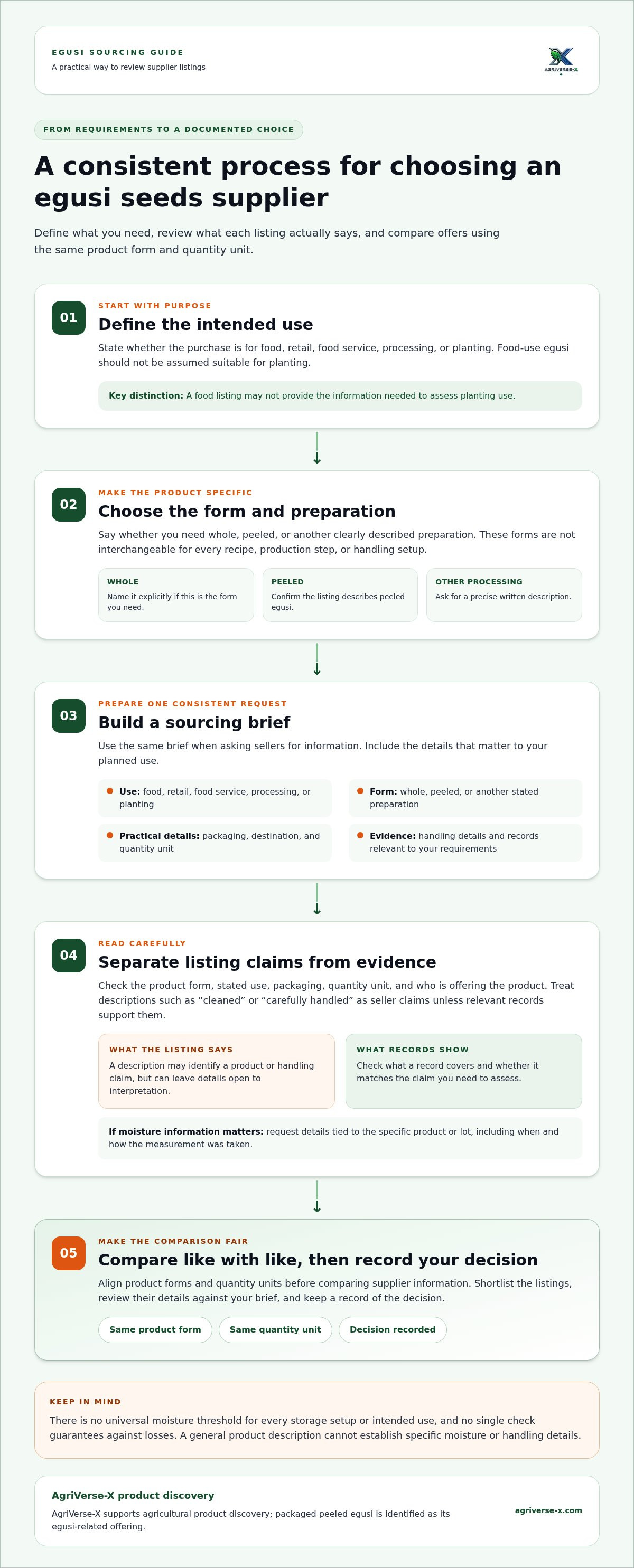
To choose an egusi seeds supplier, first define the form and intended use you need, then compare listings using the same product and quantity criteria. If moisture or handling information matters to your decision, request records tied to the specific product lot and note when and how any measurement was taken. A general product description cannot establish those details.
Before proceeding, consider the product’s handling history and what information is available for the batch you may purchase. Appearance and general assurances are not substitutes for relevant measurements or records.
This guide explains what to include in a sourcing brief, how to review product and seller details, and what to record before deciding. There is no universal moisture threshold that suits every storage setup or intended use, and no single check guarantees against losses.
Key Takeaways
- Separate food-use needs from planting-seed requirements. A food listing is not automatically suitable for planting.
- Use product form, intended use, packaging, and seller information to understand what a listing actually describes.
- Compare like with like by aligning product forms and quantity units before assessing supplier information.
- Follow a consistent process to shortlist an egusi seeds supplier, review details, and record your decision.
- AgriVerse-X supports agricultural product discovery, with packaged peeled egusi identified as its egusi-related offering.
How to Define Your Needs Before Choosing an Egusi Seeds Supplier
Before comparing suppliers, define the product form, intended use, and purchase requirements. This gives you a consistent basis for reviewing offers and helps prevent mismatches, such as sourcing peeled egusi when your preparation process requires whole seeds. Write down your requirements first, then use the same brief when requesting information from each seller.
Separate food-use sourcing from planting-seed needs. Egusi purchased for cooking or processing should not be assumed suitable for planting. A food listing may not provide the information needed to assess planting use. If you intend to sow the seeds, state that clearly and request details relevant to planting rather than relying on a food product description.
Egusi is associated with seeds used in West African cooking, but the name alone does not explain a listing’s preparation or intended use. The overview of Egusi (melon seeds) provides background on the food and its uses. For purchasing, be more specific: record your intended use, preferred preparation, packaging needs, destination, and any documentation you require for your own handling process.
Identify the egusi product form you need
Look for a clear statement of whether the product is whole, peeled, or otherwise processed. These forms are not interchangeable for every recipe, production step, or handling setup. A listing that simply says “egusi seeds” may leave you unsure whether the preparation fits your needs, so state the required form in your enquiry.
Also note how you want the product prepared before it reaches you. A household buyer may prefer a form that fits their kitchen routine, while a food processor may need a different form for its workflow. These are examples, not assumptions about standard formats. Keep your request specific, and do not infer unlisted details from a broad product name.
Translate intended use into a sourcing brief
Household, retail, food-service, and processing purchases can call for different packaging and documentation details. A household buyer might prioritize packaging suited to personal use; a retailer may need a clear pack description for resale; a processor may need information that fits its own procedures. Treat these as planning examples, not claims about standard pack sizes or supplier capabilities.
A useful sourcing brief states the product form, intended use, and documented requirements. Add your preferred preparation, packaging needs, destination, quantity unit, and the records you need to review. Avoid setting unsupported thresholds. If moisture information matters to your purchase, specify the measurement or criterion you need only when you have a defined requirement for your use.
- Use: food, retail, food service, processing, or planting.
- Form: whole, peeled, or another clearly described preparation.
- Requirements: packaging, destination, handling details, and relevant documentation.
This guide helps structure sourcing decisions; it does not guarantee product availability or supplier performance. A clear brief gives you a practical starting point for reviewing responses and deciding whether a listing fits your stated purpose.
What Egusi Product Details Should a Supplier Listing Explain?
A useful egusi listing identifies the product form, intended use, packaging, and seller. These details help you understand what is being offered and whether it merits further review. They do not, by themselves, establish product quality, safe handling, or suitability for a particular destination.
Listing basics: Look for a clear product description, stated use, packaging and quantity unit, and enough seller information to identify who is offering the product.
Separate description from evidence. A phrase such as “cleaned” or “carefully handled” is a seller’s claim unless relevant records support it. Consider each statement for what it actually tells you, and note where the listing leaves room for interpretation.
Read product form, packaging, and intended-use details
Check whether the listing explicitly describes the egusi as peeled, whole, or otherwise processed. A broad label such as “melon seeds” may not tell you enough to assess preparation. Review the stated packaging and quantity unit, too. Comparing offers is more useful when both the product form and unit match.
Consider whether the stated form fits your use, including any preparation or processing steps you plan to perform. If the description is unclear, request a precise written clarification rather than inferring details from a general product name. Keep the answer with the listing information for reference.
Separate listing claims from supporting evidence
Read seller descriptions as claims, not independent verification. If moisture, storage, cleanliness, or another handling detail matters to your decision, request clear information and ask whether relevant records are available. Documentation needs depend on the transaction and destination, so do not assume that one particular certificate applies in every case.
Check what each record covers. A document may describe a product, lot, or handling step without establishing every quality or safety attribute you need to assess. Match the evidence to the claim: if a listing gives a moisture result, look for information showing which product or lot it refers to and when it was recorded.
- Product description: form, intended use, packaging, and quantity unit.
- Seller information: the identity of the party offering the product.
- Supporting information: available product records and handling details relevant to your requirements.
A digital listing makes product information easier to review, but visibility is not proof of quality or compliance. Use the details to identify what still needs clarification. A focused guide to peeled-egusi wholesale purchasing can provide additional commercial context.
How to Compare Egusi Seeds Suppliers Without Guessing
Compare suppliers using the same criteria, and rank only listings that describe equivalent products. A peeled-egusi offer and a whole-seed offer are not like-for-like, even if both use the same broad product label. Align product form, intended use, and quantity units first. Then separate details you can verify from questions that remain unanswered.
Compare supplier information on a like-for-like basis
Use a simple comparison table to record what each seller states. Keep the columns consistent, and mark missing information as “not stated” rather than filling gaps with assumptions. If listings use different forms or units, keep them in separate groups until the differences are clear.
| Product form | Seller details | Documentation | Packaging | Communication |
|---|---|---|---|---|
| Is the egusi described as peeled, whole, or otherwise processed? | Is the seller or business identified clearly? | What product or transaction records are provided? | What pack description and quantity unit are stated? | Are responses clear and consistent? |
| Does the stated form fit the intended use? | Can you connect the listing to the named seller? | Does each record identify what it covers? | Can you compare the same units across offers? | Are unanswered questions acknowledged? |
For example, do not compare a packaged peeled product listed by package with whole egusi described by weight as though the offers were equivalent. Record the difference, then compare each offer only with listings that use the same product form and a comparable unit. An egusi seeds supplier profile can support discovery, but a profile alone does not guarantee product quality or transaction outcomes.
Assess communication and traceability information
Check whether the seller’s identity is clear and whether there is an understandable route for follow-up questions. Ask what product-origin or handling records are available for the specific transaction. Note whether each record refers to the product or lot being discussed, and distinguish supplied evidence from claims that remain unverified.
Traceability records document information about a product or its movement through a supply chain. They do not independently certify quality, safety, or compliance. Treat them as one part of your review, and match each record to the question it can actually answer. A profile, listing, or digital record is not a substitute for relevant supporting evidence.
Keep a short decision log with three labels: stated, supported, and unanswered. This helps you see whether sellers provided comparable information and gives you a clear basis for follow-up. For a focused discussion of grading metrics, use the article on egusi quality grading; keep its grading criteria separate from this supplier-information comparison.
How to Move from Supplier Research to an Egusi Order
Turn supplier research into an order through a documented sequence: define requirements, shortlist listings, request details, review responses, and record the decision. Before committing, make sure the agreed product form, packaging, quantity unit, documentation, and transaction terms match your needs. A clear process helps prevent misunderstandings, but it cannot guarantee supplier performance or product outcomes.
- Define requirements. Write down the intended use, required egusi form, packaging expectations, quantity unit, destination, and any documentation you need to review.
- Shortlist listings. Keep candidates that describe a product form and use relevant to your brief. Set aside listings that do not provide enough detail to compare.
- Request details. Send each shortlisted egusi seeds supplier the same core questions so you can compare responses consistently.
- Review responses. Check that each reply addresses your requirements and note unanswered or conflicting points.
- Document the decision. Save the listing, written responses, relevant records, and final agreed product and transaction details.
Prepare a clear supplier enquiry
State what you need in practical terms: intended use, required product form, packaging expectations, and destination. Ask for available product records and handling information relevant to your requirements. If a listing uses broad or unclear wording, ask the seller to explain exactly what it means rather than interpreting it yourself.
Keep replies together, ideally in one comparison document or email thread per seller. This makes it easier to spot differences in product descriptions or terms and gives you a written reference as discussions progress.
Review the response before confirming a purchase
Compare the seller’s response with your original brief. Confirm that it identifies the agreed form, packaging, quantity unit, available documentation, and transaction terms. If an important point remains unclear or has changed, resolve it in writing before confirming an order. Keep the final agreement and related transaction records together.
Requirements for food products and imports can vary by destination. Check applicable requirements with the relevant authorities or a qualified professional familiar with the transaction and destination. This is practical sourcing guidance, not legal advice or a substitute for checking requirements that apply to your purchase.
Moisture measurement and handling are separate from the order workflow. Consult the egusi moisture guide for that focused discussion, and do not use a general listing description as a substitute for relevant product information.
AgriVerse-X’s agricultural marketplace supports product discovery and buyer connections. Explore marketplace listings as one way to find product information, then apply the same written review process before making a purchasing decision.
How AgriVerse-X Supports Egusi Product Discovery
AgriVerse-X connects agricultural participants through a digital ecosystem that includes an agricultural marketplace. Buyers can use marketplace discovery to explore agricultural product listings and buyer connections. It is a starting point for sourcing, not a substitute for reviewing the specific product and transaction information behind a potential purchase.
The egusi-related product identified in AgriVerse-X product information is packaged peeled egusi. This description does not establish a particular grade, quantity, price, delivery arrangement, or current listing status.
Use marketplace information as one input in your decision. A profile or listing does not guarantee supplier quality, product availability, or completion of a transaction. Review the listing details, request relevant supporting information, and assess any proposed terms against your requirements.
Use marketplace discovery as one part of due diligence
Discovery helps you identify products and potential buyer connections within an agricultural marketplace. Apply the same checks to any listing you consider: establish the product form and intended use, understand the packaging and quantity unit, and distinguish seller descriptions from supporting evidence. A digital profile can help identify the party presenting an offer, but it cannot replace transaction-specific review or independent assessment of relevant records.
Keep your requirements visible as you review options. If an important point is missing or unclear, record it rather than treating a general description as confirmation. This keeps marketplace discovery useful without overstating what a listing proves.
- Product: Is the described form packaged peeled egusi?
- Information: Are the stated details relevant to your intended use?
- Transaction: Have you reviewed the applicable documentation and terms?
Explore AgriVerse-X packaged peeled egusi
Packaged peeled egusi is the relevant AgriVerse-X product example for buyers exploring egusi. The description should not be read as an offer of unpeeled seeds or planting seed, or as a promise about grade, quantity, price, or delivery terms. Product listings and commercial terms can change, so review the details presented for the transaction you are considering.
AgriVerse-X’s marketplace supports agricultural product discovery and connections between participants. The platform and its services may change as they develop and complete legal, technical, and market validation. Treat discovery as an initial step, followed by careful review of product and transaction information before making a purchasing decision.
If you are exploring egusi sourcing, use your defined requirements to assess the product information and decide what further details matter to you. Explore agricultural product discovery through AgriVerse-X as one step in your sourcing process.
Build a More Consistent Sourcing Practice
Make each sourcing decision useful for the next one. Keep a dated record of the requirements you approved, the information received, and the terms agreed for the transaction. Note who reviewed the information and when, so your team can distinguish a current offer from an older discussion and make future conversations with an egusi seeds supplier more precise.
Over time, these records can help your business refine its purchasing process. You may find that some details need clearer wording in your enquiries or that internal teams need to agree on requirements before sourcing begins. Use those lessons to update your purchasing procedure, while treating each new offer as a separate transaction that needs its own review.
AgriVerse-X supports agricultural product discovery through its marketplace. Take the next step at a pace that fits your needs: Explore agricultural product discovery with AgriVerse-X.
A clear, repeatable process helps you make more consistent sourcing decisions.
Frequently Asked Questions
Are egusi seeds the same as ordinary melon seeds?
No. Egusi refers to seeds from particular gourds or melons used in West African food, not simply any melon seed. Common names can vary, so a broad label may not identify the product clearly enough for sourcing. If the variety or food use matters to your recipe or process, ask the seller to clarify the product rather than relying on the word “melon” alone.
Can egusi seeds be used for planting?
Not necessarily. A listing for egusi intended for food should not be treated as a planting-seed offer. If you plan to sow the seeds, state that purpose and request planting-relevant information, such as germination details where available, variety, treatment, and storage conditions. Check that the product is explicitly intended for planting and meets your needs before purchase. Food preparation and crop production are different uses.
How can I check whether an online egusi supplier is genuine?
You can reduce uncertainty by checking whether the seller’s identity is clear and consistent across the listing, written responses, and transaction documents. Ask for records relevant to the specific product or lot, and make sure the seller can explain the offer in concrete terms. A profile or polished listing alone cannot prove legitimacy or product quality. Keep communications and agreed details in writing before making a payment or commitment.
What details should I include when requesting an egusi quote?
Include the intended use and exact product form you want, then state the destination and quantity unit you want quoted. Identify any packaging preference and documentation you need to assess. Separate essential requirements from preferences so the seller can respond clearly to each. Ask for the quote to identify the product and applicable transaction terms, making replies easier to compare without assuming missing details.
Do egusi seeds need to meet import requirements?
Import requirements can depend on the destination and how the product is classified or intended to be used. Before arranging shipment, check the relevant destination authority’s current guidance or consult a qualified professional familiar with the specific transaction. Do not assume that documentation used for one country or product form applies to another. Confirm applicable requirements before committing to shipment, and retain the records provided for the transaction.
Does a marketplace guarantee the quality of egusi from a listed supplier?
No. A marketplace can help buyers discover listings and seller information, but visibility does not establish that a product meets a buyer’s quality or handling requirements. Review transaction-specific evidence and agreed product details separately. For example, a listing description and a product record may answer different questions. Assess each document for what it actually covers, and do not treat a profile as an independent quality assessment.
Is peeled egusi different from whole egusi seeds for sourcing?
Yes. Peeled and whole egusi describe different product forms, and the distinction can affect preparation or processing steps. A buyer planning to use peeled seeds should not assume a whole-seed listing is equivalent, or that “egusi” alone specifies the form. State the required form in your enquiry and check that the seller’s written description matches it before comparing offers or confirming a purchase.


