

The biggest bag isn’t automatically the best buy. When you shop for poundo yam flour online, listings can differ in product details, package quantity, seller information, and order terms. Search results may also mix flour with bundles or unrelated products, so a headline or photo alone may not tell you what’s included.
To compare options, use the same criteria for each listing: product identity, stated quantity, ingredient information, seller, and fulfilment terms. AgriVerse-X supplies Yam Flour (Poundo Yam) as a packaged food staple, so you can include it in your comparison alongside other options.
This guide explains how to review product descriptions, compare the details that matter for household or business use, and handle information that a listing doesn’t provide. The goal is a clear comparison based on what each listing actually says, not on assumptions.
Key Takeaways
- Compare poundo yam flour online listings using the same criteria: product identity, stated quantity, ingredients, seller, and fulfilment terms.
- Use details shown for each specific product. Treat missing information as unstated rather than making assumptions.
- Review ingredient and preparation information for the product you’re considering. Don’t apply one listing’s claims to another.
- Match the product and order details to your household, food-service, or retail needs.
- AgriVerse-X supplies Yam Flour (Poundo Yam), a packaged food staple you can consider in your comparison.
What to compare when buying poundo yam flour online
Begin with four checks: product identity, listing details, seller information, and fulfilment terms. Together, these tell you whether a result matches what you intend to buy and whether you have enough information to assess the order. Compare the written details rather than relying on a product name or prominent image alone.
For a practical look at preparing poundo yam, watch this demonstration:
Poundo yam flour is processed yam flour used to prepare a soft, dough-like food by mixing it with hot water. It offers a convenient alternative to boiling and pounding fresh yam. For background on the crop and its role in diets around the world, see how yams are a staple food. The name alone, however, doesn’t tell you the ingredients or quantity in a particular listing.
How can you tell whether a search result is relevant?
Check that the title identifies poundo yam flour, then compare it with the image and written description. The image can help you recognize the product and package, but it doesn’t establish details the text leaves out. If the title, photo, and description seem to refer to different items, don’t treat the result as a clear match.
Distinguish the flour from preparation equipment, meal bundles, and unrelated results. A bundle may include flour alongside other foods, while a machine listing may appear because it relates to preparation. Read the description to establish what the order includes before comparing its quantity or terms with a flour-only option.
Which listing details deserve attention first?
Prioritize a clear product name and a stated package quantity. Then review ingredient information and preparation guidance, if provided. These details help you compare like with like and decide whether the product fits your intended use. Don’t assume information shown for one brand or listing applies to another.
Next, review the seller information and fulfilment terms, including what the order contains and the delivery arrangements stated for it. Note details that matter to your decision but are missing, such as an unclear product description or unstated quantity. A listing with those gaps is harder to compare with one that gives clear product information.
How to assess poundo yam flour product information
Once a listing appears relevant, assess the information provided for that specific product. Compare its name, package quantity, ingredients, label images, and preparation directions. These details show what the seller says is included and how the flour is intended to be prepared. They don’t establish a universal standard for every brand or product.
Yam has deep significance in West African food systems. The Food and Agriculture Organization describes it as an important staple food in the region. That broader context doesn’t tell you the ingredients or production details of a particular flour listing. For those, rely on the current product description and label information.
What should you check on the product label or listing?
Start with the exact product name and stated quantity. Read the ingredient information, if available, and compare it with any visible label images. Check whether the images appear to show the same product described in the text. Preparation directions can also help you understand how the seller recommends using that flour.
Keep claims in context. If a listing mentions additives, texture, nutrition, or another product quality, treat it as a claim about that item, not as a fact about all poundo yam flour. A clear description helps you compare products, but it doesn’t independently verify claims beyond what the label or seller states.
Seller-specific claims describe one listing. Don’t infer general product facts from them.
How should you handle missing or unclear information?
Consider whether the missing detail would affect your decision. If you need to know the quantity or ingredients, for example, an unstated detail makes that listing harder to compare with one that provides the information. Mark the gap as “Unstated” in your notes rather than guessing.
Don’t use a package photo to infer the product’s origin, shelf life, nutrition, or production method. Images can help identify packaging, but they may not show every label detail or establish how the product was made. Base your comparison on information actually provided for the current listing.
Apply the same discipline when reviewing poundo yam flour online: separate what the listing says from what you can reasonably conclude. AgriVerse-X supplies Yam Flour (Poundo Yam), so you can assess it using the same product-information criteria as other options.
Compare online poundo yam flour listings side by side
A side-by-side comparison makes differences easier to spot than switching between tabs and relying on memory. Record what each current listing actually states. Use “Unstated” when a detail isn’t provided, and keep product information separate from seller or marketplace conditions.
| Product name | Stated quantity | Ingredients | Seller | Fulfilment terms |
|---|---|---|---|---|
| Copy the listing name | Enter stated quantity or “Unstated” | Enter stated ingredients or “Unstated” | Record seller name | Summarize stated terms or “Unstated” |
Duplicate the row for each option. Keep the comparison current because listing details and order conditions can change. Product name, quantity, and ingredients describe the item as presented. Seller identity, delivery coverage, order limits, and returns are separate purchasing conditions. Don’t mistake a marketplace policy for a product feature or assume one seller’s terms apply to another.
Which comparison criteria help household buyers?
For home use, compare the stated product and quantity with how much you expect to prepare and how often. Review any ingredient, preparation, or storage guidance included in the listing or label images. Then check whether the seller explains delivery to your destination and any relevant order conditions. If a detail affects your decision but isn’t stated, leave it unknown.
Which comparison criteria help food businesses?
For a restaurant, caterer, or retailer, focus on stated quantities and ordering terms. Look for information about repeat orders or commercial purchasing, if provided, and record exactly what the listing says. Don’t assume a bulk format, ongoing supply, or business terms from a product photo or a single order option.
This method keeps comparisons consistent whether you’re buying for a household or assessing a food-service requirement. For wider sourcing considerations, see the African food staples wholesale buyer checklist. For poundo yam flour online, compare product details first, then evaluate seller and fulfilment terms separately.
Choose a listing based on your use and order requirements
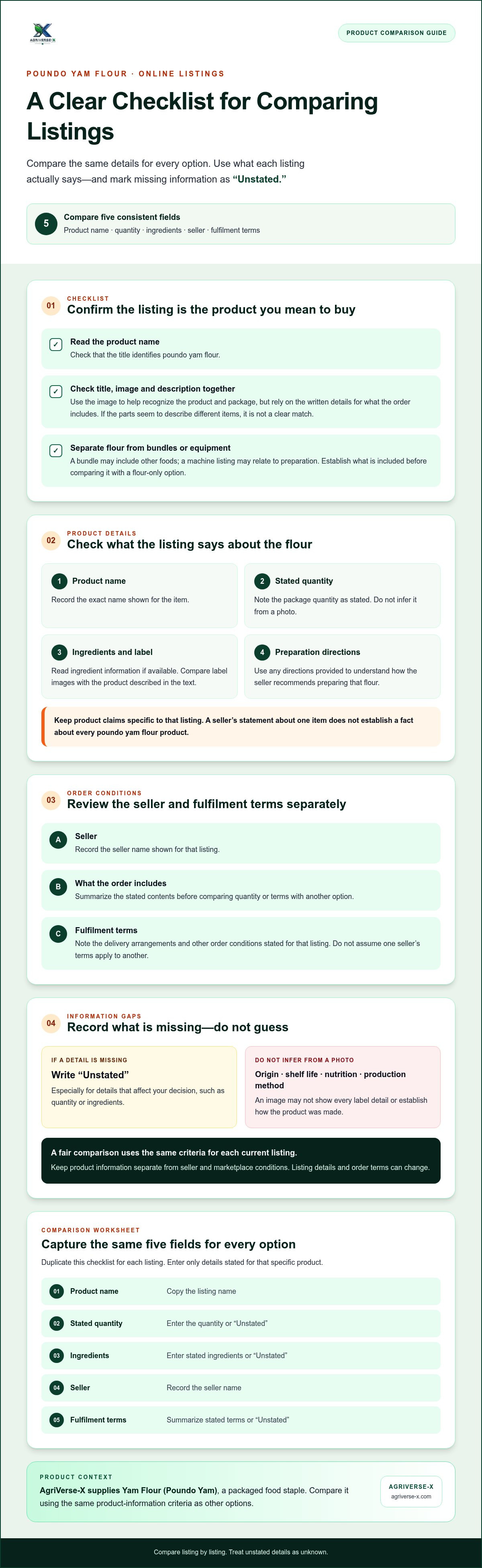
Choose by fit, not appearance alone. Start by defining your intended use. Then compare the product identity and stated quantity, decide whether the listing gives enough detail for your needs, review the seller information, and check the fulfilment terms shown for your order.
- Define the use: household meals, food service, or retail.
- Check the product: compare the stated name and quantity, plus any relevant ingredient or preparation details.
- Review the seller: note who is selling the item and what ordering information is provided.
- Assess fulfilment: read the delivery coverage and order conditions before checkout.
Availability, delivery coverage, and terms can differ between listings. Treat these as specific to the listing rather than assuming the same conditions apply across sellers or marketplaces.
How should household buyers narrow their options?
Start with the product identity and stated quantity. Consider how that amount fits your household’s expected use, then review any ingredient and preparation information that matters to you. Before choosing, read the seller and fulfilment details, including whether the stated delivery coverage and order conditions suit your needs. If an important point is unclear, compare the listing with another option that provides more detail.
What should commercial buyers compare?
For food-service or retail purchasing, look for ordering information that fits your intended purchasing pattern. Check whether the listing explains commercial quantities, repeat-order conditions, or other relevant terms. Don’t assume a retail listing supports wholesale purchasing, ongoing supply, or a particular package format unless those details are stated.
The best-fit option depends on the listing details and how you intend to use the flour.
AgriVerse-X supplies Yam Flour (Poundo Yam) as a packaged food staple. Include it in your comparison using the same criteria: intended use, stated product details, seller information, and fulfilment terms. This keeps your decision grounded in what each listing actually provides.
Explore poundo yam flour through AgriVerse-X
AgriVerse-X supplies Yam Flour (Poundo Yam) as a packaged food staple. It’s an option to include as you compare poundo yam flour online. Use the same practical approach you would apply to any product: review the information provided and assess the purchasing details against your needs.
How does AgriVerse-X fit into the comparison?
Keep your comparison consistent. Review the product information available and consider how clearly it identifies the item and supports your decision. Apply your intended-use criteria rather than assuming details about ingredients, package size, price, stock, or fulfilment. A careful comparison distinguishes what’s stated from what you might otherwise expect.
This lets you assess AgriVerse-X alongside other options without relying on assumptions about a particular package or order arrangement. Focus on the product details provided and the requirements of your household or business.
What is the next step for interested buyers?
Review AgriVerse-X’s food staple information to learn about its offerings. Use the criteria in this guide: identify the product, read the details provided, and consider whether they align with your intended use. Keep product discovery separate from assumptions about ordering or fulfilment.
Explore AgriVerse-X and review its food staple information as part of your comparison. Use the details available to assess the product against your needs.
Make Your Next Purchase with Confidence
A clear comparison helps you choose poundo yam flour online based on the details that matter to you. Review the product name, stated quantity, ingredients, and preparation guidance, then assess seller information and fulfilment terms separately. If a detail that affects your decision is unstated, don’t fill the gap with assumptions.
Match the listing to your intended use, whether you’re buying for a household, food service, or retail. Commercial buyers should look for explicit ordering and repeat-purchase terms rather than assuming a retail listing supports wholesale needs.
Include it in your comparison and apply the same criteria you use for every option.
Explore AgriVerse-X and review the food staple information to continue your comparison.
Frequently Asked Questions
Where can I buy poundo yam flour online?
You can find poundo yam flour through online grocery retailers, food marketplaces, and suppliers that list African food staples. Compare the product information and order details for each option, including stated quantity, ingredients, seller, and fulfilment terms. Don’t assume every site offers the same product or purchasing conditions.
How do I compare poundo yam flour brands online?
Compare each listing using the same criteria: product name, stated quantity, ingredient information, preparation guidance, seller, and fulfilment terms. Check the written description against label images, and mark missing details as unstated instead of guessing. Consider claims only in relation to the specific product that makes them. A seller’s description of one brand doesn’t establish the ingredients, texture, or preparation instructions of another.
What ingredients should poundo yam flour contain?
Don’t assume one ingredient list applies to every product sold as poundo yam flour. Products may differ in their ingredients. Read the current listing and package label to see what that specific product states. If a detail you need, such as whether other starches are included, isn’t provided, don’t infer it from the product name or photo.
Can I buy poundo yam flour online for a restaurant or food business?
You can assess online listings for a restaurant or food business by checking whether the stated ordering information fits your purchasing needs. Look for a clear quantity and any stated commercial purchasing or repeat-order conditions. Don’t assume a retail listing offers bulk formats, wholesale terms, or ongoing supply. Compare the information provided with your expected use, and treat unstated business conditions as unknown.
What should I check before ordering poundo yam flour online?
Before ordering, confirm that the listing is for poundo yam flour and review its stated quantity, ingredients, preparation details, seller information, and fulfilment terms. Check what the order includes and whether the stated delivery coverage and conditions fit your needs. Use the current listing rather than relying on details from another seller or an older product description. If an important detail is unclear, compare it with another listing before deciding.
Is poundo yam flour the same as fresh yam?
No. Fresh yam is a whole tuber, while poundo yam flour is a processed product used to prepare a dough-like food, often called swallow. Traditionally, pounded yam is made by boiling fresh yam and pounding it. Instant flour offers a different preparation route, but ingredients and instructions vary by listing. Follow the preparation directions provided for the specific flour you buy.
How should I store poundo yam flour after opening?
Follow the storage directions on the package because they apply to the specific product you purchased. If the label doesn’t provide guidance, keep the flour sealed and dry, use a clean, dry utensil, and protect it from moisture and contamination. Don’t assume a shelf life from the product image or another brand’s instructions. If the package becomes damp or damaged, follow the guidance on that product’s label.


