

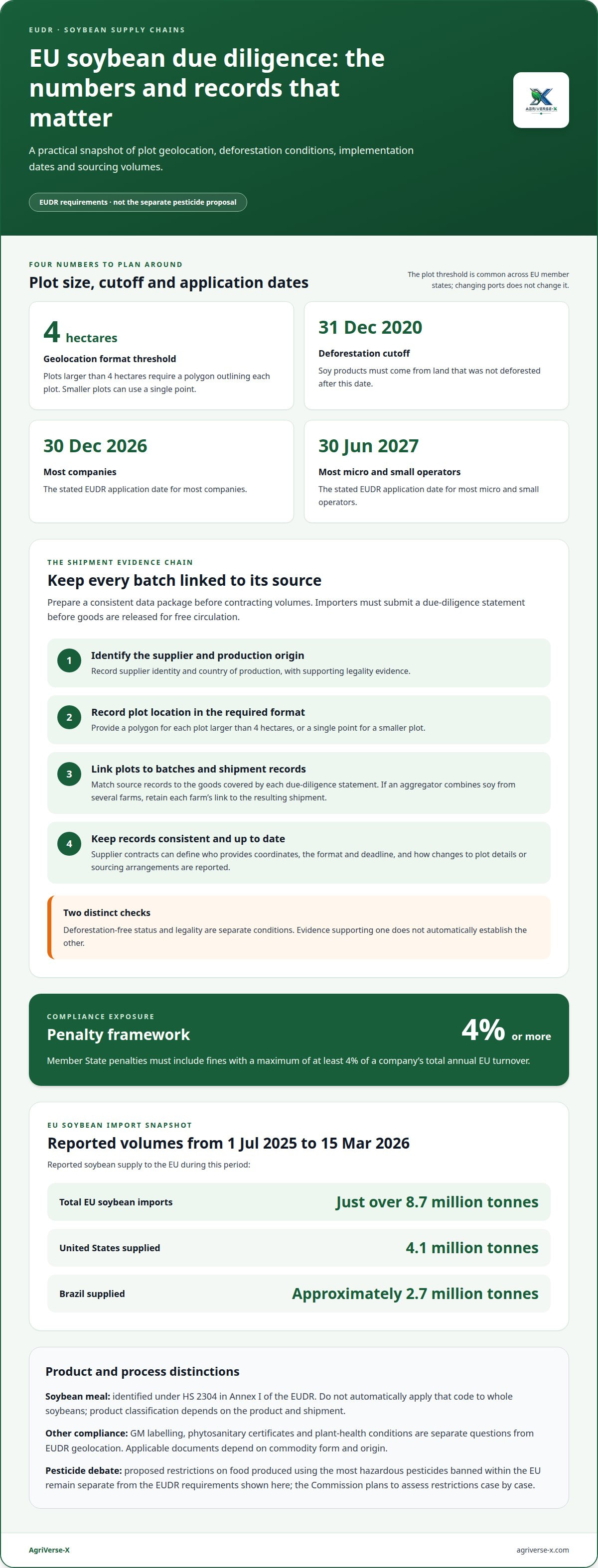
A blanket ban on US soybean imports is not the current proposal: the European Commission plans to assess pesticide-related restrictions case by case. EU import requirements for soybeans also include deforestation and due diligence conditions under the EU Deforestation Regulation, Regulation (EU) 2023/1115, which requires soy to come from land not deforested after 31 December 2020, according to the European Union. The rules apply from 30 December 2026 for most companies and from 30 June 2027 for most micro and small operators.
Importers have reason to follow the pesticide debate closely. The EU is considering restrictions on food produced using the most hazardous pesticides banned within the bloc. The Commission plans to weigh market realities and international implications rather than impose blanket bans.
This article explains what soybean due diligence and plot geolocation involve, how the EUDR’s deforestation conditions and implementation dates affect supply chains, and why proposed pesticide restrictions could create new risks for US-grown soy. It distinguishes requirements already set out in the EUDR from proposals still under consideration, helping you assess the practical implications for sourcing and trade.
Key Takeaways
- Map soybean plots accurately: plots larger than four hectares require geolocation polygons, while smaller plots can use a single point.
- Understand how due diligence statements and supply-chain records affect EU importers and businesses handling soy products.
- Separate the EUDR’s deforestation-free and legality conditions from the proposed pesticide restrictions, which are still under consideration.
- Plan around the EUDR’s stated application dates: 30 December 2026 for most companies and 30 June 2027 for most micro and small operators.
- Assess how pesticide-related proposals could affect sourcing decisions, especially for soy treated with pesticides prohibited in the EU.
What Are the Due Diligence and Geolocation Requirements?
Meeting EU import requirements for soybeans starts with clear responsibility for due diligence. EU importers must submit a due-diligence statement before goods are released for free circulation. Suppliers should provide origin and plot information early enough for the importer’s assessment. Downstream businesses should preserve supply-chain records linking batches to suppliers and source plots. Soybean meal is identified under HS 2304 in Annex I of the EUDR.
Geolocation links soy shipments to the land where the crop was produced. For plots larger than four hectares, provide a polygon outlining each plot; smaller plots can use a single point. Supplier contracts can specify who provides coordinates, the required format, and the deadline, as well as requiring notice when plot details or sourcing arrangements change.
For EU import requirements for soybeans, prepare a consistent data package before contracting volumes. Link supplier identity, country of production, plot information, shipment batches, and supporting legality evidence. Match source records to the goods covered by each due-diligence statement. If an aggregator combines soy from several farms, preserve each farm’s link to the resulting shipment.
Core EUDR due-diligence and geolocation rules apply across EU member states; changing ports does not change plot-size thresholds. National customs procedures may vary, so separate those formalities from the common EUDR data duties. HS 2304 identifies soybean meal under the EUDR. Don’t automatically apply that code to whole soybeans. Product classification and import documents depend on the product and shipment.
Genetically modified status and plant health raise separate compliance questions. EU food products containing GM ingredients must be labelled, while feed products have different labelling treatment. Phytosanitary certificates and plant-health conditions also sit outside EUDR geolocation. The applicable documents depend on commodity form and origin. For tariffs, the stated rate for soybeans and soybean meal from MERCOSUR countries is 0%. The EU-MERCOSUR agreement introduces an annual duty-free quota of 1 million tonnes, not necessarily a soybean-specific quota.
Supply concentration can shape procurement choices. The EU imported just over 8.7 million tonnes of soybeans between 1 July 2025 and 15 March 2026; the United States supplied 4.1 million tonnes. Brazil supplied approximately 2.7 million tonnes during that period. Compare sourcing options alongside plot-level evidence. Lower year-on-year rapeseed and sunflower production also reduced alternative protein supplies for animal feed.
Missing geolocation, unsupported due diligence, or failure to meet deforestation-free and legality conditions can create compliance risks. Member State penalties must include fines with a maximum of at least 4% of a company’s total annual EU turnover. EU import requirements for soybeans therefore make supplier clauses and data preparation commercially important. Set out responsibilities for plot records, origin details, and updates before shipment, reducing the chance of gaps when the importer prepares its statement.
Deforestation-free and legality conditions
For soy entering the EU, the deforestation-free condition links the commodity to the land where its production occurred. According to the European Union, soy products must come from land that was not deforested after 31 December 2020. The cutoff date makes production history central: current cultivation on a plot alone does not establish whether the land meets the condition.
Build an evidence trail from each shipment back to its producing plots. Link every batch to its supplier, country of production, and relevant plot records, then keep the information consistent across contracts, shipping documents, and due-diligence records. If a shipment combines soy from several farms, its records should retain a clear link to every source plot.
The legality condition asks whether soy production complied with applicable laws in the country of production. Assess it separately from the deforestation-free condition. A plot’s land-use history and the legality of its production are distinct questions, so evidence for one does not automatically establish the other.
Supplier records should identify where soy was produced and support claims about the legality of production. Contract terms can assign responsibility for providing accurate origin and plot information, retaining supporting records, and reporting sourcing changes. Clear responsibilities are especially important when an intermediary consolidates soy from multiple producers before export.
Keep the product chain visible through processing. Soybeans may be transformed into soybean meal before entering the EU, and soybean meal is listed under HS 2304 in Annex I of the EUDR. For a shipment of meal, retain the link between the processed product and its soybean origins. Processing does not remove the need to establish where the underlying soy was produced.
Keep production records separate from general supplier assurances. A statement that a supplier follows local rules is not a substitute for records linking goods to their origin and supporting the legality assessment. Organise evidence by supplier, plot, production period, and shipment reference. This helps importers identify gaps before submitting a due-diligence statement.
Consider the entire commercial chain, including downstream buyers using soy for animal feed. Importers are responsible for the EUDR due-diligence statement, while downstream businesses need supply-chain information to support their own handling of the product. Preserve batch references as soy passes between traders, processors, and feed businesses; disconnected records make origin harder to establish.
Set a release gate before dispatch: reconcile origin, plot records, production-legality evidence, and shipment identifiers. Resolve inconsistencies before the goods move instead of relying on broad assurances after arrival. A missing link between a batch and its production plots can weaken evidence for both deforestation-free sourcing and legal production.
EU Deforestation Regulation (EUDR)
According to the European Union, the EU Deforestation Regulation is Regulation (EU) 2023/1115. It entered into force on 29 June 2023. For soybean supply chains, the regulation connects market access with evidence about production land, deforestation, legality, and due diligence. Importers need to understand these linked tests, rather than treating the EUDR as a single origin declaration.
The key cutoff is 31 December 2020. According to the European Union, soy products must come from land that was not deforested after that date. This requirement focuses assessment on the production land behind the commodity. A supplier’s country-level statement alone cannot describe the conditions of each individual plot.
The EUDR also requires documented due diligence. Companies should keep relevant information organised and consider potential risks before making a declaration. In practice, match source plots to supplier records and shipments, then resolve missing or inconsistent information before the goods enter the EU market.
Product classification matters. Soybean meal is listed under HS 2304 in Annex I of the EUDR. This identifier helps businesses determine whether the product falls within the regulation’s listed scope. Keep the product description and classification consistent across commercial records and the due-diligence information connected to the relevant shipment.
Records must remain accessible after import. Keep EUDR-related soybean meal supply records for at least five years, organised by supplier, plot, product, and shipment reference. If a processor combines soybeans from several farms into meal, preserve the source links for each contributing plot.
Risk classification can affect the due-diligence process. India is classified as low risk under Commission Implementing Regulation 2025/1093, allowing simplified due diligence while retaining the geolocation data requirement. Low-risk status therefore changes the due-diligence approach, not the need to identify the production location. Importers must keep these obligations distinct in their records.
The regulation also creates exposure to penalties. Member State penalties must include fines with a maximum of at least 4% of a company’s total annual EU turnover. This threshold makes reliable controls commercially material. A practical review can trace each shipment from supplier and plot data through product classification, risk assessment, and the submitted declaration.
Micro and small primary operators have a separate process under rules amended in December 2025. They can submit a one-time simplified declaration instead of regular statements. This provision concerns eligible operators, not every trader or importer. Businesses should identify their role in the chain and retain supporting records that show how soy products connect to their production origin.
EU implementation dates
The EUDR entered into force on 29 June 2023, but its application dates are later. It applies from 30 December 2026 for most companies and from 30 June 2027 for most micro and small operators. These dates create different preparation windows across soybean supply chains. The relevant date depends on the operator category, so businesses should identify their role before setting internal milestones.
For a company covered by the earlier date, the operational deadline is 30 December 2026. By then, systems and supplier processes should support the applicable due-diligence duties. A practical preparation sequence is to identify covered soybean products, map supplier relationships, collect plot-level origin information, and establish how records connect to shipments. Start this work before seasonal purchasing and contract negotiations become urgent.
The later date, 30 June 2027, applies to most micro and small operators. It does not mean every business in a supply chain shares that date. A smaller supplier selling to a larger company may face data requests before its own application date, because its buyer needs information to prepare for obligations beginning on 30 December 2026. Contract schedules should account for those earlier requests.
Use the following milestones to structure implementation planning:
- Before sourcing: classify the business role and identify soybean products covered by the EUDR.
- Before contracting: assign responsibility for plot geolocation, origin records, and timely updates.
- Before each shipment: connect supplier, plot, product, and batch information for due-diligence preparation.
- Before the applicable date: test whether records can be assembled and reviewed within purchasing and import workflows.
Seasonal planning matters because soybean production, aggregation, processing, and shipping may span different calendar periods. A contract signed before 30 December 2026 could relate to production or shipment records needed after that date. Build the timeline around the actual trade flow, not only the purchase-order date. For example, a processor receiving soybeans from several producers needs a reliable way to connect each contributing source with the relevant product batches.
Environmental compliance preparation should also distinguish the legal application date from readiness work. The EUDR was already in force from 29 June 2023, while the specified application dates determine when obligations apply to the stated operator groups. Preparation can therefore include staff responsibilities, supplier data formats, record storage, and escalation steps for missing information.
Finally, align counterparties on the applicable dates. Buyers and suppliers may fall into different operator categories, with different formal application dates but shared preparation needs. Include data-delivery deadlines, update responsibilities, and shipment references in operating procedures. This makes preparation measurable and helps teams identify bottlenecks before the relevant date, not during a shipment handover.
Proposed EU restrictions on imports treated with prohibited pesticides
The pesticide debate creates a separate sourcing risk from deforestation due diligence. The European Union is considering restrictions on imported food produced using the most hazardous pesticides banned within the bloc. This is a proposal, not a blanket ban on US soybean imports. The distinction matters: importers should track policy development without treating a possible restriction as an active prohibition on every shipment.
Paraquat illustrates the issue. It is banned in the EU but used in the United States on crops including soybeans. If proposed restrictions advance, pesticide treatment history could become more important in sourcing decisions. A shipment’s origin alone does not show which pesticide was applied. Buyers need product-level information linked to the farms and production batches supplying each shipment.
What EU food safety, pesticide residue, and contaminant limits apply to imported soybeans? Food safety and residue requirements depend on the substance and product assessed; the proposed import policy does not set one universal soybean limit. A pesticide’s EU approval status and compliance with residue limits are separate considerations, and neither replaces the other.
The European Commission plans to consider toxic pesticide use case by case rather than impose blanket bans. Its approach is expected to account for market realities and country of origin. Procurement teams should therefore distinguish among products, treatments, and supply origins instead of applying one assumption to every US or non-EU supplier.
The Commission also plans an impact assessment before making potential pesticide-import decisions. It will consider effects on EU competitiveness and international implications, including World Trade Organization rules. The assessment brings agricultural supply, trade conditions, and environmental goals into the same policy discussion. Importers should monitor how any eventual decisions define covered substances and products, rather than treating the current proposal as final law.
EU Health Commissioner Olivér Várhelyi said imported products should not contain pesticides using carcinogens, mutagens, or endocrine disruptors if scientific evidence indicates they are unsafe. His statement highlights the health rationale for the debate, but does not set a soybean-specific residue threshold. For shipment planning, distinguish policy statements and impact assessments from binding import conditions.
Prepare for scrutiny without presenting the proposal as current law. Supplier contracts can request pesticide application histories, treatment details, and links between production batches and shipment lots. Keep these records separate from EUDR plot and deforestation evidence. A practical review can flag US-grown soy treated with paraquat for closer assessment without wrongly concluding that it is already barred from EU entry.
The central risk is policy change during sourcing cycles. Build a review step into purchasing decisions: record the country, production batch, pesticide treatment information, and relevant policy status. Reassess these records as the Commission’s case-by-case approach and impact assessment develop. This gives procurement teams a clearer basis for managing supply options while proposed restrictions remain under consideration.
AgriVerse-X and Legumes and Pulses
AgriVerse-X connects agricultural sellers and buyers through marketplace listings for legumes and pulses. Farmers, agribusinesses, and cooperatives can create verified digital profiles to present products and relevant credentials.
Listings may include:
- Beans, soybeans, cowpeas, peas, chickpeas, and lentils
- Groundnuts, peanuts, Bambara nuts, pigeon peas, and mung beans
- Black-eyed peas, kidney beans, lima beans, fava beans, and other locally produced pulses
Contact AgriVerse-X at [email protected] to discuss agricultural marketplace participation.
Build a More Resilient Soybean Sourcing Plan
Turn your review of EU import requirements for soybeans into a practical sourcing process. Assign clear responsibility for supplier information, document decisions consistently, and allow time for regulatory updates in procurement planning.
Use these steps to strengthen coordination across purchasing and compliance teams. When you’re ready to discuss soybean imports and your next move, contact AgriVerse-X about soybean imports.
Steady preparation helps your team make informed decisions as trade conditions evolve.
Frequently Asked Questions
A Growing Divide: Could the EU Ban US Soybean Imports?
A blanket ban is not the only sourcing risk to plan for. Model separate scenarios for shipments with different pesticide treatment histories, then assess how each could affect supplier options and contract timing. Keep treatment information tied to individual lots rather than combining it into a broad country-level statement. This gives procurement teams a clearer basis for adjusting purchase plans if EU policy changes.
What Are the Key Obligations for Operators and Traders?
Assign named owners for supplier onboarding, document review, shipment records, and escalation of missing information. A responsibility matrix can show which party supplies each data field and who resolves inconsistencies. Traders handling several suppliers should record changes to supplier details and sourcing arrangements against the relevant purchase and shipment references. This makes internal reviews more efficient without confusing commercial records with regulatory decisions.
What Is the EUDR, and Does It Cover Soybean Meal?
Yes, soybean meal falls within the EUDR’s product scope. Businesses handling raw beans and processed meal should map each transformation point, from intake and processing to storage and sale. Use consistent product descriptions across internal systems, invoices, and shipment files. This helps staff keep records for incoming soy connected to the processed product, rather than treating meal as an unrelated commodity.
What are the EU sustainability and deforestation-free requirements for imported soybeans under the EUDR?
The EUDR requires imported soy products to meet deforestation-free and production-legality conditions. Organise an internal review by separating land-use evidence from evidence of compliance with production laws. Record who supplied each document, which plots or production batches it covers, and whether sourcing changed. This helps reviewers identify gaps without treating one document as proof of every condition.
How must imported soybeans be labeled, traced, and declared under EU regulations?
Keep food and feed product records distinct, especially when the same soybean supply serves both uses. Food products containing GM ingredients require labelling in the EU, while feed products are treated differently. Align product descriptions and intended-use information across purchasing, processing, and packaging records. Before declaring a shipment, reconcile the records so product identity and destination use remain clear throughout the trade file.
What are the EU rules for importing genetically modified soybeans and obtaining authorization?
EU food products containing genetically modified ingredients must be labelled; feed products are treated differently. The material does not specify an authorisation procedure.
What are the EU import duties and tariffs for soybeans by country of origin?
The stated tariff rate for soybeans from MERCOSUR countries is 0%. The EU-MERCOSUR agreement also introduces an annual duty-free quota of 1 million tonnes, which is not necessarily specific to soybeans.


