

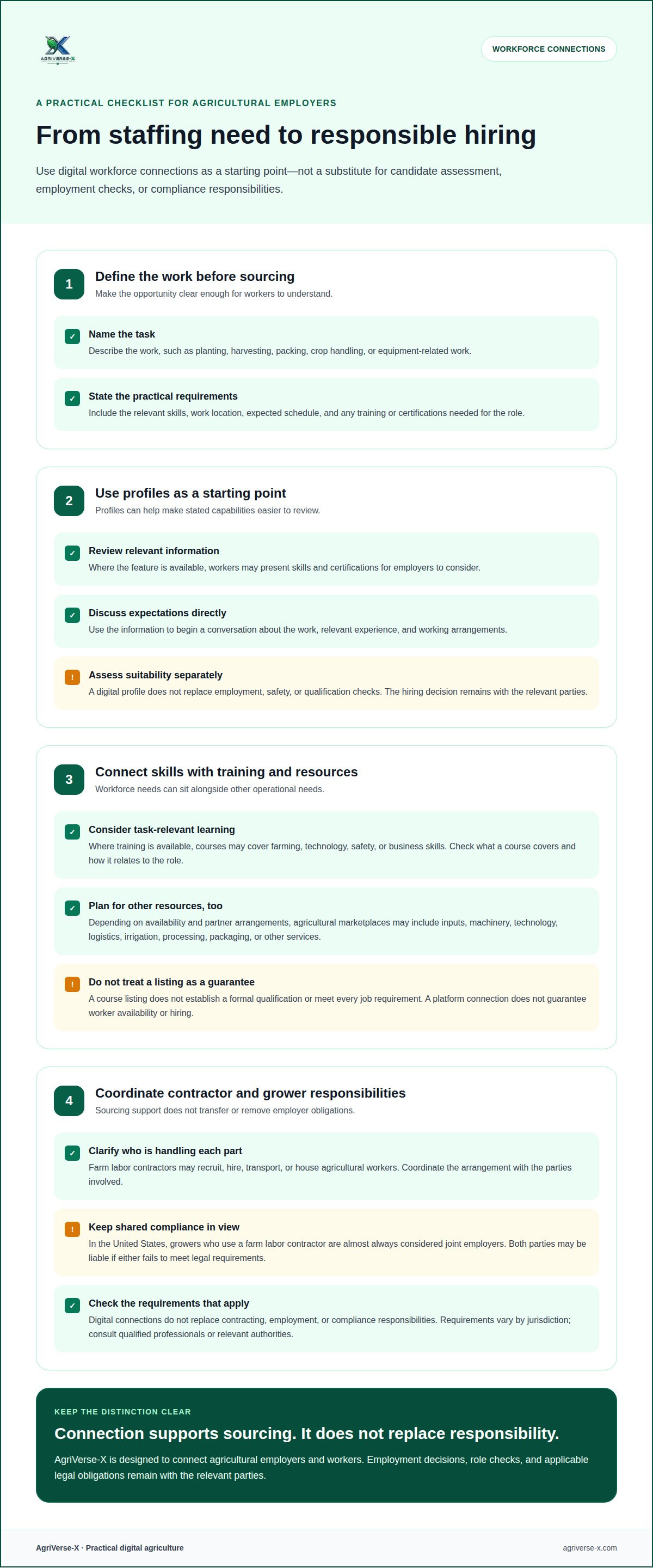
Hiring through farm labor contractor services does not automatically transfer responsibility for worker compliance. In the United States, growers who use a farm labor contractor are almost always considered joint employers. Both parties may be liable if either fails to meet legal requirements.
That shared responsibility matters. Contractors may recruit, hire, transport, or house agricultural workers, but growers still have a role in protecting workers’ rights. This article explains what contractors do, how federal and state requirements shape their work, and what growers and contractors share responsibility for, including wages, records, housing, transportation, and worker support. It also explains registration and how AgriVerse-X helps agricultural businesses connect with workers.
Key Takeaways
- Understand how agricultural labor contractors can support workforce needs through recruiting, hiring, transportation, or housing.
- Recognize why U.S. growers may share employer responsibilities with a contractor, including duties related to worker rights.
- Learn how federal certification and state requirements shape contractor registration and compliance.
- Identify the areas growers and contractors need to coordinate, from wage payments and records to safe housing and transportation.
- See how AgriVerse-X’s farm labor sourcing solutions can connect agricultural employers with workers.
What Makes AgriVerse-X a Unique AgriTech Platform
AgriVerse-X is designed to connect agricultural employers and workers through digital profiles, agricultural opportunities, training, services, and marketplace listings. For a farm business seeking workers, workforce connections can be a starting point: employers may be able to connect with agricultural workers, and profiles can present stated skills and certifications. The platform is intended to bring staffing needs into a wider operational context, alongside services, inputs, equipment, and records that may support agricultural work.
Recruiting is often one part of a larger operational plan. An employer may also need workers with particular skills, training, irrigation or logistics services, crop inputs, or a way to organize information about products and activities. AgriVerse-X is designed to bring agricultural participants and resources together, with services and programmes dependent on local requirements and partner arrangements.
Profiles can make agricultural capabilities easier to present. Subject to platform availability, farmers, agribusinesses, cooperatives, and service providers may be able to create digital profiles that present products, services, skills, and certifications. Workers may use profiles to present relevant skills and certifications to employers if that feature is available to them. Employers can consider the information provided when exploring connections with people whose stated capabilities may suit their operation.
A profile can be useful when it makes a work requirement more concrete. A grower hiring for planting, harvesting, packing, or another agricultural task can consider the skills and experience relevant to the role. A cooperative coordinating members or service providers can present its capabilities in a structured digital profile if that feature is available. The platform may help connect participants, but profile information does not replace the employment, safety, or qualification checks that may apply to a particular role.
Clear profile information can also support better conversations. Workers can present relevant skills and certifications, while employers can describe the agricultural work they need done. These details can give both sides a practical starting point for discussing expectations, working arrangements, and whether the opportunity is a fit. The hiring decision and employment relationship remain with the relevant parties.
Workforce connection may be a practical use for employers. Where the service is available, agricultural businesses can use the platform to explore connections with workers when they have a staffing need. This may suit growers and agribusinesses managing seasonal or task-based work, as well as cooperatives and other agricultural employers coordinating labor. The platform does not guarantee that a particular worker will be available or hired.
Before making a connection, define the work clearly. Consider the task, required skills, work location, expected schedule, and any training or certifications relevant to the role. Clear details can make an opportunity easier for potential workers to understand and give employers a consistent basis for discussing it with interested candidates.
For example, a produce operation may need workers to harvest and handle crops, while another business may need people with technical skills for equipment-related work. Each role calls for different profile information and questions. A connection platform can bring people together, but it cannot determine job suitability on its own. Employers should assess candidates for the role and seek qualified guidance on their applicable employment and workplace obligations.
This distinction matters when using farm labor contractor services or other workforce arrangements. Digital connections may support sourcing, but they do not replace the contracting, employment, or compliance responsibilities of the parties involved. AgriVerse-X is intended to connect agricultural employers and workers within a broader digital agriculture ecosystem. It does not take over an employer’s or contractor’s responsibilities. Requirements vary by jurisdiction; employers and contractors should consult qualified professionals or relevant authorities.
Training may help develop workforce skills. Training providers may offer courses through the platform if the relevant feature and programme are available. Courses may cover farming, technology, safety, and business skills, connecting people developing agricultural capabilities with learning providers and employers seeking workers whose skills suit their operations. Course content and delivery depend on the provider and programme.
Training is most useful when it relates to a defined task or development goal. A worker may want to build farming skills; an employer may want workers to develop relevant safety knowledge; or a service provider may need to strengthen technology or business capabilities. Where available, providers may present courses through the platform so agricultural participants can discover relevant learning opportunities.
For employers, training can be part of a workforce plan, but it does not promise that a worker will be hired or qualified for every role. A course listing does not itself establish professional certification or satisfy every job requirement. Employers and workers should understand what a course covers and how it relates to the work. Any formal qualification, authorization, or local requirement for a role must be addressed separately with qualified professionals or relevant authorities.
The marketplace may help connect workforce needs with operational resources. Agricultural labor is rarely the only requirement. Employers may also need inputs, machinery, technology, logistics, irrigation, processing, packaging, or other services. AgriVerse-X is designed to support marketplaces for agricultural goods, inputs, machinery, technology, and services, subject to availability and partner arrangements.
This wider environment can be useful when an employer is planning a work cycle. A business preparing for planting, for example, may need workers as well as planting materials or soil inputs. A business focused on moving produce may need labor alongside logistics or packaging services. The platform may connect participants and marketplace categories, but it does not guarantee that any listing, service, or resource is available in every place or at every time.
A marketplace listing can introduce a relevant product or service, but the parties still need to establish its suitability and agree on terms and delivery. If an operation depends on a particular service, qualified provider, permission, or local approval, those requirements remain important. AgriVerse-X may support discovery and connection without replacing the decisions needed to carry out agricultural work.
Agricultural inputs may be listed alongside staffing needs. Subject to marketplace availability, categories may include fertiliser, soil, and crop inputs such as compost, farmyard manure, vermicompost, biofertiliser, organic fertiliser, NPK fertiliser, soil conditioners, mulch, growing media, and soil-testing kits or services. Crop nutrition consulting may also be listed. These categories could be relevant when coordinating workers with the materials or technical support needed for production.
For example, a grower organizing field work may also need soil analysis or crop nutrition planning. Considering these needs together can help connect the work, relevant inputs, and technical support as parts of the same activity. The platform does not determine which input suits a particular crop or site. Where required, listings should provide product labels, composition, safety instructions, application rates, storage requirements, and registration information. Qualified advice may be needed for technical decisions.
The same principle applies to planting materials. Potential listings may include seedlings, nursery plants, seeds, bulbs, tubers, rooted cuttings, and propagation supplies. Sellers should accurately describe relevant details, including variety, origin, quantity, planting season, storage needs, and applicable certifications or restrictions. This can help buyers understand a listing, but they must still assess whether it suits local growing conditions and the intended use.
Technical services may support work that requires specialist capability. Potential agricultural service listings include agronomy, farm planning, soil science, crop scouting, irrigation design, machinery repair, drone operations, laboratory testing, certification support, export documentation, agricultural research, cooperative management, business planning, market research, and procurement services. Where these listings are available, employers may be able to explore service connections that complement workforce and production needs.
These services can matter when an operation needs expertise beyond general labor. A grower may need crop scouting or agronomy support alongside field workers. An employer coordinating irrigation work may need irrigation design, while a cooperative may seek management or business-planning support. A listing may help participants discover potential connections, but the relevant provider delivers the service under agreed terms.
Credentials and authorization matter when professional qualifications, licences, insurance, or local approval are relevant. The platform may present service providers and their stated skills or certifications, but a profile does not replace separate verification or approval required for an activity. This is particularly important for regulated services, safety-sensitive tasks, and professional judgments that affect an operation. Users should check requirements with qualified professionals or relevant authorities.
Digital records may support clearer operational coordination. AgriVerse-X is intended to support digital traceability records and compliance-aligned reporting, subject to feature availability and applicable requirements. Traceability records are records that can help describe or follow products and activities through relevant stages. In a workforce context, organized information may give an agricultural business a clearer view of its operations. These records do not automatically certify worker status, crop quality, farm ownership, legal compliance, or any other matter requiring separate verification.
Organized information can make operational details easier for employers to manage and communicate. A business coordinating workers, services, and agricultural goods may use digital records to document related activities if suitable tools are available. The appropriate recordkeeping approach and reporting requirements depend on the operation and jurisdiction. Users remain responsible for meeting applicable obligations and seeking qualified guidance where needed.
Digital infrastructure works best alongside sound operational practices. Profiles may present skills, marketplaces may support discovery, training may connect learners with providers, and records may help organize information. Each function has a distinct role; none guarantees hiring, performance, safety, or compliance. The practical value depends on applying available tools to a clearly defined business need.
Storage, equipment, and land opportunities may also support planning. AgriVerse-X may include storage and equipment rental, farmland, or lease listings, subject to availability and partner arrangements. These categories could help employers plan capacity around workforce needs, including the space or equipment required for agricultural activities. They are separate marketplace opportunities, not a replacement for labor sourcing or an employment arrangement.
A business considering storage or equipment should assess whether a listing suits its operation, location, timing, and terms. Land and lease arrangements require their own due diligence and attention to permissions. AgriVerse-X may facilitate discovery, while the parties are responsible for evaluating and agreeing on arrangements in accordance with applicable requirements. For land arrangements and permissions, seek guidance from qualified professionals or relevant authorities.
Financial partners may offer approved agricultural finance programmes through the platform, if available. The relevant partners deliver these programmes, and eligibility, terms, and requirements depend on the programme and jurisdiction. Financing is not guaranteed, so a workforce plan should not assume funds will be available. Anyone considering financial services should review the relevant conditions with qualified professionals and licensed organizations.
Think of AgriVerse-X as a connected ecosystem, not just a hiring tool. Where available, employers may be able to connect with workers, while profiles can help participants present their skills and capabilities. Training providers may offer learning opportunities, marketplace listings may surface agricultural goods, inputs, equipment, and services, and digital records may support traceability and compliance-aligned reporting. Together, these functions are intended to help agricultural participants connect around practical operational needs.
Services and features may depend on programme arrangements, local conditions, participating providers, permissions, or applicable laws. Not every platform category is necessarily active or available in every location. This is particularly relevant for employment, financial services, land arrangements, technical services, and work that requires professional qualifications or authorization. The platform may support connections; the relevant participants and service providers remain responsible for their roles and agreements.
AgriVerse-X may be relevant to farmers, agribusinesses, cooperatives, employers, and service providers seeking to connect an agricultural need with people or resources in the sector. Where the relevant features are available, employers may explore worker sourcing; workers and service providers may present their skills and services; and training providers may make agricultural learning opportunities discoverable. Describe the need or capability clearly, then use available platform connections in line with local requirements.
Contact AgriVerse-X to discuss whether its agricultural platform may support your workforce and operational connection needs.
Build a More Connected Workforce Plan
Make workforce sourcing part of a wider operational plan. Clearly defined roles, organized records, and relevant digital connections can help agricultural businesses coordinate workers and the resources their work requires. When considering farm labor contractor services, assess how worker connections fit your operation. This is general information; confirm your employment responsibilities with qualified employment professionals or relevant authorities.
AgriVerse-X can help agricultural employers connect with workers and related platform opportunities. Explore how a connected approach could support your workforce needs, and confirm applicable obligations with qualified employment professionals or relevant authorities.
Contact AgriVerse-X to discuss your agricultural workforce and platform needs. Take the next step with a clear plan and practical connections.
Frequently Asked Questions
Can I share responsibility for farmworker compliance if I hire through a contractor?
In the United States, an agricultural employer who hires through a farm labor contractor may be considered a joint employer, depending on the circumstances. The parties may have responsibilities for workers’ employment rights, including timely wage payment and safe, adequate housing and transportation. Either party could be liable if applicable legal requirements are not met. A written agreement can clarify who handles each task, but may not remove responsibilities imposed by law. Requirements depend on the situation; consult the relevant authorities or qualified employment counsel for current guidance.
What should I know about hiring farm labor for seasonal work?
Define seasonal work before arranging labor: identify the tasks, timing, location, required skills, and relevant safety training. Then put the expected arrangements and each party’s responsibilities in writing, including how assignments and records will be managed. Since seasonal needs can change with the work schedule, clear communication with workers and the contractor helps keep staffing aligned with actual requirements.
What services do farm labor contractors provide?
A farm labor contractor may be an individual or entity paid to provide agricultural-work services or to recruit, employ, solicit, hire, transport, or house migrant or seasonal agricultural workers. The scope and applicable definitions can depend on the circumstances and relevant law. Contractors may furnish labor for agricultural activities, while agricultural employers may directly employ workers for farm tasks. The agreement between the parties describes the services involved; consult the relevant authorities or qualified employment counsel about how the rules apply.
How much do farm labor contractor services cost?
There is no single standard fee: contractor charges vary according to the contract and services provided. The scope of work, such as recruitment, labor furnishing, transportation, or housing, shapes the agreement and its costs. Put the services and payment terms in writing so the grower and contractor share the same understanding. A general industry estimate is not a quote for a specific arrangement.
How are farm labor contractors paid and what fees do they charge?
The agreement sets the payment terms, and fees vary according to the contract and services involved. It should state what work the fee covers, how charges are calculated, when payment is due, and how additional services are handled. Do not assume every contractor uses the same payment method or fee structure. For a particular arrangement, the written terms explain what the grower owes.
How do I find and compare farm labor contractors near me?
When evaluating farm labor contractor services, compare the work covered, the written terms, and any relevant authority for housing or worker transportation. The U.S. Department of Labor’s registered contractor list may help you check registration and relevant housing and vehicle authorizations; confirm current information with the department. State requirements may also apply, so check with the relevant authorities or qualified employment counsel about the rules for the location and circumstances.
How do I verify a farm labor contractor’s license and insurance?
Under the Migrant and Seasonal Agricultural Worker Protection Act (MSPA), federal certification may be required before a contractor performs covered farm labor contracting activities. The U.S. Department of Labor’s list may provide certificate-holder details, including certificate number and expiration date, and relevant housing and vehicle authorizations. According to the United States Government Publishing Office, the law addresses carrying and displaying a registration certificate in specified circumstances. Check current requirements with the relevant authorities or qualified employment counsel. Review insurance documentation separately.
What federal laws may apply to farm labor contractors in the United States?
The Migrant and Seasonal Agricultural Worker Protection Act (MSPA) sets federal requirements that may apply to farm labor contractors, including rules concerning wages, hours, documentation, and worker protections. Federal certification may be required for covered contracting activities. For H-2A work, MSPA registration and other requirements may apply to contractors and H-2A workers. The U.S. Department of Labor’s Employment and Training Administration describes surety bond and contract requirements for H-2A labor contractors. Requirements depend on the specific arrangement and current rules; consult the relevant authorities or qualified employment counsel.


