

Owning land gives you a set of rights, not unlimited control. Landowner rights and responsibilities generally include deciding how property is used, managing access, and making choices about its future, subject to obligations and other interests that may limit what you can do.
It’s reasonable to expect ownership to provide broad control. In practice, the property’s location, existing agreements, and intended use all matter. Leasing agricultural land, developing a vacant parcel, or running a business from a residence can raise different questions. Understanding the conditions attached to your property helps you make informed decisions before changing its use or granting access.
For agricultural landowners, irrigation needs are one practical consideration when assessing permitted uses and planning how land may be used. This guide explains how land ownership relates to property use, access, income, title, taxes, and liens. It also covers practical questions for agricultural land, including how irrigation needs may interact with permitted uses. The aim is to help you identify the decisions involved, understand where ownership can be limited, and know what to consider before taking the next step.
Key Takeaways
- Think of ownership as a set of rights that can be shaped by local rules, agreements and existing obligations.
- Understand how leases and easements affect access, control and the ability to exclude others.
- Consider permitted uses and relevant requirements before earning income from agricultural land.
- Keep title, taxes and liens in view, since they can affect possession and future transfers.
- Explore how AgriVerse-X’s planned farmland listings and irrigation marketplace may support land-use plans, subject to confirmation.
Control of property use
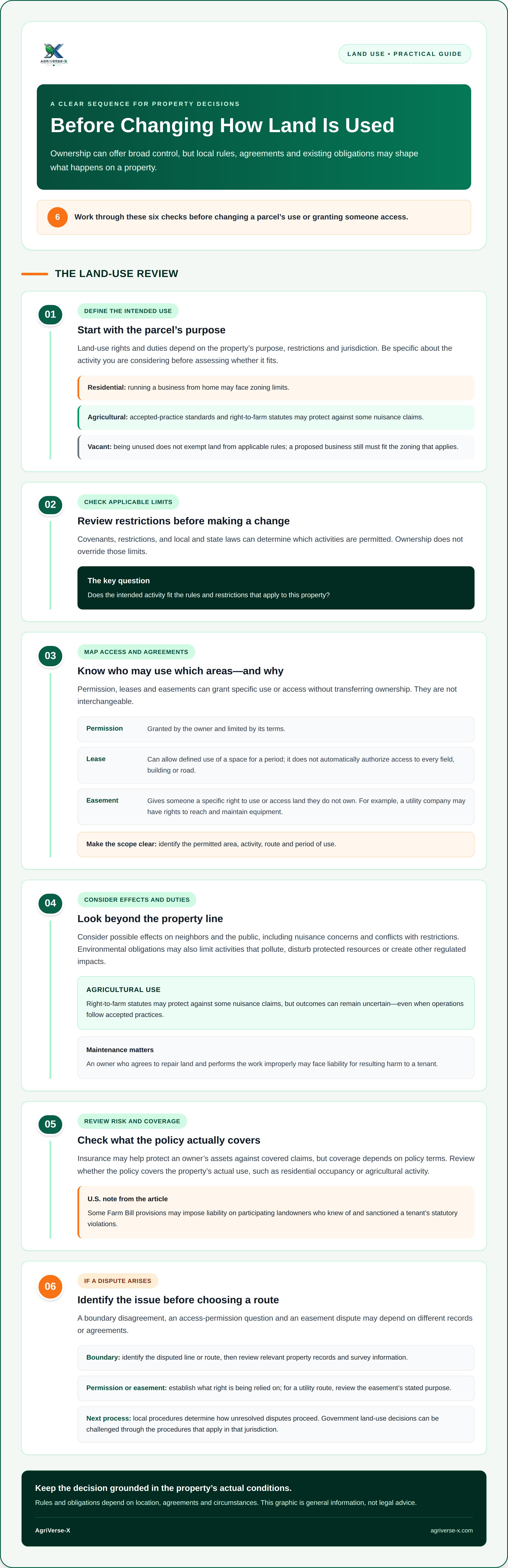
Landowners can generally choose how to use their property, but ownership does not override applicable limits. Covenants, restrictions, and local and state laws can determine which activities are permitted.
Land Use Across Property Types
Land-use rights and duties depend on a property’s purpose, restrictions, and jurisdiction. That distinction matters before you change how a parcel is used.
A residential owner may face zoning limits on running a business from home. Agricultural land may be subject to accepted-practice standards and right-to-farm statutes, which can protect against some nuisance claims. Vacant land is not exempt from applicable rules just because it is unused. For example, a proposed business on a vacant parcel must still fit the zoning that applies there.
Duties to Neighbors and the Public
Consider how activities on your land affect neighbors and the public, particularly if they could create a nuisance or conflict with an applicable restriction.
Right-to-farm statutes may protect agricultural owners from some nuisance claims, but outcomes can remain uncertain even when operations follow accepted practices. A neighbor’s concern does not automatically end a farm operation, and agricultural use does not automatically prevent a claim. To address a boundary dispute, identify the disputed line or route, then review relevant property records and survey information and follow the local dispute-resolution process. Government land-use decisions can be challenged through the procedures that apply in that jurisdiction.
Environmental and Maintenance Obligations
Environmental obligations can restrict activities that pollute, disturb protected resources, or create other regulated impacts. They matter because land use can expose an owner to liability under applicable laws.
In the United States, landowners may face liability for activities that violate the Clean Water Act, Clean Air Act, Endangered Species Act, Federal Insecticide, Fungicide, and Rodenticide Act, or Comprehensive Environmental Response, Compensation, and Liability Act. The relevant law depends on the activity and its effects. Maintenance is another consideration: an owner who agrees to repair land and does that work improperly may face liability for resulting harm to a tenant.
Liability Risks and Insurance
Liability risks can arise from environmental activity, known hazards, or obligations an owner accepts. Understand those risks before allowing operations or arranging repairs.
Some Farm Bill provisions may impose liability on participating landowners who knew of and sanctioned a tenant’s statutory violations. Insurance may help protect an owner’s assets against covered claims, while regular attention can help identify hazards and ensure agreed repairs are addressed. Coverage depends on the policy terms. For example, review whether a policy covers the property’s actual use, such as residential occupancy or agricultural activity.
Excluding others and easements
The right to exclude gives an owner control over who enters or uses the land, but it is not absolute. Permission, leases, and easements can give others specific access without transferring ownership. Understanding each right’s purpose and limits helps you manage entry without treating every visitor the same way.
An owner might allow a farmer to plant crops on part of a property or rent out a cottage. These arrangements grant another person defined use of the space for a time, but do not automatically authorize access to every field, building, or road. A clear agreement can specify the permitted area, activity, route, and period of use, reducing uncertainty about where permission begins and ends.
Permission and an easement are different. Permission comes from the owner and can be limited by its terms. An easement gives someone a specific right to use or access land they do not own. For example, a utility company may hold an easement to reach and maintain equipment. The owner retains the property but must respect the access rights set out in the easement.
Access can also affect a sale. If an owner sells a parcel behind their remaining land, a driveway across the retained property may be needed to reach it. That route can limit the owner’s ability to block passage. Its location and purpose matter, as does whether the access right is recorded or established through another applicable arrangement.
What are landowners’ duties regarding trespassers, visitors, and property hazards? Duties depend on local law and the circumstances of someone’s entry. Distinguish invited visitors from people entering without permission, and take reasonable care with known hazards, such as an unsafe structure near an agreed access path.
Manage access by identifying each person’s purpose and the right they rely on. A utility worker maintaining equipment, a farmer using a leased field, and a visitor invited to a cottage may have different permissions. Keep access routes separate from areas outside the agreed use, and communicate limits clearly to people entering the property.
When a dispute arises, first determine whether it concerns a boundary, permission, or an easement. These are distinct issues and may depend on different records or agreements. A disagreement about a utility route, for example, calls for reviewing the easement’s stated purpose, while unauthorized entry raises a question of permission. Local procedures determine how unresolved disputes proceed.
Owners considering agricultural use can explore planned farmland and lease listings, subject to confirmation as a way to connect land opportunities with prospective tenants. Any access granted for that use should remain consistent with the applicable agreement and local requirements.
Generating income from property
Land can generate income through rent, agricultural leases, or a sale. Each option offers a different balance of control, access, and continuing responsibility. Renting a cottage, for example, can generate income while giving a tenant possession under agreed terms. Letting a farmer plant crops on part of a property can create lease income while leaving other areas under the owner’s control.
An agricultural lease should clearly describe the land and permitted activity. A field used for crops differs from a parcel used for storage or access. The agreement can specify the area, length of use, payment arrangements, and responsibility for repairs or improvements. These details help both parties understand what the tenant may do and which obligations remain with the owner.
Income plans must account for restrictions on the property. Local zoning may not permit a business use, even if the owner sees a commercial opportunity. Covenants, easements, and existing leases can also constrain a proposed use. Before starting a new operation, establish whether the activity fits the property’s permitted uses and existing commitments.
Rental income does not transfer ownership. Instead, a lease gives a tenant use or possession under agreed terms, which can limit the owner’s practical access during the term. If a farmer leases one field, the agreement should distinguish it from nearby buildings, access routes, and other land the tenant may not use.
Selling land converts ownership into sale proceeds, but an outstanding mortgage affects how much the owner receives. A United States landowner who sells property while still owing a mortgage must pay the remaining balance from the sale proceeds. Account for that debt when estimating the financial result of a sale.
Tax treatment can also affect income from leasing, farming, or selling. Agricultural land may receive tax preferences under some statutes. Some agricultural land tax preference statutes include rollback provisions that can recapture lost tax revenue when land is developed for nonagricultural uses. A change from crop production to nonfarm development may therefore have consequences beyond the new use itself.
Tenant activity can create risks as well as income. Some Farm Bill provisions may impose liability on participating landowners who knew of and sanctioned a tenant’s statutory violations. If you lease a field for agricultural activity, distinguish permitted use from conduct that violates applicable requirements. Lease income does not automatically protect an owner from every consequence of knowingly sanctioned conduct.
Compare the practical trade-offs before committing: a lease retains ownership but shares control, while a sale transfers the property and may require mortgage repayment. For agricultural land, permitted use, lease terms, outstanding debt, and any applicable tax preference can shape the outcome. Income planning is therefore part of managing ownership, not simply choosing a rent or sale amount.
Possession and property title
To assess ownership, zoning, liens, and restrictions, compare title documents with land records and relevant planning and lien records. The offices and processes involved depend on the property’s jurisdiction.
Verifying Land Ownership
Property title describes the owner’s legal relationship to land and the rights attached to it. Check title before a sale, lease, inheritance transfer, or development, because physical possession alone does not establish every ownership right.
Start with the title document and corresponding land record in the property’s jurisdiction. Compare the recorded owner and parcel description with the land in question. For example, a boundary in a record may not match a fence visible on site. A survey can help clarify the parcel’s location.
Next, review documents connected to the transfer, such as a deed or other conveyance record, and look for recorded interests affecting the parcel. In the United States, ownership is commonly understood as a collection of rights in relation to other people, not merely rights to a physical object. A title can therefore coexist with another party’s access or use rights.
For inherited or jointly held land, establish how ownership is recorded and who holds an interest. A family member living in a house, for example, may not be the only person with a recorded ownership interest. Clarifying the named owners helps prevent anyone from treating possession as sole authority to sell or lease the property.
Checking Zoning, Liens, and Restrictions
Zoning, liens, and restrictions are separate records or rules that can limit land use or affect ownership. Review them before building, leasing, selling, or changing agricultural land to another use.
Check planning or zoning information for the parcel’s location and compare permitted uses with the activity you intend. A proposed business may not be allowed in a zone that excludes that use. A crop field, home, or vacant parcel can each face different restrictions, so assess your actual plan rather than relying on the property’s current appearance.
Search relevant land or lien records for claims secured against the property. In the United States, unpaid property taxes or homeowners association fees may form liens, and owners may lose possession if those obligations remain unpaid. A mortgage is another important recorded obligation: a seller who still owes a mortgage must pay the remaining balance from sale proceeds.
Finally, review recorded covenants, easements, leases, and other restrictions affecting the parcel. A utility easement, for example, may give a company access to maintain equipment on land it does not own. Compare each document’s stated area and purpose with your planned use, and resolve discrepancies through the applicable local process before assuming you have unrestricted control.
Property taxes and liens
Property taxes and other obligations can affect ownership costs and continued possession. In the United States, unpaid property taxes or homeowners association fees may become liens, and owners may lose possession if those obligations remain unpaid.
Which rules vary by state or locality? Property tax processes, lien consequences, homeowners association obligations, and agricultural tax preferences depend on the location and applicable rules. A rule affecting one parcel may not apply in the same way to land in another jurisdiction.
A lien is a claim connected to property that can affect its transfer or the owner’s ability to keep it. For example, unpaid property taxes or homeowners association fees may create liens in the United States. The obligation can matter even while the owner occupies the home or operates the land. Ownership does not erase an unpaid claim.
Tax obligations also matter during a sale. A United States landowner who sells property while still owing a mortgage must pay the remaining balance from the sale proceeds. A mortgage is distinct from a tax lien, but both can affect the seller’s position and the amount available after transfer.
For a landowner, the key issue is how an unpaid obligation affects possession, sale, or use. Overlooking a tax obligation may lead to consequences beyond a growing balance. In the United States, property owners may lose possession when property taxes or homeowners association fees remain unpaid and form liens.
Agricultural land can have a separate tax dimension. Some agricultural land tax preference statutes include rollback provisions that can recapture lost tax revenue when land is developed for nonagricultural uses. For example, converting agricultural land to another type of development may trigger a tax consequence under an applicable rollback provision.
Intended use is therefore relevant to tax planning. If you are considering a change from farming to nonagricultural development, account for whether an agricultural tax preference applies and whether a rollback provision could recapture revenue. The outcome depends on the applicable statute and the parcel’s use history, not just its current label.
Keep different obligations distinct when reviewing a property’s financial position. Taxes, homeowners association fees, and mortgage debt are not interchangeable, but each can affect ownership or a sale. A lien can constrain the owner’s position, while mortgage repayment directly reduces sale proceeds. Agricultural tax preferences add another consideration when land use changes.
Because state and local rules shape these outcomes, the relevant records and requirements depend on the parcel’s jurisdiction. Landowner rights and responsibilities include understanding which obligations attach to the property and how a proposed use or transfer may affect them.
AgriVerse-X: Irrigation and Water Management
AgriVerse-X may help landowners explore information about agricultural irrigation and water-management listings, subject to availability. Options may include drip-irrigation systems, sprinklers, pumps, tanks, moisture sensors, and water-testing services.
Before purchasing or installing equipment, consider water rights, borehole permissions, environmental rules, and local installation requirements. For leased land, clarify how the lease addresses irrigation equipment, access, and maintenance.
Turn Your Land Plan Into Action
Make your next move deliberately. Define what you want the property to support, who needs access, and what infrastructure the plan may require. This gives you a practical starting point without assuming every opportunity suits every parcel.
Landowner rights and responsibilities matter most before you make a new commitment. Set out the intended use, identify agreements or permissions that may shape it, and prepare questions for qualified local professionals. For agricultural land, water access and irrigation needs can affect whether a proposed use is workable. Ownership alone does not settle those questions.
Keep future options in view. A staged plan can help you assess how a lease, land-use change, or irrigation project fits with existing commitments. It can also clarify which agricultural listings or services might support your next move.
Explore AgriVerse-X
Move forward with clarity, one considered decision at a time.
Frequently Asked Questions
The Bundle of Legal Rights of a Property Owner: What Is It?
Landowner rights are a set of rights connected to owning land, not one unlimited right over a physical parcel. They may include possessing, using, excluding others from, transferring, or earning income from property. For example, an owner may lease a field while retaining title. A mortgage, easement, lease, or land-use restriction can affect how those rights work, so landowner rights and responsibilities depend partly on other people’s legal interests.
What legal rights do landowners have in the United States?
United States landowners generally have rights to possess, use, transfer, and exclude others from property, subject to applicable restrictions and other parties’ interests. A lease can grant a tenant use of a defined area, while an easement can allow utility access across a parcel. Ownership does not authorize every desired use: zoning rules, recorded agreements, and applicable laws can limit what an owner may do.
What federal, state, and local laws restrict land use and development?
Restrictions can apply at multiple levels. Local zoning may prevent a business use on a particular parcel, while state and local rules can also shape development. In the United States, federal laws relevant to land activities include the Clean Water Act, Clean Air Act, Endangered Species Act, and Federal Insecticide, Fungicide, and Rodenticide Act. The rules that matter depend on the proposed activity and location.
What taxes, assessments, and fees must landowners pay?
Owners may owe property taxes and, where applicable, homeowners association fees. In the United States, unpaid obligations of these kinds may form liens and affect possession. A mortgage is a separate debt, not a property tax, but it can affect a sale because the remaining balance must be paid from sale proceeds. Agricultural land tax preferences may also include rollback provisions if the land shifts to nonagricultural development.
What are the rules for property boundaries, fences, easements, and right-of-way access?
Boundaries, fence placement, and access rights depend on parcel records, agreements, and applicable local rules. A fence’s visible position alone does not establish the legal boundary. Utility companies may hold easements to access equipment, and a parcel sold behind another property may need a driveway across the owner’s land. For a disputed line or route, compare the relevant property description with recorded access documents.


