

A smooth-looking bag does not guarantee a satisfying meal. To learn how to test yam flour quality, assess its appearance, aroma, feel, hydration, and cooking results together. Each check offers a different clue to whether the flour suits the dish you plan to prepare.
Colour alone cannot show how flour will perform in your kitchen. A practical assessment also considers whether the sample is consistent and whether its cooked result meets your expectations. Comparing observations from one batch with another gives you a clearer basis for choosing and using yam flour.
This guide explains what to check before cooking and what preparation can reveal. You will learn to assess texture, spot changes that deserve attention, and understand how drying and milling affect the finished flour. It also covers simple home observations related to moisture and the limits of those checks. Use this guidance to make informed choices for everyday meals or product evaluation, without relying on appearance alone.
Key Takeaways
- Look for an even appearance and familiar aroma, then notice any unusual smell or visible change.
- Feel for persistent clumps and grit, which can signal moisture exposure or uneven milling.
- Watch how the flour absorbs water and forms a smooth, workable mixture during cooking.
- Use a small cooking test to assess texture and performance before relying on a larger batch.
- Understand how drying, milling, and careful storage can influence the flour’s freshness and consistency.
Checking for clumps, off odors, and gritty texture
Clumps, unusual odours, and persistent grit can signal changes in yam flour. Assess each separately: they may point to different concerns and need careful interpretation.
Taste, Color, and Texture
Taste, colour, and texture describe the flour’s sensory qualities. Changes within a batch can reveal inconsistency, so compare a small portion with another from the same package rather than relying on a universal shade or flavour. Taste only flour that appears clean, and assess it after cooking.
For a useful comparison, note how the sample feels before preparation and its texture afterward. Record whether differences appear throughout the bag or only in one portion. This helps you decide whether variation is isolated or consistent across the batch.
Signs of Adulteration and Contamination
Adulteration means adding another ingredient or material; contamination means unwanted matter has entered the flour. Both can affect its intended use. Look for evidence, but do not assume appearance can identify a substance.
To detect possible adulteration, compare portions for distinct particles, uneven texture, or clear separation. Sensory checks can raise suspicion, but they cannot prove what was mixed in. The study authors reported a statistically significant difference at p<0.05 in a study of yam-flour formulations; that result describes tested samples, not a home detection method.
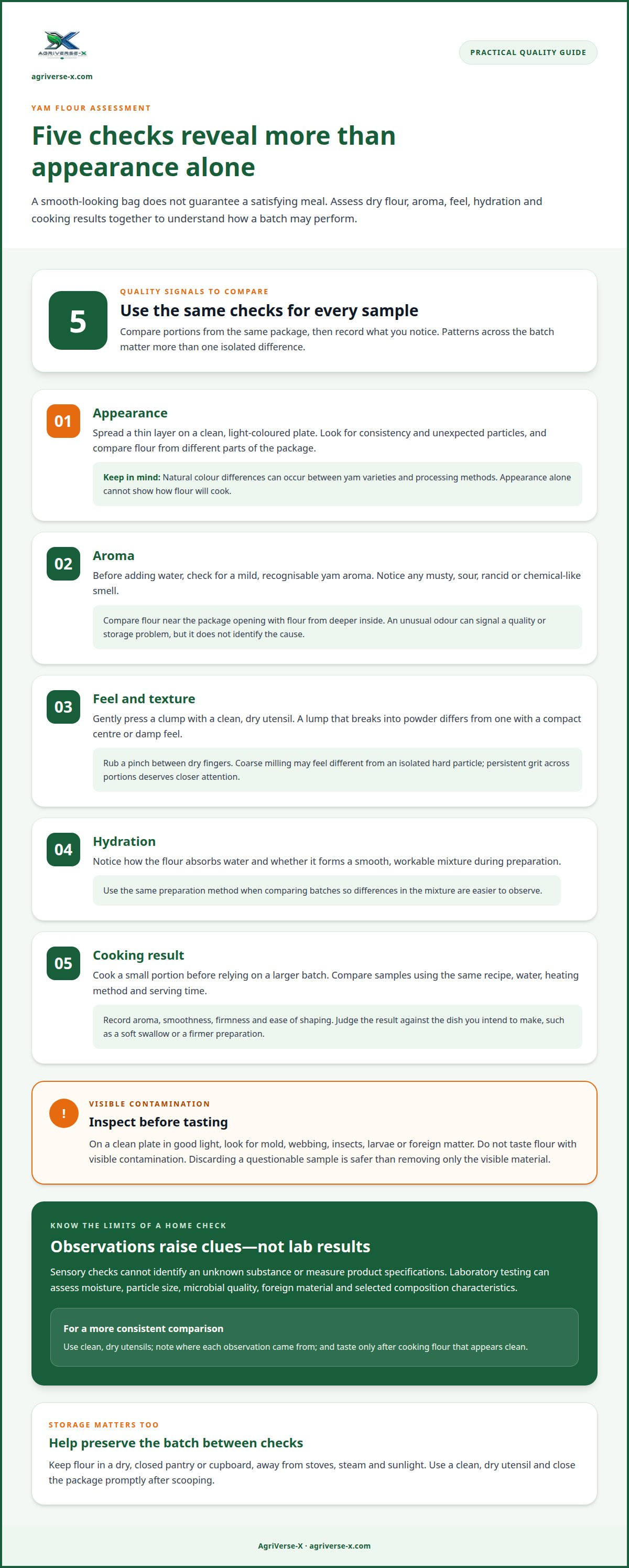
To check for mold, insects, and contamination, inspect a small portion on a clean plate in good light. Look for mold, webbing, insect bodies, larvae, or foreign matter. Do not taste flour with visible contamination. Discarding a questionable sample is safer than removing only the visible material.
Clumps need closer attention if they differ from the loose powder. Press one gently with a clean, dry utensil. A lump that breaks into powder differs from one with a compact centre or damp feel. The latter may indicate moisture exposure, while a hard particle that remains intact may be foreign matter. Neither clue alone identifies the cause.
Grit also needs context. Rub a pinch between dry fingers, then note whether the sensation is uniform or limited to isolated particles. Coarse milling can feel different from a single hard fragment. Persistent grit across several portions deserves more attention than one particle found in one spot.
Odour changes can help locate a problem within a package. Smell flour from the top and deeper inside, using separate clean spoons. A musty or sour note in only one area may suggest uneven exposure; a consistent off odour may indicate the issue extends throughout. Neither observation identifies a contaminant.
A practical way to learn how to test yam flour quality is to log each finding by sample location. Use the same record format for later batches. The question of how to test yam flour quality is easier to answer when your notes distinguish isolated particles from patterns across the package.
Appearance, aroma, and cooking performance of fresh flour
Assess freshness through several connected checks, not appearance alone. Examine the dry flour, note its aroma, then cook a small portion using the same method each time. This sequence shows whether its sensory qualities match its performance in a familiar dish.
Spread flour in a thin layer on a clean, light-coloured plate. Check for a consistent appearance across the sample, then compare flour from different parts of the same package. Patchy colour or unexpected particles deserve attention, although natural colour differences can occur between yam varieties and processing methods.
Smell a small sample before adding water. Fresh flour should have a mild, recognisable yam aroma rather than a musty, sour, rancid, or chemical-like odour. Compare flour near the package opening with flour from deeper inside. A distinct off odour can signal a storage or quality problem, even when the powder looks uniform.
To compare yam flour brands and grades, use the same recipe, water, heating method, and serving time for each sample. Record differences in aroma, smoothness, firmness, and ease of shaping. Treat grade labels as useful product information, but judge cooking results against your intended use, such as a soft swallow or a firmer preparation.
In the United States, yam flour sold as food must meet applicable food-safety, hygiene, labelling, storage, allergen, and transport requirements. Specific requirements depend on the product and how it is sold. A package label helps identify the product and handling information, but sensory checks do not replace applicable food controls.
Laboratory testing can assess moisture, particle size, microbial quality, foreign material, and selected composition characteristics. These tests answer different questions: moisture relates to storage condition, particle size to fineness, and microbial analysis to contamination. Sensory checks cannot measure these values, so laboratory results are useful when buyers need documented product specifications.
For home storage, keep flour in a dry, closed pantry or cupboard, away from stoves, steam, and sunlight. Use a clean, dry utensil and keep wet spoons out of the package. Close the bag promptly after scooping, then check the flour before cooking if its aroma or appearance changes.
Cooking completes the comparison. Prepare equal small portions, add water gradually, and stir each sample consistently. Note whether the mixture hydrates evenly, develops persistent dry pockets, or becomes smooth and cohesive. Record the result alongside your dry-flour observations; a familiar recipe makes differences between samples easier to identify.
For buyers and sellers documenting flour characteristics, food and flour product listings can help present product details clearly alongside other agricultural goods.
Cooking and hydration performance
Water absorption and cooking behaviour show how flour performs beyond its dry appearance. Use a small, consistent test to compare hydration, lump formation, smoothness, and finished texture.
For a fair comparison, prepare samples separately using the same pot, heat level, stirring method, and flour amount. Follow package directions when available. Changing the water amount or cooking time between samples makes the results harder to interpret.
Observe each sample through the same sequence:
- Add water gradually. Stir as you pour, and watch whether the flour wets evenly. Dry pockets that remain after thorough stirring may point to uneven hydration or poor dispersal.
- Check the mixture before heating. Note whether it looks uniform or forms stubborn clumps. A brief pause allows dry flour to absorb moisture, but repeated lumps may persist during cooking.
- Cook with steady heat. Keep stirring and scrape the pot’s sides and base. Look for a mixture that thickens consistently instead of scorching in one area while remaining loose elsewhere.
- Assess the finished texture. Check whether the cooked sample is cohesive and smooth, or instead feels grainy, pasty, sticky, or unusually firm for your intended dish.
Hydration affects the final result. Too little water can leave a dense, difficult-to-shape preparation; excess water can make it loose. Add water in small pours, then pause to assess the mixture before adding more. This controlled adjustment helps distinguish the flour’s behaviour from a recipe with a different water balance.
Compare cooked samples side by side while they are still warm. A sample that combines smoothly and holds together may suit a firm, mouldable preparation; another flour may cook to a softer texture. Record the water added, stirring pattern, and outcome so you can repeat the same conditions next time.
Texture also changes as cooked flour cools. Set aside a small portion and compare it with the warm sample. Note whether it stays cohesive, becomes harder to shape, or develops a rough mouthfeel. This matters if the food will be served after preparation rather than immediately.
Taste only after the sample has cooked fully and appears clean. A mild yam flavour and texture suited to the dish support a positive assessment. An unexpectedly raw, bitter, or gritty result calls for a closer look at preparation and flour consistency.
One cooking test cannot explain every difference. Yam variety, milling, storage, water, and heat can all affect the result. Repeat the same method with a fresh portion if results seem inconsistent, changing one factor at a time. This helps show whether water handling or the flour itself shaped the outcome.
Drying and milling as quality factors
Drying removes water before milling turns prepared yam into flour. These processing stages affect powder consistency, storage behaviour, and how evenly the flour cooks.
Drying and Milling Effects
Drying and milling describe how prepared yam becomes a fine, usable powder. Their consistency matters because uneven drying can leave damp material, while uneven milling creates particles that absorb water differently. A Dioscorea alata flour study dried the yam material in a cabinet dryer at 60 °C for 72 hours. It then milled the dried material and sieved it through a 600 µm sieve.
Those study conditions illustrate a controlled process, not a universal home recipe. Yam variety, piece size, drying equipment, and preparation affect how quickly moisture leaves the material. Thick pieces may dry differently from thin slices. If some parts retain moisture, the resulting flour can clump in storage or cook unevenly.
Milling determines particle size and distribution. A sieve separates finer particles from larger ones, helping create a more consistent powder. To assess a kitchen sample, rub a pinch between dry fingers and look for noticeable coarse fragments. Then cook a small portion: coarse particles may hydrate at a different rate from fine powder, affecting smoothness.
Compare samples under the same conditions. Use identical amounts of flour and water, the same pot, and the same stirring pattern. If one sample forms dry pockets while another blends evenly, particle-size or processing differences may contribute. Record the result rather than assuming appearance explains every cooking difference.
Checking Moisture at Home
A home moisture check looks for signs of dampness but cannot provide a precise moisture percentage. Touch and appearance can reveal changes, but they do not replace measurement with an instrument.
Place a small sample on a clean, dry plate. Check whether it flows freely or sticks together, then gently press a pinch between dry fingers. Compare flour from different parts of the same package. Compact lumps or a damp feel can indicate moisture exposure, especially if the remaining powder feels different.
For a simple comparison, keep one sample in a clean, dry container and another in its original package. Close both securely, then observe whether either develops new clumps or a changed aroma. This helps identify changes after storage; it does not measure water content or prove the cause.
A kitchen scale can track sample mass before and after drying, but household heating conditions vary. Without controlled temperature and reliable measurement, a change in mass does not establish a dependable moisture result. For documented moisture content, use laboratory analysis rather than treating a touch test as a numerical reading.
Store flour away from steam and sunlight, and keep wet utensils out of the package. A dry spoon and tightly closed container help prevent moisture from being introduced during handling after milling.
How to test yam flour for moisture content at home?
A home check can reveal clues of dampness, but it cannot give a precise moisture percentage. Inspect the texture, compare samples, and observe whether storage changes the flour. A measured result requires suitable equipment for moisture analysis.
Start with a clean, dry plate and spoon. Take a small sample from the package and spread it into a thin layer. Check whether it falls loosely or holds together in compact lumps. Feel a pinch between dry fingers; a damp or tacky sensation differs from free-flowing powder.
Use these observations as warning signs, not as a numerical test:
- Clumping: Note whether lumps break apart easily or remain dense and compact.
- Feel: Check whether powder sticks to dry fingers or feels unusually damp.
- Appearance: Look for damp patches or powder that appears unevenly compacted.
- Aroma: Smell the sample for a musty odor that may accompany moisture exposure.
Compare portions from separate areas of the package. If flour near the opening feels dry but material deeper inside seems compact, moisture may not be evenly distributed. Use a clean utensil for each sample, since a wet spoon can introduce moisture and distort the comparison.
A simple storage observation can add context. Transfer a sample into a clean, dry container and close it securely. Keep it away from steam, sunlight, and the stove. Later, compare its flow and texture with flour kept in the original package. New clumps suggest a change during handling or storage, but cannot identify the exact cause.
Cooking provides another practical clue. Prepare a small portion using the same water and stirring method as a separate sample. Watch for dry pockets, uneven thickening, or a mixture that behaves differently. These results may reflect moisture, but milling and particle size can also affect hydration.
A kitchen scale may help compare sample mass before and after drying, but household conditions vary. Without controlled drying and accurate measurement, a change in mass does not establish moisture content. Do not treat a warm-oven test as a reliable percentage, since heat and sample conditions can affect the result.
For decisions requiring a documented moisture value, use laboratory analysis rather than touch or appearance alone. Keep the sample clean and sealed before testing, and record which package it came from. This maintains a clear link between the tested portion and the flour being assessed.
After handling, close the package and store it in a dry cupboard. Keep wet utensils out, and check for changes before the next use. Consistent comparisons can reveal possible moisture exposure while keeping sensory observations separate from measured results.
AgriVerse-X: Post-Harvest, Packaging, and Food Products
AgriVerse-X offers farmers, processors, and food sellers a practical way to present flour and other food products to agricultural buyers. Its marketplace supports listings for flour and milled products, packaging materials, labels, and related food products. Verified digital profiles can showcase product details, services, and certifications, while digital traceability records can support clearer product information. Food sellers remain responsible for applicable food-safety, hygiene, inspection, labelling, shelf-life, allergen, storage, and transport requirements.
For information about listing agricultural food products, contact AgriVerse-X at [email protected].
Make your next flour decision with confidence
Use your findings to define what matters for how you prepare or source yam flour. The best choice is the one that consistently meets your intended use, not one judged by a single feature or a universal idea of perfection. Knowing how to test yam flour quality gives you a practical basis for deciding and communicating your expectations clearly.
For household use, let your preferred result guide your selection. For a food business or cooperative, align evaluation criteria with the intended preparation and keep product descriptions precise. Clear expectations support more consistent purchasing decisions and help buyers and sellers discuss quality with fewer assumptions.
AgriVerse-X can connect agricultural participants through food-product listings and digital profiles. If you’re exploring how to present or source flour within the agricultural marketplace, contact AgriVerse-X to discuss food-product listings. Apply your criteria thoughtfully, make decisions that suit your needs, and build confidence with each informed choice.
Frequently Asked Questions
What are the signs of good-quality yam flour?
Good-quality yam flour has a consistent appearance, a mild yam aroma, and no visible foreign matter. Its cooked texture should suit the dish you plan to prepare, whether that is a smooth, cohesive swallow or a softer mixture. For a more useful assessment, compare separate portions and note whether the cooking results stay consistent. Sensory checks help assess quality, but they do not measure moisture or prove food safety.
How to check yam flour color, smell, texture, and taste?
Examine a thin layer under steady, natural light, then smell a small sample in a clean bowl. Rub a pinch between dry fingers to notice coarse particles or unusual stickiness. Taste only a cooked sample with no visible mold or contamination. For example, record whether the cooked flour tastes mild and feels smooth, then use the same method for a later batch. This gives you a practical comparison without relying on memory.
What are acceptable moisture and particle-size standards for yam flour?
Use the applicable product specification or buyer requirement to determine acceptable moisture and particle size. These measures serve different purposes: moisture testing assesses water content, while particle-size analysis describes flour fineness. A home check can reveal clumping or coarse particles, but cannot establish a laboratory value. If a purchase or production decision depends on exact limits, request test results that identify the tested batch and measurement method.


