

Supply chain logistics for food importers connects sourcing, production, storage, freight, distribution, and the records that track food along the way. It coordinates how products move from origin to buyers while protecting their condition and managing their remaining shelf life. Import rules and documentation shape each step, and requirements vary by destination and product.
Importing may seem like moving a shipment from one country to another. In practice, the journey also depends on how goods are handled before departure, what happens in transit, and how quickly they reach suitable storage and customers. A delay or a break in required storage conditions can affect product quality and usable shelf life.
This guide explains how the food supply chain works and where logistics fits. You’ll learn how import requirements, freight choices, product condition, inventory, and shelf life connect, so you can understand the full route from supplier to final buyer.
Key Takeaways
- Follow food from sourcing through storage, freight, and delivery to see where logistics decisions affect supply and product condition.
- Understand how destination requirements shape food safety records, import documentation, and traceability.
- Match transport choices and handling conditions to the product’s needs, journey, and remaining shelf life.
- Build resilience by considering supplier options, routes, inventory, and demand together.
- See how AgriVerse-X is designed to support agricultural business connections through digital profiles, marketplaces, workforce links, and traceability records, subject to availability.
Why is logistics important for food suppliers?
Food logistics coordinates sourcing, storage, transportation, inventory, and delivery so products reach buyers in usable condition. Beginning in early 2025, the United States imposed reciprocal tariffs of at least 10% on imports from more than 60 nations, according to The White House.
Imported Inventory Planning
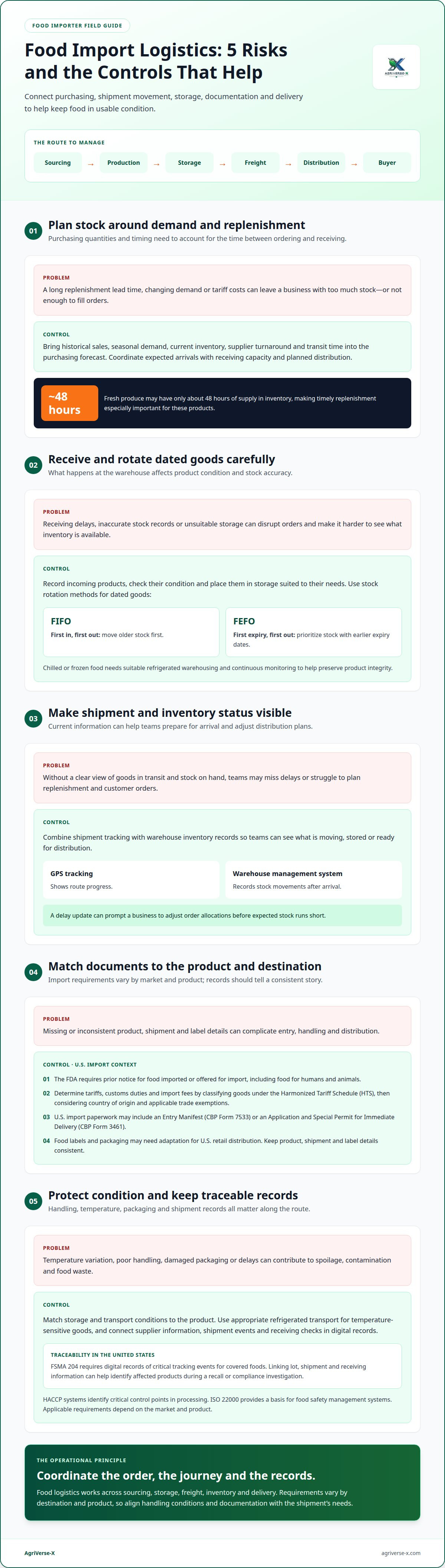
Imported inventory planning aligns order quantities and timing with expected demand, supplier turnaround, and transit time. It matters because imported goods can take longer to source and deliver than domestic products. A food importer forecasting seasonal sales should account for the time between placing an order and receiving stock. Tariff changes can also affect landed costs and influence purchasing decisions and demand forecasts.
Warehouse Receiving and Inventory Management
Warehouse receiving involves recording incoming products, checking their condition, and placing them in suitable storage. Delays or inaccurate stock records can disrupt orders and obscure what is available. For chilled or frozen food, refrigerated warehousing and continuous monitoring help preserve product integrity. Inventory methods such as FIFO, which moves older stock first, and FEFO, which prioritizes earlier expiry dates, help manage dated goods.
Shipment Tracking and Inventory Visibility
Shipment tracking records a consignment’s movement, while inventory visibility shows what is in transit, stored, or ready for distribution. Together, they help teams plan receiving, replenishment, and customer orders using current shipment information. GPS tracking can show route progress, while warehouse management systems record stock movements after arrival. For example, an update about a delay can prompt a business to adjust order allocations before expected stock runs short.
Forecasts work best when they connect historical sales, current inventory, and the time required to replenish imports. Food businesses can use sales patterns and seasonal demand to adjust stock levels, limiting both overstocking and shortages. Fresh produce may have only about 48 hours of supply in inventory, making timely replenishment especially important for those products.
Effective logistics links purchasing plans with warehouse operations and customer demand. A buyer can, for example, coordinate an expected arrival with receiving capacity, storage conditions, and planned distribution. Digital records from enterprise resource planning or supply chain management systems can bring these details together, helping teams spot gaps between purchase orders, shipments, and available inventory.
Food safety rules and import documentation
For U.S. imports, food safety documentation supports entry, handling, and distribution. The Food and Drug Administration requires prior notice for food imported or offered for import, including food for humans and animals. Importers determine tariffs, customs duties, and import fees by classifying goods under the Harmonized Tariff Schedule (HTS), then considering country of origin and applicable trade exemptions.
Common logistics risks include transport delays, temperature or handling failures, contamination, spoilage, and recalls. These risks can affect product condition and interrupt distribution, so import records and handling controls need to work together.
Traceability and Food Safety Compliance
Traceability links a food product to records about its origin, movement, and handling. In the United States, FSMA 204 requires digital records of critical tracking events for covered foods. Accurate records can help businesses identify affected shipments during a recall or compliance investigation. For example, linking a lot record to shipment and receiving information can help narrow which products require attention.
Documentation varies with the product and destination. U.S. import paperwork may include an Entry Manifest, CBP Form 7533, or an Application and Special Permit for Immediate Delivery, CBP Form 3461. Food labels and packaging may also need adaptation for U.S. retail distribution. Keep product, shipment, and label details consistent across records.
Food Safety and Regulatory Compliance
Food safety controls connect supplier practices with processing, transport, and storage. Good production practices, sanitary controls, and traceability procedures help manage risks across these stages. HACCP systems identify critical control points in processing, while ISO 22000 provides a basis for food safety management systems. Applicable requirements depend on the market and product.
Import workflows can bring labeling documents, certificates, and FDA entry filings together before a shipment arrives. Separate food loads and processes where needed to reduce cross-contamination risks. Regular audits and monitoring can help identify process gaps early, while corrective actions should be recorded alongside the affected product or shipment.
Food Safety, Spoilage, and Sustainability Risks
Temperature variation, poor handling, damaged packaging, and delays can contribute to spoilage or contamination. These failures may create food waste as well as food safety concerns. Packaging should protect the product throughout its shelf life, and storage and transport conditions should suit its needs. Temperature-sensitive goods require appropriate refrigerated transport and storage.
Digital records can connect supplier information, shipment events, and receiving checks. This visibility helps teams trace where a problem arose and which goods may be affected. Accurate records support targeted responses rather than broad product withdrawals, while timely handling can prevent avoidable spoilage before distribution.
International freight and multimodal transportation
International food freight links origin, ports, storage facilities, and final delivery through a connected transport network. Compare providers by their responsibilities: freight forwarders coordinate carriage, customs brokers handle clearance processes, and third-party logistics providers may combine transport, storage, and fulfillment.
Shipping, brokerage, cold storage, and inland freight costs depend on route, shipment size, transport mode, handling needs, and destination infrastructure. Compare quotes for the same shipment scope, including temperature control, storage, documentation, and final delivery, to understand what each covers.
Refrigerated Handling and Route Planning
Refrigerated handling coordinates suitable storage and transport conditions across each handoff, protecting food that needs temperature control. Route planning matters because delays or unsuitable facilities can interrupt the cold chain before goods reach distribution.
Choose transport modes according to distance, available infrastructure, product requirements, and destination access. Food may move by sea, air, rail, or land, or across several modes in sequence. Refrigerated transportation helps maintain stable conditions for products such as seafood, dairy, and frozen foods. The cited logistics ranges include 2-8 °C for refrigerated goods and below -18 °C for frozen goods.
Plan port arrival, transfer windows, and receiving capacity together. A container arriving at a port, for example, still needs an onward route and suitable storage arranged. IoT-enabled sensors can record temperature, humidity, and handling conditions during transport, helping teams identify disruptions between handoffs.
Raw-Material Transport and Traceability
Raw-material transport moves agricultural inputs from their source to processing sites, while traceability links each shipment to origin and movement records. This connection matters because manufacturers need to know which materials arrived and where they entered production.
Coordinate supplier dispatch, transport documents, and receiving records in one shipment file. A soy shipment, for example, can be linked to supplier details, transport milestones, and the receiving record. RFID, IoT sensors, or blockchain-based records can support visibility into origin and movement. These tools document activity; they do not by themselves verify food quality or regulatory compliance.
Provider Comparisons and Freight Costs
Comparing providers means mapping each company’s role against the shipment’s transport, customs, storage, and delivery needs. That distinction matters because a forwarder, broker, or third-party logistics provider may cover different parts of the route.
Compare the services included, handoff points, shipment visibility, refrigerated capability, and coordination with other partners. A customs broker’s role differs from a forwarder’s transport coordination, while a third-party logistics provider may also manage warehousing and distribution. Assess each quote against the same route, cargo conditions, and delivery scope. Clear role boundaries help prevent missed handoffs and inventory management gaps.
Product condition and shelf-life coordination
Food moves through production, handling, storage, processing, packaging, distribution, and retail before reaching consumers. Coordination across these stages helps protect product condition and match delivery timing to the shelf life remaining.
Planning begins with sourcing and supplier schedules. A buyer arranging imported mangoes, for example, needs to align harvest readiness, packing, departure, transit, and receiving plans. Supplier communication connects order quantities and dispatch timing with expected demand. If one stage shifts, the next may need to adjust staffing, storage space, or delivery plans.
Product condition depends on exposure to time, temperature, humidity, handling, and storage. Packaging should protect food throughout its shelf life, while transport and warehouse conditions should suit the product. A shipment of chilled goods, for instance, needs compatible storage during transfers, not only during its main freight leg. Handling records help teams understand where conditions changed.
Shelf-life coordination connects the expected arrival date with stock allocation and distribution plans. Businesses can use demand forecasts and product dates to prioritize which batches move to customers first. This matters when imported goods spend time in transit before reaching retail. Clear coordination between purchasing, warehouse, and sales teams helps reduce the risk of inventory sitting unused as its usable life declines.
Last-mile delivery adds a final handoff between distribution and the receiver. Confirming delivery windows, unloading arrangements, and suitable receiving space helps prevent avoidable delays after a shipment reaches its destination. A retailer expecting chilled food, for example, can plan staff and storage before the vehicle arrives. Coordinating with the receiver also helps record quantities, condition, and any issues at handover.
Across these operations, practical handoffs connect sourcing decisions to the consumer’s final purchase:
- Supplier to processor: align dispatch timing with production and raw-material needs.
- Processor to warehouse: match packaging and storage conditions to the product.
- Warehouse to distributor: allocate batches according to demand and remaining shelf life.
- Distributor to receiver: coordinate arrival, unloading, and condition records.
These practices make each stage accountable for the next handoff. When suppliers, carriers, warehouses, and receivers share accurate timing and product information, teams can respond to disruptions before they affect later operations. The result is a more coordinated route from sourcing to consumer, with product condition considered at every stage.
Importing goods through international supply chains
U.S. food imports move through linked stages, from sourcing and preparation to entry, storage, and distribution. Effective supply chain logistics for food importers connects each handoff so product details, shipment records, and delivery plans stay aligned.
International Import Process Stages
The import process coordinates goods and information as they move among suppliers, carriers, authorities, warehouses, and buyers. Understanding each stage helps businesses plan responsibilities and identify where one participant’s delay could affect the next.
Begin by defining the product, supplier, destination, and intended use. Coordinate preparation, packaging, shipment information, and relevant import records. The U.S. Food and Drug Administration requires prior notice for food imported or offered for import, including food for humans and animals. U.S. entry paperwork may include CBP Form 7533 or CBP Form 3461.
After dispatch, a shipment follows its selected freight route and U.S. entry process. It then moves to suitable storage, processing, or distribution. A beverage shipment and a dry ingredient shipment, for example, may need different receiving and storage arrangements. Supply chain management links these stages through clear handoffs among manufacturers, carriers, warehouses, and retail buyers.
Planning and Managing a First Shipment
A first-shipment plan brings product details, supplier readiness, documents, freight, and destination handling together before dispatch. This gives the importer a way to coordinate tasks and identify missing connections early.
Define the product, intended use, destination, and expected demand. Align purchase and shipment details with supplier records, labels, and required filings. Select transport that fits the product’s handling and storage needs. For chilled or frozen goods, plan suitable transport and receiving storage together.
Assign responsibility for shipment updates, entry documents, arrival notices, and warehouse receiving. For instance, connect the carrier’s estimated arrival with the receiving team’s schedule. At delivery, record quantities and condition, then update inventory before allocating products to processing or retail orders. This creates a useful first-shipment record for planning future orders.
International sourcing and routing also shape resilience. Businesses that depend heavily on one supplier or route can face disruption from weather, labor shortages, geopolitical conflict, or transport delays. Consider how alternative sources and distribution routes fit the product, destination, and purchasing plan. This will not remove risk, but it makes dependencies visible for operational planning.
A coordinated approach to supply chain logistics for food importers links sourcing decisions with documentation, freight, receiving, and onward distribution. For a first shipment, clarify who owns each handoff and which records travel with the goods. This structure helps teams manage the full journey rather than treating international freight as an isolated task.
What Makes AgriVerse-X a Unique AgriTech Platform
AgriVerse-X is designed to help agricultural businesses build clearer connections among products, buyers, services, and records. The status and delivery arrangements for platform services may vary. Where available, digital profiles and agricultural marketplaces can help participants present their offerings and explore relevant commercial connections. For food importers, these tools may help organize supplier and product information alongside wider supply-chain operations.
Where available, digital profiles may showcase products, services, skills, and certifications. Marketplace listings may cover agricultural goods, inputs, machinery, technology, and services, including logistics, processing, packaging, and value addition. Food-related listings may include fresh produce, grains, oils, honey, and packaged staples. Availability and listing categories may vary. Sellers remain responsible for applicable food safety, labeling, shelf-life, storage, and transport requirements.
Potential connections extend beyond buying and selling. Where the relevant services are available, employers may be able to connect with agricultural workers, and training providers may offer courses in farming, technology, safety, and business skills. Availability and delivery may depend on participating employers and training providers. These pathways may help address operational needs, such as finding workers or developing relevant skills, without promising a job or a specific training outcome.
Farmland, leases, storage, and equipment rentals may be listed where those services are available. These listings can help agricultural businesses explore operational opportunities and resources, but availability and terms depend on the relevant listing providers. Financial partners may offer approved agricultural finance programmes; eligibility and delivery depend on the partner, applicable laws, and due diligence. These services are not a substitute for independent professional advice on financial decisions.
Digital traceability records are intended to help participants organize information about agricultural activity and products where this functionality is available. Traceability means keeping records that connect items or activities with relevant origin and movement details. Such records may support compliance-aligned reporting, but they do not by themselves certify food quality or regulatory compliance. Importers still need to meet the food-safety and documentation requirements that apply in each destination market.
AVX is the AgriVerse-X utility token on the Binance Smart Chain (BEP-20) network. It may support approved platform utility or eligible participation incentives, subject to verification, programme rules, funding, technical availability, and applicable law. It does not guarantee income or investment returns. Digital-asset values can change, liquidity may be limited, and participation depends on eligibility and platform rules. This information is general and is not financial, legal, tax, or investment advice.
For businesses seeking better-connected agricultural profiles, listings, and digital records, AgriVerse-X offers a platform to explore. Contact AgriVerse-X to discuss a suitable partnership or programme. Any regulated activity is subject to applicable laws and appropriate licensed or qualified partners.
Build Your Next Import Cycle with Greater Clarity
A resilient approach to supply chain logistics for food importers develops through deliberate review. Treat each shipment as useful operational feedback: record what went smoothly, where handoffs slowed, and which records helped teams respond. Then use those lessons to refine the next sourcing and coordination plan.
That discipline can also help agricultural businesses consider how to connect with buyers, workers, service providers, and partners. AgriVerse-X is developing a platform intended to help agricultural participants build relevant connections and organize their presence in the wider ecosystem. It may be a practical option as your business explores ways to develop those connections alongside its import operations.
Start a conversation about the agricultural relationships or platform needs you want to develop. Contact AgriVerse-X to discuss your needs. Clear priorities create a stronger foundation for the next stage of your business, and steady progress starts with one practical conversation.
Frequently Asked Questions
What is the supply chain?
A food supply chain is the network of participants and activities that takes food from its origin to its end user. A shipment of rice, for example, may involve a producer, processor, exporter, carrier, importer, warehouse, and retailer. Seeing these participants as connected helps businesses understand where product information, handling records, and delivery decisions pass between organizations.
What is the role of logistics in this process?
Logistics coordinates the movement and handling of goods between supply-chain participants. It connects transport arrangements with storage, receiving, inventory records, and delivery plans. For example, a warehouse needs an arrival update to prepare space and assign staff to receive a shipment. Coordinating these operational details helps teams manage handoffs and plan how goods move onward to buyers.
What FDA requirement applies to food importers, including prior notice?
The FDA requires prior notice for food imported or offered for import into the United States, including food for humans and animals. This notice is part of the import process, alongside shipment and product records. Importers should keep product descriptions and shipment details consistent across their documentation. The specific information needed depends on the shipment, so organize the relevant records for each incoming consignment.
What product-specific checks may apply to imported animal products and produce?
Requirements depend on the product and destination. Animal products may involve veterinary certification, permits, inspections, welfare compliance, quarantine controls, and food-safety approvals. Agricultural goods and plant materials may also require additional permits or documentation. Requirements for a processed food product, for example, can differ from those for a live animal or planting material. Identify the commodity and its form before planning import handling.
What documents are required to clear imported food through U.S. Customs and Border Protection?
U.S. entry paperwork may include an Entry Manifest, CBP Form 7533, or an Application and Special Permit for Immediate Delivery, CBP Form 3461. FDA prior notice also applies to food imported into the United States. Keep the shipment’s product description and supporting records aligned. For example, use consistent product details across the purchase, shipping, and entry records associated with one consignment.
How should importers choose between ocean, air, and refrigerated transport for food shipments?
Choose transport by weighing the product’s sensitivity, route distance, available infrastructure, destination access, and required delivery timing. For a product with little tolerance for transit delays, compare the route and transfer plan, not just the main freight mode. Temperature-sensitive food needs refrigerated transport suited to its storage needs. A shipment using several modes also requires planned handoffs between carriers and receiving facilities.
How do importers maintain temperature control and traceability across the food supply chain?
Connect product and shipment identifiers with handling records, temperature readings, and receiving information. IoT-enabled sensors can record temperature, humidity, and handling conditions during transport. Linking a sensor record to a consignment and its receiving record, for example, helps teams locate relevant information if a shipment’s condition is questioned. Keep records organized through storage and distribution so the product’s movement remains traceable.
What USDA, APHIS, and FSIS rules apply to importing meat, dairy, produce, and other foods?
Requirements vary by product and destination. U.S. food imports require FDA prior notice, and agricultural goods and animal products may have special customs rules and additional documentation.


