

A seasonal role has a planned endpoint, but your best workers do not have to be one-season hires. In the United States, seasonal employment generally lasts less than six months. Retaining seasonal farm employees starts with defining the role’s duration and setting clear expectations from the outset.
It’s natural to focus on filling shifts during planting or harvest. But clear policies, fair schedules, safe work practices, and respectful management can also encourage workers to return. The rules and employment terms that apply depend on the country and the job.
This article explains how long seasonal employees may work and what farm employers can do to support retention. You’ll learn how manager training, consistent onboarding, open communication, and practical staffing plans can make seasonal work clearer and more supportive. The result is a more deliberate approach to hiring, managing, and building continuity across seasonal farm teams.
Key Takeaways
- Set clear role expectations, consistent workplace policies, and practical manager training to give seasonal workers a fair, organized experience.
- Use regular schedule updates, mentoring, and opportunities to build skills to strengthen engagement and encourage workers to return.
- Plan hiring around applicable labor rules, including requirements for young workers, hazardous work, and farm labor contractors.
- Keep accurate records of hours, pay, and employment terms to support sound workforce planning and reduce avoidable tracking errors.
- Use agricultural workforce-matching tools to connect employers with workers and make seasonal recruitment more structured.
Workplace policies and manager training
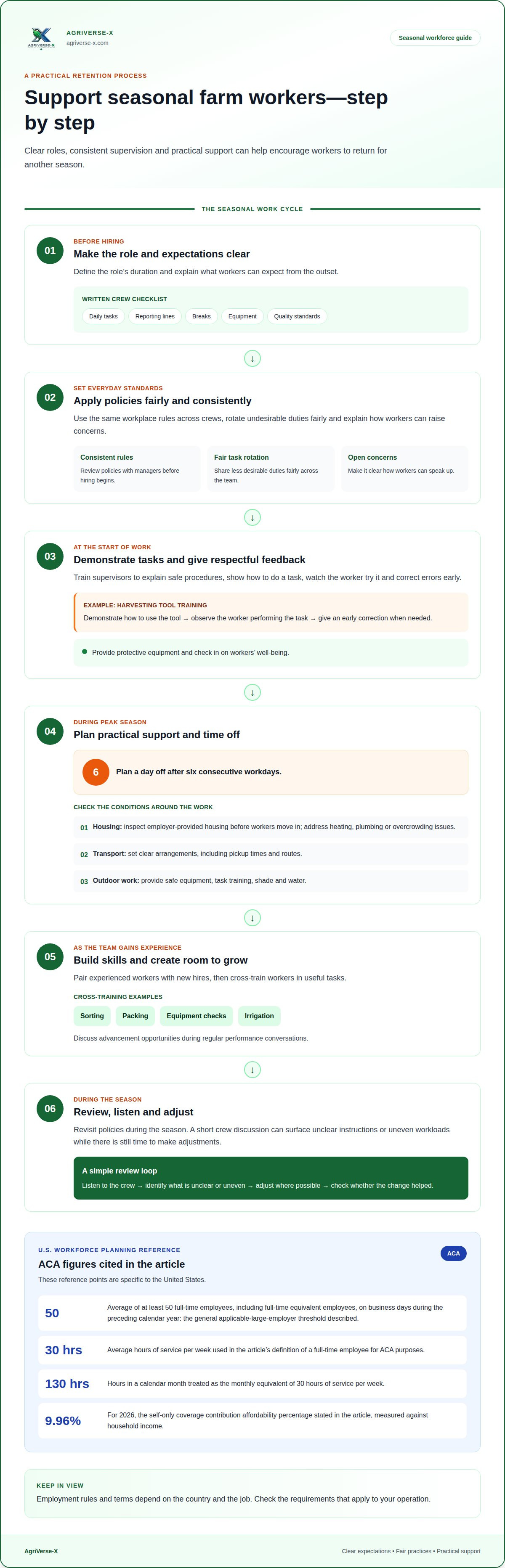
Clear workplace policies help seasonal workers understand expectations before fieldwork begins. Give each crew a written checklist covering daily tasks, reporting lines, breaks, equipment, and quality standards. A visual work board can show the day’s priorities and let workers track progress. Apply rules consistently, rotate undesirable duties fairly, and explain how workers can raise concerns.
Train supervisors to demonstrate tasks, explain safe procedures, and give feedback respectfully. For example, a crew lead can show a new worker how to use a harvesting tool, watch them perform the task, and correct errors early. Provide protective equipment and check in on workers’ well-being. During peak season, plan a day off after six consecutive workdays.
U.S. employers should also understand how seasonal staffing interacts with Affordable Care Act (ACA) thresholds. According to the Internal Revenue Service, an employer generally qualifies as an applicable large employer if it averages at least 50 full-time employees, including full-time equivalent employees, on business days during the preceding calendar year. For ACA purposes, the Internal Revenue Service defines a full-time employee as someone who works an average of at least 30 hours of service per week. According to the Internal Revenue Service, 130 hours in a calendar month is treated as the monthly equivalent of 30 hours of service per week. For 2026, the Internal Revenue Service considers ACA coverage affordable when an employee’s contribution for self-only coverage is no more than 9.96% of household income. Track hours and staffing patterns so managers can identify when these measures may matter.
Build development into the work plan. Pair experienced workers with new hires, then offer cross-training in tasks such as sorting, packing, equipment checks, or irrigation. Workers who learn several roles can help meet changing field needs and build skills for future responsibilities. Discuss advancement opportunities during regular performance conversations.
Improve housing, transportation, and working conditions with practical checks before and during the season. Inspect employer-provided housing before workers move in, and address heating, plumbing, or overcrowding issues. Set clear transport arrangements, including pickup times and routes, and provide safe equipment, task training, shade, and water for outdoor work.
Review policies with managers before hiring begins, then revisit them during the season. A brief crew discussion can uncover unclear instructions or uneven workloads while there’s still time to make adjustments. Consistent standards help workers perform with confidence and give farm teams a stronger foundation for retention.
Clear communication and schedule updates
Set a reliable communication rhythm before the first shift. A 15-minute check-in at the start of each Monday shift can cover the week’s schedule, field changes, safety concerns, and worker questions. Supervisors should share the same update so crews receive one clear set of instructions.
When weather or crop conditions change the plan, promptly inform affected workers. Explain which task has changed, where the crew should report, and whether start or finish times have shifted. Post the update on a workplace board and share it through the crew’s usual communication channel. Ask workers to confirm they received it.
Use onboarding conversations to explain who assigns tasks, how workers request schedule changes, and where they can raise concerns. For example, a new hire should know whether to contact a crew lead or supervisor if transport is delayed. Provide employment details in a language workers understand, as appropriate, and invite questions before work begins.
In the United States, seasonal farmworker earnings depend on pay terms, hours, and applicable wage rules. Workers are entitled to at least the highest minimum wage applicable under federal, state, or local law, and most nonexempt seasonal workers receive overtime at one and a half times their regular pay rate for hours over 40 hours in a week. Bonuses and benefits depend on the employer’s stated terms and applicable requirements.
Mentoring makes daily communication useful beyond task instructions. Pair a newer worker with an experienced team member who can explain crop-handling standards, demonstrate equipment routines, and answer practical questions during the shift. Supervisors can also invite interested workers to observe crew coordination or scheduling, showing a path toward greater responsibility.
Engagement grows when managers listen and respond. Ask workers which schedule changes create difficulties, then explain what can and cannot be adjusted. Where operations allow, offer flexible schedules for family needs and recognize specific contributions, such as careful sorting or helping a colleague learn a task.
End each check-in by restating the day’s priorities and identifying who is responsible for updates. These simple steps reduce conflicting messages, help crews work consistently, and make communication part of a dependable seasonal work program.
Farm labor challenges and staffing strategies
Seasonal labor needs change with planting, harvest, weather, and crop volume. A summer crew may face a different workload from a team handling storage or processing later in the season. Map tasks against the production calendar, then plan recruitment, training, and supervision for each work period. This helps teams respond to demand without relying on last-minute staffing.
In the United States, most nonexempt seasonal workers are entitled to overtime pay for hours worked over 40 hours in a week. The Migrant and Seasonal Agricultural Worker Protection Act (MSPA) sets standards concerning wages, housing, transportation, disclosures, and records. Break requirements depend on applicable rules, while housing used by migrant workers must meet applicable federal and state safety and health standards.
Child labor rules require particular care when assigning tasks. In the United States, children under 14 generally cannot be employed in any capacity, and 16- and 17-year-olds may work in non-hazardous occupations. Employees must be at least 18 to work in a non-agricultural hazardous occupation. Farm employers should match each worker’s age and assigned duties to the rules that apply to agricultural work in their jurisdiction.
Contracted recruitment can help fill staffing gaps, but it requires oversight. In the United States, farm labor contractors must register with the Department of Labor before performing farm labor contracting activities. Contractors must also obtain authorization before providing housing or transportation to migrant or seasonal agricultural workers. Employers and associations should take reasonable steps to verify that a contractor holds a valid registration certificate for the services involved.
Labor-tracking software can organize time, assignments, piece-rate output, and wage records in one workflow. For example, a supervisor can record a worker’s hours and completed harvest tasks on the same day, then compare those entries with payroll records. Accurate records help reveal workload patterns and reduce manual tracking errors. Choose a process supervisors can use consistently, even during busy harvest shifts.
Measure turnover by comparing departures with the average workforce over the same employment period. Review results by crew, role, and season, then record workers’ stated reasons for leaving. A brief exit conversation may reveal recurring issues, such as unclear duties, transport barriers, or schedule changes. Compare those findings with attendance and payroll records before revising staffing strategies.
Retention also reflects workplace culture. Ask workers what would make the next season more workable, and assign a manager to respond to recurring themes. Clear expectations, reliable records, and consistent treatment help agricultural teams address challenges early and build a stronger workforce across seasons.
Consistent onboarding for seasonal employees
Begin each worker’s onboarding with a written role summary. Describe daily duties, the supervisor’s name, work standards, and how to raise questions. A harvest worker, for example, should know which crop to handle, where to report, and how the team records completed tasks. Consistent details give seasonal workers a shared understanding from the start.
Complete required employment paperwork on schedule. In the United States, employers must complete Form I-9 Section 2 within three business days of a seasonal employee’s start date, according to U.S. Citizenship and Immigration Services. Assign a trained staff member to manage the process and keep onboarding records organized.
Explain compensation in plain language before the first shift. Put the pay basis, pay period, and method for recording hours or piece-rate output in writing. Walk each new hire through a sample timesheet, then explain whom to contact about a missing entry. Clear explanations help workers understand how recorded work connects to pay.
Make the first workday practical. Show workers the work area, tools, protective equipment, break locations, and emergency reporting process. Demonstrate a task, observe the employee doing it, and offer specific feedback. Pair new hires with an experienced colleague to learn crop-handling routines or equipment procedures, then check in after the first shift.
Include transportation in arrival planning. Give each worker the pickup point, route details, shift start time, and a contact for transport changes. If workers arrange their own travel, explain where to park and how to reach the supervisor before the shift. Clear instructions prevent avoidable confusion on the first morning.
Build engagement into onboarding. Ask each worker about their experience and skills, then connect their strengths to suitable tasks or cross-training. For example, a worker with packing experience could learn grading standards alongside field duties. A brief end-of-week conversation can uncover unclear instructions, workload concerns, or useful training needs.
Use the same onboarding checklist for every crew, while letting managers explain local tasks and conditions. Record the completion of orientation, demonstrations, and key conversations. Before the season ends, discuss performance and possible return opportunities. This gives seasonal workers a consistent process and managers a practical basis for improving future onboarding.
Guidance on finding, hiring, and retaining farm employees
Start with the crop calendar, not a generic hiring date. Map each task, skill, and expected work period against planting, harvest, packing, or processing needs. A vegetable operation may need field crews first, followed by workers for grading and packing. This plan helps managers define roles, recruit for relevant experience, and set clear expectations.
Make hiring information specific: describe duties, employment period, pay basis, schedule, and any housing or transport arrangements. In the United States, H-2A is an option for temporary or seasonal agricultural work, with no annual cap on visas. Employers must obtain temporary labor certification from the Department of Labor before filing with U.S. Citizenship and Immigration Services. H-2A employers must pay at least the highest applicable prevailing wage or federal, state, or local minimum wage. Employer costs depend on the hiring plan and applicable program obligations.
Build financial planning around the full employment period. Forecast hours, payroll, training, transport, and any employer-provided housing before making offers. Explain compensation and the expected schedule clearly, then keep records aligned with hours worked. In the United States, most nonexempt seasonal workers receive overtime at one and a half times their regular pay rate for hours over 40 hours in a week.
Benefits can strengthen an offer when they address workers’ practical needs. Predictable schedules, safe working conditions, clear pay information, transportation coordination, and flexibility for family needs can make a role more workable. In 2026, paid sick leave or general paid leave is required by 20 U.S. states and Washington, D.C.; most of those laws cover seasonal and temporary employees.
Match retention practices to the crop and local peak season. A short, concentrated harvest calls for clear shift planning and quick task training; crops that require repeated picking may benefit from steadier scheduling and cross-training. Ask returning workers which duties or conditions influenced their decision to return, then adapt the next hiring plan to their feedback. Each season, pair a few promising workers with a supervisor to observe scheduling and crew coordination.
Schedule an end-of-season conversation before work concludes. Review attendance, skills gained, preferred roles, and possible return timing. This creates a practical record for the next hiring cycle and shows workers how their experience may lead to greater responsibility. Retention strategies work best when organization, compensation, expectations, and flexibility fit the crop’s actual labor pattern.
How AgriVerse-X can support agricultural employers
AgriVerse-X is designed to help agricultural employers connect with workers and training providers through digital services. Worker connections, training options, and marketplace access depend on platform development, participating providers, and local availability. These services support connections, not guaranteed hiring outcomes.
Digital profiles are intended to help farmers, agribusinesses, cooperatives, service providers, and workers present relevant skills and credentials. Where this feature is available, employers could use profiles to identify capabilities a role requires, such as crop handling, machinery operation, or logistics experience. Profile information and credentials may require separate verification.
If workforce connection services are available in their location, employers could use them to plan recruitment around a crop’s work period. For example, an employer preparing for harvest can identify roles to fill and the skills each position requires. Workers may then be able to present relevant experience through digital profiles. Hiring decisions, employment terms, and any required checks remain the employer’s responsibility and are subject to applicable laws.
Training options may depend on participating providers and local availability. If courses are offered through the platform, they could cover farming, technology, safety, and business skills. An employer seeking to strengthen a seasonal team could explore training relevant to specific tasks, such as safe work practices or agricultural technology use. Training does not replace role-specific instruction or required workplace procedures.
AgriVerse-X is designed to support agricultural marketplaces for goods, inputs, machinery, technology, and services. Access to listings and services depends on platform availability, participating providers, and local conditions. If available, an operation preparing for planting could plan staffing alongside access to seedlings, irrigation, or logistics services. Listings and services are subject to applicable rules.
Where digital profiles are available, they can help workers present their skills beyond a single hiring conversation. Employers can make recruitment more focused with clear role descriptions and relevant skill requirements. Keep employment criteria, compensation, and schedules transparent in direct hiring discussions, and apply consistent processes to every candidate.
To ask about worker connections or training options for your agricultural operation, contact AgriVerse-X at [email protected]. Employment requirements vary by jurisdiction, so employers should seek advice from qualified professionals on applicable obligations.
Build continuity beyond the current season
Seasonal workforce continuity is built across cycles, not in a single hiring window. Treat crop-specific experience as an operational asset: returning workers can carry practical knowledge forward, while clear role expectations help new team members contribute sooner. Retaining seasonal farm employees becomes part of planning when each season informs how the next team is organized.
Use the end of the season to decide what continuity should look like for your operation. Identify roles where experienced workers add value, then consider how returning staff and new hires can work together as production needs change.
Build a stronger foundation for your next workforce plan. Explore AgriVerse-X’s agricultural ecosystem and consider how connected agricultural participation could fit your long-term direction.
Frequently Asked Questions
How long can you keep a seasonal employee?
In the United States, seasonal employment generally lasts less than six months, but that is not a universal limit for every job. A role may last a few weeks or several months, depending on the crop cycle, employer needs, and applicable rules. The Affordable Care Act uses a separate seasonal-worker definition for coverage purposes. That classification should not be treated as a general limit on how long someone may work.
What are the most effective ways to retain seasonal farm employees?
Retaining seasonal farm employees is easier to plan when managers learn why workers return or leave. Track return rates by role and season, then compare them with exit feedback and employment records. For example, if experienced packers return but new field hands do not, review how each role was explained and supported. Use those findings to improve next season’s offer and invite suitable former workers back early.
How far in advance should farms recruit seasonal workers, and which hiring channels work best?
Begin recruitment once the crop calendar and staffing needs are clear, allowing time for applications, selection, and required hiring steps. No single lead time suits every crop or location. Combine worker referrals with local agricultural networks, training institutions, community organizations, and workforce-matching platforms. Track which channels bring in applicants who meet the role requirements, then focus future outreach on the most relevant sources.
What onboarding and training practices reduce turnover among seasonal farm employees?
Give new hires a clear path from initial instruction to independent work. For example, use a simple skills record to show which tasks a worker has learned, which need supervised practice, and who can approve readiness. This helps managers assign work based on demonstrated ability rather than guesswork. Invite workers to flag training gaps, especially when a crop, tool, or workflow differs from their previous experience.
How can farms create schedules and offer hours that keep seasonal workers engaged?
Build schedules around crop demand while making expected hours as predictable as operations allow. For example, stagger crew start times when harvesting blocks mature at different points, and give workers a clear way to learn about weather-related cancellations. Where production permits, offer additional tasks or cross-trained roles during slower periods. Ask workers which schedule patterns affect their availability, then use that information when assigning shifts.


