

The paperwork can determine whether an agricultural shipment moves smoothly or stalls at a border. Agricultural export documentation typically includes a commercial invoice, a packing list and the correct HS code, along with a phytosanitary application and inspection when plant-health controls apply. Exact requirements depend on the product, exporting country and destination market.
These documents are more than administrative details. They describe the goods, confirm quantities and transaction details, classify the shipment and address plant-health requirements. Gaps or mismatches can cause delays, so make sure every document reflects the same shipment details.
This guide explains what each document does and how the pieces fit together. Learn how phytosanitary applications and inspections support plant-health checks, what commercial invoices and packing lists contain, and why HS codes matter when classifying goods. It also covers how requirements can differ for fresh produce, grains, plants, livestock and processed agricultural products, helping you organize paperwork for the shipment at hand.
Key Takeaways
- Align the commercial invoice and packing list so shipment descriptions and quantities are consistent.
- Use the correct Harmonized System classification to identify the commodity accurately.
- Find out which destination-country plant-health requirements apply before preparing a shipment.
- Match documentation and handling needs to the product, whether it is fresh produce, grain, livestock, plants, or processed food.
- Explore how digital profiles and traceability records can help organize agricultural product information.
Commercial invoices and packing lists
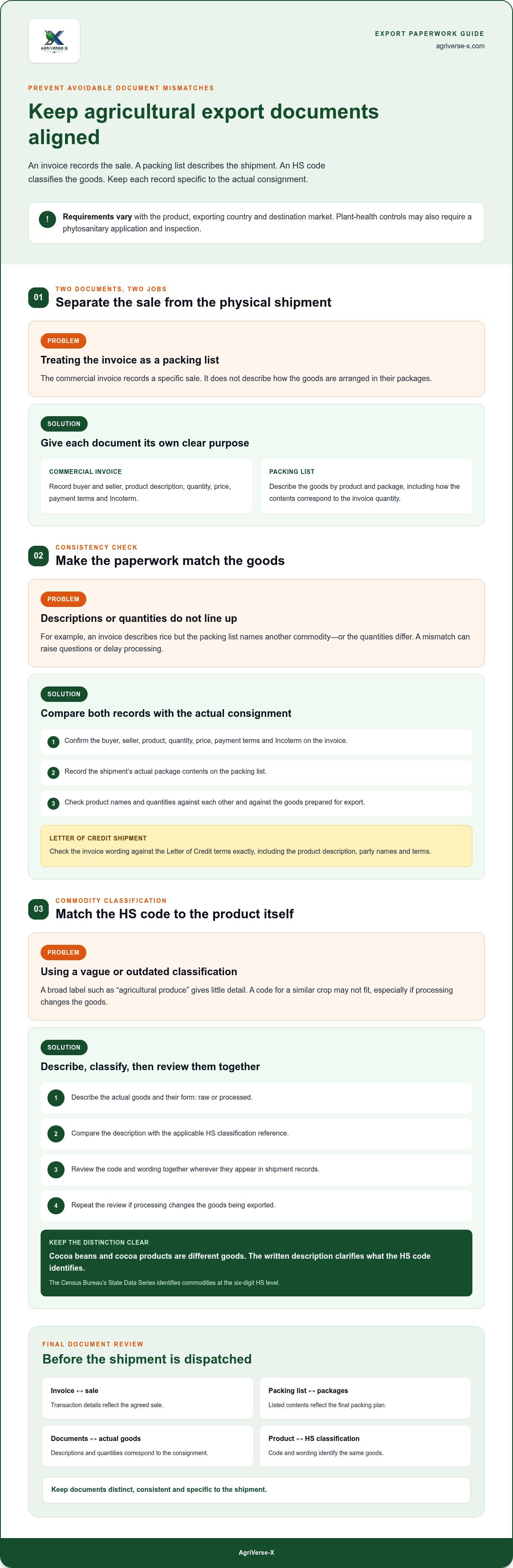
A commercial invoice records the sale; a packing list describes the shipment’s physical contents. Keep both consistent with the goods prepared for export.
Commercial invoices
A commercial invoice records the seller’s transaction for a specific export sale. For a rice shipment, it states the buyer and seller, product description, quantity, price, payment terms and Incoterm. Every entry should clearly reflect the same transaction.
Prepare the invoice from the agreed sales details. Compare the buyer and seller names, rice description, quantity, price, payment terms and Incoterm with the transaction records. Any mismatch can raise questions about the shipment’s contents or the terms of the sale.
Pay particular attention to payment terms. For a rice shipment paid for by a Letter of Credit, check that the commercial invoice is consistent with the Letter of Credit terms. Check the wording against the invoice before finalizing it. Even a small difference in the product description, party name or terms can break that exact match.
Keep the invoice focused on the sale. It is not a packing list: the invoice records transaction details, while the packing list describes how the goods are packed. In Malawi, agricultural export documentation includes commercial invoices, packing lists and certificates of origin. The certificate of origin is a separate document, not a substitute for the invoice.
Packing lists
A packing list describes how goods are arranged in their packages. It helps readers compare the physical consignment with the product description and quantity on the invoice.
Prepare the list from the final packing plan. Describe the goods by product and package, then show how the contents correspond to the invoice quantity. For example, a rice consignment can be organized by the packages containing the stated rice product. Clear descriptions help staff locate and reconcile individual shipment units.
Review both documents together before dispatch. Check that the product names and quantities match. If the invoice describes rice but the packing list names another commodity, resolve the discrepancy using the actual goods and sale records. Don’t use one document to silently correct the other.
A practical preparation sequence keeps the paperwork coordinated:
- Confirm the buyer, seller, product, quantity, price, payment terms, and Incoterm for the invoice.
- Record the shipment’s actual package contents on the packing list.
- Compare both documents with the goods prepared for export.
- For a Letter of Credit shipment, check the invoice wording against its terms exactly.
This document check strengthens agricultural export documentation by linking sale details to the physical shipment. Keep the invoice and packing list distinct, consistent and specific to the consignment.
Harmonized System commodity codes
A Harmonized System (HS) code classifies traded goods. The Census Bureau’s State Data Series identifies commodities using the Harmonized System at the six-digit level. Exporters can consult that reference to understand how commodities are grouped in the dataset.
Start classification with the product itself. Record what the goods are, their form and whether they are raw or processed. Cocoa beans and cocoa products, for example, are different goods. A broad label such as “agricultural produce” provides less useful detail than a specific commodity description.
Use the code alongside the product description. The code identifies a category, while the written description clarifies what is actually in the shipment. If a record says cocoa beans but the goods are cocoa products, review the mismatch. Don’t choose a code just because it seems close to the crop name.
Create a repeatable review process based on the goods being prepared. First, write a precise commodity description. Then compare it with the applicable HS classification reference. Check that the selected code and wording identify the same product, and keep the description consistent across relevant records.
Common errors include choosing a code for a similar product, using a vague description or carrying forward a classification after the goods change. These mistakes can prompt questions or delay processing; any penalty depends on the customs rules that apply to the shipment. A practical review can catch mismatches before documents are filed:
- Describe the actual product, such as cocoa beans or cocoa products.
- Record distinguishing details that clarify the product’s form.
- Compare the description with the six-digit HS classification reference.
- Review the code and description together wherever they appear in shipment records.
- Repeat the review if processing changes the goods being exported.
The six-digit level provides a structured way to identify commodities in the Census Bureau’s State Data Series and supports consistent product descriptions in trade records. Use the classification to help identify the commodity, not as a substitute for describing the actual goods.
For cocoa, distinguish the beans from products made from them before recording the classification. Precise wording helps staff understand what the code refers to and spot inconsistencies during document review. Keep the commodity description specific to the shipment.
Keep the commodity description aligned with the goods prepared for export, and review it whenever their form or processing changes. Anyone reviewing the record should be able to identify the commodity from the wording and confirm that the classification refers to the same item. If either is unclear, compare the description with the classification reference instead of relying on an approximate label.
At the six-digit level, the Census Bureau’s State Data Series uses the Harmonized System to identify commodities. Use it as a consistent framework for recording commodity identity, while keeping the product description specific enough to distinguish the goods. Applying the same comparison across records can help staff spot discrepancies before filing and maintain clear shipment documentation.
How do exporters find destination-country agricultural import requirements and phytosanitary rules?
Destination-country import requirements are conditions an importing market sets for particular goods. A phytosanitary certificate confirms that a plant or plant product has met applicable plant-health requirements.
Start with the destination country, exact commodity and intended use. Requirements for fresh produce may differ from those for grain, seed or processed food. Exporters in Malawi should check destination-country requirements, which may include import permits or phytosanitary certificates. For a rice shipment, importers are advised to confirm exact documentation requirements with a customs agent before placing an order.
Review requirements for the specific product rather than relying on a general country checklist. Record the product name and form, such as rice grain or seed, and its destination. Then determine whether the destination requires an import permit, plant-health certificate or other supporting documents. This helps distinguish rules that apply to the commodity from those that apply only to a particular shipment.
Origin-country procedures matter too. In Malawi, exporters apply for a phytosanitary certificate by submitting a completed Phytosanitary Application Form to the Department of Agricultural Research & Technical Services (DARS). After reviewing a complete application, DARS assigns an inspector to examine the products. Exporters in Malawi should also meet quality standards set by the Malawi Bureau of Standards, which may include certification under the Export Quality Certification Scheme.
India has different procedures and timing. Exporters are advised to apply for a Phytosanitary Certificate 2-3 days before shipment, or 8-10 days in advance for seed consignments. India’s Plant Protection, Quarantine & Storage department issues phytosanitary certificates for rice consignments. A certificate is valid for a maximum of 7 days for perishable consignments and 30 days for non-perishable consignments.
Organize the requirements in shipment order:
- Identify the destination, commodity, and product form.
- List destination-country permits and plant-health documents for that product.
- Complete the exporting country’s phytosanitary application process.
- Arrange the inspection and certificate within the applicable timing and validity period.
- Compare the resulting documents with the shipment description before dispatch.
In Malawi, products that fail phytosanitary standards may be quarantined while identified issues are addressed. A complete application and inspection connect the export process to the condition of the actual goods. Keep destination requirements, application details, inspection results and the certificate associated with the same consignment. This makes agricultural export documentation easier to coordinate across origin and destination procedures.
The page states that a phytosanitary certificate is mandatory for rice imports in almost every country. For market context, the State Trade by Country of Origin and Destination dataset covers all 50 U.S. states, Puerto Rico, Washington, DC, and approximately 230 international trading partners. It provides only the five most recent years of data, aggregated by fiscal quarter, and is updated quarterly. The data group monthly trade values into fiscal-year quarters running from October 01-September 30.
Trade figures can help describe export markets, but destination-specific import requirements still need to be checked for the product and shipment. In the 2021 Country of Origin and Destination data, Louisiana and Washington together accounted for 71 percent of U.S. soybean export value.
How do agricultural export documentation requirements differ for food, grain, livestock, plants, and processed products?
Product type determines which records and checks belong in an export file. Packaged food raises different questions from planting seed, live animals or processed oil. First identify the product’s form and intended use, then organize supporting records around those details.
Food products are intended for human consumption. Buyer requests can add documents to the shipment file. For rice, some Middle East buyers request a halal certificate, although plain rice does not strictly require one under the cited guidance. Certain European markets require a radiation certificate confirming rice is within acceptable levels. Keep buyer requests distinct from destination entry requirements so each document has a clear purpose.
Grain is a harvested cereal or pulse traded for planting, human consumption, animal feed, processing or industrial use. State the intended use precisely. Rice shipments may require a fumigation certificate before entry into the UAE, Kenya and the UK. Grain sold for planting serves a different purpose from grain sold for feed or food, so avoid descriptions that blur these categories.
Plants and planting materials include seeds, seedlings and other materials used to grow plants. Record the variety, origin, treatment, quantity, planting season and relevant certification details. For seed consignments, organize records around the seed’s identity and stated treatment. These details distinguish planting material from harvested produce and clarify the shipment’s contents.
Livestock and animal products include live animals and goods derived from animals, such as eggs, dairy and meat. Export paperwork may involve veterinary certificates, permits, inspections, welfare requirements, quarantine controls and food-safety approvals. Records for live poultry differ from those for packaged honey or inspected meat. Identify the specific product and its handling stage when assembling the file.
Processed products are agricultural goods changed through processing, such as flour, edible oil or packaged food. Describe the product and, where relevant, its grade or intended use. Edible oils, for example, may be food-grade, cosmetic-grade, industrial-grade or feed-grade, and may be crude, refined, filtered or processed. These distinctions help keep product descriptions precise.
Use this sequence to organize the shipment file:
- Identify the commodity and whether it is raw, live, or processed.
- Record its intended use, such as planting, food, feed, or industrial use.
- Separate buyer requests from destination-market requirements.
- Match supporting records to the product’s form and handling stage.
This product-based approach helps exporters prepare agricultural export documentation for the actual goods instead of relying on one checklist for every shipment.
What labeling, packaging, and traceability rules apply to agricultural exports?
An export label identifies the goods and provides information about a product or package. Packaging contains or protects goods during handling and transport. Traceability means keeping records that connect a product with its source and movement through the supply chain.
Describe the actual goods on each label. For example, a box of mangoes should not be labelled as another fruit or a processed product. Use consistent product names on labels and in internal shipment records. Buyer instructions and destination-market requirements determine any additional details, so prepare labels for the specific product and market rather than relying on a generic template.
Choose packaging according to the goods and how they will be handled. Honey needs different packaging from fresh mangoes or dry grain. Record the package type and contents clearly. If a consignment includes multiple products, distinguish them in the package information so handlers can identify each item without confusion.
Traceability records document the history of a product or consignment. A mango exporter, for example, can connect records for the supplier, packing, storage and dispatch. Keep related entries together so staff can follow the product’s movement and retrieve the right information when questions arise. Records support tracking, but they do not certify quality or replace a required inspection.
Use this review before dispatch:
- Write the product name and form accurately on the label.
- Match package descriptions to the goods they contain.
- Keep source and consignment records distinct for different products.
- Record relevant handling and movement details in the product file.
- Compare the label and records with buyer instructions and destination requirements.
A shipment containing fresh mangoes and packaged honey needs product-specific descriptions, not one label that treats both as the same goods. Keep each product’s records identifiable, especially when products share a shipment or storage location. Clear entries help staff link each item to the right product information and avoid confusion during handover.
Labels, packaging and traceability records serve different purposes: labels identify products, packaging contains them, and records preserve their history. Coordinate these details with the shipment file so each consignment has a clear, consistent identity. A practical recordkeeping routine also helps teams carry accurate product information into future shipments.
AgriVerse-X: Verified Agricultural Marketplace and Services
AgriVerse-X connects agricultural participants through verified digital profiles and marketplace listings. Exporters can use profiles to present products, services, skills and certifications, while digital traceability records help organize product information and compliance-aligned reporting.
A seller listing soybeans, sesame seeds or rice can provide clear details to distinguish products and intended uses. The platform also supports agricultural services such as logistics, processing and packaging, helping businesses coordinate related supply-chain needs. These tools complement shipment preparation; they do not replace destination-country requirements, certificates or customs procedures.
Use AgriVerse-X to organize agricultural business information and connect with relevant marketplace participants. Contact AgriVerse-X to learn more about the platform and its services.
Make Your Next Shipment Easier to Coordinate
Make shipment preparation a repeatable workflow. Assign responsibility for product details, document review and dispatch coordination. Keep the steps clear for everyone involved, from the producer and packer to the export team. A consistent process helps your business carry useful records from one consignment to the next.
Treat agricultural export documentation as part of operational planning, not a last-minute paperwork task. Effective coordination starts before goods are packed and continues through shipment handover. AgriVerse-X offers export documentation among its professional agricultural services, giving businesses support with export workflows.
Contact AgriVerse-X for export support and take the next step toward a more organized shipment process.
Frequently Asked Questions
What documents are required to export agricultural products from the United States?
A U.S. agricultural shipment may involve a commercial invoice, packing list, export filing, and product-specific certificates or permits. The exact set depends on the commodity and destination. U.S. exporters or their agents must file Electronic Export Information through the Automated Export System under Chapter 9, Title 13, United States Code. For rice shipments, check the destination’s requirements for the bill of lading and cargo release.
What customs documents are needed for U.S. agricultural exports, including commercial invoices and packing lists?
Prepare the invoice and packing list alongside the required customs export filing. For a rice shipment, the invoice includes the buyer and seller, product description, quantity, price, payment terms and Incoterm. The packing list describes the packages and their contents. U.S. exporters or their agents file Electronic Export Information through the Automated Export System. For rice shipments, retain the original bill of lading for destination-port release.
What are the steps and timelines for obtaining agricultural export permits and certificates?
First identify the product, destination and certificates or permits required for the shipment. Submit the relevant application with accurate product and consignment details, arrange any required inspection, and obtain the applicable certificate before dispatch. Then complete the U.S. export filing through the Automated Export System. Processing time depends on application review, inspection scheduling and certificate issuance, so include these steps in shipment planning rather than relying on a single timeline.


