

A strong business plan for agricultural commodity trading must show more than demand for a crop. It should explain how each purchase, sale, operating cost, and payment date affects cash on hand. Wholesale trading can involve substantial volumes, but upfront buying costs and delayed customer payments can create a cash shortfall even when projected sales look healthy.
It’s natural to start with commodities and buyers. But a workable plan also connects sales channels to sourcing, storage, transport, working capital, and realistic forecasts. Planning these elements together helps you see what the business needs to operate, where cash may run short, and how different trading models affect the numbers.
This guide covers practical steps for researching buyers and pricing, mapping operations and logistics, forecasting revenue and costs, and planning cash flow, break-even points, and contingencies. It also compares commodity-based and wholesale approaches so you can build a plan around the products, customers, and operating capacity you intend to serve.
Key Takeaways
- Map your target buyers, sales channels, pricing factors and backup markets before setting sales goals.
- Connect sourcing, storage, transport, labour and equipment plans to the timing of customer payments.
- Build forecasts from expected sales and operating costs, then use break-even analysis to assess the trading model.
- Track cash flow separately from profit, and plan for market shifts and operating disruptions.
- Compare commodity-based and wholesale models to choose an approach that fits your products, buyers and working capital.
Marketing, sales channels, and customer retention
Build your marketing around identifiable buyers, product requirements, and routes to market. Treat each sales strategy as part of the trading plan, not as a separate promotion.
-
Research Agricultural Markets and Demand
Research demand before choosing commodities or setting sales targets. Identify likely buyers, their purchasing needs, seasonal patterns, and factors that affect prices. For example, a grain trader can compare demand from food processors, animal-feed buyers, and wholesale distributors. Their product specifications and order timing may differ.
Record buyer conversations, inquiries, repeat orders, and rejected offers. These signals help distinguish steady demand from occasional interest. Assess competing products and backup markets, too. A plan that depends on one buyer or sales outlet leaves fewer options if that buyer changes its requirements.
-
Identify Target Consumers and Market Products
Match each commodity to the people and businesses that use it. A trader selling soybeans might target processors, feed businesses, or wholesalers, while sesame seeds may suit food manufacturers and bulk buyers. Define each product’s intended use and accurately describe its origin, quantity, handling, and other relevant characteristics.
Shape marketing messages around buyers’ actual decision criteria. A food processor may value consistent supply and clear product information; a retailer may prioritize packaging and reliable replenishment. If you pursue organic demand, use only substantiated claims. Vague labels can mislead buyers and undermine trust.
-
Develop Marketing and Brokerage Relationships
List the partners who can connect your business with buyers, suppliers, or market information. Brokers may introduce trading opportunities, while producer groups and cooperatives may support sourcing relationships. Define each relationship’s role in writing, including how leads are handled and commercial terms agreed.
Compare partner channels by the buyers they reach and the work they require from your team. A broker, for example, may open access to a wholesale buyer, while direct outreach gives you control over the customer conversation. Include relationship-building in your marketing investment, and track which contacts generate qualified inquiries.
-
Select Sales Channels and Retention Approaches
Choose sales channels that suit your products, order sizes, and customers. Options may include direct wholesale sales, processor contracts, distributor relationships, or an agricultural marketplace. Map how an inquiry becomes an order, then record who confirms specifications, coordinates delivery, and follows up after the sale.
Retain customers with reliable communication and clear records. Log each buyer’s preferred products, order patterns, feedback, and unresolved issues. After a soybean delivery, for example, ask whether the quantity and product details met expectations. Use feedback to improve service, refine marketing, and identify suitable repeat orders.
Business operations and supply chain logistics
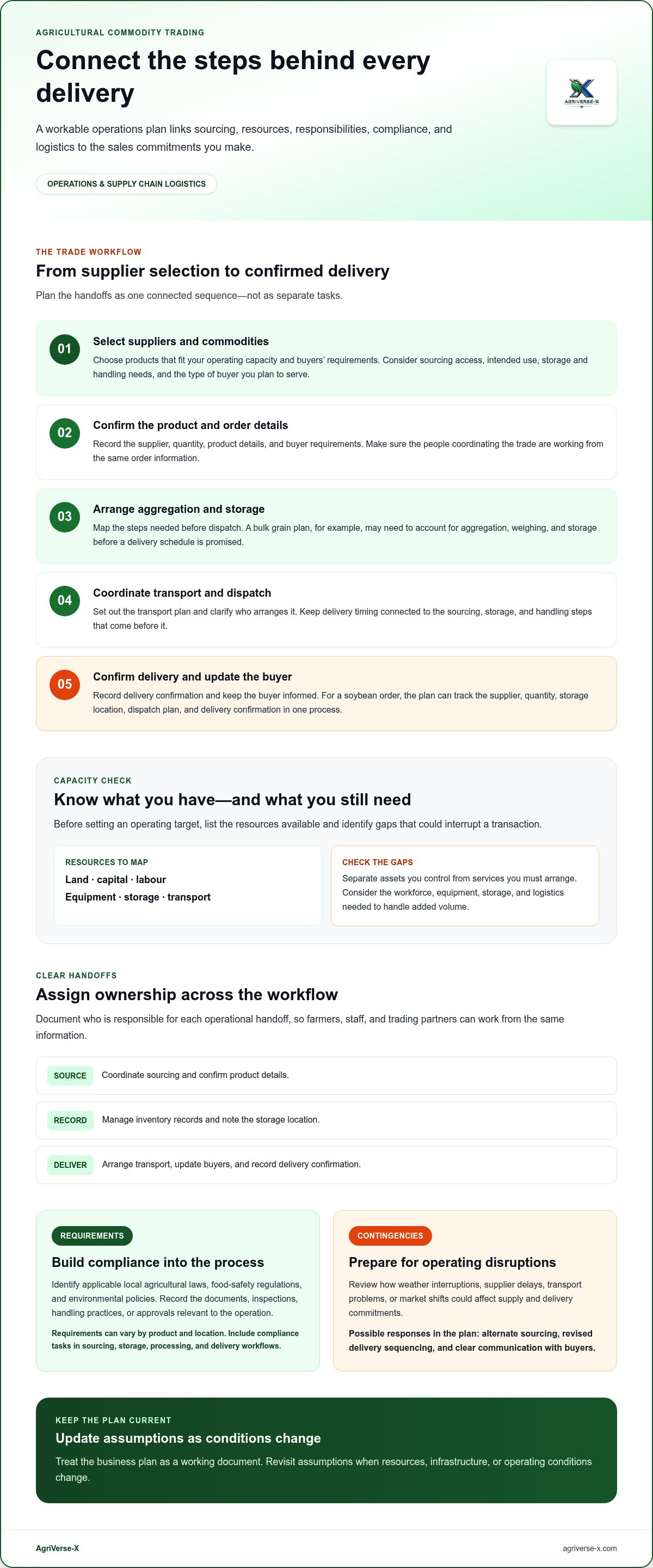
Turn your trading model into a workable sequence, from sourcing each commodity to completing delivery. A farm business plan should connect products, people, infrastructure, and logistics with the sales commitments described earlier.
- Choose commodities that fit your operating capacity and buyers’ requirements. Compare grains, soybeans, or sesame by sourcing access, intended use, storage and handling needs, and the type of buyer you plan to serve. Then map each trade from supplier selection through delivery. A bulk grain plan, for example, must account for aggregation, weighing, storage, and transport before promising a delivery schedule.
- Map your resources before setting an operating target. List available land, capital, labour, equipment, storage, and transport, then identify gaps that could interrupt a transaction. Separate assets you control from services you must arrange. A plan to expand leased land, for example, should also account for the workforce, equipment, storage, and logistics needed to handle the added volume.
- Document the workflow and assign responsibilities. Specify who coordinates sourcing, confirms product details, manages inventory records, arranges transport, and updates buyers. For a soybean order, record the supplier, quantity, storage location, dispatch plan, and delivery confirmation in one process. Clear handoffs help farmers, staff, and trading partners work from the same order information.
- Identify the requirements that apply to the products and locations involved. Include relevant local agricultural laws, food-safety regulations, and environmental policies in your business plan. Record the documents, inspections, handling practices, or approvals that apply to your operation. Requirements can vary by product and location, so build compliance tasks into sourcing, storage, processing, and delivery workflows instead of leaving them until the final paperwork.
- Plan for changes before they disrupt the transition from planning to daily operations. Review how weather-related interruptions, supplier delays, transport problems, or market shifts could affect supply and delivery commitments. Set out practical responses, such as alternate sourcing, revised delivery sequencing, or clear communication with buyers. Treat the farm business plan as a working document, updating assumptions when resources, infrastructure, or operating conditions change.
Financial forecasts and break-even analysis
Build a forecast that records expected sales, costs, cash movements, funding sources, and risks. Calculate the sales level at which revenue covers costs, and explain the assumptions behind each estimate.
-
Set Financial Assumptions
Base your assumptions on the trading plan, not on desired results. Record expected order volumes, selling prices, purchase costs, storage, transport, labour, and payment timing. Use buyer discussions and supplier terms to support each estimate. Separate confirmed commitments from forecasts so readers can see what drives projected profitability.
Then test how changes to individual assumptions affect the result. For example, model a delayed customer payment or higher transport costs. Don’t treat an optimistic sales target as guaranteed revenue. Include a risk assessment and contingency plan, such as adjusting order size or delaying a purchase when cash is tight.
-
Prepare Financial Projections
Prepare an initial budget, revenue forecast, cost estimates, cash-flow analysis, and balance sheet. Show how each trading cycle moves from commodity purchase to customer payment. Keep revenue and cash receipts separate: recording a sale does not put cash in hand before the buyer pays. Make funding needs visible across that timing gap.
Summarize the business concept, mission, goals, projections, and financing request in the executive summary. Then name potential funding sources, such as banks, credit unions, the Farm Service Agency, or private entities. According to the USDA Farm Service Agency, a detailed business plan is required for an FSA loan, a guarantee on a commercial lender's loan, or a land contract. USDA Form FSA-2038 is part of the farm loan application and identifies information to gather.
-
Analyze Break-Even
Determine the sales volume needed to cover costs before forecasting a surplus. Separate fixed costs from costs that rise with each traded unit. Then divide fixed costs by the contribution per unit, the selling price minus variable cost. This gives you a practical threshold for testing a proposed trading plan.
Run the calculation for each commodity or sales channel. A bulk soybean transaction and a smaller sesame order may have different handling, storage, and transport costs. Compare the resulting break-even points with forecast demand, then revise the plan if expected sales fall short. Use the analysis to assess funding needs and explain how the business would respond to weaker margins or delayed payments.
Profit, cash flow, and balance sheet planning
Track profit, cash timing, assets, liabilities, and ownership separately. Connect each measure to operating decisions and the business’s growth plans.
- Prepare a cash-flow schedule showing when money enters and leaves the business. Separate recorded sales from payments received, then map supplier bills, wages, storage, transport, and debt payments by due date. A completed sale can increase reported revenue while an unpaid invoice leaves less cash for the next trading cycle. Use the schedule to spot when available cash may fall below operating needs.
- Build a balance sheet showing assets, liabilities, and ownership equity. Record cash, inventory, equipment, and receivables as assets, then list loans and unpaid bills as liabilities. USDA Form FSA-2037 is a farm business plan balance-sheet template for recording assets and liabilities. Update these records when inventory moves, a buyer pays, or the business takes on a new obligation.
- Set profit and growth goals that connect to measurable operating results. One farm business goal example is improving return on assets to 6% by year-end. Identify which assets and operating choices affect that measure, then compare progress with actual records. Keep long-term goals separate, since they may take several years to achieve. Clear writing helps owners and staff understand how each goal guides decisions.
- Link each funding need to a specific business activity and its timing. For example, connect a planned inventory purchase to the order cycle it supports, then show when the cash is needed and when sales receipts are expected. Distinguish working capital from longer-term spending on equipment or infrastructure. This detail helps readers assess whether the requested funds match operational needs and projected cash availability.
- Write contingency and ownership plans alongside your growth targets. Identify how market volatility or weather disruptions could affect cash, supply, and delivery, then outline practical responses, such as revising purchase timing or adjusting operating priorities. Record who can approve changes and how ownership decisions will be handled during a transition. Review the plan when assumptions, management roles, or available resources change.
Commodity-based and wholesale business models
Choose a model by defining what you trade, who buys it, and how each transaction generates revenue. Traders make money by selling commodities for more than their combined purchase and trading costs. There is no single typical margin: the commodity, volume, quality, storage, transport, and contract terms all affect the result.
-
Define Commodity-Based and Wholesale Models
Decide whether your business will focus on staple commodities, wholesale distribution, or a combination. Commodity trading often centers on crops such as wheat, rice, and corn, which have established markets. Wholesale operators buy or aggregate products, then sell larger quantities to processors, distributors, or other business buyers. Match the model to your sourcing access, buyer demand, and operating capacity.
Starting with one suitable crop can simplify sourcing and sales. A broader portfolio may serve more buyers, but it adds product-specific handling and coordination. Describe your chosen model in the plan, including how farm supply connects with buyers and which sustainable sourcing criteria matter to your intended market.
-
Assess Trading Earnings and Margins
Calculate earnings by subtracting the full costs of each transaction from its sale proceeds. Include commodity acquisition, grading or handling, storage, transport, brokerage, and losses where applicable. A soybean wholesaler, for example, should compare the sale terms with the costs of assembling and delivering that order.
Do not rely on a generic margin assumption. Compare actual offers and costs for each product, buyer, and route. The United States has approximately 2,000 companies independently trading futures and commodities contracts for profit, and these firms collectively generate more than $25 billion in revenue each year. These figures describe the sector, not a typical trader’s margin.
- Decide whether your business will earn through physical commodity resale, brokerage, or both. A reseller takes ownership of inventory and earns from the difference between buying and selling prices. A broker connects parties and earns through an agreed brokerage arrangement. Keep these models distinct in your plan because their inventory exposure, costs, and responsibilities differ.
- Test each model against actual trading conditions. For physical resale, assess how product quality, storage time, delivery distance, and order size affect the result. For brokerage, consider whether buyer and seller requirements align and how introductions become completed deals. Use relevant market evidence rather than assuming that higher sales volume will improve profitability.
- Set clear limits for expansion. Add commodities only when sourcing, buyer demand, handling capacity, and sales processes support them. Record the assumptions behind each decision and review them as the business develops. This keeps growth tied to workable trade opportunities, rather than expanding into products or programs without a clear commercial role.
AgriVerse-X: The Digital Agricultural Ecosystem
AgriVerse-X helps agricultural businesses create verified digital profiles and use marketplaces for agricultural goods, services, and related supply-chain needs. Commodity traders can use profiles to showcase products and business information, while marketplace listings can connect agricultural participants around goods such as soybeans and sesame seeds.
Use digital traceability records to organize relevant product and transaction information. AgriVerse-X also supports listings for logistics, storage, and equipment rentals, helping traders plan operational needs alongside their sales model. These tools support commercial connections and recordkeeping, but do not replace financial forecasts, due diligence, or applicable professional advice.
If you’re ready to explore digital tools for agricultural trading, contact AgriVerse-X at [email protected].
Turn Your Trading Plan Into a Clear Next Move
A business plan for agricultural commodity trading should guide decisions as conditions change, rather than sit untouched after you write it. Set regular review points, compare actual results with your assumptions, and record the reasons for any changes. This creates a practical reference for evaluating opportunities and aligning operating choices with your business goals.
At your next review, identify the decision that needs attention first, such as a cash-flow pressure point, supply change, or new buyer requirement. Turn that finding into a clear action and assign someone to handle it. A focused next step helps move planning into steady, informed progress.
Contact AgriVerse-X to discuss your trading plan and consider how your next business decision can support sustainable growth.
Frequently Asked Questions
What should an agricultural commodity trading business plan include?
A business plan for agricultural commodity trading should connect the trading model with customers, operations, cash needs, and risks. Include the executive summary, target commodities, buyer segments, sourcing approach, sales channels, and delivery workflow. Add revenue and cost forecasts, cash-flow projections, break-even analysis, funding needs, and contingency measures. For example, show how a delayed payment on a grain order affects the funds available for the next purchase.
How do you choose commodities and target markets for a trading business?
Choose commodities by matching buyer demand with sourcing access and your ability to manage each product. Compare intended uses, such as food processing or animal feed, and note the buyer’s specifications. Then assess how storage, handling, and delivery affect your ability to serve that market. For example, a trader considering rice and soybeans can assess processor, wholesale, and feed-market demand separately before choosing a focus.
What are typical startup costs and working capital needs for agricultural commodity trading?
Startup and working-capital needs depend on the business model, trading volume, and timing of cash receipts and payments. Estimate commodity purchases, storage, transport, labour, equipment, administration, and other operating costs. Then map when each amount is due against expected customer receipts. A trader holding inventory before delivery needs to plan for cash tied up in stock, while a broker’s funding needs follow a different cost structure.
What licenses, registrations, and regulations apply to U.S. agricultural commodity traders?
Build a compliance checklist around the commodities, business activities, and locations involved. In the United States, identify applicable local agricultural laws, food-safety regulations, and environmental policies. Separate requirements for buying and selling from those for handling, storage, processing, or transport. Record the person responsible, required documentation, and review point for each item. The product and business activity determine which checks belong in the plan.
How do you source grain and other agricultural commodities from farmers or suppliers?
Source commodities by setting clear supplier criteria and documenting each purchase. Specify product type, intended use, quantity, origin, delivery arrangements, and agreed quality terms in the transaction records. A trader buying maize for a processor, for example, should match the supplier’s product details to the buyer’s order before arranging collection. Cooperatives and producer groups can also help coordinate supply from multiple farmers.
What storage, transportation, and logistics are needed for commodity trading?
Plan storage and transport around the commodity’s handling needs, order size, delivery point, and timing. Map the route from supplier to storage location and on to the buyer, assigning responsibility for each handoff. For grain, include inventory records, weighing, storage coordination, loading, and delivery confirmation. Compare these steps with the sales agreement so logistics support the transaction without avoidable delays or mismatched quantities.
How do futures, options, and other hedging strategies manage agricultural price risk?
Futures and options can offset some price exposure, but they differ from physical commodity sales. A futures position creates an obligation under its contract terms, while an option gives its buyer a choice to act under specified terms. Map how any hedge relates to the commodity, timing, and volume being traded. These strategies involve financial risk and require appropriate expertise and due diligence.
What are the main risks in agricultural commodity trading, including credit, quality, and market risks?
Key risks include buyer nonpayment, supplier shortfalls, quality disputes, price changes, and disruptions to storage or transport. Link each risk to an operational control. For credit exposure, define payment terms and monitor overdue balances. For quality, record agreed specifications and delivery evidence. For market risk, test how price changes affect projected margins. A written contingency plan should identify who responds and which transactions need prompt review.


