

IFS Food standards set requirements for food safety and product quality, assessed through an audit against defined criteria. The audit checklist referenced here is IFS version 8. Certification body accreditation is a separate layer: an accreditation body assesses whether a certification body is competent to perform its work.
A certificate and accreditation are easy to confuse, but they serve different purposes. Knowing the difference helps you understand what a certification demonstrates and how the audit process fits together.
This article explains certification-body accreditation and what IFS food safety and product quality standards cover. It also compares IFS with other international food safety certifications, clarifying the distinct roles of a standard, an audit, and an accredited certification body.
Key Takeaways
- Distinguish a food safety standard, an audit, a certificate, and accreditation to understand what each one demonstrates.
- Identify how IFS addresses food safety and product quality, then compare its approach with other certification schemes.
- Separate HACCP-based hazard controls from broader certification requirements, and understand how they fit together.
- Use the SQF and BRCGS sections to see the kinds of systems, controls, and evidence certification audits assess.
- Explore how AgriVerse-X digital profiles and traceability records can help agricultural businesses present products, services, and credentials.
IFS food safety and product quality standards
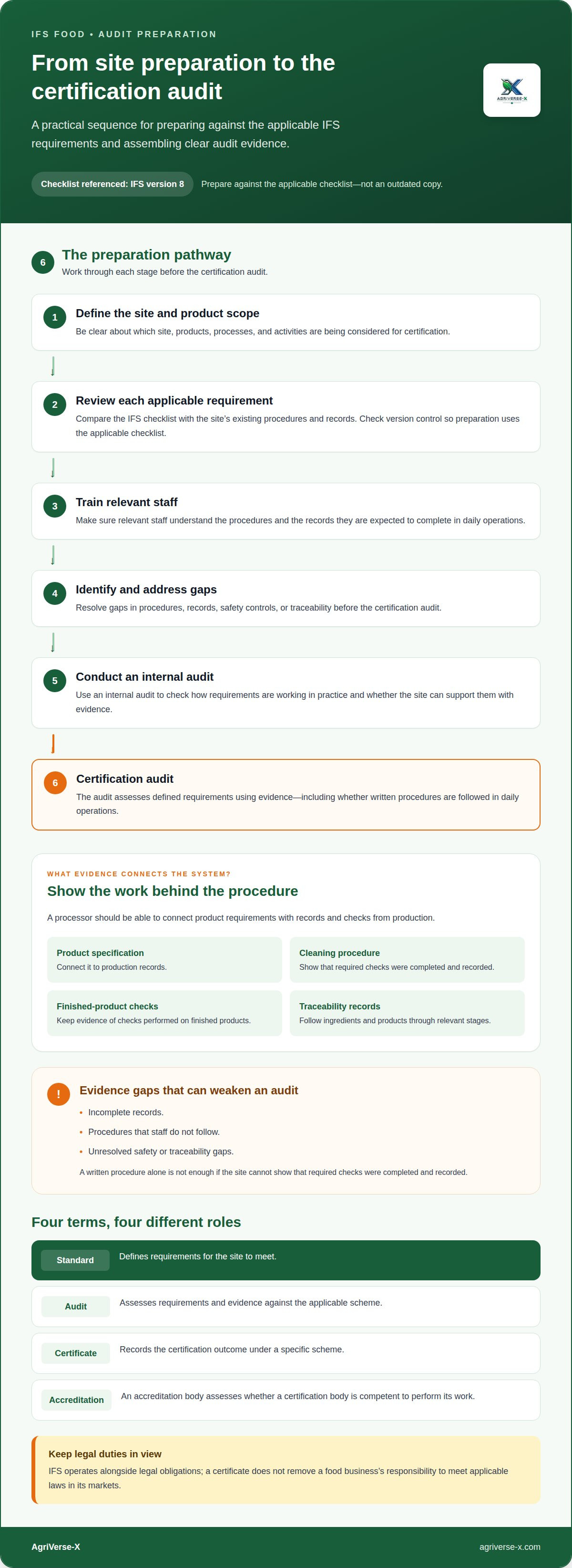
IFS Food assesses whether a food-processing site controls product safety, quality, and production processes. The audit uses defined requirements and evidence, not a certificate alone, to examine how written procedures work in daily operations. The current audit checklist referenced for this section is IFS version 8. That makes version control important: a site should prepare against the applicable checklist, not an outdated copy.
Auditors assess whether management responsibilities, staff practices, facilities, and operational controls support safe, consistent products. A processor, for example, should be able to connect a product specification with production records, cleaning procedures, and finished-product checks. Traceability records should let the site follow ingredients and products through relevant stages. Together, these controls link product quality with practical food-safety management.
IFS operates alongside legal obligations, rather than replacing them. The European Union's General Food Law Regulation is Regulation (EC) No. 178/2002, according to the European Union. A certificate therefore does not remove a food business's responsibility to meet applicable laws in its markets. Buyers can use an IFS audit result to assess a supplier, while regulators and customers retain their separate roles.
How long does certification take, and how often must it be renewed? Preparation time depends on the site’s current controls, documentation, and ability to address gaps before the audit. Renewal follows the scheme’s certification cycle, so businesses should plan for recurring audits and keep records up to date between them.
Which food safety certifications do US retailers and international buyers require? No single certificate is required by every US retailer or international buyer. Acceptance depends on each customer’s supplier criteria, product category, and supply chain. IFS is one option among international food safety certifications.
How much does certification cost in the United States? The total cost depends on audit scope, site complexity, preparation needs, auditor time, and travel. Request an estimate that separates audit work from internal preparation and any corrective actions needed.
What steps help prepare for and pass an audit? Define the site and product scope, review each applicable requirement, and compare it with existing procedures and records. Train relevant staff, address identified gaps, and conduct an internal audit before the certification audit.
What commonly causes an audit failure? Incomplete records, procedures that staff do not follow, and unresolved safety or traceability gaps can weaken audit evidence. A written cleaning procedure, for example, is not enough if the site cannot show that staff completed and recorded the required checks.
Food businesses should account for the legal framework in each market when planning compliance. The Food Standards Act is an example of food-safety legislation in the United Kingdom. India’s Food Safety and Standards Act established a unified national food-safety framework overseen by the Food Safety and Standards Authority of India. These examples show why an IFS audit does not replace market-specific legal obligations.
IFS and the Netherlands Food and Consumer Product Safety Authority (NVWA) marked ten years of collaboration in 2026.
How do GFSI-recognized food safety certification schemes compare?
GFSI recognition helps buyers compare certification programmes against shared benchmarking requirements. The Global Food Safety Initiative was established in 2000. It evaluates Certification Program Owners against those requirements, but it does not conduct audits or issue certificates. A business receives a certificate through an audit under a specific scheme, not directly from GFSI.
That distinction matters for exporters. A GFSI benchmark does not make every scheme identical, nor does it mean every buyer accepts every certificate. IFS, BRCGS, SQF, and FSSC 22000 are scheme names exporters may encounter when reviewing customer or market requirements. The useful comparison is how each scheme’s requirements fit the site, products, processes, and buyer expectations.
FSSC 22000 is a management-system-based food safety certification scheme, according to Foundation FSSC. That description points exporters toward the management system as a central focus of its certification approach. Compare this with the audit structure and scope stated in the specific programme documents for IFS, BRCGS, and SQF. Avoid assuming that a familiar scheme name automatically covers every activity at a facility.
Compare schemes based on operational fit, not name recognition alone. For each scheme under consideration, record the following:
- Scope: Identify which products, processes, locations, and activities the certificate would cover.
- Buyer acceptance: Match the scheme against documented requirements from current and prospective customers.
- Audit model: Review how the scheme assesses management controls, operational practices, records, and corrective actions.
- Site readiness: Compare the requirements with existing procedures, staff responsibilities, and evidence available at the facility.
Consider an exporter supplying buyers with different supplier specifications. One buyer may name a particular scheme, while another may accept alternatives. Before choosing an audit path, the exporter should map each buyer’s requirements to the intended certification scope. This reduces the risk of selecting a certificate that does not meet a target customer’s expectations.
Use scheme documents and buyer criteria as separate inputs. GFSI benchmarking addresses programme-level alignment, while a buyer’s supplier rules determine that buyer’s acceptance criteria. Neither removes the need to understand the certificate’s scope or the audited facility’s responsibilities.
For exporters, the practical decision is to compare scope, audit requirements, customer acceptance, and the resources needed to maintain the system. A recognized scheme can support supplier assurance, but its usefulness depends on how well it fits the products and markets served.
What is the difference between food safety certification and HACCP certification?
Food-safety certification generally assesses a defined management system against a named scheme. HACCP is a method for identifying food-safety hazards and deciding how to control them. These terms are related but not interchangeable: one describes a certification outcome, the other a hazard-control approach.
A broader certification may assess more than a HACCP plan. Depending on its requirements and scope, an audit may examine management responsibility, documented procedures, staff training, supplier controls, traceability, and corrective actions. HACCP remains central where hazards need to be analysed and controlled. The scheme and certificate scope determine what the audit covers.
Consider a processor making packaged soup. Its HACCP work might identify a process step where a hazard must be controlled, then specify monitoring records and actions for deviations. A broader food-safety certification audit may also check whether staff follow the procedure, records are complete, and management reviews recurring problems. This connects hazard controls to the wider system.
The phrase “HACCP certification” can refer to different audit arrangements. It might mean an audit focused on HACCP principles or a broader scheme that includes HACCP requirements. The label alone does not show which products, operations, or locations were assessed. Check the scheme name and certificate scope to understand its coverage.
For exporters, a HACCP certificate and a broader food-safety certificate may address different buyer needs. A customer might request evidence of HACCP controls, certification under a named scheme, or both. Treat these as distinct requirements. A certificate alone does not establish that every product line or site in a supplier’s operation is covered.
Use this sequence to compare the options:
- Define the need: Record the buyer’s requested scheme, evidence, and scope.
- Map the operation: List the products, processes, and locations covered by the intended audit.
- Review current controls: Compare the HACCP plan, procedures, training, and records with the selected scheme’s requirements.
- Check the certificate scope: Confirm that its wording matches the relevant site and activities.
HACCP provides a structured way to identify hazards and controls. Certification indicates that an audit assessed a defined scope against a particular scheme. When deciding what is needed, determine whether the buyer requires evidence of HACCP implementation, broader system certification, or both. Record the exact requirement to avoid treating different documents as interchangeable.
What are the requirements for SQF certification?
SQF certification requires a food site to implement the applicable SQF Code and demonstrate its controls during an audit. Requirements depend on the operation, products, processes, and code scope. A processor handling ready-to-eat food, for example, needs controls suited to its hazards and production activities. First identify the correct code and the site activities the certificate should cover.
Preparation starts with a documented food-safety management system. The site needs assigned responsibilities, written procedures, staff training, monitoring records, and a process for correcting problems. Hazard analysis should link identified risks to controls, responsible staff, monitoring evidence, and actions taken when a control fails. The auditor evaluates whether the arrangements are implemented, not merely included in a manual.
Good Manufacturing Practices support the operating conditions behind those controls. The U.S. Food and Drug Administration identifies 21 CFR Part 110 as a GMP reference. In practice, a site can organize its preparation around topics such as employee hygiene, cleaning, equipment condition, pest management, and records. The relevant SQF Code and the site’s products determine which requirements apply to its audit scope.
Build readiness through a sequence of practical steps:
- Set the scope: Document the products, processes, and location included in the certification request.
- Assign ownership: Give a trained food safety practitioner responsibility for coordinating the system and audit preparation.
- Assess hazards: Map process steps, identify relevant hazards, and document the controls used at each step.
- Implement procedures: Train staff and keep records showing that monitoring, sanitation, and other controls happen as written.
- Review gaps: Conduct an internal assessment, record findings, assign corrective actions, and retain evidence of completion.
A dry-goods facility, for example, should be able to show how it receives ingredients, checks storage conditions, prevents contamination, and traces a finished lot through its records. Documents and checks should reflect the actual workflow. If written procedures differ from staff practices, the mismatch weakens audit evidence.
During an audit, the auditor reviews records and observes site practices against the applicable SQF requirements. Findings require documented responses showing how the site addresses the problem and prevents recurrence. Certification depends on the audit outcome and scheme rules. Prepare by linking each requirement to a responsible person, a working control, and verifiable records. Keep evidence organized for ongoing system management, not just audit day.
What are the requirements for BRCGS Food Safety certification
BRCGS Food Safety certification assesses a food site against the applicable edition of the BRCGS Global Standard Food Safety. The audit considers the site’s products, processes, documented controls, and daily practices. Define the location and activities intended for certification. A warehouse handling packaged food, for example, has a different operational scope from a facility processing raw ingredients.
Preparation begins with a structured food-safety and quality management system. The site needs clear responsibilities, controlled documents, staff training, operating procedures, and records showing that procedures are followed. Management must support implementation, while designated staff coordinate hazard controls and audit evidence. Procedures should reflect actual work, not an idealized process employees do not use.
Hazard analysis and risk-based controls connect the written system to production. A processor should map each relevant process stage, identify hazards, and document how they are controlled. A site handling allergens, for example, should define how it prevents cross-contact and records checks. The audit can compare these controls with employee practices, cleaning records, and production evidence.
Sites should organize preparation around key evidence areas:
- Scope and products: List the facility, product categories, processes, and activities covered by the audit.
- People and responsibilities: Identify who manages food safety, trains employees, monitors controls, and responds to problems.
- Operational records: Gather examples of cleaning, maintenance, supplier checks, monitoring, and product traceability records.
- Corrective actions: Record identified issues, assigned actions, completion evidence, and steps to prevent recurrence.
A useful preparation exercise is to trace a finished product backward and forward through available records. For a packaged product, link incoming ingredients with production documentation and dispatch information. This practical test can reveal missing links before the auditor requests evidence. It also helps confirm that records match the product and site scope defined for certification.
Before the audit, review the current BRCGS standard and supporting requirements for the applicable site category. Train relevant staff to explain their tasks and present records accurately. An internal review can identify differences between written procedures and actual practice. Correct gaps, assign responsibility, and retain evidence of completed actions.
During the certification audit, the auditor examines documents, observes operations, and assesses whether the site’s controls work in practice. Findings need clear responses supported by records. Keep the system active after certification: update procedures when processes change, maintain training records, and review corrective actions. This makes audit preparation part of routine site management instead of a last-minute paperwork exercise.
AgriVerse-X: Verified Agricultural Digital Platform
AgriVerse-X helps agricultural businesses organize their digital presence after they have reviewed certification requirements. Farmers, agribusinesses, cooperatives, and service providers can create profiles showcasing products, services, skills, and certifications. These profiles help buyers understand what a supplier offers and the credentials it presents.
For exporters, digital traceability records and compliance-aligned reporting can help organize agricultural records. A business could bring together information about products such as soybeans or grains and relevant credentials. Platform records do not replace food-safety certification, an audit, or verification by an authorized body.
Use AgriVerse-X when you want to present agricultural products and credentials through a digital profile or explore marketplace connections. For information, contact AgriVerse-X or visit agriverse-x.com.
Turn certification knowledge into clear next steps
In your next review, connect certification decisions with the information buyers need to understand your business. Map your products, operating sites, and existing records, then identify the credentials and supporting documents to present. Keep certification evidence separate from digital profiles and traceability records. Each serves a different purpose in explaining how your operation works.
For agricultural businesses preparing to engage buyers, AgriVerse-X provides verified digital profiles for showcasing products, services, skills, and certifications. Its digital traceability records and compliance-aligned reporting can also help organize relevant business information. These tools complement certification work; they do not replace an audit or certificate.
Make the next step practical: decide what information you need to organize and how you want buyers to discover it. Explore how AgriVerse-X can support your agricultural profile and records by contacting AgriVerse-X about organizing your profile and records. A clear, well-organized approach to international food safety certifications can help you move forward with greater purpose. Build your next step on the requirements that matter to your operation.
Frequently Asked Questions
What are the major internationally recognized food safety certifications?
Commonly encountered schemes include IFS, BRCGS Food Safety, SQF, and FSSC 22000. FSSC 22000 is a management-system-based food safety certification scheme. These programmes differ in structure, scope, and audit approach, so the best fit depends on the facility’s products and processes. Before selecting among international food safety certifications, compare the scheme with the specific requirements of intended buyers and confirm which sites and activities the certificate would cover.
How can businesses verify an accredited food safety certification body?
Check the certification body’s current accreditation record in the relevant accreditation body’s official directory. Confirm that it covers the exact food-safety scheme, standard, and activity you need, rather than a different certification service. Compare the certificate’s legal name, site, scope, issue and expiry details, and status with the body’s records. If a buyer requires a particular scheme, verify that the certification body is accredited for that scheme and scope.


