

Across Africa, the ratio of agricultural extension officers to farmers is 1:1,000. An AI farm assistant can help bridge information gaps by turning a farmer’s question into tailored crop-management guidance, delivered through voice or text. Its usefulness depends on the context provided and the decision at hand.
Good advice takes more than a quick answer. Farmers need to describe a situation in familiar words, ask follow-up questions, and understand what shaped a recommendation. Voice interaction can make it easier to ask questions while working; text can capture instructions for later review or sharing with a team.
This guide explains how an AI farm assistant can support personalized recommendations, crop monitoring, and livestock recordkeeping, and where human judgment remains essential. Learn how to frame useful prompts, assess suggestions carefully, and protect farm information when using digital tools. The goal is practical: make each interaction support clearer observations and better-informed decisions, while farmers stay in control.
Key Takeaways
- Share crop type, growth stage, field conditions, and the decision you face to get more relevant recommendations by voice or text.
- Turn broad crop questions into specific prompts, then compare suggestions with what you observe in the field before acting.
- Review how an AI tool handles uncertainty, local context, and farm data before making it part of routine decisions.
- Use AgriVerse-X’s digital profiles and agricultural marketplace to connect relevant farm products, services, and technology with agricultural participants.
- Keep digital guidance in its proper role: a decision-support tool that complements farmer experience and appropriate professional input.
Personalized crop-management recommendations
An AI farm assistant can turn farm observations into practical guidance when you provide clear context. Include the crop, variety, planting date, growth stage, field location, and current concern. For example, a rice grower noticing uneven growth can describe the affected area and when the difference appeared. The assistant can then help organize follow-up questions about possible factors, such as water distribution or planting consistency.
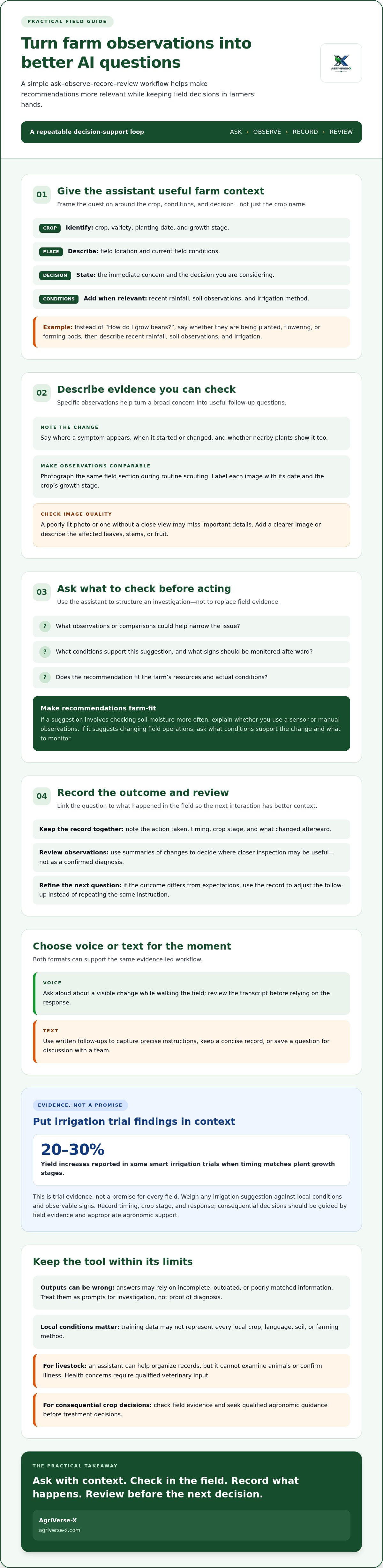
Build a useful prompt around a decision, not just a crop name. Instead of asking, “How do I grow beans?”, say whether the crop is being planted, flowering, or forming pods. Add recent rainfall, soil observations, and the irrigation method if relevant. Then ask what to check before changing field routines. This gives the assistant useful context and makes its suggestions easier to assess.
Voice and text suit different moments in the workday. A farmer walking a field can ask aloud about a visible change, then use text later to keep a concise record. A cooperative member planning work might type a question about the order of field tasks and save the answer for discussion. In either format, review the transcript or written details before relying on the response.
- Set the context: State crop, variety, growth stage, field conditions, and the immediate decision.
- Describe evidence: Note where a symptom appears, how it changed, and whether nearby plants show it.
- Ask for checks: Request observations or comparisons that can help narrow the issue.
- Record the outcome: Note the action taken and what changed in the field afterward.
Crop monitoring is more useful when observations are consistent. For example, photograph the same field section during routine scouting and label each image with its date and the crop’s growth stage. An AgriVerse-X assistant may help sort notes by location or summarize changes between observations. Use that summary to decide where to inspect more closely, rather than treating a screen-based pattern as a confirmed diagnosis.
Recommendations should also fit the farm’s resources. If a response suggests checking soil moisture more often, explain whether you have a sensor or rely on manual observations. If it proposes changing field operations, ask what conditions support the change and which signs to monitor afterward. This turns a broad suggestion into a specific, observable decision that can be reviewed against actual field conditions.
Crop variety and local growing conditions matter. A prompt about pepper plants should identify the variety and describe symptoms in plain language. A poorly lit photo or one without a close view may leave important details unclear. Add a clearer image or describe the affected leaves, stems, or fruit. The assistant can help structure further investigation, while consequential decisions should rely on field evidence and appropriate agronomic support.
Organize livestock questions around management records, not unsupported diagnoses. A poultry keeper might group notes by flock and track feed changes, water checks, egg production, and unusual behaviour. A fish farmer could record feeding response and pond conditions. An assistant can help identify questions to investigate and structure records for follow-up. It cannot examine animals or confirm illness, so health concerns require qualified veterinary input.
Make the system part of a repeatable workflow: ask, observe, record, and review. Use voice for quick field notes and text for precise follow-ups. Recommendations are more useful when linked to evidence you can revisit, rather than treated as instructions detached from the farm.
Every suggestion can be checked against what happens next in the field. For irrigation questions, include the crop’s growth stage and describe the current watering schedule, then ask what observations would justify adjusting timing. Some smart irrigation trials report yield increases of 20-30% when irrigation timing matches plant growth stages. Treat that figure as trial evidence, not a promise for every field: a recommendation should still be weighed against the farm’s conditions and what the grower can observe. Ask the assistant to distinguish between a suggested adjustment and the signs that would support it, and to name what to monitor afterward. Record the timing, crop stage, and observed response together. If the outcome differs from expectations, use that record to refine the next question rather than repeating the same instruction.
What are the risks, limitations, and privacy concerns of AI tools for farms?
An AI farm assistant can give confident answers based on incomplete, outdated, or poorly matched information. A suggestion about tomato leaf disease, for example, may miss the cause if a photo is blurred or the symptom description lacks context. Treat the output as a prompt for investigation, not proof of diagnosis. The farmer remains responsible for field decisions.
Incomplete inputs produce weak recommendations. A question that leaves out crop variety, growth stage, location, or recent field conditions gives the tool little context. If a farmer asks whether yellow leaves indicate a nutrient problem, remember that the same symptom can have different causes. Do not apply an input based on the answer alone. Add field observations and seek qualified agronomic guidance before consequential treatment decisions.
Training data can leave gaps. AI models learn patterns from examples that may not represent every local crop, language, soil, or farming method. A tool trained mainly on commercial images could misread a locally grown variety or an uncommon pest. Voice recognition may also confuse crop names spoken with regional accents. Read responses carefully, correct misunderstood terms, and use familiar local names where possible.
Privacy depends on what farmers share and how the service handles it. Farm maps, harvest records, phone numbers, livestock details, and voice recordings can reveal sensitive business information. Before entering data, review the tool’s privacy settings and terms. Check whether conversations are stored, used to improve models, shared with partners, or linked to an account. Avoid entering bank details, identity documents, or another person’s private information in a general chat.
Protect accounts and devices. A shared tablet can expose saved conversations or farm records to the next user. Set a device passcode, sign out of shared accounts, and limit access to named users. Use unique passwords and available security controls. When a worker leaves, remove their access and review which farm records they could see. These steps reduce avoidable exposure without requiring advanced technical skills.
Connectivity and language affect day-to-day reliability. A voice assistant that needs an internet connection may not respond during a network outage in the field. Keep essential farm records accessible and maintain a paper fallback for critical observations. Test speech input with local crop names before relying on voice prompts. Compare a spoken request with its written transcript, then correct errors before using the advice.
Automation adds operational risk. A recommendation to change irrigation timing or equipment settings can affect several tasks at once. Review proposed actions before applying them, especially when water, machinery, or crop-protection products are involved. Record the original setting, suggested change, and observation behind it. Use qualified operators for changes, and follow product instructions and local requirements.
Livestock advice has distinct limits. A chatbot cannot examine a goat, poultry flock, or fish pond. A description of reduced appetite may omit visible symptoms, feed changes, water quality, or animal behaviour. Use digital tools to organize observations, not to confirm disease or prescribe treatment. Record the affected animals, feed, water, and timing, then involve a qualified veterinary professional in health decisions.
Use this review before adopting a farm tool:
- Test one low-risk task, such as organizing field notes, before expanding use.
- Check whether responses identify assumptions and distinguish facts from suggestions.
- Review data controls, account access, retention settings, and sharing terms.
- Keep a human review step for crop treatments, animal health, and equipment changes.
- Compare recommendations with field observations and record the decision made.
These checks clarify the tool’s role: support information gathering and planning while farmers retain control of decisions. For example, use a system to summarize scouting notes, then base action on field evidence and appropriate professional input.
Over 60% of large farms are projected to use AI agents by 2025, but projected uptake is not evidence that an agent is suitable for every farm or decision. Farmers can weigh any proposed use against the quality of its inputs, the consequences of acting on an error, and the privacy terms of the service. Keep a human review step for consequential choices, and prefer tools whose limits and data practices are clear. If those safeguards are unclear, avoid sharing sensitive records or relying on the output.
AgriVerse-X: Connecting agricultural participants and services
AgriVerse-X offers an AI-powered farm assistant designed to provide advisory insights and operational support. Farmers, agribusinesses, cooperatives, and service providers can also create verified digital profiles showcasing their products, skills, and services.
These profiles connect to a marketplace for agricultural goods, inputs, machinery, technology, and services. A farmer can use digital advisory support while exploring relevant irrigation or crop-input listings. Digital traceability records can also help organize information about agricultural activity and services.
Turn to AgriVerse-X for farm-focused digital support alongside connections to agricultural participants and resources.
Turn digital guidance into a stronger farm workflow
Make each digital interaction useful beyond the immediate question. Build a simple routine: capture the issue, note the action your team takes, and keep the observation with the relevant crop or operation. Over time, these records can help you communicate more clearly, compare decisions across growing cycles, and identify where further expertise or technology could support your work.
An AI farm assistant can support that workflow, while AgriVerse-X connects agricultural participants through verified digital profiles and a marketplace for relevant products, technology, and services. Use these tools to organize farm information and find agricultural connections. Keep decisions grounded in field evidence and the knowledge of the people who work the land.
Take the next step at your own pace. Contact AgriVerse-X about your farm to explore relevant agricultural connections and opportunities. A practical approach to digital agriculture starts with one useful decision, then builds from there.
Frequently Asked Questions
How can farmers use AI for crop monitoring, pest detection, and yield prediction?
Farmers can combine field photos, scouting notes, weather observations, and planting records to track crop changes and flag possible pest patterns. Label images by field area and take them from similar angles during repeat inspections. An AI tool can help compare observations and identify areas for closer scouting. Yield estimates may draw on crop growth and past harvest records, but they are planning inputs, not confirmed harvest totals.
How can AI assistants support livestock health and farm management?
AI assistants can help organize herd or flock records, highlight changes, and structure daily tasks. A poultry manager might log feed use, water checks, egg counts, and unusual behaviour by group, then review entries for patterns. This can make follow-up and recordkeeping more consistent. The assistant cannot examine an animal or confirm illness. Use qualified veterinary support for health decisions, and protect sensitive farm and worker information in digital records.


