

Small-scale producers can use an AI farming advisory tool to make better-informed decisions about weather and crop risks. Advice is most useful when it reflects local conditions, is easy to access, and supports practical farm knowledge rather than replacing it.
It’s reasonable to ask whether digital advice can work on farms with limited connectivity, time, or resources. The answer depends not only on the AI, but also on how it gathers information, communicates recommendations, and accounts for local crops and growing conditions.
This article explains how AI can help farmers respond to rainfall, drought, and crop stress, what affects advisory costs and reach, and how to assess whether recommendations are clear, fair, and transparent. It also explains why accessible design, human input, and responsible data practices matter when evaluating AI farming advice.
Key Takeaways
- Use weather and crop-risk advice to inform decisions on irrigation, pests, and inputs, while considering local field conditions.
- Assess advisory costs by looking beyond the software to the data, farmer access, training, and ongoing support needed to reach users.
- Favor recommendations that are explainable, locally relevant, and open to human review rather than fully automated decisions.
- Protect farmer data and account for gaps in connectivity, language access, and the quality of information that shapes recommendations.
- Compare predicted risks with field observations and farm records before acting on advice that affects crop management.
Weather, crop stress and yield-loss prediction
An AI farming advisory tool can turn weather forecasts and crop observations into timely risk signals. It can help farmers plan for rainfall, wind, drought, and crop stress, then consider responses such as adjusting irrigation or inspecting affected plants. Its value lies in supporting clearer decisions, not guaranteeing a harvest.
Useful advice connects a weather event to a decision at a particular crop stage. For example, a forecast of limited rainfall may prompt a farmer to check soil moisture and review irrigation plans before planting or during crop growth. A strong-wind forecast can signal a need to inspect vulnerable plants or structures. A recommendation should explain the risk, timing, and action to consider.
Crop stress can result from several pressures, including water shortages, pests, and disease. AI predictions, classifications, and recommendations can support decisions about irrigation scheduling, pest and disease management, and fertilizer application. For example, an alert about possible field stress can guide a farmer to inspect affected rows before changing inputs across the entire plot.
Yield-loss predictions are most useful when they show where and when risk may rise. A drought warning paired with crop-stage information can help a farmer weigh irrigation against water availability. A pest-risk alert can prompt scouting before damage spreads. These signals support planning, but field observations still matter because conditions can vary within a farm.
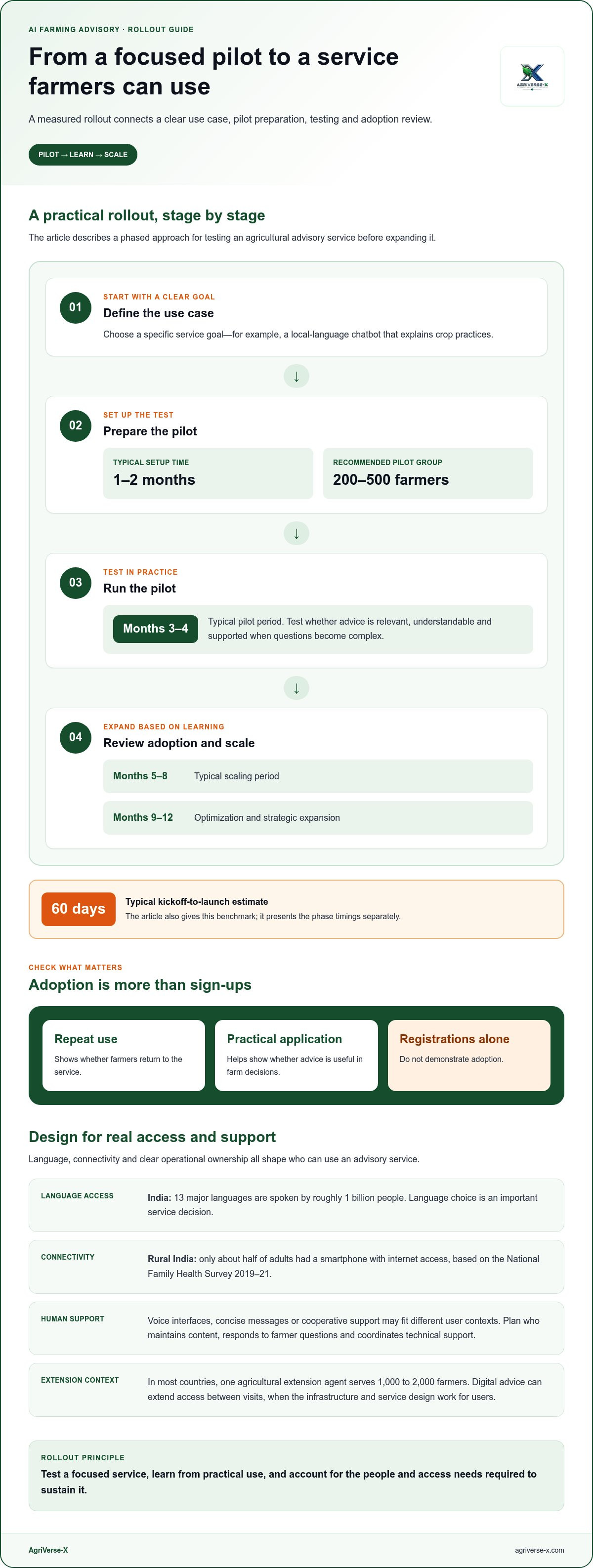
For smallholder farmers, access and timing matter as much as technical accuracy. In most countries, one agricultural extension agent serves 1,000 to 2,000 farmers. Digital advisory services can extend access to recommendations between visits, with agricultural AI programs able to deliver advice 24 hours a day. That reach depends on workable digital infrastructure and advice farmers can understand and use.
Ease of use affects whether recommendations fit real farm decisions. In a discrete-choice experiment, researchers from Virginia Tech and the University of Vermont studied Certified Crop Advisors across North America. The advisors favored decision-support systems that were easy to use and incorporated satellite data over more complex tools requiring extensive data inputs. For farmers, simpler access can make risk alerts easier to interpret.
A practical weather-and-crop advisory framework should make each recommendation actionable:
- Identify the signal: State whether the concern is rainfall, wind, drought, or crop stress.
- Connect it to a decision: Explain whether the farmer should consider irrigation, scouting, or reviewing fertilizer use.
- Make timing clear: Relate the advice to the crop stage and forecast period.
- Support local judgment: Leave room to compare the recommendation with field conditions and available resources.
For instance, if the rain forecast changes during crop establishment, a farmer can compare the updated outlook with field moisture before adjusting an irrigation plan. A recommendation that explains its reasoning is easier to assess than a bare alert. That clarity helps farmers use AI as decision support while keeping practical knowledge central.
AI advisory costs and scalability
The cost of an agricultural advisory program depends on how it reaches farmers and supports them after launch. A chatbot for routine questions has different operating needs from a service combining tailored insights, local agronomic knowledge, and human review. A cooperative program, for example, may need onboarding and shared support, while an individual farmer may need simple, direct access. Assess the full delivery model, not just the software.
Reach can shape the economics. An agricultural-input company’s addressable farmer base is often ten times larger than the number its sales representatives can cover. Digital advice may extend that reach, but it still needs relevant content, user support, and a clear way to handle complex questions. Registrations alone don’t demonstrate adoption: repeat use and practical application help show whether farmers find the service useful.
Access design affects who can participate. India has 13 major languages spoken by roughly 1 billion people, making language choice an important service decision. In rural India, only about half of adults had a smartphone with internet access, based on the National Family Health Survey 2019-21. A voice interface, concise messages, or support through a cooperative may suit a different user context than a data-heavy application. Each choice changes implementation and support needs.
Operational ownership matters, too. The FAO guide identifies the digital advisory adoption gap as largest when end-user organizations must manage the technology themselves. A program needs people to maintain content, respond to farmer questions, and coordinate technical support. If a cooperative manages the service, for instance, its staff need defined responsibilities and an escalation path. Without clear ownership, the system can be difficult to sustain even when the technology works.
A measured rollout helps teams understand these requirements before expanding:
- Define the use case: Choose a specific service goal, such as explaining crop practices through a local-language chatbot.
- Prepare the pilot: Setup typically takes 1 to 2 months. A recommended pilot group includes 200 to 500 farmers.
- Test the service: The pilot typically runs in months 3 to 4, and a typical kickoff-to-launch timeline is 60 days.
- Review adoption: Scaling typically runs from months 5 to 8, followed by optimization and strategic expansion from months 9 to 12.
During a pilot, track where participants stop, which language they use, and which questions require expert input. Repeated requests for clarification, for example, may point to confusing wording, while unanswered questions may reveal gaps in local knowledge. These observations help teams estimate staffing, content, and technical support needs before reaching more users.
Scale should follow evidence that delivery is workable, not projected reach alone. Compare onboarding effort, ongoing support, user adoption, and the ability to keep advice relevant as farming conditions change. This gives organizations a grounded view of what expansion requires and helps them build an advisory service around farmer needs and the team’s capacity to operate it.
Ethics, fairness, and transparency in AI advisory
Good agricultural advice should strengthen farmers’ decisions, not hide them behind artificial intelligence. A crop recommendation can affect real choices, such as whether to irrigate, apply fertilizer, or inspect for pests. Farmers need to understand the reason for the advice, the information behind it, and how to question it. These safeguards make predictive tools more useful in day-to-day farm management.
Crop advisors favor AI tools that augment their work rather than automate it. They prefer editable recommendations, local calibration, and options for field verification. For example, an advisor could adjust a suggested fertilizer action after observing differences in soil conditions across a field. The model should support that judgment, not prevent changes or present an estimate as certain.
Fairness starts with the data and assumptions used to train models. A recommendation built around one crop, language, or farming system may not suit another. Advice developed for large mechanized farms, for example, may overlook the equipment and labor available to a smallholder. A fair system makes its intended context clear and allows farmers and advisors to identify where recommendations need local adaptation.
Data governance also affects adoption. Crop advisors with more optimistic views of AI are more open to data-intensive systems, while advisors with privacy concerns are less likely to adopt tools requiring extensive farmer data. A practical governance approach explains what information the service collects, how it informs advice, who can access it, and how users retain control. Clear boundaries help farmers make informed choices about participating.
Co-creation can expose gaps before an agricultural advisory project scales. The Generative AI for Agriculture Advisory project covers Ethiopia, India, and Kenya, and is scheduled to run from 15 April 2024 through 31 May 2027. In this type of project, farmers and crop advisors can test whether a chatbot understands local crop names, common questions, and spoken requests. Their feedback can guide revisions to language, recommendations, and escalation to human support.
Generative AI can let farmers and farmworkers interact using natural language and speech, including while working in the field. This can help users ask questions without navigating technical menus. But fluent answers alone don’t prove that advice is accurate or suitable. A responsible service distinguishes general information from recommendations tied to a specific farm, crop stage, or observed condition.
Transparency should be clear in each recommendation. Farmers and advisors need practical explanations, not a technical account of every model operation. A useful advisory message identifies the concern, explains what information informed the suggestion, and shows what observation could support or challenge it. For example, a pest-risk alert should prompt field inspection rather than imply that a pest has been confirmed.
- Make recommendations editable: Let advisors record why local conditions changed the suggested action.
- Explain data use: State how farm information supports a specific advice feature.
- Offer human review: Provide a clear route for questions that the model cannot resolve.
- Test with users: Include farmers and advisors when evaluating language, usability, and local relevance.
These practices make trust a working design standard. An AI farming advisory tool should make the basis of its advice understandable, preserve user control, and allow for human judgment when field conditions matter. Built into the project, these elements let AI support agricultural decisions without taking decision-making power away from farmers.
What are the risks and limitations of using AI for farm management decisions?
AI advice can mislead when its information is incomplete, outdated, or poorly matched to a farm. A weather reading from a distant station, for example, may not reflect rainfall across a nearby field. Before acting, compare the recommendation’s location and timing with current farm conditions. Broad regional patterns can help frame a decision but may miss details specific to a plot.
Data quality is another potential weak point. A model using old planting dates, incorrect crop details, or incomplete farm records may give an answer that sounds relevant but rests on a false premise. If an app identifies a field as newly planted when the crop is already established, its guidance may not fit the actual growth stage. Keep records current and correct errors when the system allows edits.
Recommendations can also oversimplify complex farm systems. A crop model may treat a field as uniform, even when soil, drainage, shade, or crop growth varies across it. A suggestion suitable for one section of a plot, for example, may not suit a wetter area nearby. Applying the same action everywhere can waste resources or overlook a localized problem. Compare advice with observations from across the field.
Model outputs can be difficult to interpret. A confident answer doesn’t reveal whether the system relied on a measured condition, a farmer-entered detail, or a general pattern. If a recommendation gives a precise action without explaining its basis, users may struggle to judge whether it applies. Useful decision support distinguishes observed information from estimates and makes important assumptions visible.
AI tools may also give different recommendations when users describe the same problem in different ways. A farmer reporting “yellow leaves” may receive broad guidance, while adding affected plant parts, field location, and recent changes may prompt a more focused response. This variation makes clear questions and follow-up important. Don’t treat one answer as a complete crop assessment.
Operational dependence is another risk. If a farm relies on an app for records or reminders, device failure, a power interruption, or a lost connection can disrupt access. Keep essential farm records in a usable form and agree on a manual process for urgent decisions. For example, workers can write down observations and enter them later when the system is available.
Use a review process before acting on advice with important consequences for the farm:
- Check the farm details: Confirm the crop, field, growth stage, and dates shown in the system.
- Identify assumptions: Note which details came from measurements and which came from user entries or broad estimates.
- Compare observations: Look for differences between the recommendation and conditions across the affected area.
- Keep a decision record: Save the advice, relevant observations, and action taken for later review.
Records help show whether a recommendation was useful under actual farm conditions. If the same type of advice repeatedly misses a field’s circumstances, that pattern can guide corrections to farm data or the way the service is used. Preserve room for farmers’ and agronomists’ judgment, especially when advice affects several operations. AI can organize information, but it cannot observe every field condition or account for every practical constraint.
AgriVerse-X and connected agricultural tools
AgriVerse-X’s AI Farm Assistant is designed to provide advisory insights and operational support. The platform also supports digital profiles, agricultural marketplace connections, and traceability records, helping participants connect advice with broader farm activities.
AVX is the AgriVerse-X utility token on the Binance Smart Chain (BEP-20) network. AVX is a digital utility token. Digital-asset values can change, liquidity may be limited, and participation is subject to eligibility, platform rules, technical availability, and applicable law. This article is for general information and is not financial, legal, tax, or investment advice.
Turn advisory insight into a practical next step
Make the next step specific. Choose a farm decision where better-timed information could improve planning, such as preparing for weather changes or prioritizing field checks. Define what information should inform that decision, who will interpret the recommendation, and how the result will be recorded. This gives an AI farming advisory tool a clear role in the operation instead of adding another disconnected digital channel.
Then connect advisory needs to the wider agricultural workflow. Farm profiles, digital records, and links to relevant services can help organize production and participation information. An AI farming advisory tool works best as part of a practical workflow supported by clear records and human judgment. AgriVerse-X provides a platform for agricultural profiles, marketplace connections, and traceability records.
Bring your priorities into a practical conversation. Contact AgriVerse-X to discuss AI advisory and how agricultural digital infrastructure may support your work. Take the next step with a clear use case, a farmer-aware approach, and room for informed human judgment.
Frequently Asked Questions
Can AI give small scale producers the right advice?
An AI farming advisory tool can help small-scale producers make better-informed choices when its guidance matches their crop, location, and available resources. For example, it could help a grower organize observations about leaf discoloration before speaking with an extension agent. The farmer still decides what to do, using field evidence and practical constraints such as available labor, water, and equipment.
How Is an AI Agronomic Advisor Different from a Chatbot?
An AI agronomic advisor is designed to support agricultural decisions, while a general chatbot may respond without crop-specific context. An agronomic system might use a farm’s crop stage and records to tailor a response, while a chatbot can explain a farming term or summarize general guidance. The key distinction is whether the system uses relevant agricultural information and makes the limits of its answer clear.
How Long Does It Take to Launch an AI Advisory Program for Agriculture?
A typical program can reach pilot launch 60 days after kickoff. The setup phase typically takes 1 to 2 months, while the pilot phase runs during months 3 to 4. Teams use this period to prepare content, onboard participants, test the advisory workflow, and arrange human support. Local data readiness, language adaptation, and the complexity of the chosen use case can shape the work involved.
WHAT DOES AI IN FARM ADVISORY MEAN?
AI in farm advisory means using artificial intelligence to process agricultural information and generate decision support. A system might analyze a crop image, weather data, or farm records, then suggest areas for further inspection. For example, it could identify possible leaf damage for the farmer to examine. The suggestion is an aid to assessment, not proof of a specific cause or a substitute for on-farm judgment.
WILL AI REPLACE EXTENSION AGENTS?
No. AI can help deliver routine information, but extension agents bring local relationships, field experience, and direct observation. An agent can ask follow-up questions about a farmer’s practices or examine a problem that a digital system cannot assess clearly. A useful division is for AI to handle common information needs while extension professionals focus on complex cases, demonstrations, and decisions requiring personal support.
What is an AI farming advisory tool and how does it work?
An AI farming advisory tool analyzes agricultural information, such as crop details, weather data, or farm records, and generates guidance for a decision. A farmer might enter a crop type and describe a concern, then receive relevant information or suggested observations. The response depends on the quality and relevance of the inputs. Farmers can assess its usefulness by comparing the guidance with current field conditions.
Which features should farmers look for in agricultural AI advice?
Prioritize clear explanations, relevant crop and location context, accessible language, and a way to correct inaccurate farm details. The service should also explain how users can seek human assistance when a recommendation doesn’t address their situation. For instance, a farmer with a question about a crop image should be able to add context or describe what they observed, rather than rely on an unexplained automatic answer.
How much do AI farming advisory tools cost, including free plans and subscriptions?
Costs depend on the advisory features, data inputs, support model, and number of users. A free plan may offer basic information, while a subscription may include additional tools or support, depending on the service. Before comparing options, identify the tasks the system must perform and the resources required to use it, such as connectivity, training, and staff time. The subscription label alone doesn’t reveal the total operating cost.


