

Entry clearance depends on more than a product’s paperwork. Under food import regulations in the USA, imported food must be safe, produced under sanitary conditions, and truthfully labeled in English. The FDA does not preapprove individual food shipments before arrival. Facility registration and Prior Notice also matter, and the FDA may inspect or detain food that fails to meet U.S. requirements.
It’s easy to focus on customs documents and overlook the food-safety checks that can affect entry. This guide explains what officials assess, which facility registration and Prior Notice rules apply, and how requirements can vary by food and transport method. You’ll also learn what to expect if a shipment is selected for inspection or detained, so you can understand the process before your goods reach the border. According to the U.S. Food and Drug Administration, Prior Notice may be submitted up to 30 days before the goods arrive in the United States.
Key Takeaways
- Identify which agency oversees your food category, since requirements can differ by product.
- Review labels for required English-language information, including ingredients, allergens, and country of origin.
- Understand how facility registration and Prior Notice fit into shipment preparation.
- Keep supplier verification and product records organized to support food-safety responsibilities and traceability.
- Learn what an FDA inspection or detention may mean for a shipment and its entry process.
How does FDA verify food facility registration?
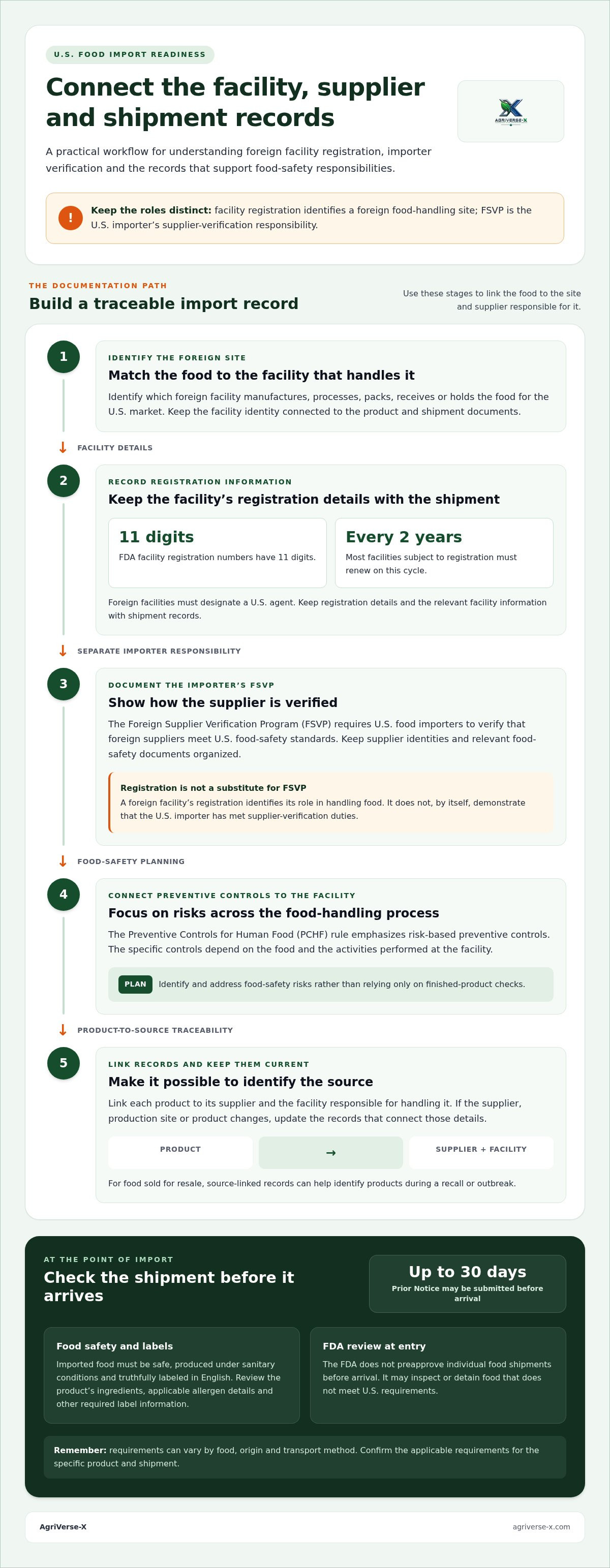
The Foreign Supplier Verification Program (FSVP), established under the Food Safety Modernization Act (FSMA), requires U.S. food importers to verify that foreign suppliers meet U.S. food-safety standards. Facility registration identifies facilities that manufacture, process, pack, receive, or hold food for the U.S. market.
Registration and FSVP are related but impose separate responsibilities. A foreign facility’s registration identifies its role in handling food; the U.S. importer’s FSVP covers supplier verification. Registration alone does not show that an importer has fulfilled its supplier-verification duties.
For facility registration, confirm which foreign site handles the food and keep its registration details with shipment documents. FDA registration numbers have 11 digits. Most facilities that manufacture, process, pack, receive, or hold food must renew registration every two years. Foreign facilities must designate a U.S. agent.
FSMA also emphasizes prevention. Its Preventive Controls for Human Food (PCHF) rule requires risk-based preventive controls, so food-safety planning focuses on identifying and addressing risks rather than relying only on finished-product checks. The specific controls depend on the food and the activities performed at the facility.
For FSVP, the importer’s core task is supplier verification. Keep supplier identities and relevant food-safety documents organized so the importer can demonstrate how it verifies that foreign suppliers meet U.S. standards. For example, a shipment record should link the product to its supplier and the facility responsible for handling it.
- Identify the facility: Match the food to the foreign site that manufactures, processes, packs, receives, or holds it.
- Record registration details: Keep the facility’s 11-digit FDA registration number with the related shipment documents.
- Track renewal: Note the two-year registration renewal period for facilities subject to registration.
- Document supplier verification: Keep records showing the importer’s FSVP work for that supplier.
Different rules can apply to different shipments. In the United States, personal-consumption consignments of meat, poultry, or egg products cannot exceed 50 pounds and cannot be sold or distributed, according to the U.S. Department of Agriculture, Food Safety and Inspection Service. This personal-use limit is distinct from the importer’s responsibilities for commercial food shipments.
For a commercial shipment, link facility registration, supplier records, and the food’s identity before entry. If the supplier, production site, or product changes, update the records that connect those details. Clear, consistent documentation helps identify the foreign facility that handled the food and explain how the importer met its FSVP responsibilities.
What food requirements are verified at the time of importation?
At entry, officials assess food safety, labeling, and requirements specific to the product category. A practical review of food import regulations in the USA starts by identifying the product, its ingredients, and the agencies with jurisdiction.
Food Labeling Requirements
U.S. food-labeling rules specify the information imported food must present to consumers. Labels must be in English, informative, and truthful, with details that match the food inside the package.
Review the common product name, ingredient list, applicable nutrition information, allergen declarations, manufacturer or distributor details, and country of origin. For example, a packaged sauce label should clearly identify its ingredients and applicable allergens. Untranslated packaging does not, by itself, provide the required English information.
The FDA permits only approved food and color additives used within specified limits. Organic foods and dietary supplements have additional labeling requirements, so their labels need a category-specific review. A label that omits required details or misrepresents a product can create an entry problem, even when shipping documents accurately describe the goods.
Importer Safety and Labeling Responsibilities
The U.S. importer is responsible for ensuring that food entering interstate commerce is safe, sanitary, and labeled according to U.S. requirements. Imported food must meet the same legal requirements as food produced domestically.
Connect food-safety review with FSVP records and the product itself. Compare the package label with supplier documents, including the product name, ingredients, and allergen details. If a label names an ingredient missing from the supplier’s product information, resolve the discrepancy before offering the food for sale.
Importers selling food for resale must be able to trace products to their source during a recall or outbreak. Link product identities with supplier records so each source can be identified without grouping separate lots or suppliers together.
Permits and Restrictions for Imported Foods
Permits, inspections, and plant-health documents depend on the food, its origin, and intended use. For fruit and vegetable imports, APHIS Fruits and Vegetables Import Requirements can help identify applicable conditions. An APHIS import permit may be required, depending on the product and origin; a phytosanitary certificate from the exporting country’s plant protection authority is often required. Some produce also requires irradiation, cold treatment, or fumigation.
Dairy goods, sugar, and meats may be subject to U.S. import quotas. Requirements depend on the product and its origin, so do not assume that rules for one commodity apply to another. Understanding food import regulations in the USA also means distinguishing food-safety review from plant-health controls.
Agency jurisdiction matters: the FDA regulates most food and food ingredients, while USDA jurisdiction covers certain meat, poultry, processed egg products, and catfish. APHIS controls can add pest-risk requirements for fruits and vegetables. For each shipment, identify the product precisely, then align its label, supplier information, and origin documents with the relevant requirements.
Product formulation matters, too. The FDA allows only approved food and color additives within specified limits, while some products have additional labeling rules. Keep the label and supplier documents linked to the same product identity. That link supports traceability if a recall or outbreak requires the source to be located.
What is Prior Notice for imported food?
Prior Notice provides advance information about food shipments entering the United States. The FDA uses it to review incoming food before arrival, making accurate filing and timing essential parts of import preparation.
Prior Notice for Food Shipments
Prior Notice tells FDA that a food shipment is coming, including details that identify the food and its movement. Most food shipments imported or offered for import require it unless an exemption applies. The U.S. Food and Drug Administration permits importers to submit Prior Notice up to 30 days before goods arrive in the United States.
Match the notice to the actual shipment. For example, compare the product description, quantity, origin, foreign supplier, and arrival information across the filing and shipping documents. Mismatched details can make it harder to link the notice to the goods presented at entry.
FDA and CBP Prior Notice Requirements
Prior Notice can be submitted to FDA or U.S. Customs and Border Protection (CBP). The applicable deadline depends on transport mode. According to the U.S. Food and Drug Administration, food arriving by road generally needs notice at least 2 hours before arrival; water shipments need it at least 8 hours before arrival.
For air and rail shipments, the general minimum is 4 hours before arrival. Use the mode carrying the food into the United States to determine the relevant submission window. The U.S. Food and Drug Administration also allows submission up to 30 days in advance.
Plan the filing around the shipment’s arrival, not just its departure from the exporting country. Transit changes or revised arrival details can make a submitted notice inconsistent with the incoming food. Keep the notice confirmation with the shipment documents so it can be matched during entry processing.
Prior Notice is separate from facility registration and the importer’s supplier-verification duties. A foreign supplier’s facility registration does not replace a shipment notice. Likewise, submitting Prior Notice does not establish that the food meets every applicable safety or labeling requirement.
Check the transport deadline before dispatch. Road shipments have a different advance-notice window from water shipments, and air and rail shipments have their own timing. Build the filing into shipment coordination, aligning the estimated arrival, food identity, supplier, and origin across the notice and commercial records.
Late or incomplete Prior Notice can lead to detention or refusal. If shipment information changes, update the filing to reflect the revised details instead of relying on an earlier notice describing different goods or arrival information. This keeps the entry record linked to the food presented for import.
- Identify the transport mode: Apply the corresponding notice deadline for road, rail, air, or water arrival.
- Align shipment details: Compare the food description, origin, supplier, and arrival information across records.
- Retain the confirmation: Keep the Prior Notice confirmation with documents used for entry.
Timely, consistent filing gives the FDA and CBP shipment information before arrival and helps link the notice to the food presented at entry.
FDA food facility registration
FDA food facility registration identifies facilities that handle food intended for the United States. It is a separate administrative requirement from supplier verification and does not mean the FDA has approved a product, label, or shipment.
Most facilities that manufacture, process, pack, receive, or hold food must register with FDA. Foreign facilities that manufacture, process, pack, or store food intended for import must register and designate a U.S. agent. FDA registration numbers contain 11 digits, which helps identify the registered facility in records.
Registration also has a renewal cycle. Most covered food facilities must renew every two years. Facilities should keep registration details aligned with their current identity and food-handling activities so shipment documents point to the correct location.
The Bioterrorism Act requirements described for food facilities include registration and detailed recordkeeping. Keep records linking the food to the facility that handles it. For example, if one site processes a product and another stores it, records should distinguish those roles rather than treating both businesses as one location.
Registration does not replace food-safety controls. The Food Safety Modernization Act (FSMA) includes the Preventive Controls for Human Food (PCHF) rule, which requires risk-based preventive controls. Separately, the Foreign Supplier Verification Program (FSVP) requires U.S. importers to verify that foreign suppliers meet U.S. food-safety standards.
For importers, the practical task is to keep facility details consistent across supplier records, registration information, and shipment documents. Compare the facility name and address with the site that actually manufactures, processes, packs, or stores the food. A mismatch can make it difficult to identify which facility handled the shipment.
- Identify each relevant site: Record whether a facility manufactures, processes, packs, receives, holds, or stores food.
- Match registration details: Keep the 11-digit registration number with the correct facility identity.
- Track renewal: Record the two-year renewal cycle for facilities subject to registration.
- Organize facility records: Connect supplier and shipment documents to the site responsible for each activity.
Some food categories have additional facility-registration requirements. Foreign processors exporting low-acid canned or acidified foods to the United States must register their processing plants with the FDA. The processing method therefore matters, not just the product name or supplier.
At the customs and border stage, registration information is part of the broader compliance picture. It does not establish that food meets every safety standard. Importers still need separate records for facility registration, supplier verification, and the shipment itself.
FDA inspection and detention at ports of entry
The FDA may inspect imported food at U.S. ports of entry and detain shipments that fail to meet U.S. requirements. To import food, prepare a commercial invoice, packing list, bill of lading, Prior Notice confirmation, and applicable product documents. Commercial imports subject to FDA requirements generally require a customs bond.
FDA Entry Review and Import Screening
FDA entry review assesses submitted shipment information and may lead to inspection or detention. Accurate product descriptions and consistent entry details help link the food presented at the border to its import records.
CBP Form 7501, the Entry Summary, consolidates import information for U.S. Customs and Border Protection. FDA Affirmation of Compliance codes are three-letter codes that importers can provide to facilitate FDA review. Keep each code consistent with the food and supporting documents.
Screening can also relate to product-specific concerns. FDA Import Alert 99-08 lists processed foods subject to detention without physical examination because of illegal pesticide chemical residues. Importers should understand whether their food is covered by a relevant alert before shipment entry.
Port Inspections and Refused Products
The FDA may inspect food at the port and detain a shipment that does not comply with U.S. requirements. Detention means the shipment is held rather than released for entry, so the importer should organize the entry record and supporting documents for review.
Import documents commonly include a commercial invoice, packing list, and bill of lading. Fruit and vegetable shipments may also require a phytosanitary certificate. A customs bond supports compliance with CBP requirements; commercial food imports subject to FDA requirements generally require one. An annual bond can last 12 months.
For an entry, align the shipment details across the invoice, packing list, bill of lading, and Prior Notice confirmation. CBP Form 7501 consolidates import information, while FDA review focuses on food requirements. Errors or omissions in entry documents can cause customs delays or fines.
If imported meat or poultry fails U.S. requirements, it must be exported, destroyed, or converted to animal food within 45 days, if eligible and with FDA approval. That outcome is specific to the stated meat or poultry situation, not a general rule for every detained food.
Build a clear entry file before the shipment arrives. Include the food’s identity, supplier and origin details, applicable safety records, and supporting transport documents. For products subject to inspection, consistent records help show how the entry information relates to the goods presented.
A customs broker can assist with entry filing, compliance, and communication with CBP. The importer remains responsible for coordinating accurate food and shipment information, including relevant foreign supplier verification records. A complete entry file helps connect customs processing with FDA review.
AgriVerse-X
Once you understand U.S. entry requirements, AgriVerse-X can help agricultural businesses present products and organize related records. Farmers, cooperatives, and agribusinesses can create verified digital profiles showcasing products, services, skills, and certifications. The platform supports agricultural marketplaces and digital traceability records to help connect product information with its source.
For example, a supplier listing soybeans or sesame seeds can use a profile to present product details, while traceability records help organize documentation. These tools do not replace FDA or USDA requirements, facility registration, Prior Notice, or shipment-specific compliance checks.
Explore how AgriVerse-X supports agricultural trade, or contact AgriVerse-X to discuss your needs.
Build a Clearer Path for Your Next Shipment
Turn what you’ve learned about food import regulations in the USA into a practical plan for agricultural trade. Map the people, products, and records involved in your supply chain, keeping internal trade records separate from official filings and agency decisions. Clear ownership of each record helps teams coordinate next steps.
AgriVerse-X supports digital profiles for presenting agricultural products and traceability records for documenting product origin and related activity. These tools can help organize business information, while official import requirements remain a separate part of shipment planning.
Choose a practical next step for your operation. Contact AgriVerse-X about digital profiles and traceability records to discuss how these platform capabilities may fit your agricultural activity. Build stronger records and move forward with confidence.
Frequently Asked Questions
Do foreign food manufacturers need FDA registration?
Yes. When a foreign facility manufactures, processes, packs, or stores food intended for import into the United States, FDA registration generally applies. A foreign facility must designate a U.S. agent. Treat registration as a facility-level record, not product approval: it does not mean the FDA has preapproved the manufacturer’s food or shipment. Low-acid canned and acidified food processors have registration requirements tied specifically to their processing plants.
How does the FDA verify labeling compliance at the time of importation?
The FDA can review entry information and inspect a shipment, but it does not preapprove individual labels before import. Importers can prepare by comparing the physical package with the product description and supporting records, checking that both refer to the same food and formulation. This can reveal a mismatch, such as a package identifying one product while shipment records describe another, before the goods are offered for sale.
What is FSVP?
FSVP is the Foreign Supplier Verification Program, which assigns supplier-verification duties to U.S. food importers. Organize records by supplier and food rather than keeping one undifferentiated file for every imported product. If a supplier provides several foods, the records should identify which supplier relationship and product each verification document covers. FSVP is a preventive food-safety responsibility, separate from customs filing and facility registration.
Which U.S. agencies regulate imported food, and what are their roles?
Agency jurisdiction depends on the product. The FDA covers most food, while USDA oversees certain meat, poultry, processed egg products, and catfish. APHIS addresses plant-health conditions for fruit and vegetable imports, which can vary by commodity and country of origin. CBP handles customs entry. For a mixed shipment, separate product categories in your planning rather than assuming one agency’s requirements cover every item.
What FDA food import requirements apply to foreign facilities and importers?
Requirements depend on the facility’s activities and the importer’s role. Registration identifies a covered food-handling facility, while the importer separately manages supplier verification and food-safety responsibilities. FSMA also includes the Preventive Controls for Human Food rule, which requires risk-based preventive controls. A current food-safety plan and records linked to the relevant supplier and product help organize these separate obligations.
How do importers submit FDA Prior Notice for food shipments?
Prior Notice can be submitted to the FDA or CBP with shipment information identifying the food and its arrival. Keep the confirmation with the entry file and distinguish it from other filings. For example, food arriving by ocean freight also requires an Importer Security Filing, which does not replace FDA Prior Notice. Check that each submission refers to the same shipment, especially if transport or arrival details change.
What USDA FSIS rules apply to imported meat, poultry, and egg products?
USDA FSIS requirements vary by product and situation. Importers bringing meat, poultry, or egg-product samples must notify FSIS before import using FSIS Form 9540-5. Foreign egg products must come from a country with an inspection system equivalent to the U.S. system. These product-specific controls are different from rules for ordinary food shipments, so identify whether goods are samples, shell eggs, or processed egg products.
How do U.S. customs entry procedures, tariffs, and duties apply to food imports?
CBP uses the product’s Harmonized Tariff Schedule classification to determine applicable duties and quotas. Some imports may also face anti-dumping or countervailing duties, depending on the goods and circumstances. Country-of-origin marking rules apply to imported goods. Ocean freight also requires an Importer Security Filing. These customs obligations operate alongside food-safety requirements, not in place of them.


