

Iowa cash rents vary across the state, so a statewide average is only a starting point for evaluating a particular parcel. These benchmarks give landowners and prospective tenants a clear starting point, but they don’t set the rent for every parcel. Average farm land lease rates in 2026 depend on the land and the agreement being considered.
A useful comparison needs more than a headline figure. This guide brings together state and county benchmarks, crop-price and input-cost pressures, and differences among cropland, pasture, and hay uses. It also explains how land quality and location shape comparisons, and what a written lease can clarify about responsibilities. The goal is to help readers interpret the numbers and assess the terms behind them.
Whether you’re reviewing a possible Iowa lease or setting a rate, use the benchmarks as context for a practical discussion. The sections ahead cover cash rent and crop-share arrangements, affordability, land characteristics, and lease costs and responsibilities. Together, these topics help you identify relevant comparisons and details to address before making an agreement.
Key Takeaways
- Compare cash, flexible, crop-share, and custom farming arrangements to understand how each structure can allocate rent, production risk, and farm responsibilities.
- Assess affordability alongside crop prices and input costs, not by rent alone.
- Use land quality, productivity, location, and intended use to interpret Iowa rental averages for a specific parcel.
- Separate cropland benchmarks from hay, pasture, and grazing rates because land use affects the relevant comparison.
- Clarify lease costs and responsibilities. AgriVerse-X farmland listings are planned and subject to confirmation, and are intended to connect landowners with prospective agricultural tenants.
How Much Does Iowa Farmland Cost to Rent in 2026?
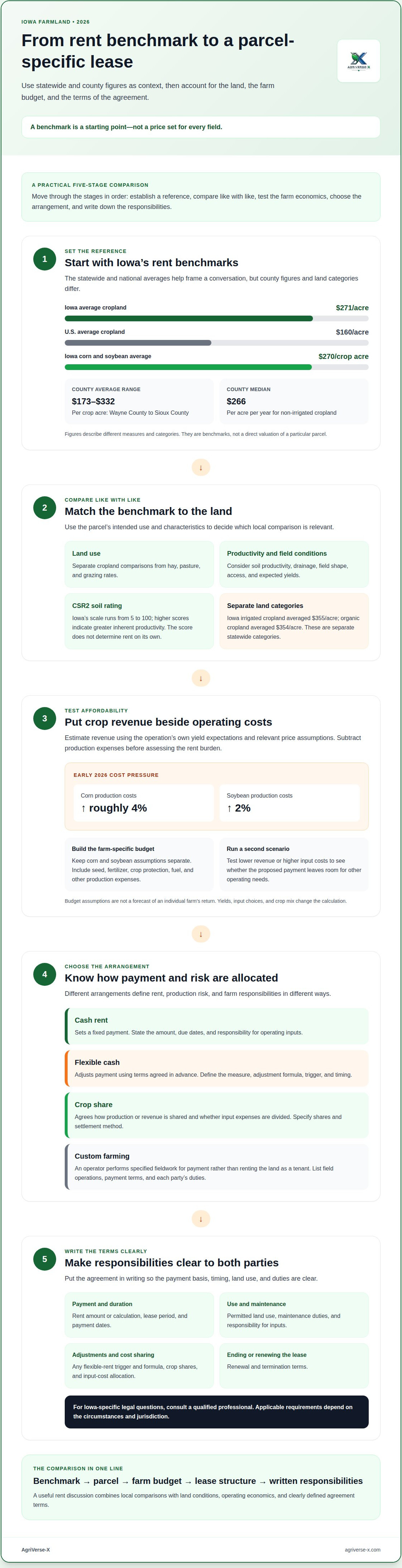
Iowa’s average cropland cash rent was $271 per acre in 2026. The U.S. average was $160 per acre. These statewide and national figures offer context, but they don’t determine rent for an individual parcel. County, land quality, crop use, and lease structure all affect how a benchmark applies.
County figures show the range within Iowa. Average cash rent ran from $173 per crop acre in Wayne County to $332 in Sioux County. The 2026 median county non-irrigated cropland cash rent was $266 per acre per year. Iowa’s statewide average corn and soybean cash rent was $270 per crop acre, a distinct measure from the statewide average cropland figure.
The USDA released state and U.S. cash-rent estimates on July 31, 2026, followed by county estimates on August 21, 2026. Iowa’s survey drew 1,450 usable responses covering more than 1.8 million rented acres. Estimates are useful benchmarks, but they summarize survey results rather than assess a specific field’s condition, access, or productive capacity.
Lease type affects how rent is calculated and how production risk is shared. A cash lease sets a fixed payment. A flexible cash lease adjusts payment according to terms agreed in advance, such as a specified price or yield measure. A crop-share lease assigns agreed shares of production or revenue and may also divide input expenses. Custom farming is different: an operator performs specified fieldwork for payment rather than renting the land as a tenant.
- Cash rent: State the payment amount, due dates, and responsibility for operating inputs.
- Flexible cash: Define the adjustment formula, trigger, and timing.
- Crop share: Specify crop shares, input-cost allocation, and settlement method.
- Custom farming: List field operations, payment terms, and each party’s duties.
For comparison, Western Ohio cash rents were expected to range from no change to an increase of 1.5% in 2026, depending on region and land class. That outlook is not an Iowa estimate; it highlights why location-specific comparisons matter.
Landlords and farmers should put the rent, lease period, payment dates, permitted land use, maintenance duties, and renewal or termination terms in writing. Applicable legal requirements depend on the circumstances and jurisdiction. For Iowa-specific legal questions, a qualified professional can explain how those requirements apply to a proposed agreement.
Crop prices, input costs, and rent affordability
Farmers and landowners can negotiate a fair rate by comparing similar local leases, then matching payment terms to the parcel’s crop potential and operating costs. Put the basis for the rate, input responsibilities, and any adjustment formula in writing. This keeps the discussion grounded in the farm’s economics rather than a single headline figure.
Crop prices shape potential sales revenue, while input costs reduce the amount available for rent. Iowa corn production costs rose roughly 4% in early 2026, while soybean costs rose 2%. A tenant should model each crop separately because price and cost changes affect them differently.
These are budget assumptions for that production scenario, not a forecast of an individual farm’s return. Actual yields, input choices, and crop mix change the calculation.
To test affordability, estimate crop revenue using the operation’s own yield expectations and relevant price assumptions. Subtract seed, fertilizer, crop protection, fuel, and other production expenses before assessing the rent burden. Then run a second scenario with lower revenue or higher input costs. Comparing the scenarios helps show whether a fixed payment leaves enough room for other operating needs.
- Compare the same crop: Keep corn assumptions separate from soybean assumptions.
- List cost responsibility: Record which party pays for fertilizer and other inputs.
- Set adjustment terms: Define any flexible-rent trigger and calculation method before signing.
For a flexible cash lease, agree in advance on what measure changes the rent, how it is calculated, and when the adjustment applies. A crop-share arrangement instead needs clear terms for dividing production or revenue and allocating shared expenses. Either structure should make the relationship between crop performance and payment clear to both parties.
Affordability depends on the farm. A tenant with different yields, crop rotations, or input plans may face a different budget from Iowa State University’s medium-yield example. Landowners and farmers can use that budget as a discussion reference, then test proposed terms against the operation’s production plan and expected costs.
Factors affecting farmland values and rents
Farmland rent reflects more than a county average. Soil productivity, drainage, field shape, access, and expected yields influence what cropland can support. Iowa’s CSR2 scale ranges from 5 to 100, with higher scores indicating greater inherent productivity. A stronger CSR2 score can help explain differences between nearby parcels, but it does not determine rent by itself.
Water access also changes the comparison. In Iowa, irrigated cropland averaged $355 per acre in 2026, while organic cropland averaged $354 per acre. These statewide figures describe separate land categories. They don’t prove that irrigation or organic production alone causes a higher rate. Equipment, management practices, yields, and local demand also shape the lease value.
For a useful local comparison, match the parcel with similar land. Start with the same county and crop category, then compare irrigation status, productivity, and lease structure. Don’t compare a non-irrigated field directly with an irrigated benchmark without accounting for water access and related operating conditions. County estimates provide context, while parcel features help explain differences in actual agreements.
Economic conditions influence what tenants can afford and what landowners may seek. Crop prices affect potential revenue, while fertilizer and other inputs affect production costs. Iowa State University’s crop budgets provide a framework for production assumptions, but an individual farm’s crop mix, yields, and expenses determine how those assumptions apply. Local supply and tenant demand can also affect negotiated rates.
- Compare like with like: Align county, crop use, irrigation, and lease type.
- Assess productivity: Consider CSR2, drainage, field access, and expected yields together.
- Separate land categories: Treat organic, irrigated, and non-irrigated figures as distinct benchmarks.
Farmland values and rent are related, but they measure different things. Land value reflects the asset, while cash rent reflects an agreement to use it. Property taxes, land condition, and local economic demand may affect negotiations, but their impact varies by parcel. Compare several local rents and document differences, such as irrigation access or field productivity, before evaluating a proposed rate.
A practical review links each adjustment to a specific feature. For example, compare two county parcels, then note differences in CSR2, water access, and expected crop use. This makes the rationale clearer for both parties without treating one statewide figure as the answer for every lease.
Hay, pasture, oats, and grazing rental rates
In Iowa, established alfalfa hay averaged $191 per acre in 2026, while established grass hay averaged $140. These figures apply to established hay, not general cropland. Hay rental rates also depend on forage condition, stand life, access, cutting rights, and upkeep. A lease should state who may cut and remove hay, and whether grazing is allowed after harvest.
Iowa’s statewide average pasture cash rent was $68.50 per acre per year in 2026. That annual rental rate provides a useful benchmark, but pasture quality and livestock access affect a specific agreement. Water availability, fencing, forage condition, and maintenance responsibilities can change the value of the permitted use. Spell out who maintains fences, manages water points, and repairs damage.
Pasture rent and land value measure different things. Average U.S. pasture rent is an annual rental benchmark, while land value measures the value of the property itself. Keep those measures separate when assessing an offer. A grazing lease should also identify the area included, permitted livestock use, access arrangements, and any limits on the tenant’s activities.
For a cow-calf pair arrangement, clarify the basis for payment and grazing period in the written terms. Nebraska pasture and cow-calf pair rental rates increased about 4% to 5% in 2026 compared with the previous grazing season. That is a Nebraska comparison, not an Iowa rate. Local forage supply, pasture condition, and livestock management shape how such arrangements work.
Oats may be grown for grain, forage, or a planned rotation, so the appropriate rental comparison depends on the intended use. A tenant growing oats for grain needs terms that address field access and crop responsibilities. For forage, define cutting, removal, and any post-harvest grazing. These distinctions help landowners and tenants compare a lease with similar agricultural uses.
Before setting or adjusting a rental rate, define what the payment covers and how the land will be used. Compare pasture, hay, and oat production separately instead of applying one cropland figure to every field. A practical lease discussion can cover:
- Use: Identify hay cutting, grazing, or oat production rights.
- Condition: Record pasture or hayfield condition and maintenance duties.
- Access: Clarify routes, water points, fencing, and field boundaries.
- Payment basis: State the rental period and whether payment is per acre or another agreed unit.
What costs and responsibilities are typically included in a farm land lease?
A farm lease should identify the rent, payment schedule, land included, and permitted use. For example, specify whether the agreement covers one field, several parcels, or pasture alongside cropland. State whether rent is fixed cash, flexible cash, or crop share, since each structure allocates payments and operating costs differently.
Separate rent from production expenses. Specify who pays for seed, fertilizer, crop protection, fuel, and custom fieldwork. In a crop-share arrangement, list how each party’s share of eligible costs is calculated. For flexible cash rent, write down the adjustment formula and payment dates. Clear terms help both parties budget without assuming that rent covers farm inputs.
Set out property care and improvements in practical terms. Identify who is responsible for drainage, fences, gates, access roads, and irrigation equipment. If a tenant plans to repair a fence or maintain a water system, describe the work, approval process, and responsibility for materials. Record the condition of key features when the lease begins.
- Land use: Define crops, grazing, hay cutting, and field access.
- Inputs: Assign seed, fertilizer, fuel, and crop-protection expenses.
- Maintenance: Allocate fence, drainage, road, and equipment upkeep.
- Improvements: Document approval, payment, and ownership of installed items.
- Records: State how rent payments, shared expenses, and agreed work are recorded.
Address services and property expenses directly. If the farm uses electricity or irrigation, specify who pays utility charges and handles routine system care. Clarify any agreed responsibility for property taxes, insurance, or other parcel-related costs rather than leaving them implied. The lease can distinguish ongoing expenses from repairs caused by damage or ordinary use.
Include the agreement’s start and end dates, renewal process, notice method, and payment due dates. Describe what happens to crops, stored materials, and approved improvements when the term ends. For example, state how a tenant may finish harvesting if the lease expires after planting. Put changes in writing and keep a copy for each party.
Before signing, organize the terms by payment, operating costs, upkeep, access, and end-of-lease duties. Land arrangements are subject to applicable laws and the written agreement. A qualified professional familiar with Iowa agricultural leases can review legal terms and help clarify obligations.
AgriVerse-X: What Makes AgriVerse-X a Unique AgriTech Platform
AgriVerse-X may support the discovery of farmland and lease opportunities through listings, subject to platform availability. After reviewing Iowa rent benchmarks, readers can explore relevant opportunities and present information about their agricultural plans. A listing supports discovery, but it does not replace lease negotiations, due diligence, or a written agreement.
Digital profiles may allow farmers, agribusinesses, cooperatives, and service providers to present information about their products, services, skills, and certifications, subject to availability and verification requirements. Prospective tenants may be able to use a profile to describe their operation and capabilities alongside a lease opportunity. Profile details should be accurate and relevant to the proposed land use.
AgriVerse-X may support agricultural marketplace listings for goods, inputs, machinery, technology, and services, subject to availability. A tenant planning a crop operation could explore listings such as grain seed, fertilizer, soil-analysis services, irrigation, or logistics, if available. Listings can support connections between participants, while product use and transactions remain subject to applicable local requirements and due diligence.
For example, a grower considering a grain lease may need to coordinate land access with seed, soil inputs, and handling requirements. AgriVerse-X may support listings for grains and cereals, including maize, rice, and oats, as well as fertilizer and soil inputs, subject to availability. Sellers should provide accurate product details, including required labels and safety information where applicable.
Farm operations also depend on people and practical services. Subject to availability, employers may be able to connect with agricultural workers, and training providers may offer farming, technology, safety, and business courses. Storage and equipment-rental listings may also be available. These connections can help tenants organize operational needs around a lease, but do not mean AgriVerse-X directly delivers each service.
Digital traceability records and compliance-aligned reporting may be available or under development, subject to platform capabilities and local requirements. They can help agricultural participants organize relevant activity information, but do not establish land ownership or replace official documents, legal review, or separate verification. Land arrangements, financial programmes, and regulated services are subject to local laws, due diligence, and the involvement of qualified professionals or licensed partners where required.
Use AgriVerse-X to enquire about discovering lease opportunities or presenting an agricultural profile, subject to platform availability. Contact AgriVerse-X to discuss a relevant platform enquiry.
Frequently Asked Questions
What is the average U.S. cropland cash rent per acre in 2026?
The average U.S. cropland cash rent was $160 per acre in 2026. This national figure gives a broad comparison point, not a quote for an individual parcel. For a practical estimate, narrow the comparison to the state, county, land class, and lease structure. A tenant evaluating a specific field should also account for its productive capacity and which operating expenses the lease assigns to each party.
What are the average 2026 U.S. pastureland lease rates per acre?
Average U.S. pasture rental rates serve as a general baseline benchmark, distinct from the market value of pastureland or cropland rent. This is a pasture rental benchmark, not the market value of pastureland or a cropland rent. A grazing agreement may also set payment according to livestock or grazing arrangements. Compare rates only after identifying the permitted use, access, forage condition, and maintenance duties covered by the agreement.
What are 2026 farm land cash rent rates by state and county?
Rates vary widely by location and land category. In 2026, Iowa’s average cropland cash rent was $271 per acre; county averages ranged from $173 per crop acre in Wayne County to $332 in Sioux County. These comparisons show why state figures alone can obscure local differences.
How do 2026 farm lease rates vary by soil quality, location, and productivity?
In Iowa, 2026 cash rent averaged $314 per crop acre for high-quality cropland, $269 for medium-quality land, and $226 for low-quality land. Location also matters: county averages differed substantially within the state. Soil productivity is one useful comparison factor, but tenants and landowners should also consider drainage, field access, and land use when interpreting a benchmark.
What are typical 2026 irrigated cropland lease rates compared with non-irrigated land?
Average U.S. irrigated lease benchmarks differ from non-irrigated averages due to the added infrastructure and yield potential. Iowa irrigated cropland averaged $355 per acre. These figures describe different geographic scopes, so compare irrigated land with similar local parcels. Water access and the included irrigation system can affect how relevant a benchmark is to a particular lease.
How do cash rent and crop-share farm leases compare in 2026?
Cash rent sets a payment amount, while crop share links the landowner’s return to an agreed portion of production or revenue. For example, a tenant seeking predictable rent expenses may prefer a fixed cash structure, while crop share divides some production-related risk. The agreement should specify how inputs, crop proceeds, responsibilities, and any adjustments are calculated. The right structure depends on the parties’ agreement and the operation.
What factors are expected to change U.S. farm lease rates in 2026?
National cropland cash rent declined by $1 per acre in 2026, or 0.6%. Crop prices, fertilizer and other input costs, farm liquidity, land productivity, and local tenant demand shape lease negotiations. Farm management analysts across the Midwest expected average rents to decline by $15-$20 per acre in 2026. That outlook is regional, so local conditions can produce a different result, as tracked by AgriVerse-X research.


