

Owning isn’t automatically the better deal, and renting isn’t automatically cheaper. Setting rent for agricultural land means weighing the land’s productive potential and ownership costs against the equipment, labor, and management each party contributes. A fair lease reflects those responsibilities and local conditions, not a universal rate.
Landowners and farmers both need clear terms. Owners need to account for the costs of holding land, while tenants need to understand what rent leaves them responsible for. This article explains how to compare renting with owning and how land costs, equipment, labor, and management shape an agricultural lease. It also explains why written terms matter and how to approach rent-setting when market conditions and rules differ by location.
Key Takeaways
- Compare owning with renting by weighing land access, responsibilities, and the costs each arrangement places on the landowner and farmer.
- Understand how cash rent differs from arrangements based on crops, crop proceeds, or other compensation.
- Assess how land productivity, equipment, labor, management, and the landowner’s carrying costs can shape a lease rate.
- Use comparable leases as a practical reference, while accounting for differences in land quality, location, and lease terms.
- Explore planned AgriVerse-X listings for farmland, leases, equipment rentals, and related opportunities.
Agricultural Land: To Own or To Rent?
Owning farmland gives a farmer control but also brings ownership costs and upkeep. Renting can provide access without a land purchase, while a clear lease defines the operation, payment, and each party’s responsibilities.
Lease Terms and Rental Rates
An agricultural lease sets out the land covered, permitted use, rent, payment schedule, duration, and each party’s responsibilities. Clear terms help both parties plan the operation and understand what the rent includes.
Estimate a proposed rate by considering local demand, intended use, and productive potential. Then account for contributions such as equipment, labor, management, and improvements. For example, land with existing infrastructure may call for a different agreement from land that needs substantial work. State whether conservation tasks or maintenance duties affect the rent.
Solar leases have distinct timelines. Development terms usually last four to five years, while operations terms usually last 30 to 35 years. Those periods make the proposed land use and duration central terms, not details to leave open until later.
Oral and Written Lease Requirements
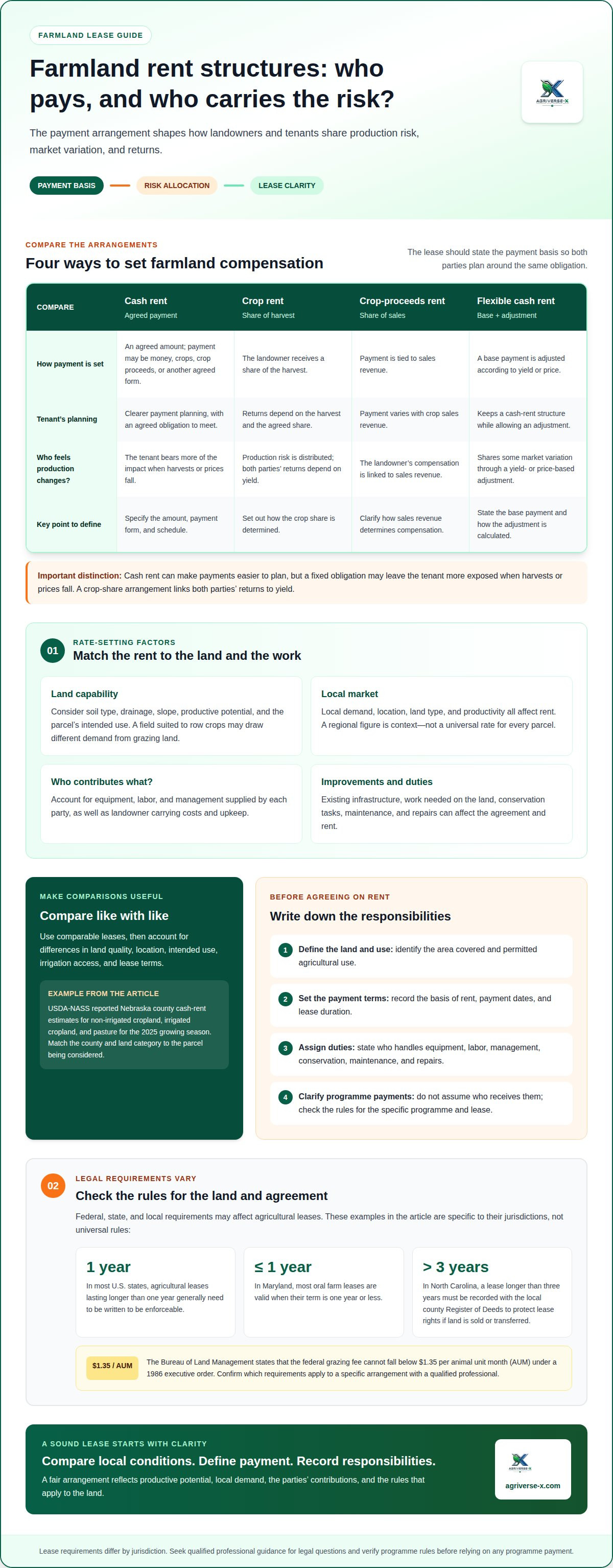
An oral lease is made verbally, while a written lease records the parties’ terms in a document. In most U.S. states, agricultural leases lasting longer than one year generally need to be written to be enforceable. In Maryland, most oral farm leases are valid when their term is one year or less.
A written agreement records the rent, payment dates, permitted use, term, and maintenance duties. It can also clarify expectations before a lease is offered for bid. For example, it can specify who handles conservation tasks or repairs to existing improvements, reducing uncertainty during the operation.
Applicable Agricultural Lease Laws
Federal, state, and local requirements can affect agricultural leases, depending on the land and agreement. Federal rules may apply to particular arrangements, while state rules can address lease form and recording. Local requirements may determine where a lease must be recorded.
The Bureau of Land Management states that the federal grazing fee cannot fall below $1.35 per animal unit month (AUM) under a 1986 executive order. In North Carolina, according to the North Carolina General Assembly, a lease longer than three years must be recorded with the local county Register of Deeds to protect the farmer’s lease rights if the land is sold or transferred.
Before entering a land lease, account for applicable laws, required permissions, and due diligence. Qualified professionals can address legal questions, and regulated services connected with the operation require appropriate licensed partners. Requirements vary by jurisdiction, so the terms should reflect the rules that apply to the specific land and arrangement.
What is a cash-rent tenant?
With a cash-rent lease, the tenant pays the landowner an agreed amount to use farmland for production. Payment may be a fixed sum of money, crops, crop proceeds, or another agreed form of compensation. The lease should clearly identify the payment basis so both parties can plan around the same obligation.
Cash rent separates land ownership from farm operations. The landowner receives the agreed payment, while the tenant manages production and keeps crop proceeds after meeting lease obligations. Under crop rent, compensation is a share of the harvest; under crop-proceeds rent, it is tied to sales revenue. Each arrangement allocates production risk and reward differently.
Cash rent makes payment planning clearer for the tenant, but the tenant bears more of the impact when harvests or prices fall. A crop-share lease can distribute production risk because the landowner receives part of the crop, though both parties’ returns then depend on yield. Flexible cash rent combines a base payment with an adjustment tied to yield or price, sharing some market variation while retaining a cash-rent structure.
Farm-program payments may be relevant to a cash-rent lease, so the parties should clarify how they are handled. Eligibility and payment treatment under the ARC/PLC program, and under specific CRP contracts, can depend on the programme rules and the lease arrangements. Do not assume that a tenant or landowner will receive a particular benefit; contact the relevant programme administrator or a qualified professional to confirm how the rules apply to a particular lease.
Rates Depend on Land and Use
Cash rents vary by land type, productivity, location, and local demand. These regional examples are context, not a single rate for every parcel or operation.
County-level estimates can sharpen comparisons. USDA-NASS reported Nebraska cash-rent estimates by county for non-irrigated cropland, irrigated cropland, and pasture for the 2025 growing season. Comparing the relevant land category and county helps distinguish local market conditions from statewide averages. Irrigation access and intended production also shape how useful a comparison is.
For example, a tenant considering pasture should compare pasture leases, not cropland agreements. Landowners and tenants can then weigh the proposed payment against the parcel’s use, production potential, and who supplies equipment or labor. A cash-rent figure is most useful when the land use and lease terms are closely matched.
Factors that determine rental rates
Land capability, local demand, and the proposed operation all affect agricultural rent. Landowners and farmers should consider uncertain production, shifting demand, and responsibilities the contract leaves unclear. A rate that overlooks these factors can strain the tenant’s budget or leave the landowner’s expectations unmet.
Start with the land’s productive capacity. Soil type affects which crops suit a parcel, while drainage and slope influence how it can be cultivated. For example, a field suited to row crops may attract different demand from grazing land. Compare the intended use with the parcel’s actual conditions before discussing rent.
Water access can change which types of production are practical. Irrigation can support crops that depend on more reliable water, while non-irrigated farmland relies more directly on rainfall. This is why the water system and land category matter when comparing rental rates.
Location and access matter, too. A parcel near roads, storage, or buyers may suit an operation differently from a remote field with limited access. These conditions can affect transport and operating needs, which in turn influence what rent the operation can support. Compare farmland with similar access rather than treating a nearby parcel as an exact match.
Land use must fit zoning restrictions and the owner’s objectives. Landowners can assess which agricultural uses suit the soil and comply with possible zoning restrictions. For example, a proposed livestock operation may not fit a parcel intended for crops. Define permitted uses in the contract, including conservation responsibilities, so both parties understand the operation’s limits.
Improvements and contributions affect the value available to the tenant. Existing irrigation, fencing, buildings, or usable equipment may reduce setup needs. A tenant who contributes labor or management for upkeep also adds value beyond the rent. Record who maintains each improvement and pays for repairs; otherwise, the rent may not reflect the actual division of costs.
Market demand can shift as local farming conditions change. Strong demand for particular soils may increase competition, while a parcel requiring substantial work may attract less interest. Assess rent against comparable land use, productivity, access, and included improvements, not acreage alone. The contract should also state whether the rate remains fixed or changes at renewal.
For both parties, the main risk is a mismatch between rent and the land’s actual performance. A tenant may agree to a rate that production cannot support; a landowner may overlook land quality or the tenant’s added contributions. Set the rate against the parcel’s use, condition, and responsibilities, and state those assumptions clearly in the contract.
Landowner fixed and carrying costs
A landowner’s carrying costs are the recurring expenses of holding farmland, whether it is rented or idle. The DIRTI-5 approach groups five fixed-cost categories: depreciation, insurance, repairs, taxes, and interest. Reviewing each category helps landowners understand the costs behind ownership before negotiating rent with a farmer.
Depreciation reflects the gradual loss of value in eligible property and improvements. Insurance covers policies held by the landowner, while repairs address upkeep assigned to the owner. Taxes are property-related obligations, and interest reflects borrowing costs tied to the property. Which costs matter depends on ownership and the lease arrangement.
Separate land costs from operating expenses. A farmer may pay for seed, labor, fuel, and crop inputs, while the landowner carries ownership costs. For example, if the landowner supplies fencing materials and the tenant provides labor, the contract should spell out that division. This avoids treating the tenant’s work as though it were a cash payment.
Maintenance can also be shared in practical ways. One arrangement is for the landlord to pay for materials while the tenant provides or pays for labor. If a fence needs repair, the lease can state who buys posts and wire, who does the work, and how the parties approve the repair. Clear assignments prevent the same task from being charged to both parties.
Taxes can influence a landowner’s decision to lease. In some jurisdictions, keeping land in agriculture may make a landowner eligible for a lower property tax rate, subject to local conditions and land-use rules. This potential tax treatment is separate from rental income. Landowners should consult a qualified tax professional about eligibility and possible consequences in their jurisdiction.
Review carrying costs using records, not assumptions. Separate recurring ownership expenses from occasional repairs, then identify which expenses the lease assigns to the tenant. For example, list insurance and property taxes separately from a one-time drainage repair. This makes rent discussions more transparent and shows both parties which costs the rental payment needs to support.
Do not automatically add every ownership expense to the rent. The tenant’s contributions of labor, materials, or maintenance affect the balance, as do the landowner’s responsibilities. If the lease assigns a repair to the farmer, identify the task and the required material or labor contribution. Both parties can then assess the proposed rent alongside their actual obligations.
For landowners, the practical aim is to understand the cost base without confusing it with market value. For farmers, the aim is to see what rent covers and which additional duties remain. Reviewing the DIRTI-5 categories and written maintenance terms gives both parties a clearer basis for discussing the lease.
How can landlords and tenants estimate fair market rent using comparable leases?
Comparable leases offer a local reference for negotiation, not a ready-made price for every parcel. Landlords and tenants can develop a useful estimate by matching land use, location, productivity, and lease responsibilities, then discussing differences before agreeing on terms.
Start by defining the parcel and proposed operation. Separate cropland from pasture, and note whether the land is irrigated. A pasture lease is a poor comparison for a crop-producing parcel because the land supports different uses and production. Record the parcel’s location, access, improvements, and intended use before choosing comparable leases.
Next, gather local rental information for the relevant land category and period. North Carolina annual farmland rental-rate information is available for 2025 and 2024. Farm advisors, area farmers, and Cooperative Extension agents can provide context on current rates for local soils and farmland demand. Their insight helps explain whether a reported rate reflects comparable land and conditions.
Start with the closest matches. Compare parcels in the same local market and land-use category, then assess differences in productive capacity. For example, an irrigated crop parcel and a non-irrigated parcel are not equivalent simply because both grow crops. Note water access and any significant improvements alongside each comparison.
- Match the use: compare cropland with cropland, or pasture with pasture.
- Match the setting: consider local soils, access, and nearby demand.
- Match the lease structure: distinguish fixed cash rent from crop-based or flexible terms.
- Match responsibilities: record who supplies equipment, labor, repairs, and management.
Then describe adjustments in plain terms. If a nearby lease includes irrigation equipment but the parcel being assessed does not, explain the difference rather than copying its rate. If one tenant handles maintenance while another lease assigns it to the owner, account for those different obligations. These adjustments make the estimate clearer for both parties.
Regional land classifications can add another useful lens. North Carolina’s 2023 Use-Value Manual reports land rents based on six Natural Resources Conservation Service North Carolina Major Land Resource Areas. This framework helps relate land-rent information to regional resource conditions, but a classification does not replace comparisons with actual lease terms.
Finally, present the result as a supported negotiating range, not a false exact match. Explain which leases informed it, which differences required adjustment, and how the proposed operation affects responsibilities. Put the agreed rental rate, payment basis, and assigned duties in the contract. For farmland opportunities and leases, explore agricultural land listings.
AgriVerse-X: Digital Agricultural Marketplace
AgriVerse-X plans to connect landowners and prospective tenants through farmland and lease listings, subject to confirmation. The planned marketplace is intended to support consideration of agricultural land opportunities, including rental rates. Listings may also include storage and equipment rentals, subject to confirmation, to help users consider related operational needs when planning an agreement.
Planned features may allow farmers, agribusinesses, cooperatives, and service providers to create digital profiles showcasing products, services, skills, and certifications. For example, a farmer seeking leased land could present relevant skills and credentials, while a landowner could explore opportunities through the agricultural marketplace, if these features become available. The parties must agree on lease terms, rent, and land use, and address applicable local requirements.
For information about planned agricultural listings and connections, contact AgriVerse-X at [email protected].
Turn a Lease Decision Into a Clear Next Step
A lease can support a long-term agricultural plan when both parties treat it as an active working agreement. As the operation develops, record how actual land use compares with the original plan. That record gives future discussions a practical basis and helps identify when conditions may warrant a review.
Make the next step a regular lease review linked to the farming calendar. Consider whether the agreed use still suits the parcel and whether each party’s responsibilities remain workable. This keeps the arrangement aligned with the operation without assuming that rent or terms should change automatically.
Use a consistent process for setting rent for agricultural land: link the proposed payment to the land’s intended use and the agreement’s practical responsibilities. Clear expectations and a planned review process help landowners and farmers move forward with confidence.
Frequently Asked Questions
What is a Lease?
A lease gives a tenant agreed use of land without transferring ownership. That distinction matters for farm planning: access rights come from the agreement, not simply from occupying or improving the parcel. For example, planting a perennial crop or installing a structure can raise questions about ownership when the tenancy ends. The parties may wish to discuss these expectations and seek qualified local advice when drafting or reviewing lease terms.
How is agricultural land rent calculated in the United States?
Begin by identifying the land actually available for the tenant’s use. A parcel’s total mapped area may include land unsuitable for the planned operation, so usable area can affect the total obligation. Then make sure the quoted rent and agreement use the same unit and payment period. This prevents comparing a whole-parcel amount with a per-acre figure as though they were equivalent.
What is the average cropland cash rent per acre by state?
There is no single figure that applies across every state and year. State-level figures depend on the reporting period and cropland categories included. Before using a published average, identify its year, geographic scope, and whether it covers irrigated, non-irrigated, or combined cropland. These details clarify what the statistic represents and help prevent mistaking an average for a quote on a specific parcel.
What is the average pastureland rent per acre by state?
Pasture averages vary by state, reporting period, and the grazing use represented. Check whether the comparison concerns pasture access alone or includes responsibilities such as maintaining water points or boundary fencing. These arrangements are not directly comparable. A state figure can provide context, but a particular grazing parcel’s value also depends on its usable area and access conditions.
How do soil quality, location, irrigation, and crop type affect farmland rent?
Crop history and field layout add useful context alongside soil and water conditions. A parcel with a history suited to the intended crop may require a different operating plan from land that needs changes to its rotation. Field shape can also affect machinery use. For example, irregular boundaries may complicate planting or harvesting compared with a consistently shaped field.
What lease terms should an agricultural land rental agreement include?
Parties may wish to discuss topics such as a map or clear parcel description, access routes, crop residue after harvest, and ownership of improvements installed during the tenancy. These details can matter if the tenant needs continued access to stored materials or wants to remove equipment before leaving. The parties should consult a qualified local professional to draft or review lease terms, as requirements vary by jurisdiction.
How do property taxes, insurance, repairs, and conservation costs affect farmland rent?
State whether each shared expense is included in the rent or handled separately. If a tenant reimburses the owner for an agreed item, define how the amount is documented and when payment is due. For example, the parties can discuss requiring prior approval and a receipt for conservation materials. A qualified local professional can advise on drafting or reviewing these terms.
How should farmland rent be adjusted for inflation, commodity prices, or changing yields?
Before agreeing to an adjustment, consider how the proposed rent would affect the operation under stronger and weaker production conditions. This helps the parties assess whether a change tied to commodity prices or yields would remain workable across different outcomes. They can also distinguish a planned review from an automatic change. The parties may wish to discuss the trigger, calculation method, and timing, and seek qualified local advice on how to document any agreed process.


