

The best bulk soybean purchase is defined before you compare offers. Assess a soybeans bulk supplier against the product form, intended use, lot information and terms your operation needs, not just a broad product label.
Soybean types and product forms are not interchangeable. A lot or product suited to one purpose may not fit another, so state your intended use and agree on relevant specifications and handling details before moving forward.
This guide turns those questions into a practical buying plan. You’ll learn how to define your requirements, compare offers using consistent information and clarify important terms before placing an order. AgriVerse-X distributes bulk agricultural commodities, including soybeans, and its agricultural marketplace connects buyers with agricultural products and services. Use the steps ahead to prepare a focused enquiry and explore bulk soybean sourcing through AgriVerse-X.
Key Takeaways
- Start with intended use and product form to make your bulk soybean requirements clear.
- Ask consistent questions about lot information, handling and commercial terms.
- Compare offers only when product descriptions and terms are clear enough to assess on the same basis.
- Settle quantity, destination, timing and product requirements before committing to an order.
- Explore AgriVerse-X’s agricultural marketplace as a sourcing option for bulk soybeans.
What Bulk Soybean Buyers Need to Define Before Sourcing
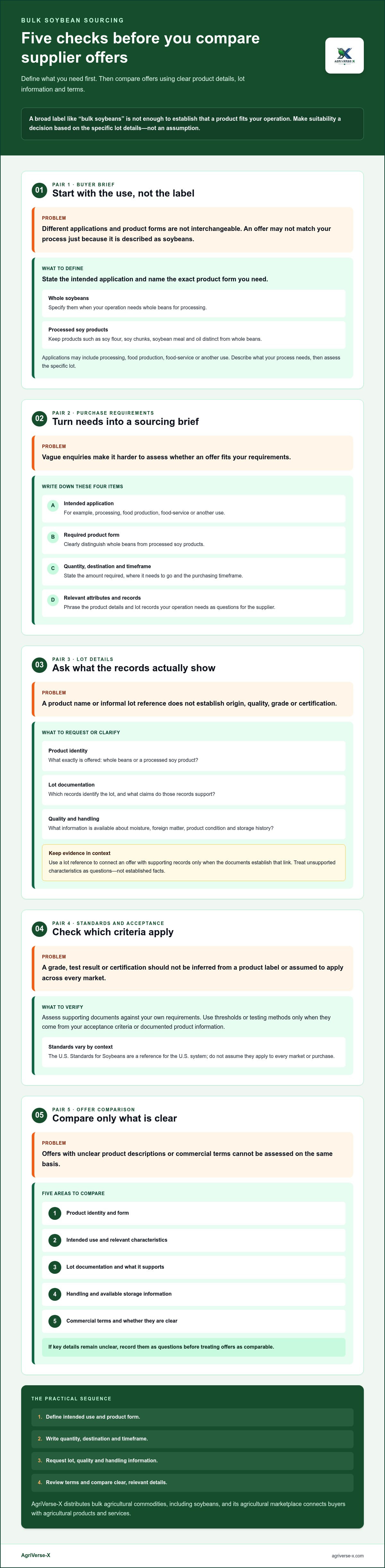
Define the intended use, product form and lot information your purchase requires before approaching a soybeans bulk supplier. With these basics in writing, you can focus the discussion on whether the product description and terms fit your operation.
Food processing, food-service, ingredient production and other uses are not interchangeable buying briefs. A buyer processing whole soybeans may need to assess different product characteristics from a business sourcing a prepared soy product. State the application, then review the specific lot details before deciding whether the offer is suitable.
For general background on soybean uses and characteristics, see Soybean. Use general information as context, not as evidence about a particular lot.
For a visual example of a bulk soybean listing, watch this third-party video. Its product-specific statements are not specifications for every soybean lot.
Use the video only to see how a supplier might present an offer. The protein figure, price, minimum order and other claims in its title are not universal benchmarks and do not establish the details or terms of another lot.
Match the soybean purchase to its intended use
State whether you need whole soybeans for processing, a soy product for food production or food-service, or another product for a different application. Keep whole beans distinct from processed products such as soybean meal or oil. These are different product categories, so an offer for one should not be treated as equivalent to an offer for another.
Different applications can require different product characteristics. Describe what your process needs and turn each relevant attribute into a clear question for the supplier. This keeps the discussion focused on the specific lot instead of assumptions based on a broad label such as “bulk soybeans.”
Build a clear bulk sourcing brief
A bulk soybean sourcing brief is a use-led summary of the product, quantity, destination, timing and lot information a buyer needs to assess an offer. Keep it concise and explicit. The same brief can make enquiries clearer across agricultural buying conversations, including on a marketplace.
Before requesting an offer, write down:
- The intended application, such as processing, food production, food-service or another use.
- The product form required, clearly distinguishing whole beans from processed soy products.
- The quantity, destination and purchasing timeframe.
- The product attributes or lot records that matter to your operation, phrased as questions for the supplier.
This preparation gives you a consistent starting point and helps prevent a mismatch between your needs and the product description. It also keeps suitability as a decision to make after reviewing the lot details, rather than an assumption made from the listing alone.
Which Soybean Details Should a Bulk Supplier Provide?
Ask for documented lot details rather than assuming bulk soybeans share the same characteristics. A useful specification makes the product form, intended use and available lot information clear. This gives you a consistent basis for assessing an offer and separates documented details from questions that still need answers.
Organise your enquiry around five areas: product identity, intended use, lot documentation, handling and commercial terms. For each, note what is documented and what you need to establish before purchase. A product label alone may not tell you what your process depends on.
Product form, use, and lot identification
Start by naming the product form. Whole soybeans are not the same product as soy flour, soy chunks, soybean meal, oil or other processed products. Record the required form and intended application in your purchasing documents so you can assess the offer against your operation’s needs.
If paperwork includes a lot reference, use it to connect the offer with supporting records when the documents establish that link. An informal reference alone is not proof of origin, quality or certification.
Quality and handling questions for supplier discussions
Turn quality and handling concerns into direct questions. What information is available about moisture, foreign matter and product condition? What storage history is documented? Which records relate to your acceptance criteria and intended use? Request relevant supporting documents and assess them against your own requirements.
Some buyers may refer to a formal grading framework. The U.S. Standards for Soybeans provide a reference for the U.S. system, but should not be assumed to apply to every market or purchase. Do not infer a grade, test result or certification from the product name alone.
Use this checklist to keep the supplier discussion focused:
- Product identity: What exactly is being offered? Is it whole beans or a processed soy product?
- Intended use: What application do you have in mind, and which characteristics need to be assessed?
- Lot documentation: Which records identify the lot, and what claims do those records support?
- Handling: What information is available about the product’s condition and storage history?
- Commercial terms: Which terms are stated, and are they clear enough to compare with other offers?
Keep requirements specific, but use thresholds or testing methods only when they come from your acceptance criteria or documented product information. If an offer states a characteristic without supporting detail, record it as a question rather than treating it as established.
AgriVerse-X distributes bulk agricultural commodities, including soybeans. Use this checklist to structure a sourcing discussion through its agricultural marketplace, then assess each lot and its documented terms on their own merits.
How to Compare Soybeans Bulk Suppliers and Offers
Compare offers using the same buyer-led framework, not product labels alone. A side-by-side review is useful only when descriptions and commercial terms are clear enough to assess against the same requirements. Separate documented information from seller claims and unresolved questions.
A comparison sheet makes differences easier to see. The entries below are illustrative placeholders, not supplier assessments or statements about any specific soybean lot.
Use a consistent supplier comparison table
Use the same fields for every offer. Write “Question to resolve” where information is missing. This flags a follow-up without treating the gap as evidence of poor quality.
| Supplier | Product description | Documentation | Stated terms | Buyer follow-up |
|---|---|---|---|---|
| Supplier A | Product form and description as stated | Records supplied or identified | Quantity, destination, timing, and other stated terms | Which details need clarification? |
| Supplier B | Product form and description as stated | Records supplied or identified | Quantity, destination, timing, and other stated terms | Which details need clarification? |
| Supplier C | Question to resolve if not stated | Question to resolve if not stated | Question to resolve if not stated | What is needed to assess fit? |
For example, do not compare an offer for whole soybeans as though it were an offer for soybean meal. If one offer identifies supporting lot documents and another does not describe its documentation, record that difference accurately. Do not infer a grade, origin, certification or quality result from a general product description.
Check whether the offer fits the buyer’s requirements
Review each offer against your written sourcing brief. Check the product form and intended use, available lot records, quantity, destination, timing and commercial terms. Whether an offer suits your operation depends on its documented product information and your own requirements, not the supplier label alone.
If the quantity does not match your requirement, or a planning term is missing, record it as a follow-up. Keep gaps visible before treating offers as equivalent. This helps distinguish a confirmed mismatch from information that has not yet been provided.
Apply the same discipline to every potential soybeans bulk supplier: document the facts, note seller claims separately and assign each unresolved point a clear question. Buyers reviewing other staple commodities may also find the African Food Staples Wholesale: A Buyer’s Sourcing Checklist useful as a broader procurement reference. AgriVerse-X distributes bulk agricultural commodities, including soybeans, through an agricultural marketplace that connects participants with agricultural products and services.
A Practical Bulk Soybean Procurement Process
Keep a bulk purchase clear from the first enquiry to the final order record. Define the requirement, compare documented offers, resolve open terms, review the order details and retain relevant communications. Written requirements help you assess offers consistently and reduce ambiguity about what is being considered.
Prepare and share the purchasing requirements
Bring together the intended use, product form, quantity, destination, purchasing timeframe and documents needed to assess the offer. Put these details in writing so you and the soybeans bulk supplier are working from the same brief. Keep it as a reference as the discussion progresses.
For broader commodity procurement context, the Bulk Agro Food Products Supplier: A Buyer’s Reference Guide can sit alongside your soybean-specific requirements. Keep your soybean brief focused on your application and acceptance criteria.
Use this sequence to move from enquiry to order review:
- Define requirements. State the intended use, product form, quantity, destination, timeframe and documentation needed for assessment.
- Compare documented offers. Separate recorded product details from seller claims and unanswered questions. Compare each offer on the same basis.
- Discuss terms. Clarify the commercial terms that affect your decision without assuming a particular payment, shipping or return arrangement.
- Review the order details. Check that the product description, quantity, destination, timing and agreed terms match your sourcing brief.
- Retain records. Keep order communications and relevant product documents with your purchasing records.
Review the offer and keep the transaction clear
Before committing to an order, settle the quantity, destination, timing and product requirements. Review the product description separately from the commercial terms. First assess whether the documented product information fits your needs, then consider whether the proposed terms work for your operation.
Look for differences between your original brief and the order details. Address a changed product description, unclear quantity or unresolved term before commitment. Keep written clarifications with the other transaction records.
Documentation supports a clear purchasing process, but does not by itself establish suitability. That judgment depends on your requirements and the information available for the specific offer. Apply the same review steps whether you are considering one offer or several.
AgriVerse-X distributes bulk agricultural commodities, including soybeans. Discuss your bulk soybean sourcing needs with AgriVerse-X as part of a clear, requirements-led procurement conversation.
Source Bulk Soybeans Through AgriVerse-X
Its agricultural marketplace connects participants with agricultural products and services, giving buyers a sourcing option within a broader agricultural ecosystem. Start with a clear brief, then align product details and commercial terms through the sourcing discussion.
A marketplace connection starts a buyer and seller discussion; it does not replace review of the specific lot and its terms. Keep the focus on the product information and requirements that matter to your purchase.
What buyers can bring to a sourcing conversation
Arrive with a concise brief that makes your needs easy to understand. State the intended use and product form, then include the quantity, destination and lot documentation your team needs to assess the offer. Separate essential requirements from questions that can be resolved during discussion.
- Intended use: Describe the application the purchase is meant to support.
- Product form: State whether you need whole soybeans or another clearly specified form.
- Quantity and destination: Record the amount required and where the order is intended to go.
- Documentation: List the lot information your team needs to review.
- Timing: Share your purchasing timeframe as a requirement to discuss, not as an assumed delivery commitment.
This shared starting point ties the discussion to your buying needs and gives your team a reference for reviewing the resulting product description and terms. It also reduces reliance on informal assumptions about the offer.
Keep product details and purchasing expectations aligned
Before proceeding, compare the offer and order details with your brief. Confirm that the product description reflects the form and use discussed, and that the quantity, destination, timing and commercial terms are understood. Keep agreed clarifications with the relevant purchasing records.
Product assessment and terms review serve different purposes. Product information helps you evaluate whether an offer meets your requirements; commercial terms help you assess whether the transaction fits your purchasing plans. Do not treat an unmentioned detail as agreed or assume a particular grade, origin, certification, packaging or delivery arrangement. Those details need to be explicit in the information and terms for the specific purchase.
AgriVerse-X is a sourcing option for buyers looking for bulk soybeans. Share a focused brief and use the conversation to clarify the requirements that matter to your operation. Contact AgriVerse-X about bulk soybean sourcing.
Make Your Next Soybean Purchase Decision-Ready
Use each purchase review to improve how your organisation manages future commodity decisions. Note which questions clarified the offer and where your process needed more information. Those observations can help your team prepare better procurement reviews over time.
Share useful lessons with colleagues who assess, approve or receive bulk agricultural purchases. A consistent internal approach makes decisions easier to explain and hand over, even when team members or purchasing needs change.
Capture what your team learns, refine its review process and carry that clarity into future sourcing decisions.
Frequently Asked Questions
What should I look for in a bulk soybean supplier?
Look for clear answers to specific questions about the offer. Record clarifications against the relevant item in your purchasing brief, and request revised information in writing if details change during discussion. This gives colleagues a clearer record of how the offer was assessed, without relying on memory or informal summaries.
Can I buy soybeans in bulk from AgriVerse-X?
Yes. For an efficient enquiry, identify who in your organisation will assess the offer and which internal approvals are needed. Flag the decision points that must be resolved before proceeding, without presuming a particular variety, grade, origin, packaging or delivery arrangement.
Which soybean specifications matter for a bulk order?
Separate essential acceptance criteria from preferences. Your technical team can identify the product details needed for its assessment, while procurement identifies the commercial information required for approval. The right specification set is the one your organisation can use to make and document its own purchasing decision.
Are hulled and unhulled soybeans the same product?
No. They are different product forms, and the choice should follow the needs of the operation that will use them. Ask the relevant production or technical team which form its process requires and how that requirement should appear in the purchasing records. This helps prevent a product-form decision being made without input from end users.
How do I compare bulk soybean supplier offers?
Decide which requirements are essential and which can be discussed further before ranking offers. If a decision-critical point is unanswered, hold the offer for clarification rather than treating it as automatically unsuitable. Keep each offer tied to the version of your brief used to assess it, so later revisions do not blur the basis of your decision.
What should I confirm before placing a bulk soybean order?
Assign someone to review the final purchasing details before your organisation proceeds. They can check that agreed clarifications appear in the version being approved and that relevant teams have seen changes affecting their requirements. If a material detail changes during review, circulate the updated information to those responsible for the decision before approval.
Are soybeans for food processing and animal feed interchangeable?
Do not treat them as interchangeable by default. Intended use should guide which team evaluates the purchase, since food production and feed operations may have different internal acceptance processes and end-use requirements. Ask the responsible technical or quality staff to define the criteria for their operation before procurement advances. A general product category alone cannot establish that a particular lot suits either application.


