

A sesame seeds wholesale price is useful only when you know which product it covers, when the quote was recorded, and what the trade terms include.
Online listings can mix hulled and natural seeds, different colors, packaging sizes, units, and sale terms. A single headline figure cannot show whether the market is moving or whether the details simply differ. To compare prices fairly, match the seed form and stated quality, date, quantity, unit, origin, and quotation basis.
This guide explains how supply, demand, harvests, inventory, and logistics can inform your reading of wholesale price movements in 2026. It also gives you a practical way to record observations before treating separate quotes as evidence of a trend. AgriVerse-X distributes bulk agricultural commodities, including sesame seeds, and its agricultural marketplace connects buyers and sellers. Use the method below to assess price information without treating a quote as a promised price or forecast.
Key Takeaways
- Read a sesame seeds wholesale price as a quote tied to a specific product, quantity, date, and sale basis, not as proof of a market-wide trend.
- Check possible supply, demand, harvest, and inventory influences against dated evidence before linking them to a price movement.
- Use a consistent record for origin, product form, unit, packaging, and quotation basis to make separate quotes more meaningful.
- Label each observation as a confirmed transaction, estimate, asking price, or incomplete information before tracking changes over time.
- AgriVerse-X’s agricultural marketplace connects buyers and sellers, while each listing and trade term remains specific to its opportunity.
What Does Sesame Seeds Wholesale Price Actually Tell a Buyer?
A sesame seeds wholesale price is a quotation for a defined product, quantity, date, and sale basis. It describes the terms attached to that observation, not automatically the price of every sesame seed or the direction of the whole market.
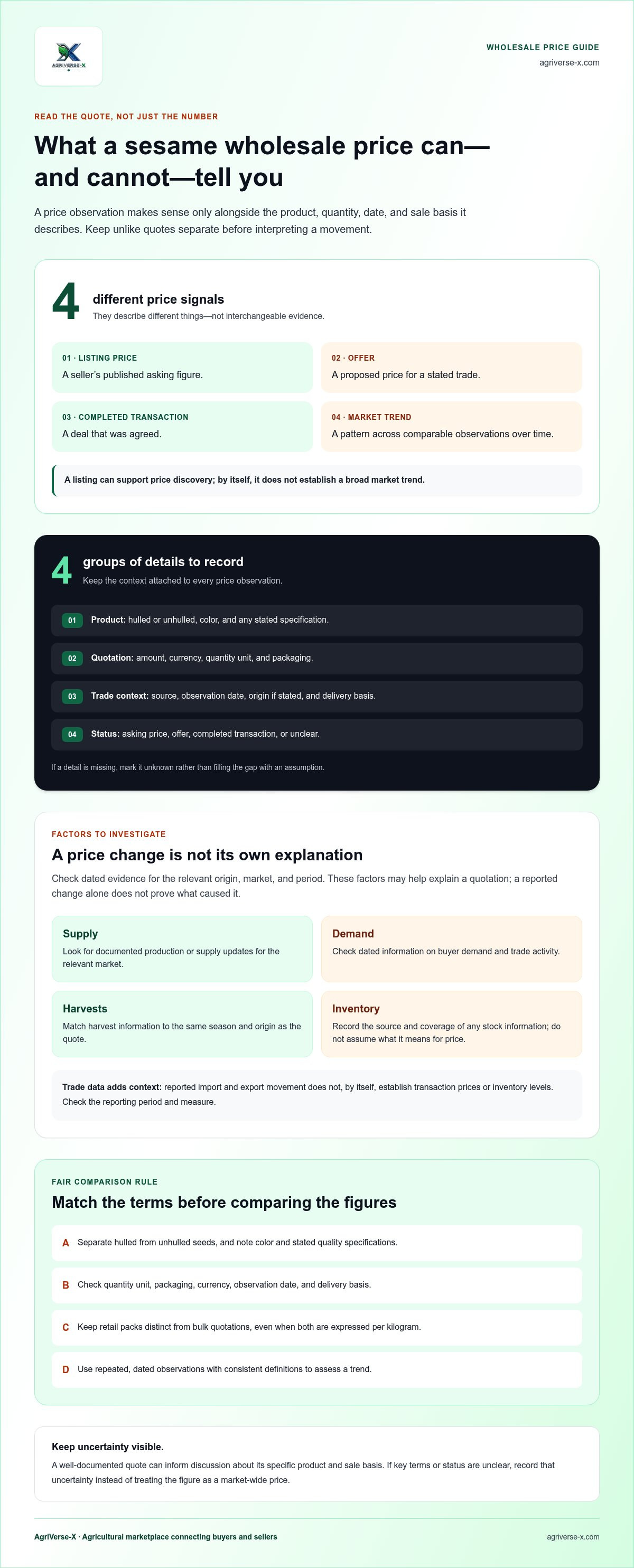
Keep three signals distinct. A listing price is a seller’s published asking figure. An offer is a proposed price for a stated trade, while a completed transaction records a deal that was agreed. A market trend is a pattern across comparable observations over time. A listing can help with discovery, but it cannot establish a broad trend on its own.
Product identity matters. Hulled seeds have had their outer covering removed; unhulled, or natural, seeds retain it. White and black sesame can serve different buyer preferences and uses, so a quotation for one type should not be treated as interchangeable with another. The botanical and culinary background of Sesame (Sesamum indicum) offers useful context, but trade comparisons still need a specific product description.
Why two sesame price figures may not be comparable
Before interpreting a difference, match the seed form, stated quality specifications, quantity unit, and observation date. A small retail pack is not equivalent to a bulk quotation, even if both are expressed per kilogram. Currency and delivery basis matter too: a figure tied to goods at one location may not include the same transport or delivery obligations as another. Compare like with like, or clearly mark the differences.
What a useful price observation should include
Build a record that preserves the context behind each figure. Capture the source, date observed, seed form, origin if stated, quantity and unit, currency, packaging, and sale or delivery basis. Label the figure as an asking price, offer, or completed transaction. If key details are missing, record them as unknown rather than filling gaps with assumptions.
A practical comparison record might use these fields:
- Product: hulled or unhulled, color, and any stated specification.
- Quotation: amount, currency, quantity unit, and packaging.
- Trade context: source, observation date, origin, and delivery basis.
- Status: asking price, offer, completed transaction, or unclear.
This format helps buyers spot false comparisons. If one source names a retail pack and another gives a bulk quotation, don’t treat the difference as evidence that the market moved. First identify what each figure describes. If the source doesn’t say whether a figure is an offer or a completed trade, keep that uncertainty visible in your notes.
Use each observation only for what it can support. A single, well-documented quote may inform a conversation about that product and sale basis. A trend requires repeated, dated observations with consistent definitions. The stronger the record, the easier it is to distinguish a real price movement from a change in seed type, unit, packaging, currency, or terms.
Which Factors Can Move Sesame Seeds Wholesale Price Trends?
Supply, demand, harvest results, and available inventory can help explain a sesame quotation, but they are factors to investigate, not automatic causes. A reported price change alone cannot show which influence mattered. To assess the sesame seeds wholesale price over time, compare consistent observations and look for dated evidence linking changes in supply or buying activity to the period under review.
Supply and demand signals to check
Start with documented production, harvest, stock, and buyer-demand updates for the relevant origin or market. A poor harvest may affect expected supply, for example, but that possibility is not proof that it caused a specific quotation to rise. Check whether the production information covers the same season and origin as the price observation.
For trade context, compare observations over a stated period and consult the U.S. Department of Commerce’s U.S. Trade Data and Analysis tools for dated import and export information. Trade statistics can show reported movement of goods, but they do not by themselves establish transaction prices or inventory levels. Check the reporting period and measure before drawing conclusions.
Origin-specific claims need particular care. Production estimates, harvest updates, and inventory reports can differ in timing and coverage. Record the source and publication date, then distinguish a documented observation from an interpretation. If the evidence does not establish a cause, label it as a factor to investigate rather than stating that it drove the market.
How product form and trade terms shape quotations
Keep hulled and unhulled sesame in separate comparison groups. Processing changes the product being offered, so a difference between quotations may reflect form or specification rather than a broader market movement. Stated quality details, such as purity or color, and packaging help determine whether two offers describe comparable goods. Do not assign a premium to any specification without like-for-like evidence.
Other commercial factors may matter, but include them only when the source documents them. Currency conversion can change the apparent relationship between quotations; freight or delivery terms may affect the amount a buyer compares. Processing and packaging costs are relevant only where the data identifies them and makes clear whether they are included. Otherwise, note the information gap instead of estimating its effect.
Use a simple evidence sequence before interpreting a movement:
- Match the period: compare observations from stated dates or seasons.
- Check the market: align origin, destination, product form, and specification.
- Trace the claim: record the source and separate its reported facts from your explanation.
- Mark unknowns: flag missing inventory, trade, or cost details instead of filling them with assumptions.
These checks help separate observed price movement from possible explanations. If the data shows a change but does not establish its cause, report the movement and leave the cause open for further verification.
How Can Buyers Compare Sesame Wholesale Price Information Fairly?
Compare quotations only after aligning their product details and trade context. A consistent record makes it easier to see whether a difference reflects a real change in comparable offers or a different seed form, unit, package, or delivery basis. It also keeps estimates and incomplete listings from appearing as confirmed market data.
A like-for-like comparison checklist
Group observations by seed form and stated specification first. Then align quantity units, noting any conversion method and its source. Keep currency, observation date, origin, packaging, and delivery basis visible beside every figure. If an entry is missing a detail, mark it clearly rather than assuming it matches the others.
| Date | Product form and specification | Origin | Unit and packaging | Currency | Quotation basis and status | Source |
|---|---|---|---|---|---|---|
| Record date | Record form and stated details | Record or mark not stated | Record quantity unit and pack | Record currency | Asking price, offer, completed transaction, or unclear; note delivery basis | Record source |
| Record date | Record form and stated details | Record or mark not stated | Record quantity unit and pack | Record currency | Asking price, offer, completed transaction, or unclear; note delivery basis | Record source |
Table note: Don’t rank entries with missing or mismatched product, unit, currency, or trade details. Keep them visible as incomplete observations, but exclude them from direct comparisons until the basis is clear.
How to avoid misleading trend conclusions
Separate confirmed observations from estimates and asking prices before drawing conclusions. A retail pack listing should not be compared directly with an unspecified wholesale quotation. Show the dates covered and sources included in any trend statement, and describe gaps in the record instead of filling them with assumed values.
Unit normalization can help, but only when the source gives a clear quantity and the conversion is transparent. If one quotation is stated per package and another per weight, record the package quantity and calculation method before comparing them. If either is missing, keep the figures separate. Currency conversions also need a stated rate and date, since a conversion can change the apparent comparison.
Keep the original source figure alongside any normalized value. This preserves traceability: another buyer can see what was reported and how you made the entries comparable. Record whether the source describes an asking price, an offer, or a completed transaction, since these statuses represent different levels of market evidence.
Apply the same definitions throughout the review period. A sesame seeds wholesale price trend is meaningful only when its observations share a comparable basis and the source coverage is clear. If the sample changes, say so. If product specifications or delivery terms are absent, identify the uncertainty instead of presenting a precise ranking that the data cannot support.
How Should You Track Sesame Seeds Wholesale Price Changes?
A reliable tracking process makes each observation traceable and keeps unlike quotations out of the same comparison. Use consistent sources and product definitions throughout the review period, then label gaps instead of estimating missing details.
Collect observations, verify their source and context, record them with clear status labels, and review only comparable entries over a defined period. This sequence helps you describe what the data shows without implying a target price or unsupported cause.
Set up a simple sesame market tracking log
Create one row for each observation. Record the date, source name and link, date accessed, seed form, origin if stated, quantity unit, currency, packaging, and quotation basis. Add a status field, such as confirmed transaction, offer, asking price, estimate, or unclear. Keep the original wording or source record so you can revisit what the figure represents.
Use a separate note or status tag for records that cannot support direct comparison:
- Missing detail: a key field, such as unit or seed form, is not stated.
- Outdated: the observation falls outside the period you are reviewing.
- Non-comparable: product form, currency, unit, packaging, or trade basis differs from the comparison group.
- Unverified: the source or quotation status needs further checking.
Keep these records in the log for transparency, but do not blend them into a comparable series. An old entry may provide historical context while remaining unsuitable for describing current movement. Apply the same definitions each time you collect information; changing source type or product category can make the record appear to shift when its basis has changed.
Turn observations into a cautious trend summary
Set the review period before drawing conclusions, then compare only entries with consistent product definitions and a clear source basis. Describe direction or variation only if the collected observations support it. If the record is sparse, mixed, or interrupted, state that limitation rather than presenting a firm trend.
Keep observations and explanations in separate fields. A log may show that comparable offers changed over a period, but it may not establish why. Record possible influences, such as harvest or demand updates, as items for further verification unless the source evidence directly supports a connection.
A concise summary can state the period reviewed, the type of observations included, the direction they indicate, and any important gaps. For instance, note that an assessment covers dated offers for one product form, while transaction data or origin details are unavailable. This is more useful than describing the sesame seeds wholesale price as rising or falling without showing what the evidence covers.
Review the log at a consistent interval and preserve earlier entries rather than overwriting them. That gives buyers and sellers a clearer record of how observations were collected and which ones support a comparison. For practical buyer-seller discovery, learn how AgriVerse-X connects agricultural participants.
How Does AgriVerse-X Fit into Sesame Seed Wholesale Discovery?
AgriVerse-X distributes bulk agricultural commodities, including sesame seeds, and its agricultural marketplace connects buyers and sellers. The marketplace supports product discovery and sourcing conversations, while each offer’s price and trade terms depend on the details of that opportunity. Use listing information as one part of price research, not as a market benchmark or forecast.
What marketplace discovery can help buyers organize
Digital discovery helps buyers find agricultural products and organize sourcing conversations. Clear product descriptions and offer details give buyers context for assessing what a quotation refers to and whether it can be compared with other market observations. For example, a buyer can use the stated product form and quantity to decide whether an offer belongs in the same comparison group as other data.
Apply the comparison method in this article before treating a difference as a market movement. A marketplace connection can support a sourcing discussion, but buyers still need to assess whether an offer is current, comparable, and suitable for their purchasing requirements.
For broader context on digital agricultural discovery, AgriVerse-X’s global agriculture marketplace resource discusses how marketplaces bring participants and products together. Use that perspective to organize discovery while grounding each sesame quotation in its own details.
Use price research alongside broader sourcing context
Price interpretation is only one part of a sourcing review. The African food staples sourcing checklist offers broader prompts for structuring that review, while the bulk agro food products reference guide provides context across commodity categories.
Keep each resource in its proper role. Use dated, comparable observations to assess price direction. Use sourcing references to frame the wider commercial context, not as evidence of a sesame price or a specific transaction. This distinction helps prevent general commodity guidance from being mistaken for a verified offer.
Explore AgriVerse-X’s agricultural marketplace to discover agricultural products and connect with buyers and sellers. Assess each sesame listing against its stated product details and commercial terms.
Make Market Monitoring Part of Your Sourcing Routine
A repeatable process for reviewing market information gives your next sourcing decision a clearer evidence base. Keep observations organized, revisit sources as conditions change, and treat each sesame seeds wholesale price as one data point rather than a stand-alone forecast. Consistent records help you spot when a new quote deserves attention and when it simply reflects different terms.
Connect that research with practical market discovery. AgriVerse-X’s agricultural marketplace brings participants together to explore agricultural products, inputs, equipment, and services. It supports a broader view of agricultural sourcing, while actual offers and terms remain specific to each opportunity.
Explore AgriVerse-X and its agricultural marketplace to discover sesame and other agricultural commodities and connect with marketplace participants. Keep your price comparisons grounded in clear product details, dated evidence, and the terms attached to each offer.
Frequently Asked Questions
How much do sesame seeds cost wholesale?
There is no single dependable figure for every bulk sesame transaction. The sesame seeds wholesale price depends on the product and quotation being considered, so a current asking price should not be presented as a completed sale or general benchmark. For a useful estimate, define the required seed form, quantity, currency, destination or delivery basis, and timing, then compare dated quotations that share those details.
What factors affect the wholesale price of sesame seeds?
Supply and buyer demand are central influences, while harvest outcomes and available stocks can affect how much product reaches the market. The effect depends on origin and period, so a general production report does not prove what caused a particular quotation to change. Check whether a harvest update and the price observation cover the same origin and season before connecting them.
Are hulled and unhulled sesame seeds priced the same?
Not necessarily. Hulled and unhulled seeds are different product forms, so buyers should first decide which form fits the intended use and compare offers within that group. A quotation for unhulled seeds does not establish the cost of hulled product after processing. Treat each as a separate category unless the source provides a clear, like-for-like comparison.
Why do sesame seed wholesale prices vary between suppliers?
Suppliers may quote different products, quantities, delivery arrangements, or transaction stages. One figure might be an initial asking price, while another reflects a negotiated offer or completed sale. Two quotations posted on the same day can still describe different seed forms or delivery points. Identify those differences before interpreting the gap as a supplier markup or market movement.
How can I compare sesame seed wholesale quotations?
Check whether each quotation refers to the same seed form, quantity unit, currency, and delivery basis, then record its date and status. Keep original figures alongside any normalized comparison so the calculation remains transparent. If a quote omits a key detail, mark it as incomplete rather than ranking it against fully described offers. This makes a purchasing review easier to revisit.
Do sesame seed prices change during the year?
They can change over time, but the pattern should not be assumed to repeat on a fixed calendar. Harvest timing and supply conditions vary by origin, while demand and inventory can also shift. To assess seasonality, compare dated observations across relevant periods using the same product definition and source approach. Separate a recurring pattern supported by records from a one-off price movement.


