

Choosing a soybeans wholesale exporter means checking whether the product, evidence, and delivery proposal fit your intended use. Soybeans for food, animal feed, industrial processing, and planting are not interchangeable, so define your requirements before comparing offers.
Supplier information can be difficult to compare when product descriptions use different terms or leave important details open. A written sourcing brief gives each offer the same reference point. It should identify the intended use, product and condition requirements, packaging needs, evidence you expect to review, and delivery responsibilities that must be agreed.
AgriVerse-X supports agricultural marketplace connections where buyers can discover soybean listings and connect with sellers. Treat marketplace discovery as the start of your assessment, not proof of suitability or delivery. This guide shows how to prepare a brief, compare offers consistently, and keep confirmed details separate from assumptions.
Key Takeaways
- An exporter’s role does not establish that the soybeans suit your process or meet your requirements.
- Define the end use first, then set out the product, condition, packaging, and evidence needed for your decision.
- Compare every offer against the same criteria. Separate confirmed details, unresolved points, and promotional claims.
- Review product specifications and evidence, document responsibilities, and agree delivery arrangements before proceeding.
- AgriVerse-X’s agricultural marketplace can help buyers discover soybean listings and connect with participants. Each opportunity still needs its own assessment.
What Buyers Should Expect from a Soybeans Wholesale Exporter
A soybeans wholesale exporter is a supplier or trade intermediary involved in arranging bulk soybean sales across markets, including cross-border sales. The role alone does not show whether a product suits your process, meets your quality requirements, or will arrive according to your needs. Evaluate the offer itself, including its stated specifications and responsibilities.
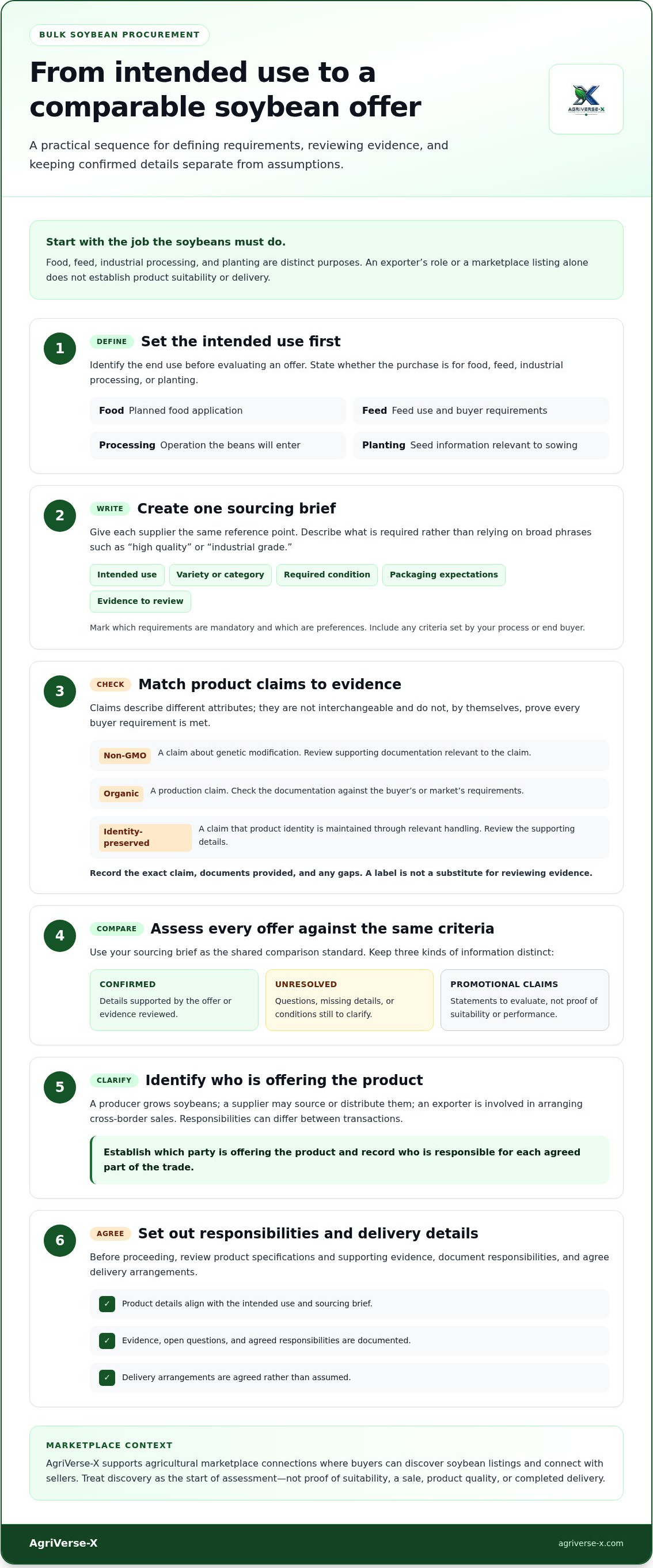
Begin with the job the soybeans must do. Food use, feed use, industrial processing, and planting create different sourcing requirements. For industrial procurement, describe the intended process and the product characteristics your operation needs. A clear brief helps you identify which details matter and prevents general phrases such as “high quality” from standing in for a specification.
The following video shows one example of how a bulk soybean supplier presents an offer. Treat statements in a supplier presentation as claims to evaluate, not as evidence of product suitability or delivery performance.
For background on the crop and its uses, see the Soybean overview. For procurement, the practical step is to turn your use case into clear requirements that an offer can address.
How exporter, supplier, and marketplace roles differ
A producer grows soybeans. A supplier may source or distribute them, directly or through other trade relationships. An exporter is involved in arranging cross-border sales, but responsibilities can differ between transactions. Establish which party is offering the product and record who is responsible for each agreed part of the trade.
A supplier directory helps buyers discover businesses or listings. A marketplace can help buyers and sellers find and connect with one another, but a listing does not guarantee a sale, product quality, or completed delivery. AgriVerse-X supports agricultural marketplace connections and lists soybeans among its bulk commodities. Assess each opportunity using the details and evidence relevant to your purchase.
Why intended use comes before supplier selection
Decide the intended use before evaluating an offer. Food, feed, industrial processing, and planting are distinct categories, and each can call for different product specifications and supporting evidence. Planting material, for example, needs information relevant to its use as seed. A processor should define the requirements tied to its operation.
- Food: Define the product characteristics and evidence relevant to the planned food use.
- Feed: State the feed application and the specifications your operation requires.
- Industrial processing: Describe the process and the product information needed to assess suitability.
- Planting: Specify that the purchase is for planting and identify the seed information and evidence your decision requires.
Build your sourcing brief around the intended use, then assess each response against it. Do not infer a grade, certification, or performance standard from a product label alone. Claims about a specific soybean offer should be supported by relevant evidence and stated clearly in the agreed details.
Match Soybean Type and Specifications to the Intended Use
Write a sourcing brief around what the soybeans need to do, not just the name used in a listing. Industrial buyers should define the planned process, the buyer’s requirements, and the market where the product will be used. This context helps determine which product details matter and what evidence is useful. Define intended use before comparing soybean offers.
Make the brief specific enough for offers to be compared on the same basis. Include the soybean variety or category, intended use, required condition, packaging expectations, and supporting evidence needed for your decision. Separate mandatory requirements from preferences. If your process or end buyer has particular criteria, state them directly rather than relying on a broad label such as “industrial grade.”
Food, feed, processing, and planting use cases
Food buyers should define suitability in relation to the planned food application. Feed buyers need the offer to identify the product’s feed use and address their requirements. Processors should describe the operation the beans will enter, since that process determines which product characteristics and evidence warrant attention. Planting seed is a separate purpose: it is intended for sowing, not simply sold as a commodity for consumption or processing.
Align the product description with its actual end use. For example, if you need soybeans as an industrial processing input, a listing that only says “soybeans” leaves key questions unresolved. Specify the intended process and the details needed to evaluate the offer. Do not assume that a general quality claim or a single grade covers every application.
How to assess non-GMO, organic, and identity-preserved claims
These terms refer to different attributes. “Non-GMO” is a claim about genetic modification, “organic” is a production claim, and “identity-preserved” indicates that a product’s identity is maintained through relevant handling. The terms are not interchangeable, and none establishes on its own that soybeans meet every buyer or end-use requirement.
Match each claim to supporting documentation and to the requirements of the intended buyer or market. A seller’s statement describes what is being offered, but it is not the same as supporting evidence. Record the exact claim, the documents provided, and any conditions or gaps that affect your assessment. Do not treat a label as a substitute for reviewing relevant evidence.
Use this checklist before comparing a soybeans wholesale exporter or supplier:
- Use: State whether the beans are for food, feed, industrial processing, or planting.
- Product: Identify the variety or category and the condition required for the intended application.
- Packaging: Describe what your operation needs for handling and receipt.
- Claims and evidence: Identify any non-GMO, organic, or identity-preserved claim you require and the supporting documents needed to assess it.
- Buyer and market: Include relevant end-buyer criteria or market-specific expectations.
This structure makes listings easier to compare without assuming that every supplier uses terminology in the same way. AgriVerse-X supports buyer connections through an agricultural marketplace where soybean product information can be explored. Use soybean marketplace connections as a discovery route, then assess each offer against your specification and evidence requirements.
Compare Soybeans Wholesale Exporters with a Consistent Buyer Framework
Compare offers against the same written requirements, rather than each seller’s preferred sales language. A consistent framework makes gaps visible. One offer might describe the product clearly but leave evidence or delivery responsibilities unresolved. Keep the seller’s statements separate from details you have verified and points that remain open.
A fair supplier comparison uses identical criteria for each soybean offer. Apply the same checklist to each soybeans wholesale exporter you assess. Mark each detail as confirmed, unresolved, or promotional wording. “High quality” is a claim, not a specification. A product description that addresses your stated requirements is more useful for procurement.
A practical exporter comparison table
Use this framework for each offer. Add your requirement beside the supplier’s response so that a blank field cannot be mistaken for a match.
| Comparison field | Buyer requirement | Offer details and status |
|---|---|---|
| Intended use | State the end use or buyer application. | Record the stated use; mark it unresolved if absent. |
| Product description | Specify the relevant category, variety, and condition. | Copy the seller’s description; note any mismatch or ambiguity. |
| Supporting evidence | List the documents or evidence your buyer requires. | Record what was provided and what remains outstanding. |
| Packaging | Describe the packaging needed for your operation. | Capture the offered packaging details or mark unresolved. |
| Delivery terms | Set out the delivery arrangements and responsibilities to be agreed. | Record stated terms; flag missing coordination details. |
This is a comparison tool, not a scorecard. Do not mark a supplier positively because a field is blank, and do not treat persuasive wording as evidence. Keep the original offer, supporting documents, and your notes distinct. This gives your team a consistent basis for comparison and shows what needs resolution before moving forward.
Questions that reveal whether an offer fits
Use focused questions to test the offer against your sourcing brief. Keep the same questions for each offer so the responses are comparable:
- Does the product description match the written specification and intended use?
- Which documents support the product details or claims, and do they address the stated requirements?
- What packaging details are included, and which remain open?
- Who is responsible for logistics coordination, shipment updates, and communication about changes?
- What receiving arrangements need to be planned, and which details remain to be agreed?
Separate proposed delivery arrangements from responsibilities that have been agreed. A general statement about shipping does not explain who provides updates or coordinates with the receiving party. Record those responsibilities in writing alongside open questions. This creates a clearer comparison without assuming supply, suitability, or delivery performance.
Assess Documentation, Logistics, and Trade Risks Before Proceeding
Before advancing a wholesale soybean order, turn the offer into a sequence of decisions: confirm the specification, review the evidence, agree responsibilities, and coordinate next steps. Keep commercial terms, product evidence, and delivery arrangements in separate records. An open point in one area should not be mistaken for agreement in another.
Trade documentation and market-entry requirements can vary by transaction and destination, so there is no single set of forms that applies to every soybean shipment. Identify the requirements relevant to the transaction and assign responsibility for each document and logistics task. For destination-specific trade, product-quality, or logistics questions, use appropriately qualified professionals.
- Confirm the specification. Check that the product description aligns with the buyer’s intended use and written requirements.
- Review the evidence. Match each document and supporting detail to the claim or specification it is meant to substantiate.
- Agree responsibilities. Record who supplies each document, who coordinates each delivery task, and when actions are expected.
- Coordinate next steps. Align communication, shipment updates, and receiving arrangements with the relevant parties.
Review product evidence and transaction details
Read product evidence alongside the specification, not in isolation. Check that descriptions refer to the same product category and intended use, and that supporting documents relate to the offer under consideration. A general statement about quality or suitability is not established product fact unless evidence supports it.
Make document responsibilities explicit. Record which party will provide each agreed item and when it is expected during the transaction. If a claim lacks supporting material, mark it as unverified and leave it open for review. Do not treat an expected document as received or a seller’s assurance as proof that the buyer’s requirements have been met.
Coordinate shipment responsibilities without assumptions
Document the agreed delivery point, packaging description, and each party’s responsibilities. Clarify who coordinates transport, who provides shipment updates, and how the receiving party will be informed of arrangements or changes. Clear responsibilities help prevent gaps between the commercial agreement and the practical work of receiving the goods.
Keep unresolved logistics items visible. If the delivery point is stated but responsibility for updates is not, record that responsibility as outstanding. Destination-specific requirements may affect documentation and coordination, so use qualified trade and logistics professionals for transaction-specific questions. AgriVerse-X supports agricultural marketplace connections for buyers exploring soybean offers; use discovery alongside your own evidence review and due diligence.
Before proceeding, document the product specification, evidence status, commercial terms, and delivery responsibilities as separate but connected parts of the decision. This gives your team a practical record of what is agreed, what is supported, and what still needs resolution.
Discover Soybean Wholesale Connections Through AgriVerse-X
AgriVerse-X connects agricultural participants through a digital ecosystem that includes an agricultural marketplace for products and buyer connections. Soybeans are among the bulk agricultural commodities listed. The marketplace can help buyers discover sourcing opportunities and connect with participants, but a listing does not guarantee supply, a completed transaction, or availability in every market.
Digital profiles can showcase products, services, skills, and certifications, helping buyers understand what a participant says they offer. A profile or listed credential does not automatically verify every product detail or claim. Review the information and supporting evidence against your procurement requirements before treating an offer as suitable.
How marketplace discovery supports soybean sourcing
Use marketplace information to shape a focused sourcing conversation. A structured product description can help you identify the seller’s stated category, intended use, packaging details, and supporting information. Compare those details with your written brief and keep any unanswered points visible.
For example, an industrial buyer can use its process requirements to frame a focused assessment of a soybean offer, rather than relying on a broad commodity label. AgriVerse-X provides a discovery and connection channel for agricultural goods and participants. It does not replace product assessment, evidence review, or agreed commercial arrangements. The broader Global agriculture marketplace article provides additional context on the marketplace concept.
Keep three things distinct as you explore: what a listing states, what evidence supports those statements, and what the buyer and seller agree for the transaction. That separation makes marketplace discovery more useful without turning visibility into an assumption of quality, suitability, or delivery.
A clear next step for wholesale buyers
Prepare before beginning a sourcing conversation. A concise brief makes your requirements clear and keeps the discussion focused. Include:
- Intended use: Explain the industrial process or end-buyer application.
- Product specification: Set out the category, condition, packaging needs, and relevant product details.
- Evidence needs: Identify the documents or supporting information needed to assess the offer.
- Delivery questions: List the arrangements and responsibilities that need to be agreed.
AgriVerse-X supports buyer connections through its agricultural marketplace. Specific listings and transaction opportunities can vary by market, and platform programmes and commercial terms may change as the platform develops and completes legal, technical, and market validation. Treat discovery as the start of due diligence, then assess each opportunity using its documented details.
To explore AgriVerse-X’s agricultural marketplace and sourcing connections, visit AgriVerse-X with your sourcing brief ready. Clear requirements can make the conversation more focused, whether you are comparing a soybeans wholesale exporter or exploring other bulk soybean opportunities.
Move from Sourcing Brief to the Next Opportunity
Make each sourcing decision useful beyond the current purchase. Keep a concise record of why an offer advanced, which conditions shaped the decision, and what your team learned during review. That record helps colleagues apply consistent procurement criteria as requirements or buying teams change.
Use each sourcing conversation to test how well an offer supports your operational priorities. Whether you are assessing a soybeans wholesale exporter or considering another opportunity, base the decision on documented fit rather than assumptions.
Explore AgriVerse-X as you plan your next step. A clear process and a well-kept decision record can help your team approach future sourcing with a consistent framework.
Frequently Asked Questions
What should I look for in a soybeans wholesale exporter?
Assess the offer against your intended use, written product specification, supporting evidence, packaging needs, and delivery responsibilities. Assign someone on your team to review each area, such as procurement for commercial terms and quality staff for product evidence. This makes it clear who should resolve open questions before the organization advances the offer. Supplier statements alone do not establish suitability, availability, or shipment performance.
How do I compare soybean exporters for a bulk order?
Use one written specification and record each response in the same format. Keep the seller’s original wording beside your own assessment, and note the date or version of each offer so a revision is not confused with an earlier response. Compare the same product category, intended use, evidence, packaging, and coordination details across offers. Update the record when details change rather than relying on memory or promotional language.
What is the difference between food-grade and feed-grade soybeans?
Food-grade and feed-grade identify different intended applications. The buyer should state which use applies and define the requirements for it. This matters when a product moves from procurement to production or a downstream customer: a seller’s label may not capture the buyer’s full specification. Put the end-use description in purchasing records and have the relevant internal team assess the offer against those requirements.
What documents should I request when sourcing soybeans wholesale?
Identify the claims and product details your organization relies on, then specify the supporting material needed to assess them. Keep each document linked to the offer and product it describes so evidence from one offer is not mistakenly applied to another. The buyer’s requirements and destination affect which documents are relevant. For transaction-specific documentation questions, use appropriately qualified trade or quality professionals.
Can I buy non-GMO or organic soybeans from a wholesale exporter?
A seller may describe soybeans as non-GMO or organic, but assess each claim separately. Check that the supporting evidence corresponds to the claim your organization intends to rely on and applies to the product being offered. If you plan to make a downstream claim, align your purchasing records with your requirements before placing an order. Do not infer either attribute from a general product description.
How does an agricultural marketplace help soybean buyers find suppliers?
An agricultural marketplace can help buyers discover agricultural participants and begin sourcing conversations. Prepare a concise inquiry that states your buying needs and the information required for the next decision. A profile or listing is an introduction; evaluate the opportunity through your normal purchasing controls. Discovery does not ensure supply or a completed transaction.


