

Programs that connect farmland owners with farmers gather information from both sides, identify potential fits, and facilitate introductions. Owners describe the land and the arrangement they seek; farmers outline their experience, intended operation, and land needs. Matching these details gives both parties a focused starting point for a conversation.
A potential match is a starting point, not a finished agreement. The owner and grower still need to discuss expectations, clarify how the land could be used, and identify questions that need further attention. Understanding each party’s goals makes those early discussions more useful and grounded.
This article explains how matching programs work and how to prepare before making contact. You’ll learn what goals and land details to consider, how land access can affect rural communities, and how owners and growers can assess a potential fit. It also covers ways farmers can find leasing opportunities and make initial conversations more productive.
Key Takeaways
- Set clear goals, experience, and resource expectations before exploring a land match.
- Describe the property’s condition, access, and intended use to help identify a practical fit.
- Consider how well-planned farm transitions can support local continuity and rural communities.
- Prepare focused profiles and questions so early conversations can move toward workable terms.
- Explore AgriVerse-X farmland and lease listings as one way to find relevant opportunities.
Assessing goals, experience, and assets before linking
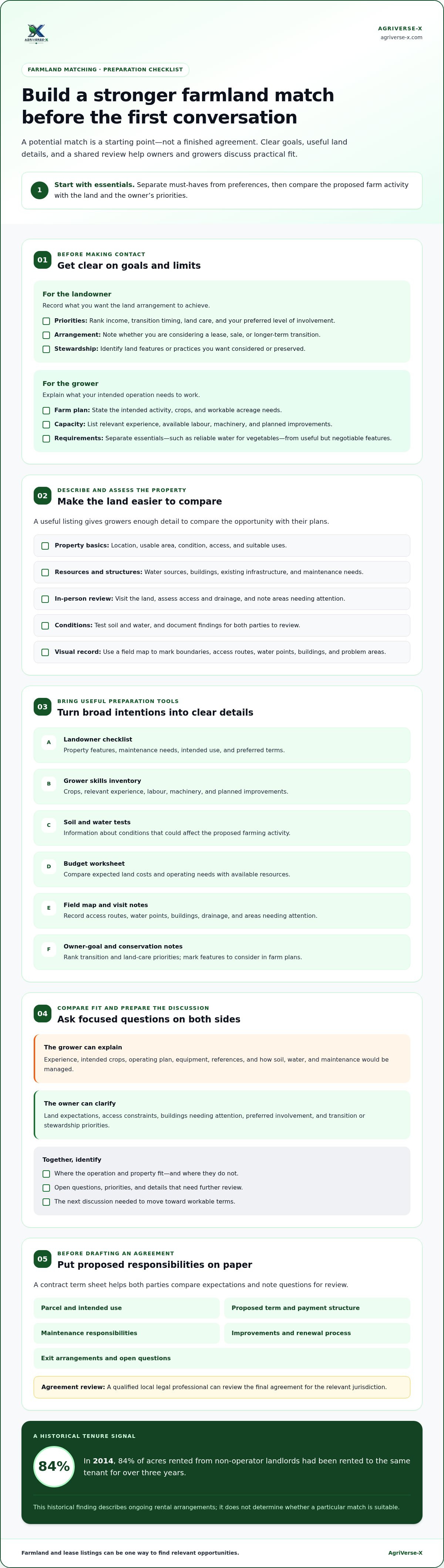
A productive land match starts with decisions, not introductions. Owners and growers should define their goals, resources, and limits before discussing a lease or transfer. A grower might need workable acreage for vegetables, while an owner may prioritize continued stewardship and a gradual transition to the next generation.
Write down the intended farming activity, available labour and equipment, and preferred arrangement. Separate essentials from preferences. For example, reliable water may be essential for a vegetable operation, while an existing storage shed could be useful but negotiable.
To learn more about farmland access and farmer connections, watch this video from the Connecticut Land Conservation Council:
A farmland listing should describe the property’s location, usable area, condition, access, water sources, buildings, and suitable uses. Owners should also state whether they seek a lease, sale, or longer-term transition, and explain their preferred level of involvement. Specific details help growers compare the opportunity with their plans.
Owners can assess prospective farmers by discussing their experience, intended crops, operating plan, equipment, and references. Ask how the grower would manage soil, water, maintenance, and communication. Compare the answers with the property’s needs and the owner’s expectations.
Assess land in person before renting or buying. Visit more than once, test soil and water, and document findings such as drainage, access, and existing infrastructure. A field map can mark boundaries and problem areas. A written record makes later decisions clearer for both parties.
Use practical assessment tools to turn broad goals into useful information:
- Landowner checklist: Record property features, maintenance needs, intended use, and preferred terms.
- Grower skills inventory: List crops, relevant experience, labour, machinery, and planned improvements.
- Soil and water tests: Identify conditions that could affect the proposed farming activity.
- Budget worksheet: Compare expected land costs and operating needs against available resources.
- Field map and visit notes: Mark access routes, water points, buildings, and areas needing attention.
These tools support a focused first conversation. For example, a grower proposing grain production can explain equipment and storage needs, while the owner can disclose access constraints or buildings requiring attention. Use the findings to identify gaps, set priorities, and agree on the next discussion. In 2014, 84 percent of acres rented from non-operator landlords had been rented to the same tenant for over three years, showing the value of workable ongoing arrangements.
Understanding land and clarifying owner goals
Start by defining what the land should make possible. An owner planning a gradual transition may value continuity, stewardship, and a successor who understands the property. A grower may prioritize workable fields, access, and an arrangement suited to a specific farming plan. Record the owner’s priorities before comparing potential matches.
Land tenure patterns show why access and ownership goals can differ. In the 2014 farmland tenure analysis, 8 percent of land operated by farmers under 34 years old was fully owned by the operator. For farmers aged 65 or older, 43 percent of operated land was fully owned, while 7 percent was in full-tenant operations. These figures frame different tenure situations, not individual suitability.
Conservation can shape a transition as much as production. More than 300 million acres are set to change hands, prompting conservation professionals to help farmers and ranchers with succession planning. Farm-linking programs can connect new farmers with retiring landowners, supporting continued operation and good stewardship. Owners should identify which land features or practices they want preserved, then discuss them during transition planning.
Policy research also considers affordability. The Land Access Policy Incentives partnership is assessing policies that support land seekers’ ability to afford land. Use a policy tracker to organize local land-access incentives and eligibility details. A farmland finder or matching directory can help locate opportunities, while a conservation map can flag land features relevant to stewardship discussions.
Contracts turn shared goals into clear responsibilities. Land Transfer Navigators are trained to support farm and ranch transfers. For a proposed lease or transfer, list the parcel, intended use, term, payment structure, maintenance duties, improvements, renewal process, and exit arrangements. A contract term sheet helps both parties compare expectations before drafting. A qualified local legal professional can review the final agreement for the relevant jurisdiction.
- Owner-goal worksheet: Rank income, transition timing, land care, and ongoing involvement.
- Tenure comparison sheet: Compare ownership, leasing, and succession priorities side by side.
- Conservation map: Mark areas or features the owner wants considered in farm plans.
- Contract term sheet: Record proposed responsibilities and open questions for review.
Use these tools to focus decisions on the land’s purpose, the owner’s transition goals, and the grower’s intended operation. A clear record gives both parties a practical basis for their next conversation.
Tenure patterns can help owners distinguish a transfer of land from a transfer of an operating farm. In the farmland tenure analysis, 45 percent of farmland was in small family farms, and 46 percent of this land was in operations that owned all the land they operated. About 39 percent of the 911 million acres of farmland in the contiguous 48 States was rented in the 2014 farmland ownership and tenure analysis. More than half of U.S. cropland was rented in the 2014 farmland ownership and tenure analysis, while just over 25 percent of U.S. pastureland was rented in the farmland tenure analysis. Retired farmers made up 38 percent of non-operator landlords in the farmland tenure analysis.
These considerations make it useful to clarify whether a proposed arrangement concerns ownership, operating access, or both. Owners can ask what a successor needs to farm successfully, whether renting fits their goals, and how land care and continued involvement should work. Distinguishing these priorities can guide conversations with potential operators and shape a transition that reflects the owner’s intentions.
Benefits for rural communities
A well-planned farmland match can connect agricultural activity with the wider community. Consider a grower leasing land for grain production. The operation may need machinery, storage, transport, seasonal labour, and buyers. Mapping these needs helps local businesses and community organizations see where their services could support the farm’s plans.
Continuity also has a human dimension. When an owner prepares to step back, a new operator can learn practical knowledge about the property, local growing conditions, and established routines. A handover plan can record what the owner wants to share, such as field access patterns, drainage issues, or maintenance practices. This makes the transition more specific than simply transferring responsibility.
Community groups can help make land opportunities more visible and useful. A cooperative, agricultural educator, or local institution can host an information session where owners explain their priorities and growers describe the operations they want to build. A shared referral sheet can track leads, introductions, and follow-up needs without replacing direct conversations between the parties.
Land access can also support a broader range of people in agriculture. A beginning grower may bring new production skills, while an experienced operator can contribute knowledge during a transition. Training providers can identify relevant learning needs, such as safe equipment use or farm business skills. A skills and services directory can connect those needs with local people and organizations.
Shared infrastructure is another practical consideration. If several farms need machinery during the same planting period, an equipment schedule can show demand and potential conflicts. A transport map can identify routes between fields, storage, and collection points. These tools help participants discuss coordination before operating plans are set.
Use a community opportunity worksheet to make these connections concrete:
- Service and skills directory: Record local workers, training providers, machinery services, storage, and transport contacts.
- Farm activity calendar: Compare expected planting, maintenance, and harvest periods across participating operations.
- Referral record: Track who shared each opportunity and whether an introduction occurred.
- Community priorities sheet: Document local goals, such as maintaining agricultural use or creating learning opportunities.
Review the worksheet with owners, growers, and relevant community participants. Limit personal and commercial details to what is needed for coordination. A clear record helps the group identify practical gaps, such as missing training or transport capacity, and decide which conversations should happen next.
These community tools do not determine whether a particular arrangement is suitable. They make shared needs visible while leaving land-use decisions to the people directly involved. When local organizations understand an operation’s needs, they can focus support on relevant connections, skills, and services.
Preparing to connect farmland owners with farmers
Prepare for a match by creating a readiness file before approaching a program or potential partner. Keep relevant notes, records, and decisions together so conversations can progress without repeating the same background. A dated decision log is useful when an owner weighs transition options or a grower compares opportunities.
Set a clear decision process. Identify who can speak for the owner, who will assess the proposed operation, and who must participate before terms move forward. For a family-held property, agreeing on these roles early can prevent mixed messages. A responsibility chart records each person’s role and decision-making authority.
Separate discussion topics into stages. An initial conversation can test shared interest; a later meeting can address operational details; further discussions can focus on a written arrangement. A meeting agenda keeps each stage focused. For example, an owner and grower might first clarify whether their transition priorities align before developing detailed operating proposals.
Plan how information will move between participants. Choose one contact person for scheduling, record which documents have been shared, and note open questions. A document index helps both parties find relevant records without relying on memory. Keep a version log when either party updates a proposal, so everyone refers to the same draft.
Prepare for a mismatch as carefully as for a potential fit. Write down the conditions that would make an arrangement unworkable, such as a timing conflict or an operating plan that does not suit the owner’s goals. A decision-gate worksheet helps participants pause, revise the proposal, or end discussions respectfully when a key condition cannot be met.
Use these preparation tools to make progress visible:
- Readiness file: Keep organized notes and relevant records together for discussions.
- Responsibility chart: Clarify who represents each party and who makes decisions.
- Meeting agenda: Set the purpose and questions for each conversation.
- Document index: Track shared materials and identify the current version.
- Decision-gate worksheet: Record conditions for continuing, revising, or stopping discussions.
Before each meeting, review previous notes and identify the decisions needed next. Afterward, record agreed actions, responsible people, and unresolved questions. This simple cycle helps both parties move from initial interest toward a considered decision while leaving room to adjust plans as they learn more.
How do farmers find available farmland to rent or lease?
Start with programs that specialize in farm linking. These programs bring together landholders seeking a connection and land seekers looking for an opportunity. They commonly maintain profiles or lists, after which the farmer usually contacts the landowner. This creates a focused route from an initial search to a direct conversation.
Search by region because programs often serve specific states or local areas. Some operate nationwide, while regional programs may understand nearby opportunities and community networks. A program directory helps identify each service’s coverage and focus. Record the areas served, contact method, and next step in a search tracker.
Build a parallel search through local agricultural networks. Family, friends, extension agents, real estate agents, and feed-store staff may know about farm transitions. Explain what you need, such as leased cropland near an existing market or pasture with suitable access. A referral log helps track who shared each lead and when to follow up.
Use several tools together rather than relying on a single source:
- Farm-link program directory: Find matching services by state or region and note their land-seeker process.
- Local contact map: Organize extension agents, farming contacts, real estate agents, and agricultural businesses by area.
- Opportunity tracker: Compare each lead’s location, land use, arrangement, contact, and status.
- Grower profile: Summarize experience, intended production, resource needs, and preferred tenure.
- Follow-up calendar: Schedule outreach and record replies, visits, and agreed next actions.
Once a program identifies a potential fit, prepare a clear first message. State the type of land sought, intended farming activity, preferred region, and interest in a lease or rental. Briefly describe relevant experience and operating needs. For example, a grower seeking land for a small vegetable operation can explain the planned crops and access needs. Concise details help the owner decide whether a conversation makes sense.
Keep the search active after making contact. Update the tracker when an opportunity changes, a new referral arrives, or a conversation ends. If a lead comes through a feed-store contact, note its location and source before arranging a discussion. This record prevents duplicate outreach and helps you compare options consistently.
AgriVerse-X lists farmland and leases, giving landowners and growers another way to find relevant opportunities. Explore farmland and lease listings as part of a broader search that includes regional programs and trusted local networks.
When a farm is changing hands, local relationships can help farmers find transition opportunities. Family, friends, extension agents, real estate agents, and feed-store staff can share leads through their networks, making opportunities in the community easier to hear about.
Matching programs commonly compile lists of new farmers and landowners seeking a connection, after which the new farmer usually contacts a landowner. More than fifty farm link programs operate nationally in the United States. For beginning farmers, land matching can help them access land, financing assistance, and guidance from experienced landowners. A match may therefore offer support as well as a place to farm.
AgriVerse-X
AgriVerse-X gives landowners and growers a digital place to present farmland opportunities and explore relevant connections. Landowners can list farmland and leases, while farmers can create verified profiles showcasing their skills and certifications. These profiles and listings help both sides describe what they bring to a potential arrangement.
Use a listing to outline the land opportunity, then compare it with a grower’s experience and intended operation. For example, a farmer can describe relevant crop experience and the resources needed to assess a lease. Platform information supports discovery and communication; it does not replace independent land, contract, or local due diligence.
If you’re ready to explore farmland listings or create a profile, visit agriverse-x.com or contact AgriVerse-X.
Turn a Possible Match Into a Practical Next Step
A land connection becomes meaningful when both parties move from interest to a shared working plan. Before proceeding, agree on the questions that still need answers, assign responsibility for each, and record the next discussion. This keeps the relationship grounded in clear decisions rather than assumptions.
Matching programs can connect farmland owners with farmers, but the people involved shape what happens next. Owners can communicate priorities openly; growers can explain their operating plans and limits. Both sides should take time to review the proposed arrangement and seek qualified local guidance on land agreements and applicable requirements before making commitments.
For a next step, use AgriVerse-X to explore farmland opportunities and present your agricultural profile. A clear listing or profile can help make your goals visible to potential connections. Explore farmland connections with AgriVerse-X and take a considered step toward a productive working relationship.
Frequently Asked Questions
How do matching programs work?
Matching programs typically gather information from landowners and growers, compare their needs, and arrange introductions. Profiles may describe intended crops, preferred tenure, farming experience, and land features. Once a potential fit emerges, both parties can discuss responsibilities, visit the property, and consider proposed terms. Treat an introduction as the start of the process, not a substitute for assessing the land or documenting an agreement.
What websites and apps connect farmland owners with farmers in the United States?
Farm-link programs and digital platforms can connect farmland owners with farmers in the United States. AgriVerse-X provides farmland and lease listings. To find relevant options, search for programs serving the property’s state or region, then compare each opportunity’s intended use, access, arrangement, and contact process. The right channel depends on whether the owner seeks a tenant, an operator, or a longer-term transition partner.
How do farmland owners find farmers to lease or manage their land?
Owners can begin by deciding whether they need a tenant, an operator to manage the land, or a transition partner. Share a clear opportunity description through a farm-link program and trusted agricultural contacts. Explain the property’s intended use, access, expected duties, and preferred communication. Ask prospective farmers about relevant experience, staffing plans, and references. Discuss decision authority, maintenance, recordkeeping, and issue resolution before settling on an arrangement.


