

An online listing is a starting point, not a complete lease decision. When you lease farmland online, compare cash-rent and crop-share arrangements, lease length, permitted uses, and any lease-to-own terms. Assess the soil, drainage, water supply, and work needed to bring the land into production, then put expectations in a written agreement.
Finding suitable land is only part of the challenge. You also need an operator whose experience, financial capacity, and stewardship plans fit the property and lease. This guide explains how to connect with prospective tenants, assess an opportunity, and compare lease structures without overlooking practical details.
Use these resources and questions to move from an online listing toward a clearer decision. You’ll also learn which lease, tax, insurance, and program-eligibility considerations may matter, and why requirements can differ by location.
Key Takeaways
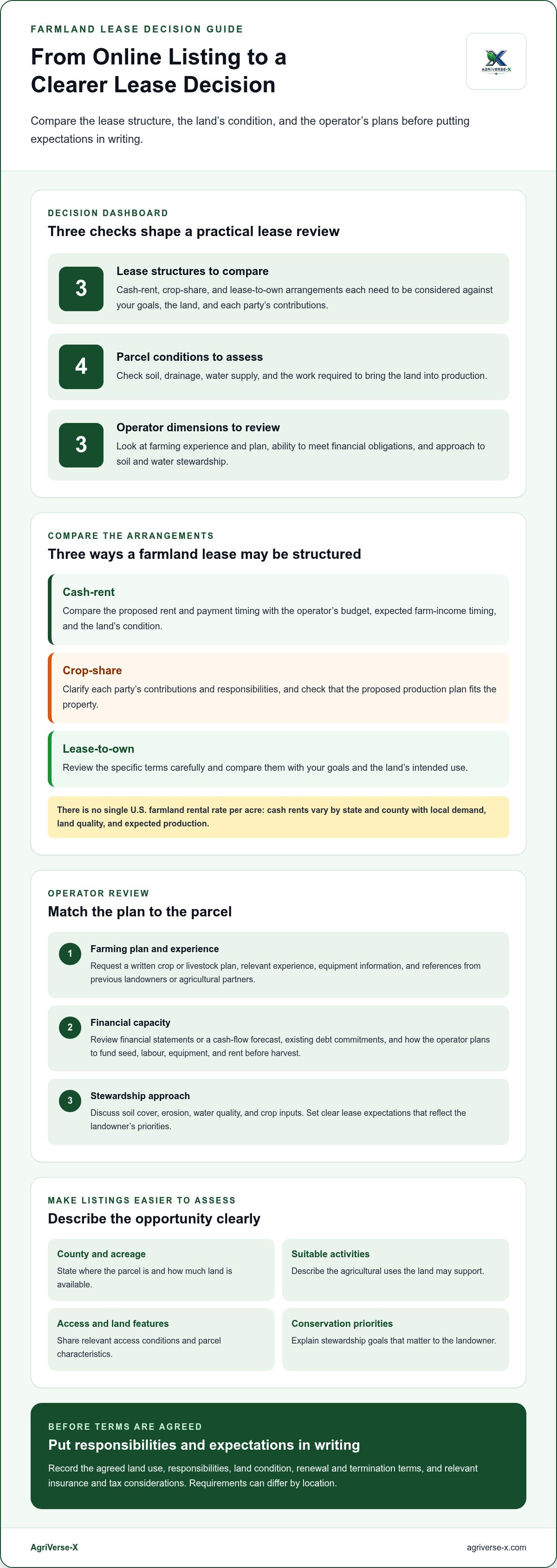
- Compare cash-rent, crop-share, and lease-to-own structures against your goals, the land’s condition, and each party’s contributions.
- Assess an operator’s farming experience, financial capacity, and plans for soil and water stewardship before agreeing to terms.
- Make listings easier to assess by clearly describing the acreage, county, land features, and permitted agricultural uses.
- Put responsibilities, renewal and termination terms, land condition, insurance, and tax considerations in a written lease.
- Use AgriVerse-X’s farmland and lease listings to connect with prospective agricultural tenants and compare opportunities.
Operator creditworthiness and land stewardship
There is no single U.S. farmland rental rate per acre. Cash rents vary by state and county according to local demand, land quality, and expected production.
To compare lease structures, fair rental value, and online land resources, watch “Farmland Leases 101: Types, Terms, and Structuring Agreements with Confidence” from LandApp by LandGate.
Start with the operator’s farming plan and assess how well it fits the property and lease terms. Request a written crop or livestock plan, an operating budget, and references from previous landowners or agricultural partners. Compare the proposed uses with the operator’s experience and available equipment. A tenant planning grain production, for example, needs a different operating plan from one proposing pasture-based livestock.
Assess creditworthiness by determining whether the operator can meet agreed rent and operating obligations. Review financial statements or a cash-flow forecast, existing debt commitments, and the timing of expected farm income. Compare the proposed payment schedule with the production cycle. A credible plan explains how the tenant will fund seed, labour, equipment, and rent before harvest, rather than relying solely on projected sales.
Give stewardship equal weight. Ask how the operator will manage soil cover, erosion, water quality, and crop inputs. The Illinois Department of Natural Resources’ agricultural lease program promotes ecologically sound practices to improve soil health, minimize erosion, improve water quality, and reduce chemical impacts on wildlife and habitats. Use these priorities to set clear, measurable lease expectations.
Define your land goals before comparing listings. Decide whether your priority is annual income, keeping the land in production, habitat care, or supporting a beginning farmer. Then examine soil type, drainage, water supply, and the work required to bring the parcel into production. Land-assessment tools can help evaluate suitable agricultural uses alongside zoning restrictions.
Use the right tools for each decision: soil maps help compare soil characteristics; local zoning maps identify land-use restrictions; financial records help assess payment capacity; and online listing filters narrow parcels by county, acreage, and intended use. Treat listing details as a first screen, then compare them with the operator’s plan and the land’s condition.
When you lease farmland online, record questions for every candidate parcel: What production does the soil support? Is water accessible? What improvements are needed? Does the operator’s plan align with the landowner’s goals? The answers make credit and stewardship assessments specific to the property, not just the applicant’s profile.
Connecting landowners with qualified operators
Start with a clear description of the operation you want on the land. Specify the county, available acreage, suitable farming activities, access conditions, and conservation priorities. A landowner seeking continued crop production may attract a different operator from one prioritizing pasture or habitat care. Aligning these goals early helps both sides focus on workable lease opportunities.
Farm link programs can connect landowners with farmers seeking property. State agencies and nonprofit organizations may administer these programs. The Columbia Land Conservancy established its Farmer Landowner Match Program in 2008. Farm incubator programs offer new farmers short-term leases on parcels, sometimes alongside training in business and farm management.
Use targeted channels to reach prospective tenants. Cooperative Extension offices, farmland protection programs, and agricultural organizations may know local farmers seeking land. Agriculture groups and farm trade newspapers can help circulate an opportunity. A farm incubator project may offer beginning operators a route to land access and practical training. The New Entry National Incubator Farm Training Initiative maintains a list of farm incubator projects across the United States.
- Farm link programs: Use these to connect an available parcel with farmers actively seeking land.
- Cooperative Extension offices: Share the opportunity with staff familiar with local agricultural networks.
- Farmland protection programs: Reach operators whose plans may align with conservation goals.
- Farm incubator directories: Find projects that support new farmers through land access and training.
- Local agriculture groups and trade newspapers: Place a clear opportunity notice where regional operators may see it.
Screen expressions of interest consistently. Ask each prospective operator to describe the planned operation, relevant farming experience, intended crops or livestock, and conservation approach. Request a concise proposal identifying the parcel, proposed lease structure, and expected land improvements. Compare applicants using the same criteria, then discuss differences in production plans, land use, and stewardship expectations.
For example, a landowner offering cropland could compare a grain operator’s field plan with a market-garden applicant’s proposal. Each plan should explain how the operator intends to use and maintain the parcel during the rental period. A pasture proposal should describe livestock use and grazing management. These details help both parties assess fit before negotiating terms.
Keep the matching process organized. Track each inquiry, meeting, proposal, and follow-up in a simple spreadsheet or shared record. Record the applicant’s experience, proposed operation, conservation priorities, and questions. If you want to compare opportunities through an online directory, explore digital farmland listings as one practical starting point.
Legal, tax, insurance, and program-eligibility considerations
Before signing, align the lease terms with the property’s state, payment structure, and intended production. Record who pays property taxes, insures buildings, handles major repairs, and maintains improvements. A sample farm lease assigns property taxes, fire insurance on buildings, and major repairs or improvements to the landlord. Use a lease checklist to assign each duty clearly.
To verify a farmland listing and reduce scam or dispute risks, match the landowner’s identity with county property records, confirm parcel boundaries, and visit the site. Document the agreed terms in a signed written lease, and keep copies of notices, payments, and property-condition records.
Termination rules vary by state and lease type, so enter the notice deadline in a calendar when signing. In Missouri, farmland lease termination notice is due 60 days before the end of the lease, according to the Missouri Revisor of Statutes. In Illinois, written termination notice is due four months before the lease ends or by a date specified in the lease. The contract’s stated deadline matters.
Recording requirements can also affect a tenant’s rights if land ownership changes. In North Carolina, farmland leases longer than three years must be recorded with the county Register of Deeds to protect the farmer’s right to lease the land if ownership changes, according to the North Carolina General Assembly. Identify the county office and required documents before finalizing a long-term agreement.
Tax eligibility depends on documented production and local rules. In North Carolina, a landowner renting farmland may maintain the Present Use Value reduced tax rate if the farmer produces at least $3,000 in product value over a three-year period and documents that production. Keep sales records, production logs, and lease documents together. A farm accounting spreadsheet can track income and supporting evidence.
- Insurance inventory: List buildings, stored crops, livestock, and equipment; identify which party’s policy covers each item.
- Policy review: A North Carolina landowner may request addition to the farmer’s policy as an “additional insured” for third-party damage or liability.
- Improvement record: Describe fences, drainage work, or other fixed improvements, including who pays and what happens when leasing ends.
- Eligibility file: Retain production records and cooperative documents when a program requires evidence of farm activity.
For example, a tenant storing equipment in a rented building should assess whether separate coverage is needed for that property. Before installing improvements that are difficult to remove, document ownership, payment, and what happens to them when the lease ends. These records distinguish rent obligations from farm operating costs and clarify each party’s responsibilities.
Tax, insurance, recording, and termination rules differ across jurisdictions. Use a lease calendar, document folder, and parcel-record search to organize due diligence. Obtain independent advice from qualified legal, tax, and insurance professionals for the applicable location.
Listing acreage and county
County and acreage make an agricultural listing searchable, comparable, and easier to assess. In Michigan, lease listings range from 4-acre parcels in Van Buren and Kalamazoo counties to a 3,800-acre property in Eaton County. These examples show why a listing should state both its location and usable scale, rather than relying on a broad regional description.
Start with the county, then describe the parcel’s total acreage and the portion available for the proposed operation. A 40-acre listing in Washtenaw County communicates a different opportunity from a 129-acre listing in the same county. State whether acreage is tillable, pasture, woodland, or otherwise restricted. Separate those categories so prospective tenants can judge fit without assuming every acre supports production.
Use practical tools to build and review a listing. County GIS parcel maps help locate property boundaries and nearby roads. A parcel map orients readers to the site, while satellite imagery can show visible land cover and access features. Online listing filters narrow results by county, acreage, and intended use. A spreadsheet can compare candidate properties side by side.
For example, a 35-acre parcel in Chippewa County and a 79-acre parcel in Alger County may suit different farming plans. A livestock operator may prioritize pasture, fencing, and water access. A crop operator may focus on tillable acres, field shape, and equipment access. Describe those features in the listing, but distinguish observed details from information that requires an on-site assessment.
- Location: Name the state and county, then identify the nearest community or road where relevant.
- Size: Give total acreage and separately identify tillable, pasture, or wooded portions.
- Access: Explain road access and any practical limits for farm machinery or livestock transport.
- Land use: State the agricultural activities the landowner is considering, such as crops or grazing.
- Supporting material: Add a parcel map, clear site photographs, and a brief description of visible features.
County-level information also helps readers compare listings accurately. A 20-acre property in Livingston County is not directly comparable with an 80-acre Tuscola County property unless land type, access, and intended use are clear. Consistent descriptions let a prospective tenant screen options before arranging a site visit.
Before publishing, compare the listing text with the parcel map and available ownership records. Check that the county, acreage, and map refer to the same property. If the boundary image shows a larger parcel than the acreage offered, clearly identify the leased portion. Precise details help attract operators whose plans match the land.
Why written farmland leases are recommended
A written lease gives farmers and landowners a shared record of their agreement. It can set out each party’s goals, responsibilities, and expectations before production begins. If a disagreement arises over access, rent, or repairs, both parties can refer to the agreed terms rather than relying on memory.
Describe the property’s condition at the start and end of the lease. Record visible features such as gates, fences, drainage, buildings, and field condition. Take dated photos and keep them with the signed agreement. A photo log helps distinguish existing damage from changes made during the rental period.
A written lease should cover the practical details that shape the operation:
- Property: Identify the parcel, leased acreage, access points, and any excluded areas.
- Use: State permitted agricultural activities, such as crop production or livestock grazing.
- Payments: Set the amount, due dates, payment method, and any shared-cost responsibilities.
- Term: Record the start date, end date, renewal process, and termination notice requirements.
- Maintenance: Assign responsibility for fences, buildings, repairs, and improvements.
- Condition: Attach dated photographs and describe the land’s condition at handover.
Use a lease checklist to compare the written terms with each discussion. A calendar can track payment dates, renewal windows, and notice deadlines. Keep signed copies, payment records, written approvals, and property photos together in an organized folder. These tools make it easier to find the exact term when the parties revisit the agreement.
Payment schedules need precise wording. Some farmland leases call for half the rent on March 1 and the balance after harvest. Other agreements require the full amount on March 1. State the chosen schedule and clarify how the parties will document each payment.
Match the lease term to the planned production. For annual-crop farming, a one-year renewable lease may be a suitable starting point. Perennial crops take longer to establish, so a 3-5-year term is preferable. Put the agreed duration and renewal process in writing before either party commits resources.
One sample lease calls for written notice at least 90 days before the current rental period expires to prevent automatic renewal. Treat that as a sample term, not a universal deadline. State the applicable notice process directly in the agreement, then record the deadline in a calendar.
Before signing, read each clause alongside the parcel description and attached condition record. Ask both parties to initial agreed changes and retain the final version. A complete written record helps farmers plan production and gives landowners a clear reference for responsibilities, payments, and the lease’s end.
AgriVerse-X
AgriVerse-X helps landowners and agricultural operators discover farmland and lease listings in one digital ecosystem. Use the platform when you’re ready to present a land opportunity or explore options alongside other agricultural resources.
Farmers, agribusinesses, cooperatives, and service providers can create digital profiles showcasing their products, services, skills, and certifications. These profiles help prospective partners understand an operator’s agricultural experience and capabilities. The platform also supports marketplaces for agricultural goods, inputs, machinery, technology, and services.
For example, an operator planning crop production can explore lease listings while considering relevant inputs, equipment, logistics, or training opportunities. Listings and connections support discovery, but they do not replace property checks, written lease terms, or independent legal, tax, and insurance advice. Requirements vary by location and activity.
Contact AgriVerse-X to explore farmland and lease listings.
Turn your farmland search into a clear next step
A lease can shape more than the next planting cycle. Treat it as part of a longer-term plan for your agricultural operation, and be ready to adjust as your priorities change.
As you move from evaluating options to planning future activity, consider how connected agricultural services and relationships could support your broader goals. Explore AgriVerse-X’s agricultural ecosystem as you plan your next step.
With a clear direction, you can approach future opportunities with purpose and confidence.
Frequently Asked Questions
Farmland Leases: What Are My Options?
Options include fixed cash rent, crop-share, flexible rent, and lease-to-own. First decide whether you prefer predictable payments, shared production outcomes, or a possible purchase arrangement. For example, a tenant with limited cash before harvest may compare payment timing and shared-cost obligations, not just the lease label. Ask how the arrangement handles a poor harvest, unexpected costs, or a change in the intended operation.
Where can I find farmland for lease online in the United States?
Search agricultural land marketplaces and farm opportunity directories using state, county, and intended use as filters. State agriculture department classifieds may also list local opportunities. Someone seeking grazing land, for example, can include livestock or pasture terms in searches, while a crop grower can search by crop type. Treat online results as leads, then assess whether each opportunity fits your operating plan.
Which websites list farmland for rent or lease by state and county?
AgriVerse-X is one platform for finding farmland and lease listings. State agriculture department classifieds and farm-link directories offer other ways to discover local opportunities. Search by state, then narrow by county when those filters are available. A directory may connect people rather than display active properties, so distinguish matching services from direct listings before pursuing an opportunity.
What should I compare when choosing farmland to lease, such as soil, water, access, and infrastructure?
Compare each parcel with the needs of your intended crop or livestock plan. Consider growing-season timing, field layout, equipment movement, storage needs, and whether existing infrastructure supports your operation. Land suited to seasonal grazing may not support machinery-intensive crop production. A comparison sheet can capture each property’s advantages, constraints, and open questions, without treating acreage alone as a measure of suitability.
What terms should a farmland lease include, including rent, duration, renewal, and permitted uses?
Beyond payment and lease length, clarify how the agreement handles crop residues, contractor access, shared roads, and changes to the operation. For example, specify whether a tenant may bring in livestock after harvest or store harvested materials on the parcel. Clear terms help prevent everyday activities from becoming disagreements over expectations.
What are the differences between cash rent, crop-share, and flexible farmland leases?
Lease structures differ in how rent responds to production and how costs are shared. A share arrangement can allocate crop or livestock returns according to each party’s contributions and expenses. A flexible structure adjusts rent using agreed measures, so define the calculation inputs and records in advance. Cash rent fixes the payment amount, leaving production results outside the rent calculation.
What legal, tax, insurance, and conservation rules apply to leasing farmland?
Rules depend on the state, lease terms, land use, and any tax or conservation program involved. Before committing, identify the jurisdiction governing the parcel and whether the parties intend to apply for a program tied to agricultural production. Keep program paperwork separate from the lease, and track the records each program requires. Qualified local professionals can interpret requirements for the specific arrangement.


