

The crop split is only part of the agreement. A useful crop share lease agreement example also explains who pays operating expenses, fertilizer, lime, and other soil-fertility costs.
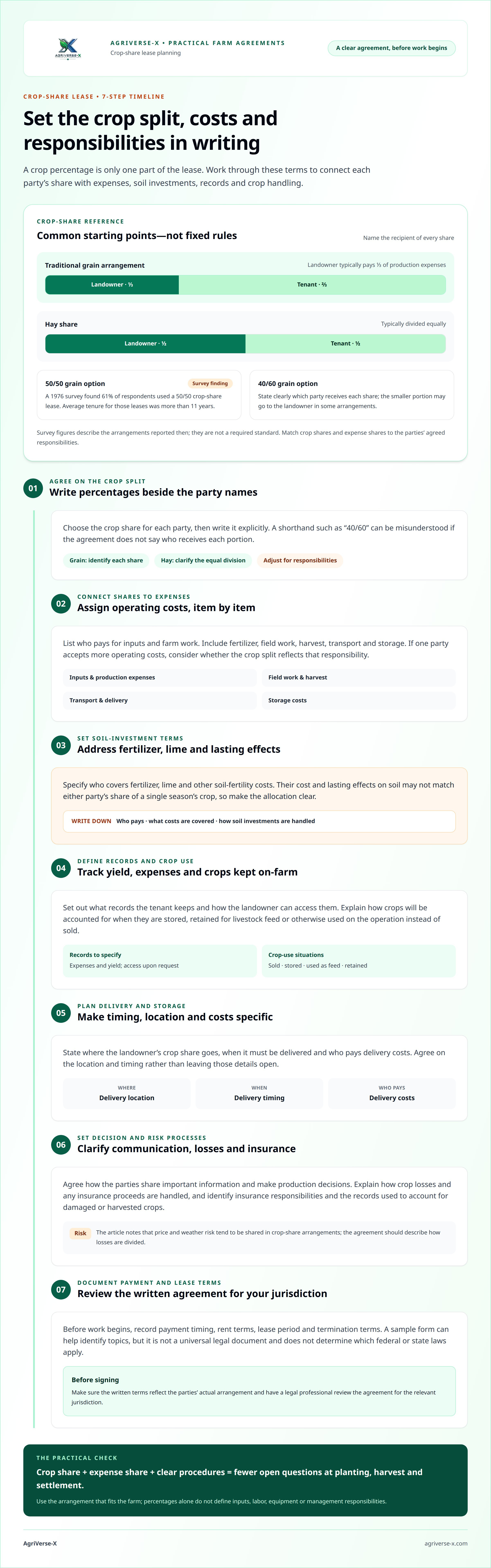
In a traditional U.S. grain arrangement, the landowner receives one-third of the crop and the tenant receives two-thirds. Hay shares are typically divided 50/50. Other arrangements vary, so the written terms should connect each party’s crop share with the costs and responsibilities they take on.
It’s easy to focus on the harvest while leaving important details unresolved. This guide explains common grain and hay shares, how crop income and expenses can be allocated, and which lease clauses cover records, delivery, storage, and production decisions. It also explains why fertilizer and lime need clear, separate terms: their costs and lasting effects on soil fertility may not match either party’s share of one season’s crop.
Key Takeaways
- Match the crop split to the crop type and the responsibilities each party accepts.
- Put each operating expense in writing, including who covers inputs, field work, harvest, transport, and storage.
- Set clear terms for fertilizer, lime, and other soil investments so costs and long-term benefits are handled fairly.
- Define how production records, crop delivery, and important farming decisions will be shared between the parties.
- Consider material participation when reviewing federal tax treatment; the Internal Revenue Service says crop-share rent is included in self-employment earnings when a material-participation test is met and the crop shares are sold, exchanged, given away, or used.
Common crop-share arrangements for grain and hay
Crop-share arrangements divide harvested crops between a landowner and tenant. In a traditional grain arrangement, the landowner receives one-third and the tenant receives two-thirds. The landowner typically pays one-third of production expenses under this model. The parties can agree on a different division, but should consider crop shares and expense shares together. If one party takes on more operating costs, the crop split may need to reflect that responsibility.
Hay shares are typically divided equally between the landowner and tenant. Grain arrangements can use other proportions, including 50/50 or 40/60. With a 40/60 split, the agreement should identify which party receives each share; some arrangements give the landowner the smaller portion. Writing both the percentages and party names prevents a shorthand ratio from being misunderstood during harvest or settlement.
A 1976 survey found that 61% of respondents used a 50/50 crop-share lease. The average tenure of those 50/50 leases was more than 11 years. These figures describe arrangements reported in that survey, not a required standard. An equal split can serve as a starting point for discussion, but it does not establish how inputs, labor, equipment, or management responsibilities will be divided.
Compare the proposed share with the farm’s production pattern. A crop-share lease can be harder to adapt when the farm mainly produces crops for livestock feed or other on-farm use. In that case, the crop may not be sold, so a calculation based only on sales may not show how each party receives value. The agreement can explain how the parties account for harvested crops used as feed, stored for later, or otherwise retained on the operation.
- Traditional grain: The landowner receives one-third and typically pays one-third of production expenses.
- Hay: The parties typically divide the crop equally.
- 50/50: A 1976 survey found this arrangement among 61% of respondents.
- 40/60: State clearly which party receives the smaller share.
Use these arrangements as comparison points, then put the exact crop share and expense allocation in writing. A percentage alone does not explain how the parties will handle crops retained for feed, storage, or another farm purpose. For example, the lease can specify how the tenant records those quantities and accounts for each party’s portion. Clear terms connect the agreed split to the farm’s actual production and crop use.
Crop-share lease form and contract terms
A crop share lease agreement example can help the parties identify terms to address, but the final document should reflect their actual arrangement. Specify rent, records, crop delivery, storage, and decision-making. Also explain how insurance and crop loss affect each party’s share.
Applicable Federal and State Laws
The federal and state laws that apply depend on the property’s jurisdiction and the lease relationship. A sample form cannot establish which rules govern every farm or resolve a dispute by itself. Use a written agreement that reflects the parties’ actual arrangement, then have a legal professional review it for the relevant jurisdiction.
Keep the terms specific without treating a sample as a universal legal document. For example, a template includes fields for the landlord’s and tenant’s addresses. Identify the property and lease period, then ensure the written agreement matches the parties’ responsibilities and the jurisdiction connected to the property.
Set out how the arrangement works in practice. One sample clause sets rent at “xx percent” of gross crop income from the property during each twelve-month period of the lease. The parties must replace the placeholder with their agreed share. Another sample describes annual rent as a share of crops harvested from the leased land and cultivated and harvested by the tenant.
Negotiating, Documenting, and Ending the Lease
Before work begins, agree on crop shares, payment timing, records, delivery, storage, and production decisions. Document those terms in writing, as written crop-share agreements are recommended. Establish how the parties will communicate important information and make production decisions. Clear processes help prevent disputes over who approved an expense or changed a farming plan.
Include a recordkeeping clause. A sample lease requires the tenant to keep expense and yield records and make them available to the landowner upon request. Specify where the landowner’s crop share goes, when it must be delivered, and who pays delivery costs. One sample assigns delivery to the location and time specified by the owner, while advising the parties to agree on those details.
Address insurance and crop loss directly. A crop-share sample says price and weather risk tend to be shared, so the lease should explain how the parties divide losses and handle any insurance proceeds. Identify each party’s insurance responsibilities and the records used to account for damaged or harvested crops.
Use a crop share lease agreement example as a starting point for payment and termination terms, not as a substitute for agreement on details. One sample requires payment within 30 days after the tenant receives each payment for the prior year’s crop, starting with the 2021 crop year. It also sets final rent for the prior year’s crop by August 1 each year, unless the tenant gives notice of a reason for delay. The form is made in duplicate, and alterations and improvements exclude tenant equipment and machinery. Define termination terms and consult a legal professional about the agreement and relationship.
Division of crop income and operating expenses
Crop-share agreements usually divide harvested crops and production expenses according to the parties’ agreed shares. The crop percentage does not automatically settle every operating cost. The lease should state who pays each expense, how sale proceeds are recorded, and how crops used for purposes other than sale are accounted for.
Crop-share rent per acre changes with production and market prices. That means each party’s return can rise or fall with both harvest volume and crop value. A worksheet example for an average-cost corn-soybean rotation calculates an equitable division of 53.3% for the landowner and 46.7% for the operator. This is an example, not a universal split: land quality, expected yield, and each party’s costs affect the calculation.
Land quality can change how a fixed crop share affects the operator’s return. In one simplified example, an operator’s 30-bushel share equals 50% when expected yield is 60 bushels. In a low-quality-land example, the same 30 bushels represent 75% of total yield. These examples show why the parties should evaluate expected production before treating one percentage as equitable.
Operating costs need their own clear allocation. A sample lease assigns production expenses to the operator unless the agreement names an exception. Some crop-share arrangements assign land taxes and irrigation-equipment ownership costs to the landowner. In those arrangements, tenants commonly pay irrigation maintenance, labor, field operations, harvesting, and transportation to an agreed destination. Seed and irrigation energy may instead be assigned solely to the tenant.
- Machinery upkeep: Tenants paid upkeep, fuel, and oil in 85% of arrangements reported in a 1976 survey.
- Soybean harvest: Tenants charged for harvesting in 58% of reported arrangements; 92% of those charges used a per-acre basis.
- Grain hauling: A 1976 survey found field-to-elevator hauling charges in 17% of arrangements, while 14% charged for hauling grain from the bin to the elevator.
Small parcels create a separate accounting challenge. A tenant farming several parcels may find it difficult to separate operations and attribute production accurately under crop-share or livestock-share rent. The agreement can define parcel-level records and a method for allocating shared inputs, labor, or machinery use. Clear records and allocation methods can help make each parcel’s production easier to reconcile with its share.
Also account for crop residue. Revenue from selling baled crop residue should be divided between the landowner and tenant according to their agreed crop-share percentages. A lease that identifies the sale, records, and allocation method can keep residue income from being omitted when the main crop is settled.
Fertilizer, lime, and soil-fertility costs
Fertilizer and lime affect both this season’s crop and the field’s future fertility. The lease should state who pays for each input, how application decisions are made, and how lasting soil investments are handled. These terms matter because a tenant’s share of the harvest may not match the tenant’s share of input costs. Separate clauses make the allocation clear.
A fertilizer example shows how cost allocation can shape application decisions. With a 50% crop share, an operator paying all fertilizer costs would apply 140 lbs. If the operator paid none, the example shows an application of 200 lbs. An owner-operator applying 160 lbs achieved a 178-bushel yield.
These figures illustrate the incentive issue, not a recommended fertilizer rate for every field. The lease can specify how the parties approve fertilizer purchases and application plans. It can also define how invoices, application records, and field-level expenses are documented. A clear process links an input decision to the crop and parcel receiving it, creating a record that supports later accounting between the parties.
Lime deserves its own allocation clause. In a 1976 survey, landowners paid for lime in 58% of reported arrangements. The figure describes those surveyed leases, rather than a required rule. The parties can state whether lime is a landowner expense, a shared expense, or handled through another agreed method. They should also record the treated fields and the party responsible for arranging and documenting application.
Fertilizer and herbicide costs were shared equally in 92% of arrangements reported in the same 1976 survey. That historical pattern offers a comparison, not a default obligation. A lease should identify the inputs covered by equal sharing and distinguish them from costs assigned solely to one party. Otherwise, “shared inputs” can leave uncertainty about which products or field operations qualify.
- Annual inputs: State how fertilizer and herbicide expenses are divided and recorded.
- Lime: Identify who pays and which fields receive the application.
- Longer-term fertility: Record who funds phosphate or potash and how the tenant’s investment is treated.
- Application decisions: Define how the parties approve plans and preserve field-level records.
Phosphate and potash can have value beyond one harvest. A Purdue lease discussion suggests depreciating a tenant’s investment over 2 to 5 years, depending on the amount applied. The lease can explain how the parties will account for that investment if the tenancy ends before its value is fully recognized. Naming the inputs, records, and treatment reduces ambiguity across seasons.
What are the tax implications of crop-share rental income for landowners?
In the United States, federal Social Security treatment can depend on a landowner’s participation in agricultural production or production management. Crop-share rental income is excluded from self-employment income for federal Social Security purposes unless the landowner materially participates in production or management. Receiving a crop share alone does not establish material participation.
The Internal Revenue Service addresses a related timing rule for landowners who meet one of four material participation tests when shares are produced. In that case, crop-share rent is included in self-employment earnings for the year the landowner sells, exchanges, gives away, or uses the shares. For example, a landowner who stores grain after harvest may need to consider the year the grain is later used or otherwise disposed of.
Material participation can also affect retirement benefits. A material-participation crop-share lease may reduce Social Security benefits in retirement. The landowner’s actual role matters, not just the lease label. Taking part in production management can lead to a different federal Social Security result from receiving rent without material participation.
Keep lease terms and farm records aligned. A written agreement can describe each party’s production responsibilities, while records can show what the landowner actually did. The lease sample discussed earlier calls for the tenant to maintain expense and yield records and make them available to the landowner upon request. Those records can help explain the crop-share arrangement and the parties’ activities.
- Identify the role: Record whether the landowner participates in production or production management.
- Track the crop shares: Keep records of when shares are sold, exchanged, given away, or used.
- Preserve farm records: Retain the lease, expense information, yields, and relevant communications.
- Separate the questions: Consider Social Security treatment and the timing of crop-share earnings as distinct issues.
For instance, a landowner may receive grain as rent, take part in production management, and sell the grain later. The federal Social Security analysis then involves both participation and the year of sale. A different landowner who does not materially participate may fall under the exclusion described above. The agreement’s name alone does not resolve either question.
Tax treatment depends on the landowner’s conduct and the timing of crop-share transactions. Use Internal Revenue Service guidance and consult a qualified tax professional about the specific lease, participation facts, and applicable tax obligations. This overview is general information, not tax advice.
AgriVerse-X: Digital Agricultural Platform and Marketplace
As illustrative platform functions, AgriVerse-X could support agricultural participants in presenting profiles, exploring relevant listings, and building connections. Land and lease listings could help landowners and prospective tenants discover opportunities, alongside the written crop-share terms covered above.
Digital profiles could showcase farmers’, agribusinesses’, cooperatives’, and service providers’ products, services, skills, and certifications. Illustrative marketplace categories include agricultural inputs, machinery, technology, logistics, processing, and packaging. For example, a farm operation could explore listings relevant to grain production while documenting its lease, expense allocation, and crop records separately.
Digital traceability records could support agricultural recordkeeping and compliance-aligned reporting if such tools are made available. They would complement, rather than replace, a written lease or jurisdiction-specific professional advice. AgriVerse-X’s platform functions and availability should be confirmed before relying on them to connect agricultural participants or explore leases and marketplace categories.
Contact AgriVerse-X to discuss how the platform may support your agricultural goals.
Put Your Agreement to Work Beyond This Season
Use a crop share lease agreement example as a starting point, then treat the signed document as an operating reference throughout the tenancy. Return to it before key decisions, not just after a disagreement. If crop plans, equipment use, or management roles change, record agreed updates in writing and keep them with the agreement. This creates a clearer reference for the next planting cycle.
Build a review point into the parties’ annual planning. Discuss what has changed, what still works, and whether the arrangement reflects how the land is used. For tax or legal questions, consult qualified professionals familiar with the relevant jurisdiction. This keeps farm planning grounded in the operation’s needs and helps avoid assumptions about legal or tax treatment.
When you’re ready to strengthen your agricultural connections, connect with AgriVerse-X about your next steps. Keep communication open and the working relationship ready for the seasons ahead.
Frequently Asked Questions
What are common share arrangements?
Grain leases commonly give the landowner one-third and the tenant two-thirds, while hay shares are typically equal. The right arrangement depends on the crop, expected production, and each party’s responsibilities. For example, a lease involving irrigation may allocate costs differently from one without it. Treat customary splits as starting points, then specify how crop shares relate to costs, management, and handling harvested crops.
What expenses are split?
Expenses can include seed, fertilizer, herbicide, field operations, harvesting, irrigation, and transport. Name each category in the lease and identify who pays, including any exceptions to the general rule. For example, distinguish purchased inputs from machinery upkeep or irrigation maintenance. Keep invoices and field records tied to the relevant crop or parcel so shared charges can be reconciled during settlement.
What income is split?
The parties divide harvested crop income according to their agreed crop-share percentages. If the farm sells baled crop residue, the agreement can explain whether that revenue follows the same allocation or another stated split. It should also address crops used on the farm rather than sold, since those uses may not produce a sales receipt. Clear accounting terms help track each party’s share across different crop uses.
Why a crop share?
A crop share can link the landowner’s return to production and market prices, rather than setting rent as a fixed amount. This can share price and weather risk between the parties. It may also let a landowner take part in farming decisions and give a tenant access to the landowner’s experience. The trade-off is variable returns and the need for clear communication about decisions, costs, and crop handling.
What is a crop share lease agreement, and how does it work?
A crop-share lease is a written arrangement in which the tenant uses land to grow and harvest crops, and the landowner receives an agreed portion of the crop or its proceeds as rent. The parties also set out how expenses, records, and crop delivery are handled. For example, harvested grain may be divided in kind, or sales may be recorded before each party receives their share.
What clauses should a crop share farm lease include?
Include the property covered, lease period, crop-share calculation, payment timing, and responsibility for each expense. Add terms for records, storage, crop delivery, production decisions, crop loss, insurance, and termination. For example, clarify whether the owner may reserve storage space in proportion to their crop share. The written form should reflect the parties’ actual arrangement, and a legal professional can review jurisdiction-specific terms.
What are common crop-share percentages for landowners and farmers in the United States?
A traditional grain split gives the landowner one-third and the tenant two-thirds; hay shares are typically 50/50. In eastern Nebraska irrigated areas, 50/50 is the most common arrangement. In southeast and south-central Nebraska, 40/60 arrangements are popular, with the landowner receiving the smaller share. These are examples of regional practice, not a nationwide required percentage or a substitute for negotiated lease terms.
How are crop inputs, expenses, and government payments divided in a crop-share lease?
Crop inputs and operating expenses follow the lease’s stated allocation, so list each cost and any exception rather than relying on the crop split alone. Address government payments and crop insurance in the agreement and support the terms with clear records. A crop-share landlord may be eligible to receive government payments and crop insurance in addition to a crop share. Eligibility and allocation depend on applicable programme terms and circumstances.


