

The best crops for tenant farming are those suited to the land’s soil, climate, water access, and lease terms. Grains, legumes, and other field crops may fit land used for seasonal production, while fruit and nut crops need suitable growing conditions and a lease long enough to account for their longer growing cycle. Start with the field, not a crop’s popularity.
Familiar crops with established buyers can seem like the obvious choice, but a sound plan also considers production risks, available equipment, labour, and routes to market. A crop that thrives on one rented field may struggle on another, and a short lease may not make long-term planting worthwhile.
This guide shows how to assess land for a crop plan and compare field crops, grains, legumes, fruits, and nuts for tenant farming. It covers the factors that shape crop choice, how diversification can spread risk, and why lease conditions matter.
Key Takeaways
- Match crop choices to the field’s soil, climate, water access, equipment and lease conditions.
- Compare grains, legumes and alternative field crops by their fit with local growing conditions and available markets.
- Assess profitability through costs, expected yields, labour needs and market access rather than crop name alone.
- For short-term leases, weigh seasonal crops against fruit and nut plantings that need more time to establish.
- Use AgriVerse-X’s farmland and lease listings, agricultural marketplace and workforce connections to support your tenant-farming plans.
Choosing land suitable for the planned type of farming
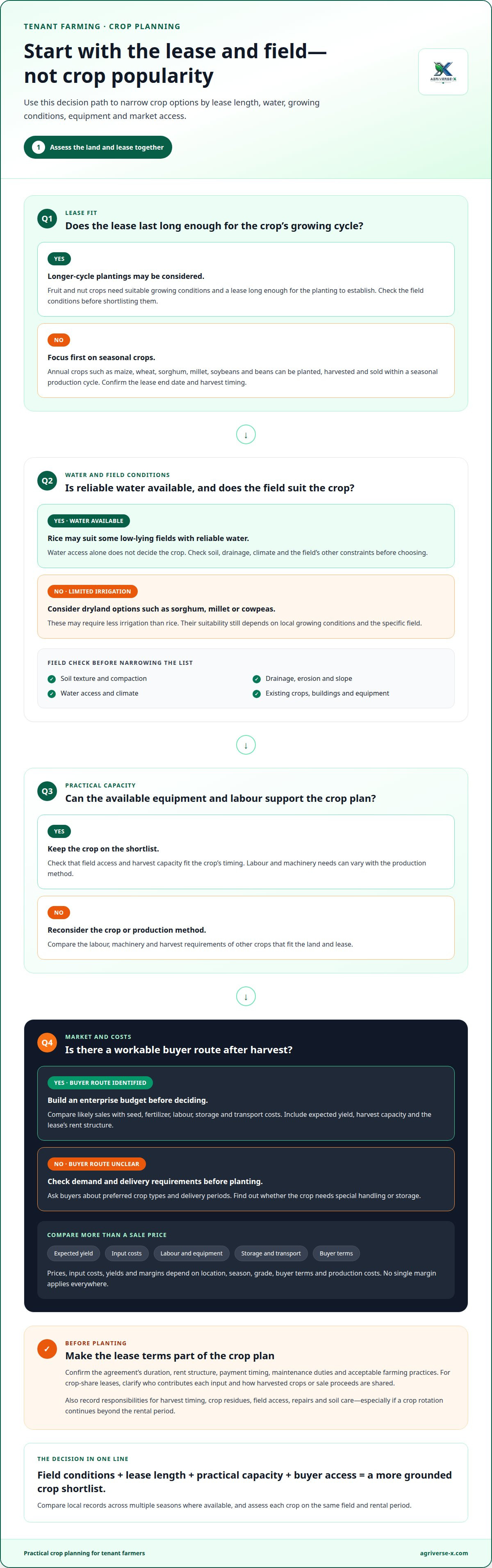
Choose farmland by matching its soil, water, climate, access, and lease terms to a specific crop plan. A low-lying field with reliable water, for example, may suit rice better than a dry, sloping parcel. Sandy soil, limited irrigation, or poor drainage can narrow the options before you decide on seed or equipment. When choosing the best crops for tenant farming, assess the field and the agreement together.
Start by walking the field and recording its strengths and constraints. Note soil texture, compaction, erosion, drainage, water access, slopes, existing crops, buildings, and equipment. A tenant planning maize needs workable access for planting and harvest, while a fruit grower needs suitable conditions and enough time for trees to establish. Match each crop’s growing cycle to the lease period and available equipment.
Leases shape what tenants can plant and how they manage land. A written agreement should clearly set out rent, payment timing, maintenance duties, and acceptable farming practices. The Agricultural Tenancies Act 1995 framework applies to relevant new tenancies granted on or after 1 September 1995 in England and Wales, according to the UK legislation register. In the United States, cash rent gives a different cost structure from crop-share arrangements. Crop choice should reflect who carries costs and how revenue is divided.
Crop prices, input costs, and expected margins depend on location, season, grade, buyer terms, yield, and production costs. A soybean plan, for example, should weigh seed, fertilizer, labour, and storage against likely sales channels and expected harvest. No single margin applies everywhere. Soil, rainfall, temperature, pests, and buyer access affect yields and returns, and conditions that suit wheat may not suit rice.
Crop-share leases divide costs and revenue according to the written agreement. The parties can specify who contributes each input and how they share harvested crops or sale proceeds. Cash, crop-share, crop-share cash, and livestock-share leases are different arrangements, so the crop plan should fit the chosen structure.
Crop insurance and government programmes vary by country and jurisdiction. Eligibility, covered crops, insured risks, and payment conditions depend on the relevant programme and the tenant’s lease interest. Market, weather, pest, and soil risks vary too: drought can constrain water-dependent crops, while poor drainage can damage crops suited to drier fields. Buyer access, pests, erosion, and depleted soil can also affect production.
Irish land reform offers historical context, not a template for a current lease. The Irish Land Commission supervised transfers of up to 13 million acres between 1885 and 1920, then dissolved in March 1999. For sustainable stewardship, landowners should set management expectations before leasing. Tenants and owners can document responsibilities for drainage, fences, buildings, and soil care, while crop rotations and erosion-conscious practices help protect the field’s future production potential.
Alternative field crops, grains, and legumes
Compare crops by local demand, growing conditions, equipment, and lease length. Dryland sorghum, millet, and cowpeas may require less irrigation than rice, while labour and machinery needs depend on the production method.
Profitability of Alternative Crops
Profitability is what remains after production costs and the landlord’s agreed share. In the United States, no grain or legume is the most profitable in every region. Compare several years of local yield and commodity data, then weigh likely sales against seed, fertilizer, labour, storage, and transport costs. Oklahoma crop reports cover wheat, sorghum, soybeans, peanuts, cotton, and corn, although not every county reports each commodity.
Compare options with a simple enterprise budget. For example, assess soybeans and sorghum on the same field, over the same rental period, and using the same expected buyer route. Include input costs, harvest capacity, and the lease’s rent structure. A strong sale price may still leave less income if the crop requires costly inputs or nearby storage is unavailable.
Crops for Short-Term Leases
Short-term cash leases generally favour annual crops that can be planted, harvested, and sold within the agreement. Maize, wheat, sorghum, millet, soybeans, and beans have seasonal production cycles, unlike fruit trees that take time to establish. Lease terms vary, so confirm the agreement’s duration before considering long-term plantings.
Before planting, align harvest timing with the lease end and clarify who manages any remaining crop residues. The landlord and tenant can also record responsibilities for conservation practices, field access, and repairs. Clear terms support planning and help maintain the relationship, especially when a crop rotation continues beyond one rental period.
Crop choice can reflect local food and feed needs as well as growing conditions. Beans, cowpeas, and groundnuts are legumes; maize, rice, and fonio are grains. A mixed plan can spread production across crop groups, while rotations may help manage weeds and maintain soil cover. Choose combinations that suit the field, available labour, and community demand.
Historical records and local programmes can inform decisions, but conditions differ from place to place. Use county-level records where available and compare multiple seasons instead of relying on a single harvest. Ask buyers about preferred grain types and delivery periods to assess market fit before planting. This can also reveal whether a crop needs special handling or storage.
For crop planning connected to available rental opportunities, explore farmland and lease listings.
Which crops are most profitable for tenant farmers in the United States?
No single crop leads in every United States region or lease arrangement. Profit depends on local yield, market price, input costs, harvest capacity, transport, and rent. Corn, soybeans, wheat, sorghum, peanuts, and cotton may suit some areas, but their relative returns vary by field and season. Compare likely net return, not just sale price.
Build the comparison from local production records. Use several years of USDA National Agricultural Statistics Service data to examine commodity production and yield variability. In Oklahoma, crop reports cover wheat, sorghum, soybeans, peanuts, cotton, and corn, although not every county reports every commodity. That variation matters: statewide figures may not reflect conditions on a tenant’s land.
Next, estimate a crop budget for each realistic option. List expected saleable yield and likely sales channel alongside costs for seed, fertilizer, crop protection, labour, machinery, drying, storage, and transport. Compare operating costs with expected revenue, then account for rent and the lease’s division of costs. For a fair comparison, use consistent land, season, and accounting assumptions for corn and soybeans.
Lease structure can change which crop leaves the tenant with more income. Under cash rent, the tenant generally carries production risk while owing the agreed rent. Crop-share arrangements divide revenue and may also divide specified expenses, so the tenant’s return depends on the written terms. A crop with higher gross sales can leave a lower return if its input costs or rent share are greater.
- Corn: Assess expected local yield, machinery access, drying needs, and buyer demand.
- Soybeans: Compare seed and crop-management costs with expected production and sale options.
- Wheat: Review county-level production patterns, harvest logistics, and the lease calendar.
- Sorghum and peanuts: Include their local production record and the equipment or handling available.
- Cotton: Check whether local production, harvest capacity, and buyer access support the plan.
Use the same budgeting method across the crops, then test how lower yields or weaker selling prices would affect the result. This makes risk visible before you commit labour and inputs. It also helps distinguish a crop suited to the land from one with only a strong market reputation.
Review the figures against the actual lease terms and sales plan. If a crop needs storage or processing, include the related steps in the budget and schedule. A sound choice fits local production evidence, available operations, buyer access, and the tenant’s share of costs and revenue.
What crops have the lowest startup costs for tenant farming?
No crop has the lowest startup cost on every rented farm. Cowpeas, beans, sorghum, and millet may be practical candidates when they suit the field, local market, and available equipment. Compare the full first-season budget, including seed, land preparation, labour, crop inputs, irrigation, harvest, storage, and transport. Existing tools and equipment can substantially change the comparison.
Begin with crops that suit machinery already available to the tenant. A farmer with suitable planting and harvesting equipment may avoid major machinery purchases for maize or soybeans. A smaller operation using hand tools might consider beans or cowpeas, while checking that planting, weeding, and harvest labour fit the budget. The production system, not crop choice alone, determines startup costs.
Separate upfront expenses from costs incurred during production. For sorghum, estimate seed, field preparation, weed management, harvest, and storage. For beans, include seed, field-operation labour, and post-harvest handling. If a crop needs irrigation, specialized machinery, processing, or cold storage, include those costs before treating it as a low-cost option.
- Cowpeas and beans: Compare seed access, labour requirements, field preparation, and the local route to sale.
- Sorghum and millet: Assess whether existing equipment can handle planting and harvest, and whether storage is available.
- Soybeans: Include seed, crop inputs, harvesting, and handling rather than relying only on expected sales.
- Maize: Account for machinery access and post-harvest handling, especially when the tenant must arrange them.
These are starting points, not fixed cost rankings. A farmer who already has access to a tractor and planter may find maize more affordable to establish than a crop requiring unfamiliar tools. On another rented field, limited water access could make an irrigation-dependent plan expensive. Compare crop requirements with the actual land and available resources.
Build a simple budget for each candidate crop. List the quantities and expected costs for seed, inputs, labour, equipment hire or use, water, harvest, and storage. Separate expenses due before planting from those due later. This helps show how much working capital the operation needs before any crop is sold.
Then match the budget to the lease and sales plan. A cash-rent tenant should account for rent alongside crop costs, while crop-share terms can change how expenses and proceeds are allocated. Choose a crop only after comparing its resource needs, harvest handling, and likely buyer route with the tenant’s available cash and equipment.
Choose a crop only after reviewing the budget and the circumstances attached to the holding. Succession rights and tenancy arrangements vary by jurisdiction and depend on the circumstances. The five-year succession-rights claim for spouses and relatives in England and Wales should be checked against current approved information. This is separate from the crop budget; consult a qualified local professional about how succession rights or tenancy terms may affect longer-term plans.
Landowners should seek permission before contacting a prospective tenant’s other landlords or collecting references and work-history information, and should follow applicable privacy rules. Prospective tenants can use clear records of experience to explain their proposed crop and the resources needed to establish it. Consider these discussions alongside rent, crop-share terms, and the budget, so the crop choice is assessed within the actual tenancy.
Which crops are best suited to short-term cash leases?
Under a cash-rent lease, plan crop spending around rent due dates, input purchases, and expected sales. Suitability depends on whether the tenant can meet each payment from available working capital, not simply on the harvest date. Map expected cash outflows and income across the season before committing to a production plan.
Start with the written rent amount and payment schedule. Add planned spending for seed, field preparation, labour, crop inputs, harvest, storage, and transport. Estimate when each cost is due and when crop sales may generate cash. A tenant growing soybeans, for example, should account for costs incurred before harvest revenue arrives, rather than treating projected sales as cash already available.
Compare crops by cash flow as well as expected return. A crop with costs concentrated early in the season may put more pressure on working capital. Later sales may require a plan to cover rent and operating costs before payment arrives. Buyer arrangements, harvest timing, and storage needs can all affect the gap.
- Rent timing: Align each scheduled payment with the operation’s expected cash availability.
- Input timing: Record when seed, labour, and other production expenses must be paid.
- Sale timing: Estimate when harvested crops can be delivered and payment received.
- Contingency: Keep room in the budget for production or marketing changes.
Put the rental rate, payment schedule, maintenance responsibilities, and acceptable farming practices in the written agreement. Clarify access for planting, field operations, and harvest, as well as responsibilities for crop residues and repairs. These terms connect the crop calendar to the tenant’s cash commitments and help prevent disputes during handover. Lease rules and obligations vary by jurisdiction; have a qualified local professional review the agreement before signing.
Compare the plan against local production records and the intended buyer route. Farmland and lease opportunities can help connect a proposed crop plan with rental options. Choose a lease and crop combination whose payment timing, operating needs, and expected sales can be planned together.
Lease structures and their suitability vary by location and agreement. The guide describes four basic types of farm leases: cash, crop-share, crop-share cash, and livestock-share leases. Its statements that crop-sharing leases are usually workable only for strictly cash-crop farming and that crop-share cash leases are common throughout the Corn Belt of the Middle West should be treated as claims requiring verification against approved material, not as general rules. Compare any proposed arrangement with cash rent, keeping payment schedules and operating budgets central to the decision.
A variable cash lease is another structure to assess alongside a fixed cash commitment, but its terms and suitability depend on the agreement and local circumstances. Treat any figures described in the guide as examples, not recommended rates for a particular farm, and evaluate terms in light of the proposed crop and expected revenue. The guide’s suggestion to consider a longer-term farm lease after a successful first year, with an option to terminate at the end of any year, is not a general recommendation; the appropriate duration and exit terms depend on the parties’ circumstances. Lease rules and obligations vary by jurisdiction, so seek review from a qualified local professional before signing. This is general information, not legal or financial advice.
AgriVerse-X
AgriVerse-X helps farmers connect crop plans with agricultural opportunities, resources, and market participants. Tenants comparing grains, legumes, or other crops can use farm-property listings to explore rental opportunities. The agricultural marketplace connects participants around goods, inputs, machinery, technology, and services, and employers can connect with agricultural workers.
Verified digital profiles let farmers showcase their products, skills, and certifications. These connections can help organize practical parts of a tenant-farming plan, from finding relevant equipment to presenting crops to potential buyers. Local requirements and the terms of each opportunity still matter.
To learn how AgriVerse-X can support your agricultural plans, contact the team at [email protected].
Turn Your Crop Plan Into a Confident Next Move
Choosing the best crops for tenant farming is only the start. Turn your preferred option into a practical operating plan, recording key assumptions, responsibilities, and decisions to revisit as the season progresses. This gives everyone involved a shared reference point.
Set a planning rhythm to keep the operation on track. Review progress against the crop calendar, record important changes, and organize production and sales information. These habits make it easier to adapt and carry useful lessons into the next growing cycle.
Take the next step by exploring agricultural opportunities through AgriVerse-X. Build your plan with purpose, keep it responsive, and move forward one considered decision at a time.
Frequently Asked Questions
What are current crop prices, input costs, and expected profit margins?
Prices, input costs, and expected margins vary by location, season, crop grade, buyer terms, yield, production costs, and lease structure. Compare expected local revenue with seed, fertilizer, labour, storage, transport, and rent costs. No single margin applies across regions.
What are the main market, weather, pest, and soil risks for common tenant-farmed crops?
Market risks include limited buyer access or demand, while weather risks include drought, especially for water-dependent crops. Poor drainage can damage crops, and pests, erosion, or depleted soil can also undermine production.


