

A crop-share lease needs more than a plan for dividing the harvest. A farmland lease agreement template can set out the property, crop-share terms, each party’s contributions, improvement rules, termination process, and governing law. One California sample sets a one-year term, allows a tenant’s termination notice to take effect 60 days after delivery, and selects California law.
A written agreement gives both parties a shared reference for the work, costs, and decisions involved in a lease. Crop-share terms need particular care: define how the crop is divided and who contributes inputs, labor, equipment, or other resources.
This guide explains what a farm lease covers and how to make its key provisions clear. Learn what to include in crop-share arrangements, how to address improvements and contributions, and why termination language and governing law should fit the property and the parties’ circumstances. Use a farmland lease agreement template as a starting point, then have the completed agreement reviewed for the relevant jurisdiction before signing.
Key Takeaways
- Set out crop-share calculations and each party’s contributions to inputs, labor, equipment, and other costs.
- Clarify who approves major improvements and who owns them when the lease ends.
- Write termination triggers, notice methods, and notice periods into the agreement so both parties understand the process.
- Choose governing-law language that reflects the property’s jurisdiction, and have the completed agreement reviewed before signing.
- Compare cash rent, crop share, and flexible rent by considering how each allocates costs, production risk, and returns.
Crop-share lease templates
A crop-share lease ties the tenant’s rent to an agreed portion of the crop. A clear template records how the harvest, production costs, and responsibilities are divided, giving both parties a written reference.
Crop-Share Arrangements
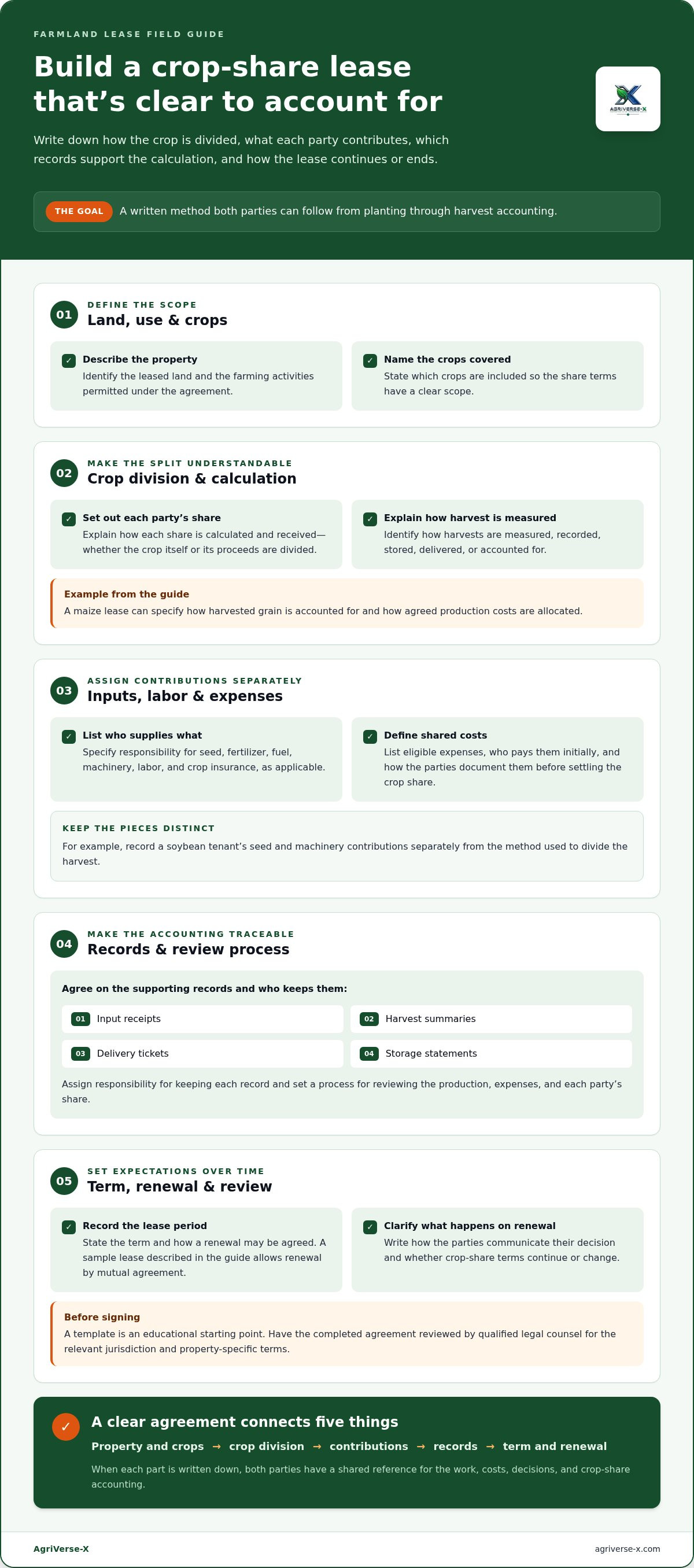
In a crop-share arrangement, the landlord receives an agreed share of the crop or its proceeds. The agreement should identify the crops covered, explain how each share is calculated, and state how harvests are measured or recorded. For example, a maize lease can specify how harvested grain is accounted for and agreed production costs are allocated.
Set out each contribution separately. Specify who supplies seed, fertilizer, fuel, machinery, labor, or crop insurance, as applicable. Don’t leave “shared costs” undefined. A written schedule can list eligible expenses, who pays them initially, and how the parties document them before settling the crop share.
Flexible Rent Arrangements
A flexible-rent arrangement adjusts rent according to an agreed production or market measure. The template should define the measure, the calculation method, and when the parties settle the amount. Rent might vary with crop yield or prices, for example, but the agreement must explain which records establish those figures and how the calculation works.
Spell out how the arrangement handles different crops, poor harvests, and changes in contributions. Referring only to “market price” leaves room for disagreement about the crop, grade, location, or pricing date. Name the agreed reference method and make sure both parties can follow the calculation.
What a Crop-Share Template Should Record
A crop-share template is a document that organizes the lease terms into written clauses and schedules. Ag Lease 101 provides sample forms for cash, crop-share, pasture, buildings, machinery, and livestock rentals. Use the crop-share form as a drafting starting point, then adapt its fields to the land, crops, and working relationship.
Include the following details in the agreement:
- Land and use: Describe the leased property and permitted farming activities.
- Crop division: State how the parties calculate and receive their shares.
- Contributions: Assign inputs, labor, equipment, and agreed expenses.
- Records: Identify the harvest, delivery, and expense documents used for accounting.
- Term and renewal: Record the lease period and how renewal may be agreed.
For example, a tenant growing soybeans could record seed and machinery contributions separately from the method for dividing the harvest. This makes the calculation easier to follow when the crop is sold or stored.
Accounting, Renewal, and Review
Crop-share accounting means recording production, expenses, and each party’s share. Agree on the supporting records, such as input receipts, harvest summaries, delivery tickets, or storage statements. Assign responsibility for keeping each record and set a review process. These steps turn a general promise to share crops into an auditable process.
Renewal means agreeing to continue the lease beyond its current term. A sample farm lease states that renewal may occur by mutual agreement. Put the renewal process in writing, including how the parties communicate their decision and whether crop-share terms will continue or change.
A farmland lease agreement template is an educational starting point, not a substitute for advice from an attorney licensed in the relevant state. A template may not address every detail of a particular landlord-tenant relationship. Before signing, review crop calculations, responsibilities, renewal language, and property-specific terms with qualified legal counsel.
Improvements to leased farmland
In the U.S., cash rent is commonly calculated by multiplying an agreed rental rate by the leased acreage. USDA National Agricultural Statistics Service county cash-rent rates, updated annually for each state, can serve as a reference when assessing a proposed rate.
A farmland improvement is a lasting change or addition that supports the property’s use. Examples include installing drainage, repairing fences, adding irrigation, or improving a farm building. A lease should distinguish routine upkeep from major repairs and improvements, since approval and ownership arrangements may differ.
Before work begins, document the proposed improvement, its purpose, who will pay, and who must approve it. The lease template requires landowner approval for major repairs or improvements. For example, a tenant planning a new irrigation system should describe the work and obtain the landowner’s approval under the agreement.
This record can prevent later disputes about whether work was authorized, who paid for it, and what happens when the lease ends. Keep supporting documents with the lease, including written approvals, invoices, plans, and notes describing the work. Refer to the relevant clause whenever the parties discuss a change.
Set out ownership terms for permanent improvements separately. The agreement can state whether they become the landowner’s property or remain the tenant’s at lease end. This matters for an irrigation system, permanent structure, or other improvement that cannot be removed without affecting the property.
Describe each improvement clearly instead of relying on a broad phrase such as “farm upgrades.” Identify the item and its location, then state how the parties will handle it at termination. For example, distinguish a removable pump from installed irrigation lines and specify the agreed ownership outcome for each.
A written improvement schedule can organize these decisions. Include the following points for each planned project:
- Scope: Name the repair or improvement, such as a fence repair or drainage work.
- Approval: Record the landowner’s approval for major work before it starts.
- Payment: State which party pays for materials, labor, and agreed maintenance.
- Records: Keep approvals, invoices, and descriptions with the lease documents.
- End-of-lease treatment: State whether the improvement stays with the landowner or remains the tenant’s property.
Maintenance terms should identify who cares for fields, fences, equipment, and facilities. The template assigns the tenant responsibility for keeping these in good condition. Distinguish this ongoing duty from a major improvement, such as replacing a fence or installing drainage, so the parties can apply the right approval and payment terms.
For cash rent, USDA county figures provide a comparison point, while the agreed rate and acreage determine the lease total. Record the calculation method alongside improvement obligations, especially if a project changes how the leased land can be used. A complete written schedule makes responsibilities easier to track throughout the lease.
Termination and governing law
Termination terms explain how a farm lease ends, while governing law identifies the law named in the agreement. Address disputes involving breach, unpaid rent, notice delivery, holdover occupancy, and which jurisdiction’s rules apply.
Termination Provisions
A termination provision sets out the events and process for ending a lease. One California template allows a tenant’s termination notice to take effect 60 days after delivery. A lease may also set out when a tenant can terminate after a landlord breach or a specified physical event. These are sample terms, not universal deadlines.
For breach, non-payment, or failure to comply, the template provides for a notice period set by the parties. State the breach, how notice must be delivered, and when the opportunity to address it ends. For example, list unpaid rent and failure to maintain an agreed area as separate grounds, with clear notice procedures for each.
Notice procedures matter. The California sample requires written notices and allows delivery by mail, hand, fax, or email. It treats mailed notices as given two business days after deposit. A lease should identify the parties’ notice addresses and accepted delivery methods, then explain how to document sending and receipt.
Expiration also needs a clear outcome. Under the sample, a tenant who remains after the lease term becomes a month-to-month tenant. Either party may cancel with 30 days’ written notice after expiration of the term. Put the holdover rule in the agreement so both parties know what happens if the tenant stays.
- Identify triggers: List breach, non-payment, and other agreed termination events.
- Set notice steps: State the delivery method and applicable notice period.
- Address expiration: Explain whether occupancy ends or changes after the term.
Governing Law Terms
A governing-law term names the jurisdiction’s law selected to interpret the agreement. The California template selects California law. Treat this as a jurisdiction-specific sample, not a default for farmland elsewhere.
Match the governing-law clause to the transaction and the property’s location. A California template may contain terms that do not suit farmland in another state or country. Before signing, have an attorney licensed in the relevant state review the clause and entire lease for local requirements and the parties’ circumstances.
Give written changes the same attention as the original agreement. The California sample says modifications must be in writing and signed by both parties. If the landlord and tenant later change a termination date or notice method, record the change in a signed document rather than relying on an informal conversation.
Farm lease templates are educational examples, not substitutes for legal advice from an attorney licensed in the relevant state. Each party can have independent counsel review the termination process, notice records, holdover language, and governing-law clause before signing. Clear terms help both parties understand the agreed steps if a dispute arises.
Balancing landlord and tenant contributions
A contribution schedule is a written allocation of each party’s duties, costs, and resources. Lease terms for crop insurance, conservation practices, and government payments should identify responsibilities, required records, and how relevant proceeds or obligations are handled.
Michigan Farm Bureau says farm leases should support profitable, long-term operations and benefit both parties. Put that principle into specific terms: name the tasks, assign responsibility, and describe how completion is documented. For example, list field maintenance separately from a major repair or landlord-funded improvement.
The template assigns the tenant responsibility for maintaining fields, fences, equipment, and facilities in good condition. It assigns payment of real property taxes to the landlord. Record these allocations clearly, then add property-specific duties the parties agree on, such as who arranges routine fence repairs.
A contribution checklist helps both parties identify responsibilities before signing:
- Landowner: Record the responsibility for real property taxes.
- Tenant: State duties for fields, fences, equipment, and facilities.
- Both parties: Assign crop inputs, labor, machinery, and agreed shared expenses.
- Records: Identify receipts, invoices, and maintenance notes used to document contributions.
- Insurance: Name who arranges and pays for crop insurance, and how claims are recorded and handled.
Crop insurance terms should distinguish the policyholder, responsibility for premiums, and treatment of claim proceeds. If the tenant obtains coverage, for example, the lease can state how the landlord receives relevant information and how a claim affects crop-share accounting. Keep these clauses consistent with the agreed crop division.
Conservation terms describe farming practices and related responsibilities on the leased land. The template calls for good farming practices, soil-erosion prevention, water conservation, and compliance with environmental laws and conservation programs. Specify the practices the parties agree to follow and who keeps records, such as notes documenting erosion-control work.
Government-payment terms should identify relevant payments, who handles related applications or records, and how payments connected to shared production are treated between the parties. Distinguish payments tied to the tenant’s work from those associated with ownership or participation in a conservation program. Program rules and eligibility affect how payments can be handled.
Review the contribution schedule whenever the parties change the crop plan, cost-sharing arrangement, or conservation responsibilities. A written amendment can record the revised task, responsible party, and effective date. This creates a clear reference alongside the lease instead of relying on someone’s later recollection of a conversation.
What are common farmland lease types: cash rent, crop share, and flexible rent?
Lease types differ in how they distribute income uncertainty, operating costs, and decision-making between the landowner and tenant. Compare their effects on cash flow, crop choices, recordkeeping, and each party’s exposure before choosing a structure.
Cash Rent
Cash rent separates the tenant’s payment from the crop’s final performance. This can make the landowner’s expected payment easier to plan, while leaving the tenant more exposed to a poor harvest or lower crop returns. Consider whether expected farm revenue can cover rent alongside seed, labor, fuel, and other operating expenses.
This structure can also give the tenant more independence over production choices, subject to the lease’s permitted-use and farming-practice terms. Before agreeing, compare the payment schedule with the farm’s expected income cycle. A due date before crop proceeds arrive creates a different cash-flow burden from a date after harvest sales.
Crop-Share Rent
Crop-share rent ties the landowner’s return more closely to the crop outcome. This can align both parties’ interests in production, but it makes clear decisions about expenses and crop handling essential. Compare how contributions affect each party’s net return, not just the share of the crop assigned.
Consider how the arrangement may affect crop rotation, input levels, harvest timing, and storage. If either party contributes resources or shares costs, specify how those contributions relate to the agreed division. Decide how to handle crops delivered to different buyers or retained for later sale.
Flexible Rent
Flexible rent adjusts payment using a formula agreed in advance, allowing the parties to account for changing conditions without renegotiating each payment. Its practical value depends on whether both parties can understand and reproduce the calculation from the same records.
Compare possible formulas for clarity and balance. A yield-based measure responds to production, while a price-based measure responds to market movements. A formula using both needs clear definitions for the crop, measurement period, and records. Decide how unusual conditions or missing records affect the calculation before they arise.
Compare the Lease Structures
Use the same questions to assess each option. Which party can absorb income variability? Who controls production decisions? How do input contributions affect the economics? What records can both parties access? The answers show whether the structure’s allocation of risk fits the working relationship.
- Cash rent: Assess payment timing against the tenant’s expected farm cash flow.
- Crop share: Compare each party’s contributions with its share of crop value.
- Flexible rent: Test whether both parties can calculate the formula consistently.
Write down the chosen structure and its calculation method. Then compare the draft with the farm’s operating plan, contribution schedule, and intended crop use. This comparison helps both parties choose terms they can administer throughout the lease.
AgriVerse-X and farmland lease opportunities
AgriVerse-X lists farmland and leases, helping agricultural participants discover land opportunities through the platform. Farmers, landowners, and cooperatives can create verified digital profiles showcasing relevant products, services, skills, and certifications.
After defining the lease type, contributions, improvements, termination, and governing law, use a listing to connect the written terms with a potential opportunity. Review the land details and lease conditions carefully, then document any agreed arrangement in a written contract tailored to the property and applicable jurisdiction. Seek qualified legal advice before signing.
AgriVerse-X also supports agricultural marketplaces for goods, inputs, machinery, technology, and services. Contact AgriVerse-X at [email protected] to learn more about its land and lease listings.
Turn the Draft Into a Working Lease Plan
Use the agreement to support decisions beyond the signing moment. It provides a shared foundation for planning as priorities, crops, or working relationships change. A farmland lease agreement template can start that process, while ongoing communication helps both parties keep their plans aligned.
As you consider the next stage, connect your land plans with the wider agricultural activity they support. Contact AgriVerse-X about your lease to discuss your next steps.
Frequently Asked Questions
What is a Farm Lease Agreement?
A farm lease agreement is a contract that sets the conditions for using agricultural property. Beyond identifying the arrangement, it can preserve operational details that may otherwise be forgotten. For example, parties can document access routes, shared water points, or areas excluded from cultivation. A written record can also help clarify the parties’ rights and obligations if a landlord or tenant dies or a dispute arises.
What are the landlord's and tenant's responsibilities under a farm lease?
Distinguish operational decisions from property-related decisions in the agreement. For example, the tenant may choose a planting schedule within the agreed use, while the landlord may need access to inspect the property. Set out a practical way to coordinate site visits and communicate decisions, especially during seasonal work. Clear roles help prevent confusion about who can authorize an action or speak for the other party.
How should a farmland lease address repairs, improvements, and maintenance?
Use a condition record to document the farmland’s starting state and changes during the lease. A handover checklist can note existing drainage problems, damaged gates, or worn building features, supported by dated photographs. This helps distinguish pre-existing issues from damage or wear arising during occupancy. Keep the record with the agreement and update it when a substantial change affects the property.
How long should a farmland lease last, and what are the renewal and termination rules?
Choose a lease term that matches the production cycle and the tenant’s planned commitments. A lease for annual crops should account for planting, harvest, and the time needed to clear or store the crop. Longer-term operations or perennial plantings may require a different planning horizon. Set a renewal decision point early enough for both parties to plan labor, inputs, and land use for the next growing cycle.
What state laws and notice requirements apply to farmland leases?
The governing-law clause identifies which state’s law the agreement selects, while notice requirements depend on applicable rules and the lease terms. Requirements vary by state, so have an attorney licensed in the relevant state review the agreement before signing. Keep copies of notices and delivery records with the lease, giving both parties a clear file of what was communicated and when.


