

The strongest food import business starts with a clear buyer and a product that meets a real local need. To understand how to start a food import business in 2026, choose a product, test demand, assess supplier reliability, calculate the full landed cost, and map the food-safety and import rules for your destination country before committing to a shipment.
Choosing what looks popular is only the first decision. You also need to know who will buy, how the product will reach them, and whether storage, shelf life, packaging, and compliance fit the way you plan to sell. Requirements vary between markets, so build your operating plan around the country where the food will be imported.
This guide explains how to compare product opportunities, assess suppliers, choose a business model, and coordinate each step from sourcing to sale. It also covers food safety, logistics, and costs to consider before ordering, so you can ground your plan in buyer demand and prepare for day-to-day operations.
Key Takeaways
- Validate buyer demand and product fit before committing to a shipment.
- Assess supplier reliability and plan logistics around the food’s storage and shelf-life needs.
- Map the food-safety, labelling, and import requirements for your destination market.
- Choose a sales workflow that connects sourcing, landed-cost planning, and delivery to buyers.
- Use AgriVerse-X digital profiles and marketplace tools to present agricultural products and connect with potential buyers.
1. How does Market Research Shape Trade Decisions?
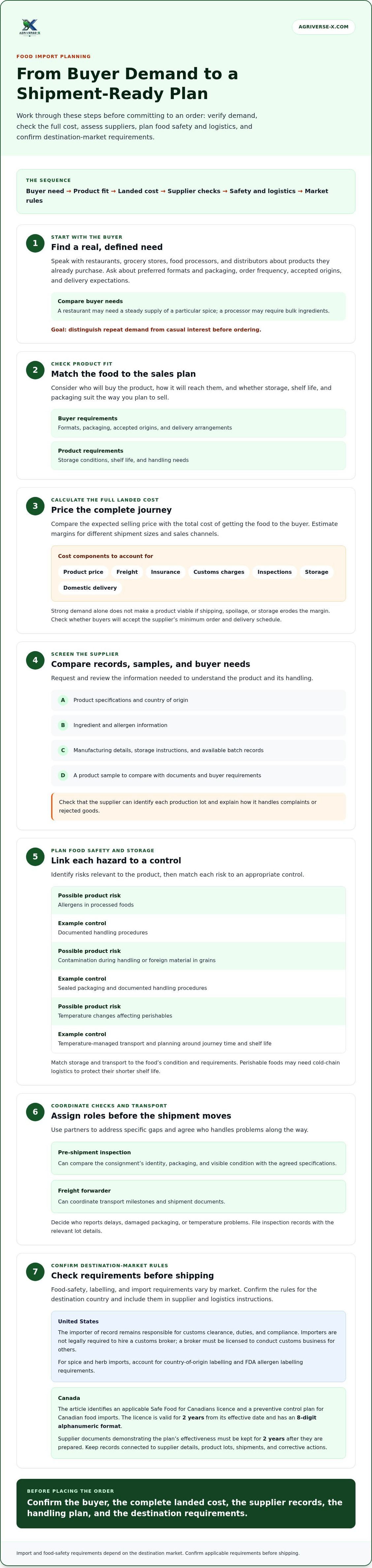
Start with a defined buyer, not a supplier catalogue. Speak with restaurants, grocery stores, food processors, and distributors about products they already purchase. Ask which formats and packaging they prefer, how often they order, what origins they accept, and what delivery arrangements they expect. A restaurant may need a steady supply of a particular spice, while a processor may require bulk ingredients. These conversations help distinguish repeat demand from casual interest before you commit to an import order.
Compare the expected selling price with the full landed cost. Include the product price, freight, insurance, customs charges, inspections, storage, and domestic delivery. Then estimate margins for different shipment sizes and sales channels. Strong demand alone does not make a product viable if shipping, spoilage, or storage erodes the margin. Test whether buyers will accept the supplier’s minimum order and proposed delivery schedule.
Screen suppliers through a documented process. Request product specifications, country of origin, ingredient and allergen information, manufacturing details, storage instructions, and available batch records. Compare those documents with a product sample and the buyer’s requirements. Check that the supplier can identify each production lot and explain how it handles complaints or rejected goods. Reliability matters: supplier performance can influence whether a new trading company survives its first year.
Assess food-safety hazards before choosing logistics. Identify risks relevant to the product, such as allergens in processed foods, contamination during handling, foreign material in grains, or temperature changes affecting perishables. Match each risk to a control, such as sealed packaging, documented handling procedures, or temperature-managed transport. Perishable foods may need cold-chain logistics to protect their shorter shelf life. Plan transport around the product’s condition, storage requirements, and journey time.
Use inspection and logistics partners to address specific gaps. A pre-shipment inspection can compare a consignment’s identity, packaging, and visible condition with the agreed specifications. A freight forwarder can coordinate transport milestones and shipment documents. Decide who reports delays, damaged packaging, or temperature problems, and file inspection records with the relevant lot details. When sourcing directly from farmers, clear grading rules and consistent quality checks help align fair prices with the product buyers expect.
For imports into the United States, the importer of record remains responsible for customs clearance, duties, and compliance. US importers are not legally required to hire a customs broker, but a broker must be licensed to conduct customs business for others. Decide whether to manage filings yourself or appoint a broker based on your workflow and in-house expertise. For any destination, confirm entry and food requirements before shipping, then include them in supplier and logistics instructions.
2. What Exactly is an Import And Export Business in 2026?
An import-and-export business buys goods across borders or sells them abroad, then coordinates their movement into a sales channel. A food importer might source packaged ingredients overseas, clear them for entry, and supply stores, restaurants, or a distributor. An exporter sells goods to buyers in another country. Both models require coordination of suppliers, product records, transport, regulatory duties, and payment terms. Assign responsibility for each step before placing the first order.
Choose storage based on the food’s handling needs and your sales model. Sealed, shelf-stable goods may need a different setup from chilled foods. Map receiving, inspection, storage, order preparation, and dispatch so products move through a controlled sequence. Select equipment to suit the goods, such as appropriate shelving, scales, packaging tools, or temperature-monitoring equipment when needed. Keep food separate from chemicals and damaged stock.
Plan utilities and staffing around the actual work. Cold storage depends on reliable power and temperature monitoring; dry-goods handling requires clean, organised storage and clear stock records. Assign responsibility for receiving shipments, checking lot identification, maintaining inventory, preparing orders, and handling complaints. A small operation may combine duties, but every task still needs an owner and a written procedure.
For Canadian food imports, obtain the applicable Safe Food for Canadians licence and maintain a preventive control plan. The licence is valid for 2 years from its effective date and has an 8-digit alphanumeric format. The plan should describe how the business controls food hazards and supports safe handling. Canada’s preventive controls are based on the Codex Alimentarius General Principles of Food Hygiene.
Keep supplier records connected to the preventive control plan. In Canada, importers must keep supplier documents demonstrating the plan’s effectiveness for 2 years after those documents are prepared. Section 11 of the Safe Food for Canadians Regulations describes sanitary conditions for manufacturing, preparing, storing, packaging, and labelling food. Build document storage around product lots, supplier details, shipment records, and corrective actions.
Review labels for the destination market before printing packaging. For US spice and herb imports, account for country-of-origin labelling and FDA allergen labelling requirements. Compare the label with the product’s ingredients, allergen information, origin, and intended market. For Canadian sales, include label review in the preventive-control workflow and ensure package information matches the food being imported.
Check import permits separately from the food-safety licence. In Canada, the Trade Controls Bureau of Global Affairs Canada issues permits for goods on the Import Control List under the Export and Import Permits Act. Food importers may also need to consider the Food and Drug Regulations, Health of Animals Regulations, and Plant Protection Regulations. Match the product and destination to the relevant requirements before confirming packaging, transport, or delivery to stores.
3. Choosing products for local consumer demand
Define the target consumer and buying occasion. A product purchased for everyday cooking has different demand drivers from a specialty snack or seasonal ingredient. Speak with grocery buyers, restaurant operators, food processors, and distributors. Ask what they already source, which formats they prefer, and how they assess quality. Record answers by buyer type and compare recurring needs with one-off requests. This gives your shortlist a practical foundation rather than relying on broad assumptions about national demand.
Test each product against local food habits and existing alternatives. Thai, Chinese, Italian, French, and Indian cuisines use distinctive spices and ingredients associated with their regions. Ask prospective buyers which ingredients they need, in what form, and how regularly they purchase them. Compare responses from restaurants with feedback from stores and processors. A product may appeal to one customer group without supporting a viable market across your intended sales channels.
Specialty products need a specific buyer profile. Gluten-free products, organic teas, and plant-based snacks are examples of products to investigate, not proof of local demand. Ask prospective buyers about format, packaging, sourcing claims, and repeat-order interest. For organic products, assess required certification and labelling documentation early. These requirements can affect which suppliers and markets are practical.
Build a comparison sheet for every product you are considering. Record its intended use, target buyers, expected order pattern, storage needs, shelf life, supplier location, and documentation requirements. Compare a shelf-stable spice with a perishable product, for example. The spice may be simpler to store, while the perishable item may require coordinated cold-chain logistics. Evaluate each option against buyer demand and operational requirements, not novelty alone.
Validate a potential lead product before choosing it. Ask buyers for the specifications they would accept, then request samples that match. Gather feedback on flavour, texture, pack size, and intended use. Record positive responses separately from purchase commitments: a distributor’s interest is not the same as a confirmed order. Use this distinction to decide which product merits further supplier discussions.
Finally, rank the shortlist by demand strength, supply reliability, compliance workload, and delivery fit. The global market is broad: nearly 96 percent of consumers live outside the United States. That figure points to varied markets, not automatic demand for any one imported food. Choose the product whose buyers, documentation, supplier capacity, and logistics align in your chosen destination. Keep the shortlist focused, and build the business around evidence from the people expected to buy.
4. Food safety certification and compliance
For US food imports, use the applicable FDA requirements to plan for FSVP. Requirements and compliance costs depend on the food, supplier, documentation, and operational work involved. Before sourcing, define the product and destination, identify relevant FDA requirements, and include the resulting compliance tasks in your operating budget.
State and local rules can affect food storage, distribution, and sales in the United States. Map the route from import arrival through storage to the domestic buyer, then identify the states and local areas involved. If your business uses its own storage facility, account for its role alongside your distribution and sales activities when identifying applicable requirements.
Organise compliance records around each food product and its movement. Link supplier and shipment documents to product descriptions, lot details, storage records, and customer orders. This helps staff find relevant information when a buyer raises a concern. For US imports, check FDA requirements for the specific food and build any required records into the shipment workflow.
Canadian importers must create, implement, and maintain a preventive control plan. Controls for food imports are based on the Codex Alimentarius General Principles of Food Hygiene. Maintain clear records connecting suppliers, imported food, and the controls used in your business. This supports consistent handling and documentation.
Prepare a complaint process that records the product, affected lot, customer concern, follow-up action, and completion date. In Canada, complaint-related documents must be retained for 2 years from the date follow-up actions are completed. Keep each case linked to its supporting records, so staff can retrieve the relevant information without searching across unrelated files.
Food recall records in Canada must be retained for 2 years after the recall starts. Canadian food importers must also simulate a recall once every 12 months and retain its details and results for 2 years after it ends. Use the exercise to test whether staff can trace affected stock and document decisions, then record any process improvements.
Assign responsibility for reviewing food-safety records, complaints, and recall procedures. Decide who logs a customer complaint, locates the related shipment information, and records follow-up. Keep the process aligned with the requirements of the relevant market, since importing, storage, distribution, and retail sales can involve different compliance tasks.
Plan for FSVP by identifying the FDA requirements that apply to the specific food and supplier, then incorporating required records into your shipment workflow. Compliance costs vary with the food, supplier, documentation, and operational work involved. Budget for the tasks identified for your product and destination.
5. Business model and service workflow
Choose a sales model that fits your buyers, stock capacity, and order pattern. You might sell imported foods directly to local restaurants and stores, or supply distributors and retailers in larger lots through a wholesale model. Direct retail gives you more control over presentation but also requires order handling and customer support. An electronic ordering channel can support either approach by collecting enquiries, confirming orders, and recording delivery details.
Set the workflow before placing a purchase order. Start with the buyer’s product specification, intended quantity, packaging format, and delivery location. Match these requirements to a supplier quotation and shipment plan. Confirm who arranges transport, manages import documents, receives the goods, and communicates delays. Written responsibilities prevent gaps between the supplier, freight coordinator, importer, warehouse, and buyer.
Connect every shipment to a sales plan. A restaurant order for a particular ingredient can guide the product format and delivery schedule. A distributor serving several stores may need consolidated deliveries and consistent lot records. If you import before securing orders, decide how you will store, promote, and rotate stock. Base forecasts on buyer conversations and order history rather than broad assumptions about demand.
Set clear order and payment rules. Explain how buyers request stock, how you confirm availability, when an order becomes binding, and how you handle changes or damaged goods. For electronic orders, record the item, quantity, buyer, agreed delivery point, and order status. Enter the same details for phone or in-person sales. Consistent records help reconcile inventory with invoices and deliveries.
Track each product from purchase through domestic sale. Link supplier documents, import records, receiving checks, storage locations, and customer orders to the relevant product lot. If a buyer reports a quality concern, these links help identify affected stock and sales. Make records accessible to the staff responsible for purchasing, warehouse operations, sales, and customer complaints.
Review performance after each shipment is completed. Compare the quantity received with the quantity sold, note delays or damage, and record buyer feedback. If stores reorder but restaurants do not, adjust the next sales plan toward the stronger channel. If stock moves slowly, revise the order quantity or seek buyer commitments before importing again. Use this feedback to connect sourcing decisions with actual sales.
A workable import business is a coordinated service workflow, not just a cross-border purchase. Before trading begins, define the target buyer, sales channel, stock responsibilities, documentation flow, and response process. Use shipment and order records to refine the model as demand becomes clearer.
AgriVerse-X: Integrated Digital Agricultural Platform
AgriVerse-X can support food importers seeking connections between agricultural products, sellers, and potential buyers. Farmers, agribusinesses, cooperatives, and service providers can create verified digital profiles showcasing products and relevant documentation. The agricultural marketplace supports listings for goods, processing, packaging, logistics, and value-addition, helping importers explore supply-chain connections for their chosen products.
For example, a buyer assessing imported grains or packaged foods can use marketplace listings to explore relevant sellers and product details. Digital traceability records can help organise information about product movement and compliance-aligned reporting, but they do not replace official inspections or regulatory approvals. Use these tools alongside supplier checks and destination-market requirements.
To explore agricultural marketplace connections or discuss a partnership, contact AgriVerse-X or visit agriverse-x.com.
Turn your product choice into a practical next move
Treat your first import as a learning cycle, not a commitment to expand immediately. Use buyer feedback and shipment records to refine product specifications, order timing, and the sales channel. Once the process works for a focused product range, assess whether another category fits your buyers and operating model.
If you’re deciding how to start a food import business in 2026, connect your product plan with the people and systems needed to trade. AgriVerse-X supports verified digital profiles and agricultural marketplaces where participants can showcase products and connect across the supply chain. Digital traceability records can also help organise product information alongside your own compliance processes.
Take the next step at your pace. Contact AgriVerse-X to discuss your plans and explore how its agricultural platform may fit your trading goals. Build carefully, learn from each transaction, and grow from a clear view of your market.
Frequently Asked Questions
What Exactly is an Import And Export Business in 2026?
An import-and-export business organises cross-border purchases or sales and coordinates the transaction from supplier to buyer. Its role may include selecting products, arranging payment, managing shipment records, and deciding who handles resale. A food importer might purchase packaged goods for resale, while an export business sells locally sourced goods to an overseas buyer. The model depends on the goods, trading partners, and destination market.
Conclusion: Is Global Trade Still Viable for Beginners?
Yes, beginners can enter global trade by starting with a focused product and a defined buyer group. For someone assessing how to start a food import business in 2026, the practical test is whether demand, supplier capability, compliance tasks, and delivery plans fit together. Many new import-export businesses take 6-18 months to stabilize margins and cash flow, so plan for learning and careful cash management rather than rapid expansion.
How Should Pricing and Payment Risks be Managed?
Build a pricing model around the full transaction, then set payment terms that protect working capital. Record product cost, transport, border charges, storage, and domestic delivery separately. Avoid offering buyers open credit terms before a strong working relationship is established. For every order, document the currency, payment timing, quantity, delivery point, and process for late payment or a disputed shipment.
How do Sourcing Partners Influence Business Viability?
Sourcing partners affect product consistency, shipment timing, and the quality of records available for each order. Define responsibilities with suppliers, logistics partners, and inspectors before goods move. Agree how product specifications are recorded, who reports delays, and how inspection findings reach the buyer. A clear handoff helps prevent conflicting instructions and gives you useful information for planning future orders.
How does Market Research Shape Trade Decisions?
Market research turns buyer interest into decisions about product format, sales channel, and order planning. Compare feedback from restaurants, retailers, processors, and distributors rather than treating all consumers as one group. A processor may prioritise bulk quantities, while a retail buyer may focus on pack size and shelf presentation. Record recurring requests and use them to guide product selection and supplier discussions.
Is Professional Support Necessary for Beginners?
Professional support can help when a task requires specialist knowledge or your team lacks capacity. A customs broker can conduct customs business for others, while food-safety or inspection professionals can assist with specific operational tasks. In the United States, hiring a customs broker is not legally required to clear imports. The importer remains responsible for understanding its obligations and keeping the records needed to manage trade.
Step 1: Know your food - what are the risks?
Identify risks linked to the product’s ingredients, processing, packaging, transport, and intended use. A packaged snack, for example, needs a different review from a raw ingredient sold to food manufacturers. Map the product’s route from production through storage and sale, noting where handling or information could change. Use this risk map to guide supplier questions, inspection priorities, storage procedures, and customer communications.
What Legal and Regulatory Steps are Required to Start?
Requirements depend on the destination country, product category, and how your business handles food. In the United States, a person importing on their own account does not need a licence solely to transact with CBP. An importer number is commonly the business’s IRS EIN or a sole proprietor’s Social Security number. Identify the applicable food, import, labelling, and facility requirements before arranging shipment.


