

A promising farmland lead is only a starting point. A farmland leasing platform helps landowners present opportunities and prospective growers discover them, but a digital listing does not confirm ownership, land suitability, or agreed lease terms.
When listings provide limited details, it can be difficult to compare properties or decide whether an online connection is ready to become a lease. This guide explains how digital land discovery works, which details can help you assess an opportunity, and what to verify locally before moving toward an agreement.
AgriVerse-X provides farm and land opportunity information to connect landowners with prospective growers and commercial farming operators. Use a listing to begin a discussion, then assess the land for its intended use, verify relevant information locally, and review written lease terms carefully. Keeping discovery separate from due diligence helps you ask clearer questions before taking the next step.
Key Takeaways
- A farmland leasing platform can help people discover and present land opportunities, but a listing is not proof of ownership or a completed lease.
- Compare the information provided in each listing and note what remains unknown about the land and its intended use.
- Move from reviewing an opportunity to assessing its fit, then arrange local checks before pursuing an agreement.
- Landowners and prospective growers may assess the same opportunity according to different practical and commercial priorities.
- AgriVerse-X connects landowners with prospective growers; verification and lease documentation remain part of the appropriate local process.
What a Farmland Leasing Platform Can, and Cannot, Do
A farmland leasing platform gives landowners a digital place to present agricultural land opportunities and helps prospective growers discover them. It can extend discovery beyond personal networks and make it easier to review information about different properties. Its purpose is to support discovery and connection, not to establish that land is ready to lease.
For landowners, a clear opportunity description can help explain what is being offered. For growers, details such as the stated location, land characteristics, and intended use can help identify questions and assess initial fit. Information in a listing is not automatically complete, accurate, or independently checked.
This video offers another perspective on digital farmland rentals:
Concise definition: A farmland leasing platform is a digital place to present and discover land opportunities. A listing describes an opportunity; it does not prove land title, suitability, or an agreed lease.
Lease arrangements can differ in how rent and responsibilities are handled. The Farm land overview describes farmland as a real estate niche and discusses arrangements such as cash-rent and flex leases. The right terms depend on the parties and the opportunity, so finding a listing is only an early step.
How online farmland discovery differs from informal networks
Local relationships can provide context, introductions, and knowledge of an area. Online discovery adds another way to find opportunities. Landowners can present them digitally, while prospective operators can review the available information and decide which leads merit follow-up.
A clear description can help a grower compare an opportunity with practical needs, such as the intended farming activity or relevant infrastructure. Treat those details as a starting point for questions, not verified facts. Online visibility does not establish their accuracy.
What a listing does not verify
A listing does not automatically confirm who owns the land or whether the person offering it has authority to lease it. A description of soil, water access, or other characteristics also does not replace an assessment of suitability for a particular operation.
Before pursuing a lease, arrange local verification and due diligence. Depending on the location and circumstances, this may involve checking land rights, reviewing relevant requirements, assessing the property, and seeking qualified professional input. A platform can support discovery and connection, but it does not replace these checks or create a signed agreement.
AgriVerse-X provides farm and land opportunity information to connect landowners with prospective growers and commercial farming operators. This information is subject to local verification. Use it to begin a conversation, then establish relevant facts and document any agreement through the appropriate local process.
How a Farmland Leasing Platform Organises Land Opportunities
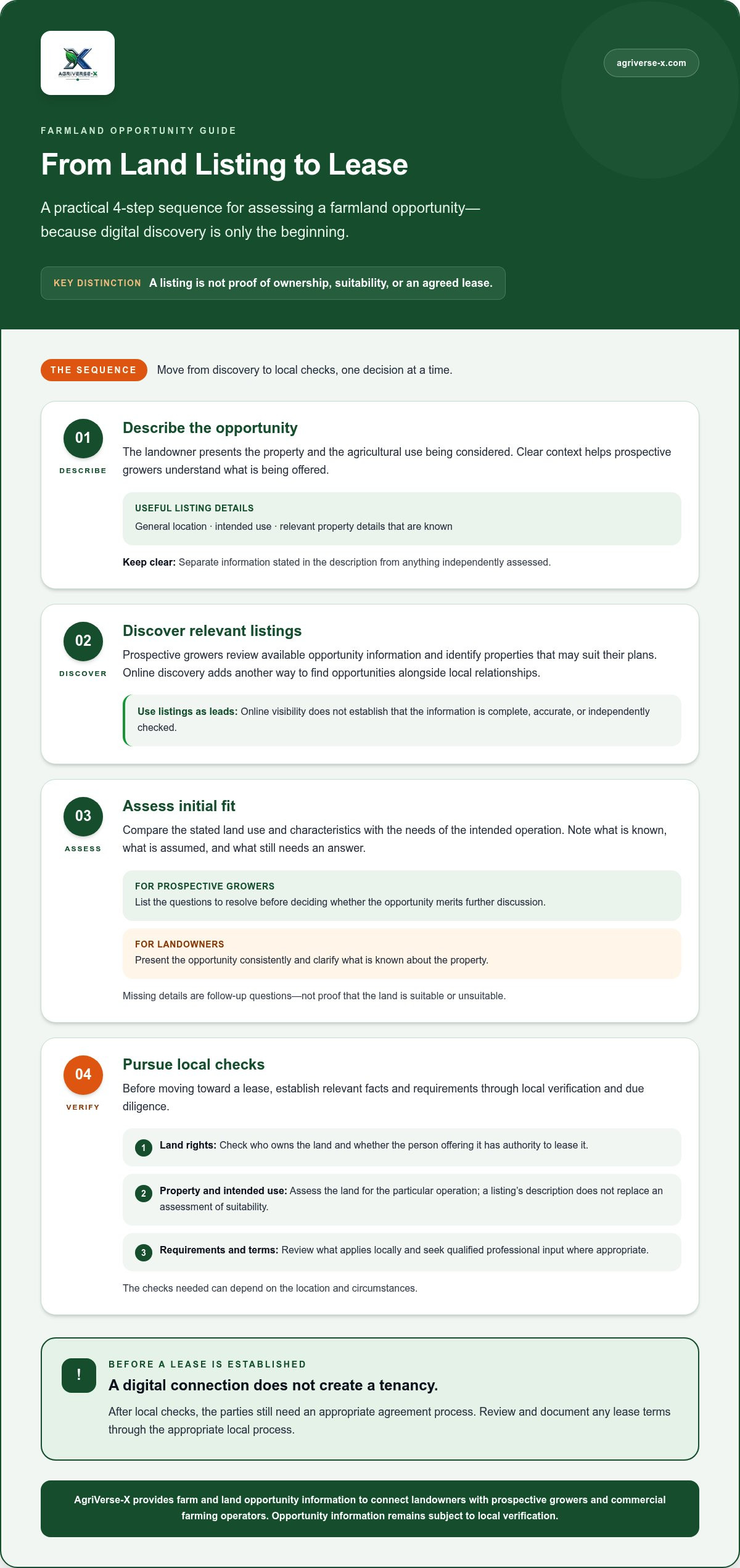
A farmland leasing platform brings land opportunities into a digital setting, making them easier to present and discover. Think of the process as a sequence, not an automatic route to tenancy: describe an opportunity, discover relevant listings, assess initial fit, then pursue local checks and any agreement process.
- Describe the opportunity. The landowner shares a clear account of the property and the agricultural use being considered.
- Discover relevant listings. Prospective growers review available opportunity information and identify properties that may suit their plans.
- Assess initial fit. Both sides compare the stated details with their priorities and note questions that need answers.
- Pursue local checks. The parties establish relevant facts, requirements, and terms through local verification and due diligence.
Digital discovery can start a lease conversation, but an appropriate agreement process is needed to establish an executed lease. A listing can introduce an opportunity and help the parties decide whether to speak. It does not create a tenancy or settle its terms.
Information landowners can organise for discovery
Begin with a location description that helps prospective operators understand the general area. State the intended agricultural use clearly, such as crop production or another farming activity. Share relevant property details that are known, and distinguish information supplied in the description from anything independently assessed. A description alone does not establish ownership, access rights, or land condition.
Clear context helps both sides use their time well. A grower can decide whether the stated use may suit their operation, while a landowner can explain the opportunity consistently. The Food and Agriculture Organization’s discussion of digital technologies in agriculture places these tools in a wider context of agricultural information and land administration. Digital presentation supports discovery; local evidence still matters.
What growers can assess before making contact
Compare the stated land use and characteristics with your intended operation. For example, if you are considering a particular crop, note whether the description covers the conditions you need to assess, then list what remains unclear. Treat gaps as follow-up questions, not as evidence that the property is suitable or unsuitable.
- Separate details stated in the listing from assumptions you have made.
- Note what you need to learn before deciding whether the opportunity merits further discussion.
- Reserve questions about land rights, access, permissions, condition, and possible lease terms for local verification and due diligence.
Landowners and prospective operators assess an opportunity according to different needs. An owner may focus on describing the property and intended use; a grower may focus on how those details fit a planned operation. The information is subject to local verification, and next steps depend on the circumstances, applicable requirements, qualified professionals, and the parties’ due diligence.
Compare Farmland Leasing Platforms by Discovery, Clarity, and Control
Compare more than the number of listings or how widely a property is promoted. Assess whether a farmland leasing platform helps landowners explain an opportunity, helps growers find relevant information, and leaves decisions with the people involved. The framework below highlights what to examine; it does not imply that every platform has the same features.
| Comparison area | What to examine | What it can tell you |
|---|---|---|
| Listing clarity | Are the location and stated land-use details understandable? Can you distinguish supplied descriptions from independently assessed information? | Whether readers can identify useful details and spot unanswered questions. |
| Discovery | How can growers find opportunities relevant to their intended operation? Review the provider’s stated search or browsing options. | Whether the discovery approach fits how you want to explore opportunities. Do not assume a particular tool is available unless the provider says so. |
| Participant information | What information can landowners and prospective growers present about their needs or experience? | Whether both sides have context for an initial discussion. Profiles do not independently verify every detail. |
| Landowner decision control | How does the provider describe the landowner’s role in reviewing interest and considering possible next steps? | Whether the platform supports a deliberate decision process rather than suggesting an automatic match. |
Questions that reveal whether a platform supports both sides
Consider the landowner’s path: can they describe the opportunity and intended use clearly? Then consider the grower’s path: can they find enough information to decide whether to start a conversation? A balanced discovery process gives each side relevant context without presenting a listing or profile as verified evidence of ownership, land condition, or farming suitability.
Separate general capabilities from provider-confirmed features. A platform may organise listings or participant information, but that does not mean every provider offers search filters, maps, alerts, identity checks, or other specific tools. Look for a clear description of what the provider does, and treat unaddressed details as questions rather than assumptions.
How to weigh reach against decision control
Visibility can bring an opportunity to the attention of prospective growers, but broad reach alone does not show that they are a good fit. Compare the clarity of listings, relevance to the intended use, and process for reviewing interest. A high offer may matter to a landowner, but it does not establish suitability or resolve other priorities.
Use this checklist when reviewing a platform:
- Can landowners and growers understand what information is presented?
- Are stated details distinguishable from verified facts?
- Does the provider explain how discovery and participant information work?
- Does the process leave evaluation and next steps to the parties?
Do not rely on acreage totals, listing volumes, or trust claims as proof of quality unless their source and meaning are clear. Such figures may be provider-stated claims and do not establish the accuracy of an individual opportunity. Compare platforms by identifying what each helps you discover, what remains unclear, and what requires local verification and due diligence outside the listing.
A Practical Due-Diligence Sequence Before Leasing Farmland
Use a farmland leasing platform to identify an opportunity, then move from description to evidence before making a commitment. A careful review helps both sides separate what the listing says from what needs confirmation, whether the land could support the intended activity, and what a final agreement should address.
- Review the opportunity. Note the location, stated land characteristics, intended use, and information the listing leaves unclear.
- Define the proposed operation. Set out the farming activity you have in mind and the practical conditions it requires.
- List unanswered questions. Separate questions about the property, land rights, access, permissions, responsibilities, and possible terms.
- Arrange local checks. Verify relevant information with appropriate local sources and qualified professionals before relying on it.
- Document any agreement. Keep discussions distinct from a written lease, and seek qualified advice on documentation and applicable requirements.
Platform information can guide the review, but it is not an independent assessment or lease document. Local requirements vary. The checks depend on the property, intended use, and jurisdiction, so qualified legal, technical, or land-specific advice may be appropriate.
Checks for prospective farm operators
Compare the description with the operation you plan to run. A listing may mention land characteristics or access, but you will need to establish whether those details meet your needs and what evidence supports them. Identify local questions about land rights, access, condition, and permissions; answers may require local confirmation or professional input.
Keep a written record of what is stated, what has been independently confirmed, and what remains unresolved. Separating these categories helps prevent an assumption in an online description from becoming a planning decision.
Checks for landowners evaluating prospective tenants
Discuss the prospective operator’s intended agricultural activity and how they envision the working relationship. Participant information can start that conversation, but a profile or description does not guarantee future performance, suitability, or fulfilment of proposed terms.
Assess each expression of interest against your priorities and the facts you can verify. Keep selection, negotiation, and agreement decisions with the relevant parties, and obtain qualified advice when legal or land-specific questions arise.
Before moving toward an agreement, check that you have:
- Compared the stated opportunity with the intended use.
- Separated listing details from independently confirmed information.
- Identified questions about rights, access, condition, and permissions.
- Considered whether local requirements or qualified professional input apply.
- Clarified proposed responsibilities and terms before documenting an agreement.
The information is subject to local verification. Explore AgriVerse-X land opportunities as a discovery step, then complete the relevant due diligence and agreement process for your location.
How AgriVerse-X Connects Landowners and Prospective Growers
AgriVerse-X provides farm and land opportunity information to help connect landowners with prospective growers and commercial farming operators. It supports digital discovery: landowners can present an opportunity, and prospective operators can identify information that may merit discussion. A listing can open a channel between participants, but it does not promise a lease or determine whether a property suits a particular operation.
Opportunity information is subject to local verification and does not establish land title, ownership rights, land condition, or permission to lease. Treat it as a starting point for discussion, then confirm relevant details locally and complete due diligence before making a commitment.
How land opportunities fit the wider agricultural ecosystem
Land is one part of an agricultural operation. A prospective grower may also need to consider people, equipment, services, and other resources relevant to the planned activity. AgriVerse-X connects agricultural participants through a wider digital ecosystem, with farm and land opportunity information alongside agricultural profiles and marketplace connections. The services involved can vary by location and availability; a land opportunity listing alone does not arrange those resources.
This wider context can help participants frame useful questions. A grower assessing an opportunity might consider whether its intended use fits their operational needs, while a landowner may want to understand the prospective operator’s plans. The platform supports discovery and connection; it does not certify either party’s claims or decide whether their plans will succeed.
Next steps for exploring a land opportunity
Prepare before opening a discussion. Landowners can organise a clear description of the opportunity and intended agricultural use. Prospective growers can outline their planned activity and the details they need to assess fit. Both sides benefit from separating information already provided from questions that still need answers.
- Record what the opportunity description states and what remains unclear.
- Identify land-specific details, rights, access, or permissions that need local confirmation.
- Consider which qualified professionals may be needed for legal, technical, or property questions.
- Discuss proposed use and expectations directly, then document agreed terms through the appropriate process.
Use a farmland leasing platform as a practical first step, not as a substitute for local checks or a written agreement. Requirements and appropriate verification processes depend on location and circumstances, so seek qualified professional advice where needed before committing.
If you are exploring land opportunity information or a relevant partnership, contact AgriVerse-X. Share the type of opportunity or agricultural use you have in mind, and continue with local verification and due diligence as discussions progress.
Phone: +61 428 577 516
Email: [email protected]
Administration: [email protected]
Take Your Next Land Opportunity from Discovery to Planning
Before approaching a potential lease, define the agricultural activity you want to pursue, the conditions your operation depends on, and the questions that need answers. This preparation turns a promising lead into a focused discussion without treating online information as a commitment.
A farmland leasing platform can help you discover opportunities, but sound decisions still depend on careful evaluation and appropriate local guidance. Assess each opportunity against your needs and take the next step at a pace that allows you to make informed choices.
AgriVerse-X provides land opportunity information within a broader digital agriculture ecosystem. Explore farmland opportunities with AgriVerse-X, then take a considered next step toward the conversations that can shape your agricultural plans.
Frequently Asked Questions
What is a farmland leasing platform?
A farmland leasing platform is an online resource for presenting and discovering agricultural land opportunities. For a grower, it can help turn a broad search into a shortlist of properties to investigate. Compare the stated location and proposed use, then note which opportunities warrant a conversation. Platforms differ, so use the information each one presents to guide your questions.
Does a farmland leasing platform verify land ownership?
No. A listing alone cannot establish who owns a property or has authority to offer it. Before spending time or resources on a proposed tenancy, identify the locally appropriate way to confirm the relevant land information and the person’s authority. Record what has been checked and what remains unresolved. AgriVerse-X land opportunity information is subject to local verification, and qualified advice may be appropriate.
What information should a farmland listing include?
A useful listing gives a clear, accurate account of the opportunity and its intended agricultural context. Where known, distinguish direct observations from information supplied by another party, and identify details that still need clarification. This helps a prospective operator prepare focused questions, such as whether the described use matches their plans. Do not add details you cannot support; confirm important points locally before relying on them.
Can an online farmland listing replace a lease agreement?
No. Treat the listing as an initial reference, then make sure any eventual written arrangement reflects what the parties have discussed and accepted. Depending on the situation, they may need to clarify the land covered, intended use, responsibilities, timing, and other agreed terms. The relevant process varies by jurisdiction. A qualified professional can advise on documentation, so do not treat general online guidance as legal advice.
How can I assess farmland when I cannot visit it immediately?
Use the time to prepare a focused information request. Separate questions about location, access, land characteristics, and intended use, then record the answers and their source. If a visit is not possible yet, consider whether a suitable local inspection can be arranged before making a commitment. Descriptions or images, if provided, may help frame questions, but they cannot replace an informed local assessment.
Is a farmland leasing platform suitable for both landowners and growers?
Yes. It can give both groups a starting point for an exchange, although their preparation will differ. A landowner might outline the intended use and expectations for a working relationship. A grower might explain their planned operation and the conditions they need. Sharing these points early can make a first discussion more focused, without treating online participant information as evidence of future performance.
Are farmland opportunities on a platform available in every location?
A platform listing does not mean opportunities exist everywhere. Availability depends on the land information presented and the local context; AgriVerse-X opportunity information is subject to local verification. If you are considering a particular place, assess the specific opportunity rather than assuming broad coverage. Confirm relevant facts and requirements for that location and intended use before making plans or commitments.


