

A roast label alone cannot tell you whether a bulk cashew order will suit your business. When sourcing oven roasted cashew nuts wholesale, compare the product’s grade, kernel form, roast description, ingredients, packaging, and intended use. These details help you judge whether a product fits retail packaging, food service, or further processing.
AgriVerse-X supplies W320 oven-roasted cashew nuts as a bulk agricultural commodity. Use the stated grade and roast description as a starting point, then compare the product details with your own purchasing specification. A structured review is more useful than relying on a short product description alone.
This guide sets out practical criteria for comparing wholesale roasted cashews. You’ll learn how to record product details consistently, identify gaps in a listing, and prepare a sourcing brief that your purchasing and operations teams can use.
Key Takeaways
- Compare grade, kernel form, roast description, ingredients, packaging, and intended use as separate product details.
- Use a comparison table to organize supplier-stated specifications, not as proof of quality or compliance.
- Assess oven roasted cashew nuts wholesale against written product details and your business requirements, rather than roast wording alone.
- Define how your business will use the cashews before comparing listings, so you can focus on the details that affect your decision.
- AgriVerse-X supplies W320 oven-roasted cashew nuts in bulk for buyers to consider against their sourcing requirements.
What wholesale buyers should know about oven-roasted cashew nuts
Wholesale oven-roasted cashews are sold in bulk with oven-roasted given as the preparation description. That wording is only one part of a product specification. Before comparing oven roasted cashew nuts wholesale, define the intended use and identify the details your business needs, such as grade, kernel form, ingredients, and packaging.
Keep these details separate when you assess a product. A buyer sourcing whole kernels for retail packs may have different requirements from a food business using cashews as an ingredient. Roast wording does not identify whether kernels are whole or pieces, and neither the roast description nor kernel form tells you what ingredients are included.
Grade, kernel form, roast style, and seasoning are separate product details. Treating them as separate fields helps prevent a familiar grade name or roast label from being mistaken for a complete product specification.
AgriVerse-X supplies W320 oven-roasted cashew nuts in bulk. Buyers can use that product description as a starting point, then assess the product against their own retail, food-service, or processing requirements.
What does oven-roasted mean in a wholesale listing?
“Oven-roasted” identifies a preparation description, but the term alone does not specify an oven, process, temperature, or particular result. Record it as one field in the listing rather than using it as a general quality measure. Ingredients, kernel form, grade, packaging, and intended use each need their own entries.
For a clear comparison, use the same fields for every product. If one listing provides a roast description and another gives ingredient details, record each statement under the relevant heading. Do not assume that an omitted detail matches the information on another product.
What does W320 tell a cashew buyer?
W320 is the grade designation for AgriVerse-X’s oven-roasted cashew product. Use it to record the stated grade, not to infer roast style, seasoning, ingredients, or kernel form. If your purchasing specification depends on a precise interpretation of the grade, use authoritative product documentation as the basis for that interpretation.
For a broader introduction to cashews and their culinary uses, consult the Cashew Nut Overview. Keep general background separate from supplier-specific product information. A general reference about cashews does not verify the attributes of a particular wholesale product.
Translate the product description into requirements your team can apply. For a retail snack, you might specify the kernel form and ingredient information needed for your product review. For processing, you might focus on grade, form, and how the product is intended to fit a recipe or production step. These are examples of buyer criteria, not claims about a particular product.
Write down the requirements before comparing offers. Record what each listing states, distinguish product details from commercial terms, and flag any information your team needs to resolve before making a decision. A shared specification helps purchasing, packaging, and production teams assess the same product attributes.
How to compare wholesale oven-roasted cashews for your business
Compare products using the same fields, then assess each detail against the way your business will use the cashews. A consistent framework makes it easier to distinguish a practical match from a description that simply sounds appealing. It also keeps supplier statements separate from evidence used to support a product claim.
Build a like-for-like comparison
Use this table as a working template. Record what each supplier states, and mark a field “not stated” when the listing does not provide that detail. The table organizes information for comparison; it does not independently establish product quality or compliance. AgriVerse-X supplies W320 oven-roasted cashew nuts, and buyers can assess the product against the requirements in their own specification.
| Grade | Kernel form | Roast description | Ingredients | Packaging | Intended use |
|---|---|---|---|---|---|
| Record the stated grade, such as W320 | Record whole, pieces, or the stated form | Copy the supplier’s roast wording | Record the ingredient statement | Record the stated packaging details | Note your business application |
For example, a retailer may focus on how kernel form fits its planned shelf presentation and portioning. A food-service buyer may prioritize the way the product fits menu preparation, while a processor may compare form and ingredients with a recipe or production step. These are different purchasing priorities, not automatic conclusions about which product is better.
Keep the comparison factual. It captures the details a supplier states, but it does not independently verify the product, certify quality, or establish compliance. For background on processing stages and quality control, the International Nut and Dried Fruit Council outlines Cashew Processing Steps and Quality Control.
Separate form, roast, ingredients, and packaging
Kernel form is a purchasing distinction, not a quality verdict. Whole kernels and pieces may suit different presentation, portioning, or processing needs. Compare products in the form your business requires, and do not assume that a grade alone describes the kernel form or guarantees uniformity.
Record roast wording separately from ingredients. A plain roast description is not the same as a description of a salted, flavoured, or oil-containing product. Compare ingredient statements and allergen information when provided, and do not infer ingredients from the word “roasted.” Record packaging details in their own field so you can assess whether the offer fits your handling and packaging plan.
Use the completed comparison to separate essential requirements from preferences and details that need supporting documentation. Buyers assessing oven roasted cashew nuts wholesale can apply the same criteria to AgriVerse-X’s W320 product as part of a focused sourcing review. Explore AgriVerse-X’s bulk agricultural commodities as you refine your requirements.
Does oven-roasted automatically mean consistent wholesale quality?
No. “Oven-roasted” describes preparation, but it does not establish every attribute a wholesale buyer may need to assess. The term does not specify kernel form, ingredients, packaging, supporting documentation, or commercial terms. Treat it as one product detail, not as proof that different products or repeat orders will match.
A sensory description, such as a supplier’s words for colour, crunch, or flavour, is different from a written product specification. Sensory impressions can help a buyer consider suitability, but they do not replace documented details. Record the commercial terms agreed for an order separately from product characteristics.
A product description can introduce an offer, but documented specifications should guide your comparison. This distinction matters when sourcing oven roasted cashew nuts wholesale because a familiar roast label may still leave important product and purchasing details to assess.
Which details should buyers document before ordering?
Create one record for every product you assess, using the same fields throughout. Capture the stated grade, product form, roast description, ingredients, packaging, and intended application. Save supplier-provided batch or product documents when they are available and relevant to your requirements.
Use “not stated” for information a listing does not provide. Do not infer ingredients from a roast description or assume that one product has the same packaging as another. A clear record separates supplier statements from details that still need to be resolved for your purchasing decision.
- Product identity: Record the stated grade and form.
- Preparation and ingredients: Capture the roast description and any ingredient or allergen information provided.
- Packaging and use: Note packaging details and the application your business has in mind.
- Supporting records: Keep relevant supplier documents with the product information.
How should buyers assess suitability for their application?
Start with the job the cashews need to do. Whole-kernel presentation may matter for a retail or serving format, while portioning or processing requirements may make other product forms relevant. These are application considerations, not automatic judgments of quality.
Use one comparison method across the products your team is reviewing. Have purchasing and production colleagues assess the same recorded fields, note gaps, and compare the same details again when evaluating a later order. This makes product differences easier to identify without assuming that a roast label predicts consistency between orders.
Keep sensory impressions, written product details, supporting documents, and commercial terms in separate parts of your purchasing record. This helps your team assess fit without making assumptions about shelf life, nutritional effects, or food-safety performance. It also gives you a clearer baseline for comparing offers against the specifications your business needs.
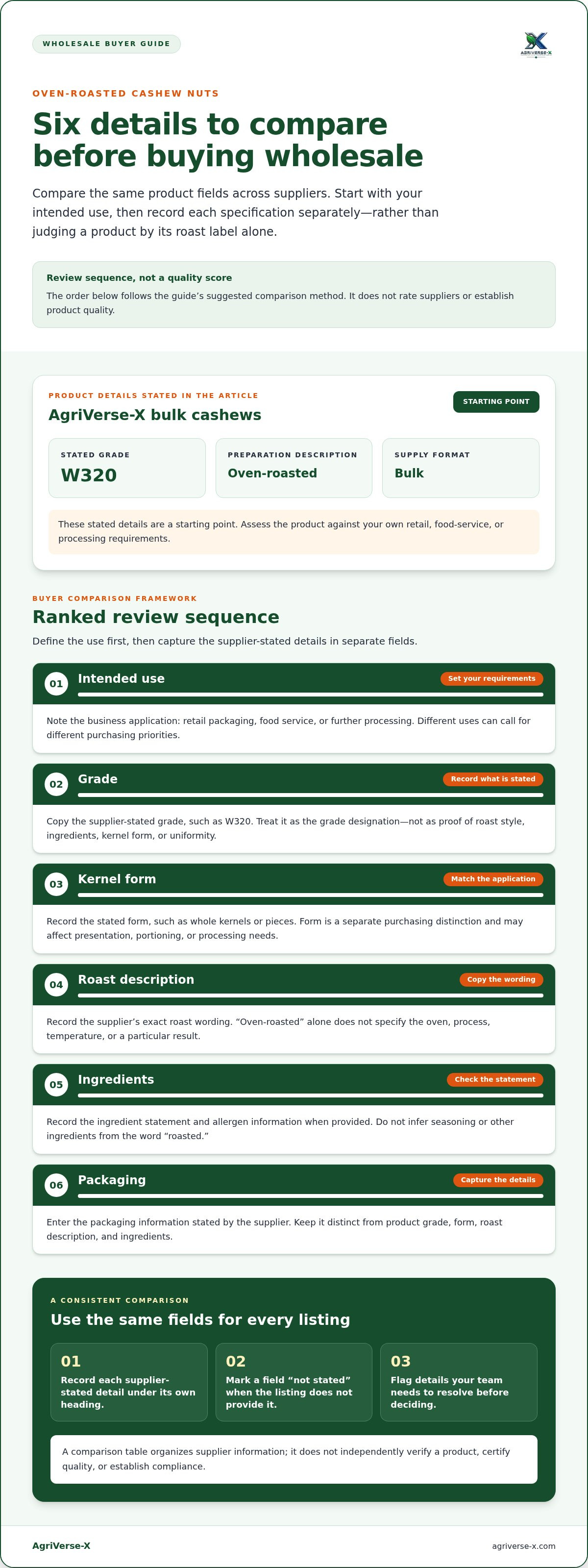
A practical checklist for evaluating a wholesale cashew listing
A repeatable checklist turns a product description into a clearer purchasing brief. Define the job first, then compare each product against the same requirements. For oven roasted cashew nuts wholesale, this helps your team identify meaningful differences and avoid relying on assumptions.
The buyer’s five-step comparison process
- Define the application. State whether the cashews are for retail presentation, food service, or processing. Describe how your business will use the product so that the specification reflects the actual job.
- Set the required form and grade. Record the kernel form and grade your application calls for. AgriVerse-X supplies W320 oven-roasted cashew nuts, giving buyers a confirmed grade and roast description to include in a product comparison.
- Capture preparation and ingredient details. Write down the supplier’s roast description and any ingredient or allergen information provided. Keep these fields distinct rather than treating “oven-roasted” as a complete ingredient statement.
- Note packaging information. Record the stated packaging details, then compare them with your business’s handling and packaging needs. Do not assume that a detail omitted from a description matches your requirements.
- Compare the written product information. Review products using the same fields. Mark details that are missing or inconsistent, and keep supplier statements separate from supporting documentation and commercial terms.
A useful minimum comparison records grade, kernel form, roast description, ingredients, packaging, and intended use. This gives your team a shared reference point without treating a completed table as proof of quality or compliance.
Questions to resolve in the purchase specification
Before finalizing a specification, describe the product identity and intended commercial application in plain language. State the required grade and form, then explain whether the product is intended for serving, retail presentation, or a processing step. This helps purchasing and operations teams interpret the requirements consistently.
List buyer-specific needs separately. These may include packaging preferences, handling considerations, or information your team needs for internal records. Treat them as requirements to address in your sourcing review, not as features to assume are included in a particular product. Keep any detail your team cannot verify separate from the confirmed product description.
Keep the specification in a format your team can reuse. When assessing a new product or a later order, compare the same fields and identify any changes in the written information. A consistent record helps purchasing teams make informed decisions without relying on memory or broad product descriptions.
For a wider procurement framework, use AgriVerse-X’s African food-staples sourcing checklist alongside your cashew comparison. Then assess AgriVerse-X’s W320 oven-roasted cashew nuts against the requirements you have recorded.
Source W320 oven-roasted cashew nuts through AgriVerse-X
AgriVerse-X supplies W320 oven-roasted cashew nuts as a bulk agricultural commodity. That product identity gives commercial buyers a clear starting point, while their own specification determines whether it fits a particular application. Define the intended use and compare the relevant product details as part of your procurement review.
What AgriVerse-X’s confirmed cashew offering is
The offering is W320 oven-roasted cashew nuts in bulk. Use that description to identify the product, then assess its fit against your purchasing requirements for grade, form, ingredients, packaging, and intended use. Keep each attribute tied to written product information rather than inferring details from the grade or roast label.
AgriVerse-X’s agricultural marketplace connects buyers with agricultural goods and suppliers. Buyers can consider cashews alongside other sourcing needs while keeping each product’s specifications distinct. For more context on the platform’s marketplace approach, explore the global agriculture marketplace.
Turn the sourcing checklist into a clear next step
Prepare a concise purchase brief before procurement. State the product identity and intended use, then list the grade and form your operation requires. Add fields for roast description, ingredient information, packaging, and any buyer-specific handling or documentation needs. Keep your requirements distinct from details provided in the product description.
Next, compare written product information against that brief. Separate supplier-stated attributes from your own requirements, note any gaps, and retain the information used in your decision. This gives purchasing and operations teams a shared record to refer to when reviewing a product or considering a later order. It also prevents a product label from standing in for a complete specification.
For oven roasted cashew nuts wholesale, use a straightforward process: define the product you need, compare the written details, document what is stated, and assess the product against its intended use. AgriVerse-X’s W320 bulk cashew offering can be considered within that framework.
Explore AgriVerse-X’s agricultural marketplace to learn more about its marketplace and the agricultural goods and suppliers it brings together. Use your sourcing brief to guide your next step and assess the product against your business requirements.
Make your next sourcing decision more deliberate
Use your product requirements as a working standard, not a one-time note. A clear brief gives purchasing, operations, and production teams a shared reference when evaluating oven roasted cashew nuts wholesale. It also helps your business carry its priorities into future sourcing decisions instead of relying on memory or broad product descriptions.
Start with the application, define the details that matter, and keep written product information together for review. Then consider how AgriVerse-X’s agricultural marketplace fits into your wider procurement planning. Explore the marketplace to see how it connects buyers with agricultural goods and suppliers.
Explore the AgriVerse-X agricultural marketplace and take your sourcing plans forward with clear requirements and a practical approach.
Frequently Asked Questions
What does W320 mean for wholesale cashew nuts?
Use W320 as the stated grade designation in your procurement records, and use the same wording in the documents your team relies on to review the product. If your purchasing policy depends on a precise interpretation of the grade, base that policy on authoritative product documentation. This keeps internal records consistent without treating the grade as a complete description of the product or transaction.
Are oven-roasted cashews the same as dry-roasted cashews?
Do not assume the terms are interchangeable. If your business requires a specific preparation description, write that wording into your purchasing requirements and use it consistently in internal reviews. This reduces ambiguity when staff compare product descriptions. Keep the requirement focused on preparation, rather than using it to infer ingredients or other product characteristics.
How do I compare wholesale roasted cashews from different suppliers?
Separate essential requirements from preferences before evaluating products. Your team can mark each requirement as essential, preferred, or unresolved, then apply those same categories to every offer. This helps decision-makers see whether a difference affects the purchase or simply needs to be recorded. Keep the rationale with the comparison so colleagues understand how the decision was made.
Are W320 cashews suitable for food service or retail?
Assess suitability through your business’s own review process rather than relying on the grade name alone. A retail team might review how the product fits its planned presentation, while a food-service team might consider its fit with a preparation workflow. Use the product information available to your team and document how it compares with your requirements.
What information should a wholesale cashew listing include?
For a clearer review, record the listing date, the source of each product statement, and the version of any supporting document your team used. These are procurement recordkeeping practices, not a claim that every seller provides a particular document. They help distinguish current information from notes carried over from an earlier review.
Does AgriVerse-X offer oven-roasted cashew nuts wholesale?
Yes. AgriVerse-X supplies W320 oven-roasted cashew nuts as a bulk agricultural commodity. Use the product details in your procurement review and assess them against your business requirements. Keep agreed commercial terms in the relevant transaction documents.
What is the difference between roasted cashew pieces and whole cashews?
They describe different product forms. To avoid confusion in purchasing documents, define the form your business requires in plain terms and use that wording throughout the order review and receiving process. If your team uses internal categories, explain them in the specification rather than assuming every seller uses the same labels. This helps staff apply the same standard from evaluation through receipt.


