

The lowest quote won’t help if the beans don’t match your order requirements. Finding a dependable honey beans wholesale supplier starts with defining the lot clearly, then comparing product details, packaging, quantity units, and fulfillment terms on the same basis.
Supplier listings can be difficult to assess when descriptions leave important details unclear. Before planning a bulk purchase, write down what you need, distinguish your requirements from seller-provided information, and identify which details must be documented. This guide shows you how to prepare a sourcing brief, compare listings consistently, and check an order when it arrives.
AgriVerse-X supplies honey beans as a bulk agricultural commodity and supports marketplace discovery for agricultural products. Use the steps ahead to organise your requirements, review listing information, and plan for receiving the order. Product origin, variety, grade, packaging, handling, and fulfillment terms can differ, so rely on the details stated for the specific offer. This article is for general information and isn’t official legal, financial, or regulatory advice.
Key Takeaways
- Define intended use, requested quantity, preferred packaging, and delivery destination before comparing bulk listings.
- Apply the same criteria to each listing so product identity, stated details, packaging, and fulfillment are easier to assess.
- Record the agreed product description, quantity and unit, packaging, and fulfillment terms before placing an order.
- Use the order record to check the goods received and document any visible differences.
- Use AgriVerse-X marketplace discovery to explore agricultural product listings and assess a honey beans wholesale supplier against your sourcing brief.
What wholesale honey beans buyers need to define before sourcing
Define the product and order requirements before comparing suppliers. Start with the commodity named in the listing, then specify how much you need, how you intend to use it, and where it must be delivered. This gives every offer the same reference point and helps separate confirmed product details from assumptions.
A honey beans wholesale supplier is a seller or distributor offering honey beans in bulk to business buyers. For a useful comparison, review the offer’s product description alongside its quantity unit, packaging, and fulfillment terms. Treat each detail as specific to that offer rather than assuming it applies to all honey beans.
Honey beans is the commodity name used here. The name alone doesn’t establish origin, variety, grade, intended use, or other product characteristics. For general background on beans and their varieties, see What are beans? Use the specific product description and order documents to establish what is being offered.
Which buyers typically source honey beans in bulk?
Retailers may buy in bulk to divide a larger order into smaller sales units. Food-service businesses may plan quantities around their purchasing and storage routines, while distributors may coordinate larger lots for onward supply. These are different purchasing contexts, not proof that a particular offer suits a particular use.
Let your intended use shape the order plan. A retailer may focus on how the quantity can be handled for resale; a food-service buyer may plan receiving around kitchen and storage capacity; a distributor may need to coordinate delivery with onward movement. In each case, match the requested quantity unit and packaging preference to how your business will receive and manage the goods.
What does a wholesale honey beans listing need to clarify?
Read the listing for product identity, any seller-stated origin or variety, available packaging, and the unit used to state quantity. These are details to assess, not gaps to fill in yourself. If a detail that matters to your purchase is absent or unclear, mark it as unresolved before deciding.
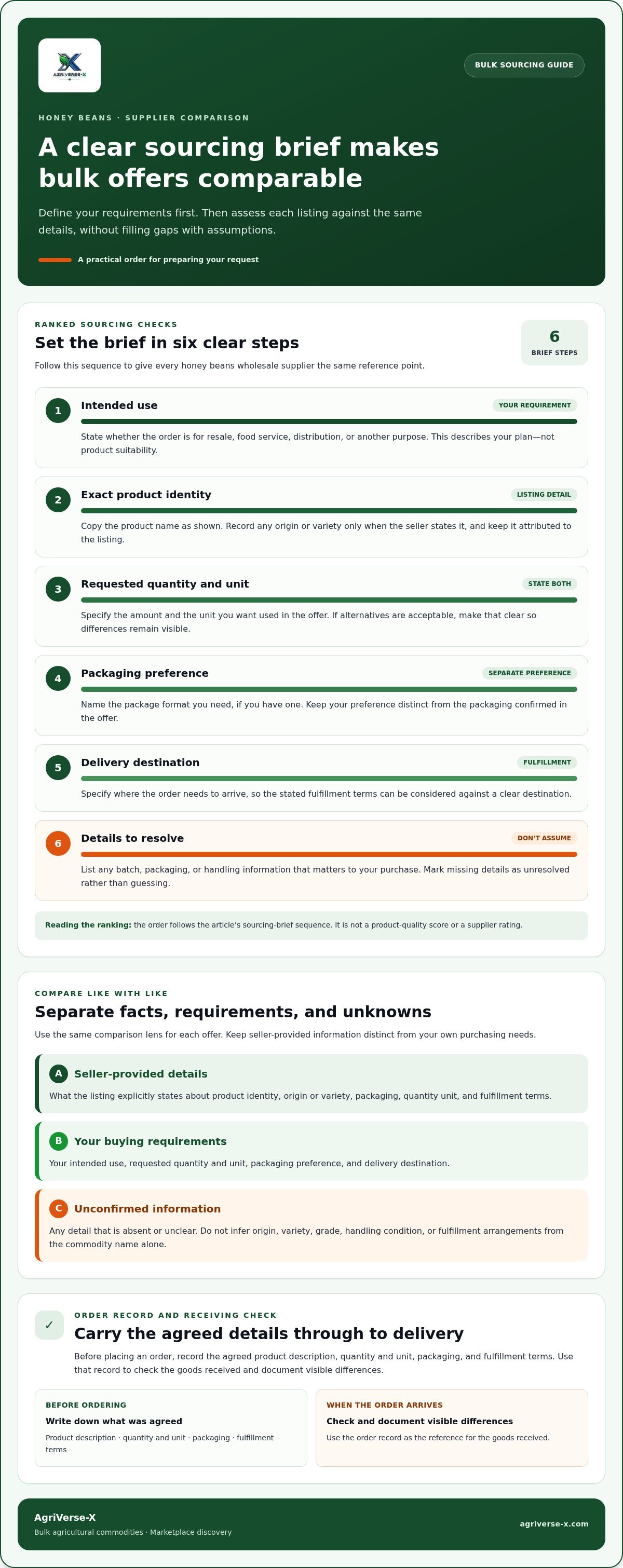
- Seller-provided details: What the listing explicitly states about the product, origin, packaging, and quantity unit.
- Your requirements: Intended use, requested quantity, packaging preference, and delivery destination.
- Assumptions to avoid: Any unstated origin, variety, grade, handling condition, or fulfillment arrangement.
Keep these categories separate in your sourcing notes. That makes comparisons more consistent and prevents a buyer preference from being mistaken for a seller’s product claim. AgriVerse-X supplies honey beans among its bulk agricultural commodities and supports marketplace discovery for buyers preparing a sourcing brief.
This guidance is for general information only and isn’t official legal, financial, or regulatory advice.
How to write a clear honey beans wholesale specification
A written sourcing brief turns a broad request into requirements that an offer can be assessed against. Keep confirmed product information separate from your preferences. This helps you compare listings on a consistent basis without treating an unstated feature as part of the offer.
Prepare the brief before reviewing offers from a honey beans wholesale supplier. Use this sequence:
- State the intended use. Identify whether the order is for resale, food service, distribution, or another purpose. This describes your plan, not a claim about product suitability.
- Copy the product identity. Use the exact name shown in the listing. Record any seller-stated origin or variety as attributed information, not as an assumption.
- Set the requested quantity. Write the amount and the unit you want used in the offer. If you can accept alternatives, state that clearly so any difference is visible.
- Describe the packaging preference. Name the package format you need, if you have one. Keep your preference distinct from packaging confirmed in the offer.
- Give the delivery destination. Specify where the order needs to arrive so fulfillment can be considered against a clear destination.
- List details to resolve. Note any batch, packaging, or handling information that matters to your planned purchase.
A written specification makes supplier comparisons more reliable by giving each listing the same requirements to answer. Use it as a working brief, then update it with the details stated in the offer and the final agreed order terms.
Which product and batch details should buyers record?
Save the exact listing name and note any origin or variety the seller states. Where available, record batch identifiers and the seller’s information about packaging and handling. These details help distinguish one offer from another, but they don’t establish a grade or certification unless that is documented. Mark missing information as unresolved rather than filling gaps with assumptions.
How should buyers define packaging and order requirements?
Write down your preferred package format and the quantity unit you want used in the offer. Include the intended use and delivery destination in the same brief so the response can be assessed against the whole request. Label your preferences as buyer requirements and record confirmed offer details separately. When exploring bulk honey beans through AgriVerse-X, use the brief to guide product discovery and compare listing information consistently.
How to compare honey beans suppliers and listings
Compare listings against the same buyer requirements, not vague labels such as “premium” or “high quality.” First check that each offer describes the same product identity and uses a comparable quantity unit. Then review the information actually provided, including any batch details, packaging, and fulfillment terms. Specific, documented details are more useful than general promotional wording.
Consistent criteria make information gaps visible and help buyers compare offers on a like-for-like basis. Use a simple comparison table, and mark unknown fields as unresolved rather than filling them with assumptions.
| Product identity | Available details | Packaging | Fulfillment | Unresolved questions |
|---|---|---|---|---|
| Copy the listing name | Record seller-stated batch or origin details | Note stated format and quantity unit | Copy stated delivery or collection terms | List unclear or missing information |
| Check whether listings describe the same product | Separate documented facts from general claims | Mark differences from your requested format | Compare terms against your destination and order plan | Identify what needs clarification before proceeding |
Which supplier details help buyers assess a listing?
Review the product description, any batch information, packaging details, and stated fulfillment terms. Give more weight to specific information attached to the offer than to broad promotional language. A claim such as “consistent quality” doesn’t explain what was assessed or how. Missing or conflicting details are comparison gaps, not proof of a product defect or a supplier’s inability to meet an order.
How can buyers compare offers without assuming equivalence?
Compare listings only when they describe the same product identity and use comparable quantity units. Record differences in seller-stated origin, batch details, package format, and delivery arrangements. If one offer provides a detail and another does not, show that difference rather than treating the information as equal. Avoid ranking offers on price or quality claims alone when their underlying descriptions aren’t comparable.
For example, if two listings use different units to describe quantity, don’t treat the amounts as equivalent until they’re expressed in a common unit. Keep differences in package formats and fulfillment terms visible, since they may affect how an offer fits your purchasing plan. This gives you a fairer basis for comparing what each seller has stated.
To make the table easier to review, give each field a simple status: documented, unclear, or conflicting. You can then assess a honey beans wholesale supplier by the completeness and consistency of the stated information, while keeping unresolved points visible for the next purchasing decision.
How to prepare, place, and receive a bulk honey beans order
A clear order process connects the sourcing brief to the goods received. Confirm the product specification, record the details stated in the offer, document the agreed terms, and use that record when receiving the order. This creates a practical reference without assuming product details that haven’t been agreed.
- Approve the specification. Check that product identity, intended use, requested quantity and unit, packaging preference, and delivery destination are clear. Resolve open points before treating the brief as final.
- Review the offer. Compare its details with your requirements. Record any differences or terms that still need agreement, such as package format or fulfillment arrangements.
- Confirm the order in writing. Record the final product description, quantity and unit, packaging, and agreed fulfillment terms. Keep the offer, seller communications, and transaction documents with the order record.
- Prepare for receipt. Share the order record with the people responsible for receiving and storing the goods. Make sure they know which details to check and how your business records discrepancies.
- Reconcile the delivery. Compare what arrives with the written order and the details stated in the offer. Record any visible difference through your usual receiving process.
What should a wholesale purchase record include?
Keep one accessible record of the product identity, ordered quantity and unit, packaging, and agreed fulfillment arrangements. Attach relevant offer details, communications, and transaction documents so the order can be traced back to what was described and confirmed. Additional documents may depend on the transaction and jurisdiction, so don’t assume one document set applies to every purchase.
What should buyers check when goods arrive?
Check that the delivered product description, quantity units, and packaging correspond with the purchase record and the details provided for the order. Note visible discrepancies promptly, using your normal process to record what was observed and when. Don’t create moisture, purity, or defect limits unless they’re based on product standards agreed and documented for that order.
Keep the receiving record factual. For example, record a mismatch between the stated package format and the format received rather than applying an unstated quality grade. If the shipment raises a question, keep the relevant order details and communications together so the issue can be reviewed against the agreed terms.
Shipping, import, food-safety, and labeling requirements vary with the transaction and jurisdiction. This guidance is general information, not official legal, financial, or regulatory advice. Seek appropriate qualified guidance for requirements that apply to your purchase.
Keep your order documentation ready as you move from planning to sourcing. Buyers can use AgriVerse-X’s agricultural marketplace to explore agricultural product listings and assess offers against their purchasing requirements.
Source bulk honey beans through AgriVerse-X
AgriVerse-X supplies bulk agricultural commodities, including honey beans, and supports an agricultural marketplace for products and services. Buyers can use marketplace discovery to explore agricultural products and organise listing details around a defined sourcing brief. A listing is a starting point for evaluation, so assess the details of the specific offer and order.
Keep your requirements beside each listing as you review it. Compare the stated product identity with your intended purchase, then record the available information about the product, packaging, quantity units, and fulfillment. Mark absent or unclear details as questions to resolve before an order is finalised. Don’t assume every listing includes the same information or that marketplace discovery confirms a particular order arrangement.
How does AgriVerse-X fit into wholesale commodity sourcing?
AgriVerse-X supplies honey beans as part of its bulk agricultural commodities and supports marketplace connections around agricultural products. A sourcing brief makes listing discovery more structured: match the product description to your requirement, identify the information supplied, and keep open questions visible. This approach helps buyers assess offers without implying a particular transaction or outcome.
Before exploring listings, prepare a short reference that states:
- Product: The exact commodity description you’re seeking.
- Order: Your required quantity and preferred quantity unit.
- Packaging: Your requested format, clearly labelled as a preference.
- Fulfillment: Your delivery destination and the terms you need to assess.
- Evaluation: The details you’ll compare and any unresolved questions.
Use this reference to separate your requirements from information in a listing. A packaging preference remains a buyer request until the offer states how the order will be packed. Likewise, note origin, batch, or other product details only as provided. This keeps comparisons grounded in the information available and helps prevent assumptions from becoming purchase expectations.
What is a practical next step for bulk buyers?
Start with the requirements that affect your decision most: product identity, intended use, quantity, packaging, and destination. Then compare the information in each listing against those needs. If offers differ in detail or quantity units, record the difference rather than treating them as equivalent. Keep your sourcing brief available as you move from discovery to reviewing an order.
Assess a honey beans wholesale supplier against the specific offer and your stated requirements. AgriVerse-X provides a marketplace context for exploring agricultural commodities, including honey beans, while your sourcing brief keeps the decision focused on relevant listing details. Explore AgriVerse-X’s agricultural marketplace as a starting point for structured commodity discovery.
Turn your sourcing brief into your next step
A stronger buying process starts before the next order. Treat your sourcing brief as a working document: capture what your business needs, record what an offer states, and tie decisions to information you can review. This makes purchasing handovers clearer and helps your team apply a consistent approach when evaluating a honey beans wholesale supplier.
AgriVerse-X supplies bulk agricultural commodities, including honey beans, and supports an agricultural marketplace for products and services. Explore the marketplace when you’re ready to put your requirements into practice and review agricultural product listings through a structured sourcing process.
Explore AgriVerse-X’s agricultural marketplace to review agricultural product listings against your sourcing brief.
Frequently Asked Questions
What are honey beans commonly used for?
Honey beans are used in meals such as bean porridge, Ewa Agoyin, and Moi-Moi. For a business, the intended dish or product should guide evaluation: a food-service team might test a sample in a planned recipe, while a processor may assess it against its production needs. Don’t assume a listing guarantees a particular cooking result; confirm the product details and assess a sample before committing to a large order.
Are honey beans the same as Oloyin beans?
Honey beans are commonly referred to as Oloyin beans, but product names can vary across listings and markets. Check how the offer identifies the product and record that exact description in your purchasing documents. If the name alone doesn’t make the product identity clear for your business, resolve that point before ordering. Don’t infer origin, variety, grade, or other specifications from the name unless those details are provided.
Can I buy honey beans wholesale for retail resale?
Yes, retailers can source honey beans in bulk for resale when the order terms and product information suit their business needs. Before purchasing, plan how you’ll receive, store, and divide the lot, and decide what product details you need for your sales records. Labeling and other requirements can depend on the product and jurisdiction, so seek appropriate local guidance rather than assuming wholesale packaging is ready for retail sale.
What should a honey beans sample tell me before a bulk order?
A sample can help you assess visible characteristics and test how the beans perform in a recipe or process relevant to your business. Compare it with your stated requirements, and establish whether it represents the lot being offered. A sample doesn’t by itself prove that a later delivery will match. Keep notes on what you tested and link your findings to the product description and order discussion.
How can food-service businesses assess honey beans for menu planning?
Test a sample using the preparation method and equipment your kitchen expects to use. Record practical observations such as preparation steps, cooking time in your own test, texture, and how the result fits the planned dish. Use the same method if you’re comparing offers. These checks can inform menu planning, but they don’t guarantee the result of every delivery; confirm the agreed product details before ordering in bulk.
What information should accompany a wholesale honey beans delivery?
Use the purchase record as the reference for checking the delivery. Keep the agreed product description, quantity and unit, packaging details, seller-provided batch information if available, and fulfillment terms with relevant order communications. This gives your receiving team a record to consult and helps document discrepancies. Additional paperwork can depend on the transaction and destination, so don’t assume the same documents apply to every order.
How should a business plan storage for bulk honey beans?
Plan storage before the delivery arrives. Identify where the goods will be kept, who will manage them, and how your team will monitor stock under its usual food-handling procedures. Follow any product-specific storage information provided for the order and applicable local guidance. Avoid assuming a shelf life or storage condition that isn’t documented. Keep delivery and inventory records together so staff can track the received stock.


