

A reliable sesame sourcing decision starts with a precise buying brief, not a supplier shortlist. If your product requirements are unclear, even a promising sesame seeds bulk supplier can be difficult to compare with other offers. Define the intended use, essential product details, records to review, order structure, and delivery context before you assess suppliers.
A shared brief gives each supplier the same starting point and helps your team identify missing information before it disrupts purchasing or receiving plans. This guide explains how to set requirements, compare product and traceability information, assess supplier responses, and prepare for delivery. AgriVerse-X distributes bulk sesame seeds and supports an agricultural marketplace for product discovery and buyer connections. Use the steps below to make sourcing discussions more focused and procurement decisions easier to document.
Key Takeaways
- Define the intended use and required product details before comparing offers, so each supplier responds to the same brief.
- Compare product information, supporting records, and traceability details. Separate documented evidence from assumptions.
- Assess a sesame seeds bulk supplier on response clarity, fulfilment coordination, and issue handling, not just the product description.
- Plan receiving, storage, and internal quality checks alongside the order to reduce avoidable gaps.
- Use AgriVerse-X’s agricultural marketplace for sesame seed product discovery and buyer connections as part of a structured sourcing process.
Why a Clear Sesame Seeds Bulk Supplier Brief Matters
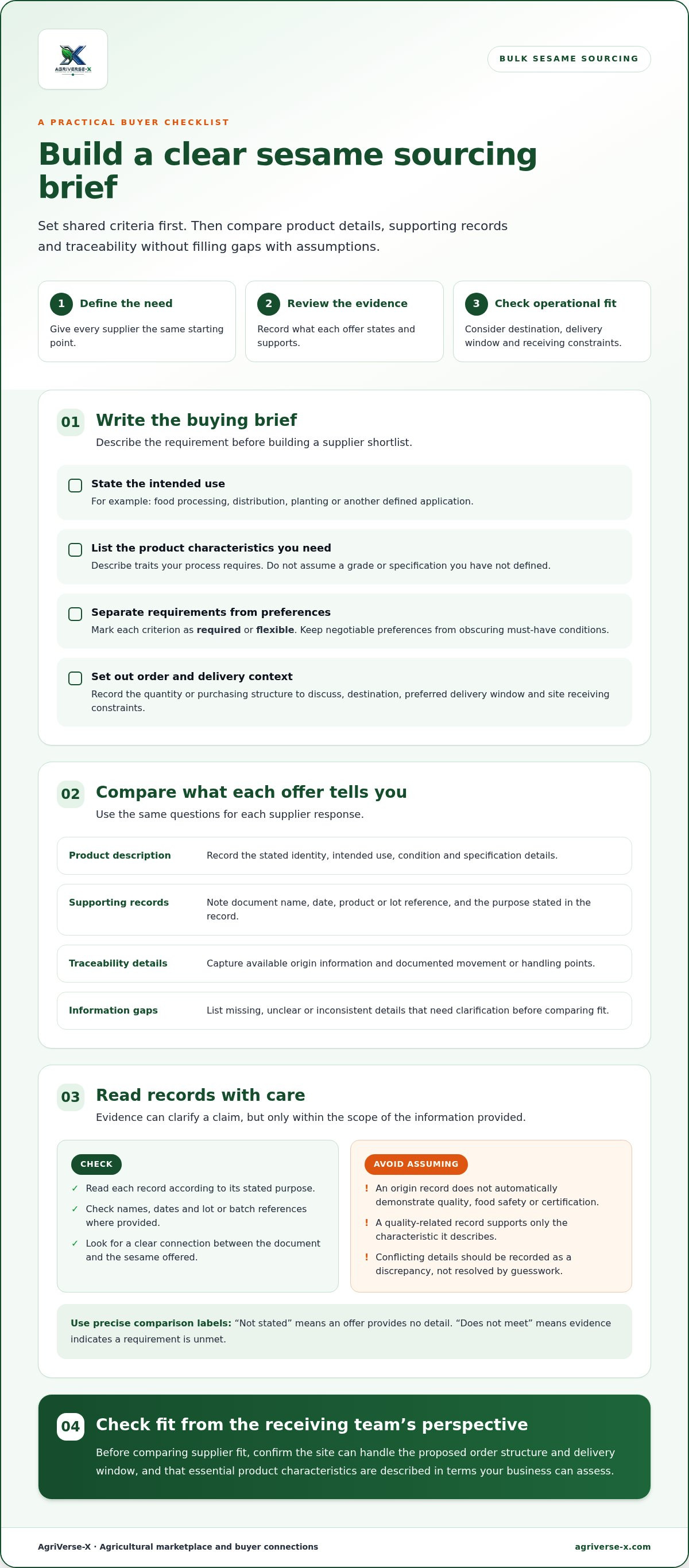
A bulk sesame supplier is a commercial source that responds to business purchasing needs, such as a processor sourcing ingredients or a distributor planning a product purchase. A useful comparison begins before offers arrive. Set out the intended use, essential product requirements, and delivery context so every response addresses the same need.
A clear brief turns a purchasing need into shared criteria, making offers easier to compare and decisions easier to explain. Sesame seeds can be intended for different uses, so state the application rather than relying on a broad product label. For background on the crop and its culinary uses, see History and uses of sesame.
Separate requirements from preferences. A required product characteristic can determine whether an offer is suitable; a preference can help distinguish between offers that meet the essentials. This keeps the brief focused and prevents negotiable details from obscuring must-have conditions.
What should a commercial sesame seed brief contain?
Make the request specific enough to guide a response without assuming a grade or specification your business has not defined. Describe the intended application, list the characteristics your process requires, and set out the order and delivery context.
- Intended use: State whether the sesame is for food processing, distribution, planting, or another defined application.
- Product characteristics: List the traits your use requires and identify which are mandatory.
- Order structure: Record the quantity or purchasing structure you plan to discuss.
- Delivery context: State the destination, preferred delivery window, and receiving constraints, such as when your site can accept an order.
Keep preferences visible but separate. For instance, a preferred delivery window should not be treated as a firm requirement unless your receiving operation depends on it.
How does a sourcing brief reduce procurement uncertainty?
A shared brief gives each supplier the same starting point. You can compare responses against the same intended use, product requirements, order structure, and delivery context instead of trying to reconcile different interpretations of a short request.
Mark each criterion as required or flexible. This helps identify mismatches early: an offer that does not address a mandatory characteristic needs clarification, while a difference in a preference may still leave room for comparison.
Documented requirements also give internal reviewers a common reference. Procurement, quality, and receiving teams can work from one description of the need, reducing the risk that an assumption from an early conversation becomes an unspoken purchasing condition.
Before approaching a sesame seeds bulk supplier, review the brief from the receiving team’s perspective. Can the site handle the proposed order structure and delivery window? Are essential product characteristics described in terms your business can assess? Clear answers make sourcing discussions more focused and help your team judge fit rather than broad claims.
Compare Sesame Seed Quality, Documentation, and Traceability
Compare what each offer states, which records support those statements, and what remains unclear. Traceability in bulk agricultural sourcing means being able to follow documented product information and movement through the supply chain. It can help buyers understand origin claims and handling history, but it does not by itself establish product quality or prove every claim.
Which product details help buyers compare sesame offers?
Start with the product identity and intended use, then record the characteristics each offer actually describes. Note whether the seller specifies a sesame form, condition, or other detail relevant to your process. Do not fill blank fields with assumed industry norms or treat a general description as a measured specification.
A side-by-side comparison makes gaps easier to spot. Use “not stated” when an offer provides no detail, and distinguish that from “does not meet,” which requires evidence that a requirement is unmet.
| Comparison area | What to record | What it helps clarify |
|---|---|---|
| Product description | Stated identity, intended use, condition, and specification details | Whether offers describe a comparable product |
| Supporting records | Document name, date, product or lot reference, and stated purpose | Which claims the record addresses |
| Traceability details | Available origin information and documented movement or handling points | How much of the product’s recorded history can be followed |
| Information gaps | Missing, unclear, or inconsistent details | What needs clarification before comparing fit |
How should buyers assess records and traceability?
Read each record according to its stated purpose. A document identifying a claimed origin does not automatically demonstrate quality, food safety, or certification. A quality-related record supports only the characteristic it describes and only within the scope of its information. For US food-safety and labeling information, consult the FDA website and assess requirements applicable to your product and market.
Check that records refer clearly to the offer being assessed. Compare names, dates, lot or batch references where provided, and any stated connection between the document and the sesame on offer. If details conflict, record the discrepancy rather than resolving it through assumption.
When comparing a sesame seeds bulk supplier, this evidence-led approach separates supplier-provided information from unverified descriptions. Records support due diligence, but they do not automatically verify every product claim. Use your comparison to identify what is documented, what is missing, and what needs clarification before a sourcing decision. AgriVerse-X distributes bulk sesame seeds and supports an agricultural marketplace for product discovery and buyer connections.
Assess Sesame Supplier Fit Beyond the Product Description
A suitable supplier is one whose documented offer and purchasing arrangements align with your stated needs. The product description matters, but so do the completeness of the response, coordination details, and clarity about how questions or issues are handled. Supplier fit depends on both the sesame product and the requirements of purchasing, receiving, and using it.
Evaluate each response against the same brief. Does it address the requested product characteristics and delivery context? Are details consistent across the offer and any supporting information? If a point is missing, record it as unanswered rather than treating general promotional language as proof of capability.
Which supplier capabilities matter to bulk buyers?
Check whether the response covers each stated requirement, including order and delivery details relevant to your operation. Consider how clearly the supplier presents supporting information, coordinates fulfilment, and explains its process for resolving questions or issues. Assess only what the response documents. Do not infer capacity, origin, certification, or service performance from broad claims.
A pros-and-cons matrix can make the review more balanced. Use “strength” for a documented point that matches your brief, and “open question” for information that is missing or unclear. These labels describe the evidence available, not a blanket judgment about the supplier.
Documented strengths
- The response addresses a required product characteristic in clear terms.
- Supporting information refers directly to the offer being considered.
- Delivery coordination details align with the buyer’s stated receiving context.
- The supplier describes a clear route for raising and addressing issues.
Open questions or risks to clarify
- A required product or order detail is absent or described inconsistently.
- A promotional claim has no supporting information in the response.
- The delivery discussion does not account for the stated destination or receiving constraints.
- The process for handling a discrepancy or concern remains unclear.
How can buyers compare offers fairly?
Use identical criteria for every offer and keep the evidence beside each assessment. Separate three categories: details stated in the response, open questions that need an answer, and buyer assumptions that must not affect the assessment. This prevents a polished description from receiving more weight than a specific, documented match.
For example, if one response names a delivery window and another leaves it blank, record the difference without guessing what the second supplier can arrange. If a product description uses a broad quality term without explaining it, note that the term has not established a measurable requirement. Compare what is actually stated.
This approach helps buyers assess a sesame seeds bulk supplier on fit rather than impression. For wider procurement context, the guide “African Food Staples Wholesale: A Buyer’s Sourcing Checklist” offers a related framework for organizing sourcing decisions. Apply the same discipline to product details, communication, fulfilment coordination, and issue resolution, then carry unanswered points into the next purchasing discussion.
Plan a Bulk Sesame Seed Order Before Procurement
A workable order plan connects the product request to purchase approval, receiving, storage, and internal quality review. Set out those arrangements before procurement begins. This gives your team a clear path from defining the need to assessing offers and coordinating next steps with a sesame seeds bulk supplier.
What should buyers settle before requesting offers?
Prepare the intended use, required product description, destination, and receiving arrangements. Identify which product details and records your team needs to review, then name the decision-makers and approval steps. This keeps procurement, quality, and receiving teams aligned before offers arrive, rather than leaving essential decisions until order coordination is underway.
How should a buyer organise the comparison and next steps?
Use one comparison sheet for every offer. Record stated evidence, unanswered items, and the status of each requirement. Before proceeding, check the selected offer against the original brief and note any agreed changes clearly, so the purchase plan reflects the current decision rather than an earlier version.
- Define the application. State how the sesame will be used and which product characteristics are essential for that purpose. Keep optional preferences separate.
- Set the order context. Record the order structure you intend to discuss, the destination, preferred delivery window, and any receiving constraints. Avoid assumptions about quantities, packaging, or timing.
- Prepare review requirements. List the product information and documents your internal teams need to assess an offer. Identify who reviews each item and who approves the purchase.
- Compare offers consistently. Use the same criteria across responses. Mark each point as documented, unanswered, or an internal assumption, then follow up on gaps relevant to your decision.
- Coordinate the selected offer. Reconcile the chosen response with the brief before moving ahead. Align expected receipt with your site’s receiving arrangements, planned storage approach, and internal quality checks.
Review receiving readiness separately. Confirm who will handle the incoming order, where it will be directed, and how your team will record its arrival and conduct planned checks. Align the storage plan with your operating procedures and the information available for the specific product. Avoid applying generic storage conditions or shelf-life assumptions when the offer and your internal requirements do not establish them.
Keep the comparison sheet current as decisions are made. A documented status helps purchasing and receiving teams work from the same plan, while unresolved points remain visible instead of being mistaken for agreement. For broader context on agricultural product discovery, the Global Agriculture Marketplace concept connects buyers with agricultural products through a marketplace setting.
Explore agricultural product discovery as you develop your sourcing plan.
Find Sesame Seeds Through AgriVerse-X's Agricultural Marketplace
Finding a potential commercial source is only one part of a sound sourcing decision. Buyers also need a clear way to connect product discovery with their purchasing requirements. AgriVerse-X distributes bulk sesame seeds and supports an agricultural marketplace for products and buyer connections. Use the marketplace as a starting point for product discovery, then apply the brief, comparison criteria, and review process developed in this guide.
How can a marketplace support agricultural product discovery?
An agricultural marketplace is a digital environment where buyers can discover agricultural products and connect with relevant participants. For sesame buyers, it provides a route into product discovery and buyer connections, while the buyer remains responsible for defining requirements and evaluating offer details. A marketplace supports connection; it should not be treated as a guarantee about product characteristics, supply, or commercial terms.
Keep your brief close as you explore. It helps you explain the intended use and purchasing need consistently in a sourcing discussion, while your comparison framework gives the team a way to assess the information provided. For wider commodity sourcing context, consult Bulk Agro Food Products Supplier: A Buyer’s Reference Guide alongside your sesame-specific requirements.
A marketplace can be useful when identifying a relevant product pathway and preparing to communicate a defined need. It does not remove the need for due diligence. Continue to distinguish stated information from assumptions, and assess each offer against your requirements before making a decision.
What is the next step for a sesame seed buyer?
Bring a prepared brief into the sourcing conversation. Include the intended application, essential product characteristics, expected order structure, destination, delivery context, and the information your team needs to review. This gives the discussion a practical focus and keeps procurement, quality, and receiving considerations connected.
- Use your brief to explain the purchasing need clearly.
- Record details provided in response and identify unanswered points.
- Compare the offer with your original requirements before proceeding.
- Align receiving, storage planning, and internal review with the purchase plan.
This approach connects marketplace discovery to a disciplined procurement process. Assess a sesame seeds bulk supplier against your requirements rather than assuming an offer is suitable based on a general description. Keep the brief and comparison record together so your team can use consistent criteria as the sourcing discussion develops.
AgriVerse-X’s bulk sesame seed distribution makes its agricultural marketplace a relevant pathway for product discovery and buyer connections. Prepare your requirements, then explore AgriVerse-X’s agricultural marketplace to begin a focused sourcing discussion.
Turn Your Sourcing Brief Into a Repeatable Process
Make your purchasing brief a working tool, not a one-time document. After each sourcing cycle, capture which requirements proved essential, which questions took time to resolve, and where internal coordination could be clearer. Use those lessons to refine the next request while grounding each purchase in its own intended use and receiving needs.
This process helps your team discuss requirements with a sesame seeds bulk supplier in clear, consistent terms. It also gives procurement, quality, and receiving colleagues a shared reference as they assess information and prepare for the next decision.
When you are ready to move from planning to product discovery, explore AgriVerse-X’s agricultural marketplace for sesame seed sourcing and buyer connections. Explore AgriVerse-X’s agricultural marketplace and take your next sourcing discussion forward with a brief your team can use confidently.
Frequently Asked Questions
How much sesame seed should a business order in bulk?
Base the order on expected use over a defined purchasing period, not on a generic bulk benchmark. A food processor can estimate what its production plan requires, then account for existing inventory and any buffer its own operations call for. Check that the proposed order fits purchasing approvals and planned use. Review the estimate when demand, production plans, or available storage capacity changes.
What affects the wholesale price of sesame seeds?
Wholesale offers can reflect product characteristics, origin, processing, order structure, and delivery arrangements, as well as changing market conditions. Compare offers on a like-for-like basis: a price comparison is less meaningful if product descriptions or delivery terms differ. Record which commercial details are included in each offer, and distinguish stated terms from assumptions before evaluating overall fit.
Are sesame seeds for planting the same as sesame seeds for food use?
They are not automatically interchangeable. Planting seed is intended for sowing, while food-use sesame is intended for consumption or processing. State your intended use clearly and assess the product description against that purpose. For example, a food manufacturer should not treat a planting-seed description as evidence that the product suits its ingredient requirements. Let use-specific requirements guide the purchasing decision.
How should a business plan sesame seed storage after delivery?
Build an inventory-control plan around the product’s handling guidance and your organisation’s procedures. Decide how staff will identify stock, manage rotation, and prevent unintended mixing with other materials. Keep the system practical for the people who handle and use the inventory. Do not rely on generic shelf-life or storage-condition assumptions; use relevant product information and established internal controls to guide decisions.
What records can help a buyer trace bulk sesame seeds?
Connect the purchasing record to the shipment’s receiving record and your internal stock reference. If sesame is later used in production or sent onward, link those internal records to the relevant batch or dispatch entry. This creates a practical record path for reviewing where inventory went within your operation. Keep references consistent so staff can reconcile records without relying on memory.
Can a buyer request a sample before placing a bulk sesame order?
A sample can support preliminary evaluation when sampling is part of the agreed sourcing process. Set clear review criteria, document which product description the sample relates to, and record your team’s observations. Treat the result as an assessment of that sample, not proof that a later bulk shipment will match it in every respect. Keep the sample review distinct from checks applied to the order received.
Does sesame seed availability vary by supplier and order requirements?
Yes. Availability can depend on the supplier and the details of the requested order, so avoid building a production plan around an unconfirmed assumption. State the intended product, order structure, and delivery context in the sourcing discussion, then make planning decisions based on the response.


