

The practical answer to how to improve crop yield with technology is to use reliable field information to guide crop-management decisions. Precision agriculture, sensors, and data tools can help farmers spot changing conditions and plan targeted responses. Results depend on how well each tool suits the farm’s crops, soil, climate, and resources.
Yield helps farmers assess production and plan future growing cycles. Technology supports sound farming practices; it does not replace them.
This guide covers precision farming, targeted irrigation, controlled growing environments, and data analytics. It explains why yield matters and how these tools can support informed farm decisions.
Key Takeaways
- Understand how crop yield helps assess production and guide decisions for future growing cycles.
- Use field-level information to spot crop stress and direct resources where they are needed.
- Learn how soil moisture data can inform irrigation timing and water delivery.
- See how controlled growing systems manage conditions such as light, temperature, and humidity.
- Combine farm records, sensor readings, and forecasts to make more informed crop-management decisions.
What Is Crop Yield and Why Is It Important?
Crop yield measures the harvested crop produced from a defined area. Farmers use it to compare fields, seasons, and management decisions for crops such as maize or soybeans. Keep the crop, area, harvest stage, and measurement method consistent when comparing records. This helps show whether lower output followed drought, disease, nutrient shortage, or another field constraint. Yield records also support planning for seed, labor, storage, and sales in the next production cycle.
Resilience means sustaining crop growth and harvest potential through drought, heat, salinity, and disease stress. Drought limits available water, while extreme heat can increase evaporation, stress plants, and disrupt pollination. Salinity can interfere with water uptake, so soil and water tests can help identify affected areas. Map these zones, compare crop performance, then adapt crop choices and irrigation to local conditions. For example, a field map can reveal whether weak growth corresponds with a dry area or a saline patch.
Seed selection is an important operational decision. High-yielding, disease-resistant varieties are bred to perform in particular conditions and resist specific pests or diseases, but a variety suited to one climate may not suit another. Use local trial results and crop-specific guidance to select seed. Record the variety, planting date, and harvested output together. These records help identify reliable performance across seasons, rather than relying on a variety’s name alone.
Pests and diseases can reduce harvests, while repeatedly relying on one pesticide approach can encourage resistant populations. Integrated pest management combines monitoring with biological, cultural, and chemical controls to limit damage without depending on a single tactic. Inspect leaves, stems, and fruit for spots, feeding damage, wilting, or unusual growth. Use crop-protection products in accordance with their labels, applicable laws, and qualified professional guidance.
AI-based surveillance can add another layer to field monitoring. Cameras and sensors can detect patterns associated with pests or disease, helping teams focus scouting on flagged areas. Image analysis may highlight unusual leaf symptoms; a field worker can then inspect the crop and assess the finding. Combine alerts with weather, soil, and field records to provide useful context. AI can support efficient responses, but reliable diagnosis still depends on crop conditions and careful observation.
Precision Agriculture and Field-Level Decision-Making
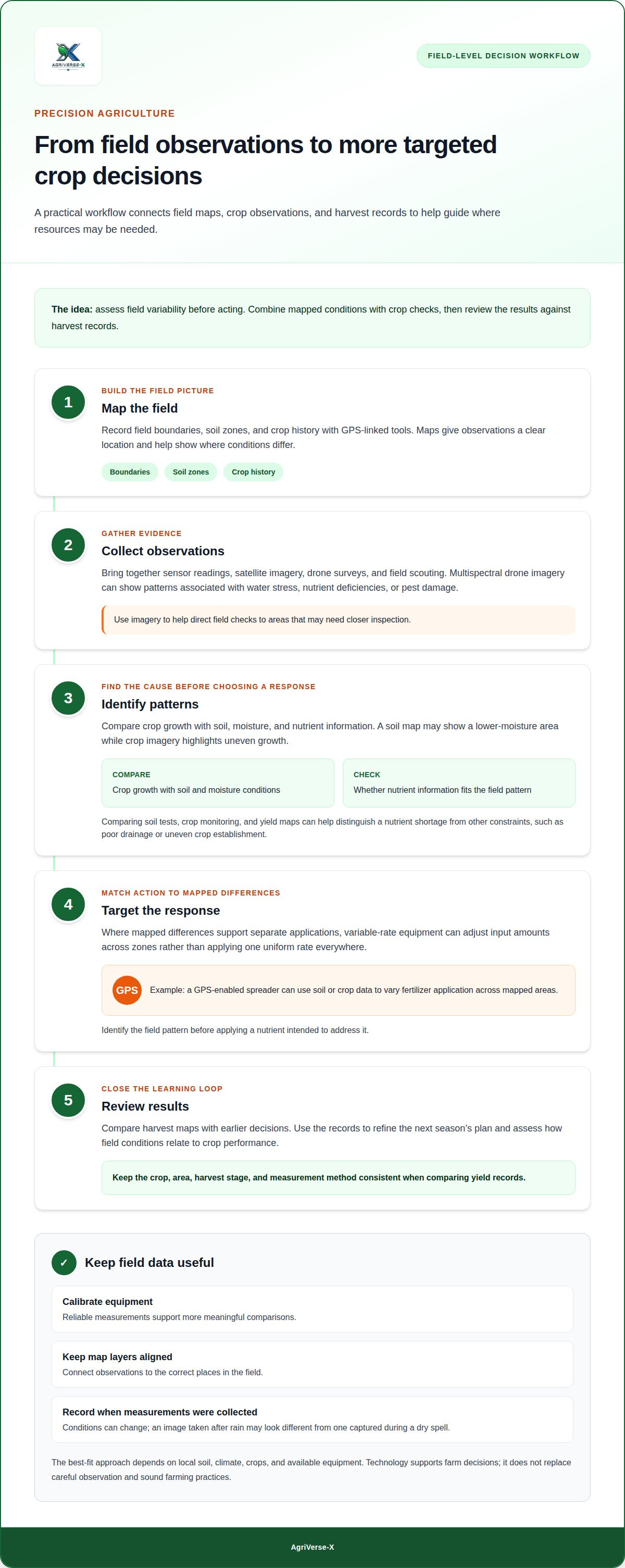
Drones and satellite imagery can reveal uneven growth patterns across a field, helping farmers spot crop stress. Multispectral drone sensors can show signs associated with water stress, nutrient deficiencies, or pest damage, directing field checks to affected areas.
Precision farming combines GPS guidance, sensors, and field maps to connect crop conditions with specific locations. A soil map, for example, may show that one section holds less moisture than another, while crop imagery highlights differences in plant growth. Together, these observations help farmers respond to field variability instead of treating every area alike.
Variable-rate application adjusts the amount of an input across mapped zones. A GPS-enabled spreader, for example, can apply fertilizer according to soil or crop data instead of spreading one uniform rate across the entire field. This makes application more targeted and can help direct inputs to areas where they are needed.
Fertilizer decisions are stronger when they combine soil tests, crop monitoring, and yield maps. A soil test can identify nutrient levels, while a yield map shows where previous harvests were stronger or weaker. Comparing the records can help distinguish a nutrient shortage from other constraints, such as poor drainage or uneven crop establishment. Identify the field pattern before applying the nutrient intended to address it.
Use a clear field-level workflow:
- Map the field: Record boundaries, soil zones, and crop history using GPS-linked tools.
- Collect observations: Combine sensor readings, satellite imagery, drone surveys, and field scouting.
- Identify patterns: Compare crop growth with soil, moisture, and nutrient information.
- Target action: Use variable-rate equipment where mapped differences support separate applications.
- Review results: Compare harvest maps with earlier decisions to refine the next season’s plan.
Reliable data matters. Calibrate equipment, keep map layers aligned, and record when each measurement was collected. A drone image taken after rain may show different crop conditions than one taken during a dry spell. These details help farmers interpret results accurately and adapt precision farming to local soil, climate, crops, and available equipment. Across global agriculture, that practical match between data and field operations supports more efficient input use and sustainable decision-making.
Crop yield management systems can combine satellite imagery, sensor monitoring, yield maps, and predictive analytics to inform field-level decisions during the growing season. Precision farming uses GPS, sensors, and mapping technology to monitor and manage crops. These tools can reveal field variability and crop-development patterns, helping growers make more precise decisions about resource allocation throughout production.
Precision farming can target water, fertilizers, and pesticides to the places and times they are needed. These examples show how field information and targeted applications can help determine where resources may be allocated more precisely.
Precision Irrigation and Soil Moisture Sensing
Precision irrigation matches water delivery to crop demand and field conditions. A soil-moisture sensor near the root zone indicates whether soil is drying or retaining water. Combine readings with crop growth stage, recent rainfall, and soil type to plan irrigation. For example, a sandy plot may need a different schedule from heavier soil under the same crop. Targeted irrigation supports production while helping avoid unnecessary watering.
Sensor placement determines how useful the data will be. Install sensors in representative crop areas and at root-zone depths relevant to the plants. Compare readings after irrigation and during dry periods, then use the pattern to adjust timing. A sensor in an unusually wet spot will not represent the whole field. Pair readings with direct observations, such as wilting leaves or standing water, to make practical irrigation decisions.
Drip irrigation delivers water through lines and emitters near plant bases. This directs moisture toward roots and can reduce evaporation and runoff compared with spreading water over exposed soil. In a vegetable plot, growers can organize rows into irrigation zones and check for blocked emitters. Even water delivery supports consistent soil moisture, while avoiding prolonged saturation helps protect soil health and root development.
Automated irrigation controls connect sensor readings to pumps or valves. A farmer can set conditions so irrigation starts when soil moisture reaches a chosen threshold. Review readings and field response regularly, since sensor position, crop stage, and rainfall can affect how well the setting works. Automation supports timely operations, but functioning filters, pipes, and pumps are still essential for reliable water delivery.
Rainwater harvesting provides another source to consider in irrigation planning. A storage tank connected to a roof or collection surface can hold rainfall for later use during dry periods. Match storage and delivery plans to available water, crop demand, and the growing season. In water-scarce areas, combine stored rainwater with drip systems and moisture monitoring to direct limited supplies to active root zones.
Build a practical routine around each irrigation cycle: record sensor readings, rainfall, irrigation timing, and crop response. Compare these records with crop development and harvest outcomes. They can reveal whether scheduling supports growth or leaves some areas too wet or too dry. Precision agriculture turns that evidence into better-timed water management and more efficient use as field conditions change.
Controlled-Environment Agriculture and Vertical Farming
Greenhouses and vertical farms manage environmental conditions to reduce exposure to outside weather. Sensors and control systems track temperature, humidity, light, and carbon dioxide (CO₂). A greenhouse growing lettuce, for example, can use these readings to adjust ventilation and lighting as crop conditions change. Managing plant spacing also helps distribute light across growing areas.
CO₂ enrichment can benefit many crops in controlled environments, but supplying it adds cost and requires careful management. Consider crop response alongside ventilation, lighting, and energy use. In a greenhouse, environmental sensors can show how conditions change during the day, helping operators coordinate CO₂ delivery with active crop growth instead of treating it as a standalone input.
Vertical farming uses stacked growing areas, often with hydroponic systems, grow lights, pumps, and nutrient controls. These systems let operators manage water and growing conditions in a defined space, but output depends on reliable equipment and coordinated daily operations. A pump interruption, for example, can affect water and nutrient delivery. Maintenance routines and clear response procedures are therefore central to system performance.
Farm-management software, including agricultural enterprise resource planning (ERP) solutions, can connect planning, inventory, labor, and production records. AI tools can analyze crop history, weather forecasts, and machinery information to help schedule planting and harvesting. For example, a farm manager could use forecasts and field records to plan planting windows, then coordinate harvest labor and equipment around crop development.
Technology adoption also depends on practical training. Learning to use sensors, climate controls, data entry, and equipment maintenance helps workers interpret system readings and act on them. A grower introducing greenhouse sensors, for example, needs procedures for checking readings and recording actions. Training providers may offer agricultural and technology courses, while compatible equipment and dependable connectivity can shape implementation.
Equipment and software costs depend on the growing system, facility size, energy needs, sensor coverage, and integration requirements. Return on investment depends on effects on usable production, resource use, labor, maintenance, and operating costs. Compare expected benefits with the full cost of running the system.
Technology also brings risks: inaccurate sensor readings, software interruptions, equipment failure, energy demand, and gaps in staff training can disrupt operations. In the United States, grant or incentive options depend on active federal, state, and local programs, applicant eligibility, and project type. Assess current program terms alongside the proposed technology and its operating needs.
Data Analytics and Decision Support Systems
Farm data becomes useful when it answers a specific production question. A decision-support system can bring together planting dates, machinery records, weather, soil readings, and harvest results. For example, comparing planting records with field yields can help identify which planting windows performed better under local conditions. Farmers can use that pattern to plan future operations and compare results across seasons.
Machine learning, geospatial analysis, and sensor monitoring can help refine yield forecasts and crop-management recommendations. Forecasts are more useful when they account for soil, weather, and regional crop conditions, with agronomic expertise guiding interpretation. A model might flag an area with unusual crop development. A field assessment can then help distinguish moisture stress from a nutrient issue before the farmer chooses a response.
Yield maps locate harvest results within a field. Comparing them with machinery and soil records can reveal patterns that recur across seasons. A lower-yield zone calls for investigation, not an automatic increase in inputs. Review its field history, drainage, crop establishment, and management records to identify possible causes. This helps distinguish a persistent issue from a short-term variation.
A practical analytics cycle links records to decisions:
- Record: Capture planting dates, input use, field observations, and harvest results.
- Compare: Review current records against previous seasons, weather, and field locations.
- Interpret: Combine model outputs with agronomic knowledge and observations.
- Adjust: Apply one documented change, then assess the result at harvest.
Farm-management software can organize costs, yields, and production records in one workflow. Reviewing input use alongside harvested output helps identify where an operation may be losing efficiency. Weather forecasts can inform the timing of field tasks. For example, a farmer can use a forecast to schedule work, then record actual conditions and compare them with the plan.
A practical way to understand how to improve crop yield with technology is to start with a clear question, such as why a field zone repeatedly underperforms. Gather relevant records, check their accuracy, and make a documented adjustment. At harvest, compare the outcome with the previous baseline. This learning cycle helps farmers refine decisions over time, with algorithms supporting rather than replacing field knowledge and agronomic judgment.
How AgriVerse-X Can Support Agricultural Technology Adoption
AgriVerse-X is designed to connect farmers, cooperatives, agribusinesses, and service providers through digital profiles and agricultural marketplaces. Where these features are confirmed and available, a farmer exploring precision agriculture can use them to find relevant technology, equipment, inputs, or services. Providers may be able to showcase products, skills, and certifications, helping agricultural participants find potential connections.
Adopting technology often involves more than choosing a device. A cooperative may need irrigation equipment, sensor data, trained workers, or a service provider for a particular operation. AgriVerse-X’s marketplace is intended to support agricultural technology and service listings, including irrigation, drones, machinery, and logistics. Some services are partner-delivered, and availability depends on the market and applicable requirements.
Training can help farmers and teams turn new tools into practical routines. Training providers may offer courses in farming, technology, safety, and business skills. For example, a cooperative preparing to use crop-monitoring tools could look for relevant training alongside technology listings, where available. Digital profiles are intended to showcase skills and certifications, helping participants present their experience and capabilities where this feature is available.
Participants may be able to use the platform to explore several adoption needs, depending on feature availability:
- Find suitable technology: Explore marketplace listings for agricultural equipment, digital tools, irrigation products, and related services, where listings are available.
- Connect with expertise: Review provider profiles showcasing relevant agricultural services, skills, and certifications, where available.
- Build capability: Explore training opportunities that may support practical use of farming and technology tools.
- Consider circular inputs: Explore listings such as compost or biochar, where available and handled according to applicable requirements.
Where available, verified profiles and digital traceability records are intended to help participants present information about products, services, and agricultural activity. These records can support documentation and reporting, but do not automatically certify crop quality, yield, or regulatory compliance. Keep claims and records accurate, and treat any required certification separately.
AgriVerse-X may be relevant when you need to connect an agricultural operation with technology listings, service providers, or related training. Explore available marketplace features and participant profiles to identify options suited to your needs and local context.
Contact AgriVerse-X to discuss an agricultural technology pilot or partnership.
Frequently Asked Questions
What Precision Agriculture Technologies Improve Crop Yields?
The most useful technology depends on the farm’s decisions and existing equipment. Before adopting a tool, identify what data it produces, whether it works with current machinery, and how staff will use its output. A field-data platform, for instance, has limited value if its records cannot be understood or connected to existing workflows. Prioritize tools with clear outputs, practical mobile access, and usable records.
How Does Variable-Rate Fertilizer Application Affect Crop Yield and Input Costs?
Variable-rate application can align fertilizer placement with field differences, but its value depends on reliable recommendations and execution. Evaluate it by comparing a treated area with a similar reference area, then recording crop response and fertilizer use. Keep the crop, timing, and field conditions comparable. This helps show whether the change improved production efficiency, rather than assuming more precise machinery automatically saves resources.
How Can Soil Sensors and Smart Irrigation Increase Crop Yields?
Smart irrigation is most useful when sensor information leads to a clear operating decision. Track pump activity, water delivery, and crop response together, then assess whether the irrigation schedule matched field conditions. For example, a grower can compare sensor trends with visible crop symptoms and system records. This helps identify whether a problem stems from scheduling, delivery equipment, or another factor affecting crop performance.
Which Crop Varieties and Technologies Improve Yields Under Drought or Heat Stress?
Select varieties using local trial evidence, including maturity timing, establishment, and performance under stressful growing conditions. Check whether trial conditions resemble the farm’s soil and planting calendar. Then pair the variety with tools that support timely decisions, such as weather alerts or crop monitoring. Keep variety and management records separate, so the next harvest review can distinguish seed performance from changes in planting or crop care.
How Can Small Farms Adopt Yield-Improving Technology Affordably?
Small farms can limit commitment by testing a technology on one crop or clearly defined production task before expanding its use. Consider shared access through a cooperative or using a service for specific work instead of owning every device. Choose tools suited to available connectivity and staff skills. Record the operational problem, how the tool was used, and what changed, then use that evidence to guide future adoption.
What are typical costs and ROI of precision agriculture equipment and software?
Precision agriculture has demonstrated yield improvements of up to 20% in cereal crops and a 30% reduction in input use.


