

A farmland lease can secure access to land, but unclear terms can turn routine costs into disputes. The risks of leasing agricultural land often depend on what the agreement says about rent, repairs, soil restoration, improvements, and the end of the tenancy.
Leasing can reduce the upfront commitment of acquiring land and let a farmer focus resources on production. But tenants may have limited control over the property, face rent obligations even when returns are uncertain, or lose the value of improvements if the lease ends before they can benefit from them. Landowners also face tradeoffs, including how to allocate costs and share the effects of changing yields or crop prices.
Clear written terms help both parties understand who pays, who maintains the land, and what happens if damage or a dispute arises. This article explains how lease structure affects rent, remediation duties, tenant contributions, and the balance of risk between landowner and farmer, so you can identify important terms before committing.
Key Takeaways
- Put remediation timelines, reimbursement terms, and responsibility for damage in writing to reduce uncertainty when the lease ends or the land needs work.
- Define how tenant labor, skills, equipment, fixtures, and improvements will be treated during the lease and at termination.
- Compare the stability of fixed rent with the shared risks and returns of a crop-share arrangement before choosing a lease structure.
- Assess rental fees in light of the land’s soil, shape, location, prior use, and access to water or irrigation.
- If considering an agricultural marketplace, confirm whether listings for plants, seeds, and propagation materials are available, and check details on variety, origin, handling, and applicable restrictions.
Lease provisions for remediation timelines and reimbursement
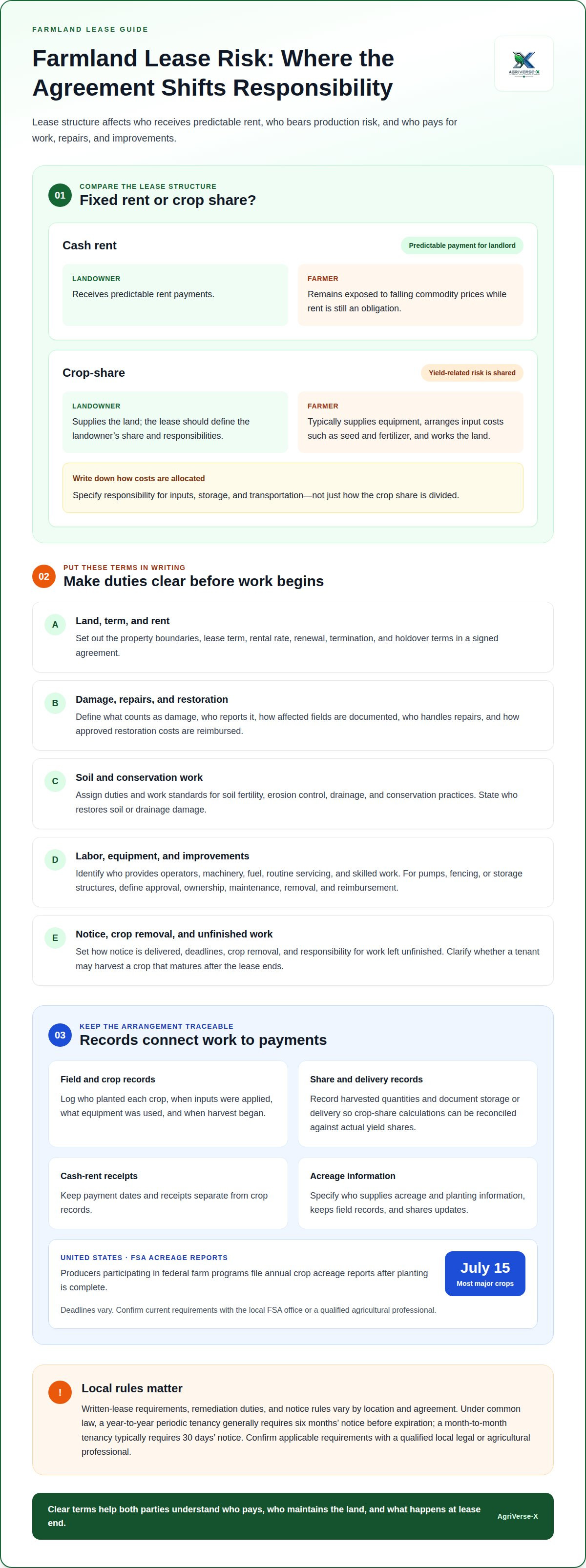
Put the property boundaries, lease term, rental rate, and remediation duties in a signed agreement. Requirements for written agricultural leases vary by state, so confirm with a qualified local legal professional what form an agreement needs to be enforceable. A written record can clarify what both parties agreed to do.
Define what counts as damage, who must report it, and how repairs or restoration will be handled. For example, the agreement can set a notice process after flooding, identify who documents affected fields, and explain how the parties record changed duties in a written addendum. Responsibility for natural-disaster damage and restoring agricultural land can depend on the lease and applicable local rules. Ask a qualified local legal or agricultural professional to confirm the parties’ responsibilities. Clear timelines and reimbursement terms can help prevent disputes over repair costs or delayed access.
Set renewal, termination, and holdover terms before either party invests in improvements. A periodic tenancy may renew automatically unless proper notice ends it, depending on the agreement and applicable local rules. A Michigan lease may state that a tenant who stays after a fixed term becomes a month-to-month tenant. Confirm local requirements with a qualified legal professional. Define how notice is delivered, the deadlines, crop removal, and responsibility for unfinished work. For example, specify whether the tenant may harvest a crop that matures after the lease ends.
Farm leases also affect records tied to government payments, crop insurance, taxes, and USDA programs. State who reports acreage and pays property taxes; in the United States, FSA acreage reports are filed after planting, and July 15 is the deadline for most major crops, though deadlines vary. Confirm current deadlines with the local FSA office or a qualified agricultural professional. If both parties buy crop insurance or participate in a government program, payment allocation may depend on the program rules, lease terms, and each party’s share. Confirm the applicable requirements with a qualified local agricultural or legal professional.
Address soil fertility, erosion control, drainage, and conservation practices by setting out duties, work standards, and documentation. Applicable duties can vary by state and lease; consult a qualified local legal or agricultural professional about requirements. A cash-rent agreement gives the landlord predictable payments while leaving the farmer exposed to falling commodity prices. A crop-share lease shares yield-related risk, so its terms should also allocate input, storage, and transportation costs. State who is responsible for restoring soil or drainage damage and how approved costs are reimbursed.
Tenant labor, skills, and equipment contributions
A farm lease should distinguish the tenant’s work from the landowner’s obligations. In a crop-share arrangement, the farmer typically supplies equipment, arranges input costs such as seed and fertilizer, and works the land, while the landlord supplies the land. Record who provides operators, machinery, fuel, routine servicing, and skilled work. A tenant’s ability to repair irrigation equipment, for example, can affect operating costs and the timing of fieldwork.
Set a practical process for recording labor and production. A field log can identify who planted each crop, when inputs were applied, what equipment was used, and when harvest began. These records help both parties monitor progress and reconcile crop-share payments against actual yield shares. For cash rent, document payment dates and receipts separately from crop records. Clear records reduce disagreements about missed payments, completed work, or the amount of crop covered by the agreement.
Address fixtures and improvements before installation. Pennsylvania tenants may remove their own fixtures necessary to operate their business when a lease ends, unless the lease says otherwise. If a tenant adds a pump, fencing, or storage structure, the written terms should cover ownership, maintenance, removal, and any reimbursement. State whether the landowner’s approval is needed and who repairs damage caused during removal. These details protect each party’s rights when equipment or improvements remain on farmland.
Termination notice can affect the value of labor and seasonal spending. Under common law, a year-to-year periodic tenancy generally requires six months’ notice before expiration; a month-to-month tenancy typically requires 30 days’ notice. For example, a farmer who has prepared fields or bought seed may face disruption if notice arrives near planting. Put the applicable notice method, deadline, and process for unfinished work in the agreement, while accounting for local rules.
Finally, define how the parties monitor crops and handle records linked to federal programs. Producers participating in federal farm programs file annual crop acreage reports with the FSA after planting is complete. Specify who supplies acreage and planting information, who keeps field records, and how quickly each party shares updates. For a share lease, also record how harvested quantities are measured and storage or delivery documented. This makes payment calculations traceable and helps prevent either party from relying on incomplete production information.
Advantages and drawbacks of leasing farmland
Leasing gives farmers access to land without buying the estate, but it doesn’t build ownership. In the lower 48 states, farmland covers approximately 911 million acres. About 60% is owner-operated, 40% is leased, and 54% of tillable cropland acres are rented. These figures show how strongly U.S. farming relies on both ownership and rental arrangements.
For a new or expanding operation, leasing can provide access to productive acreage without requiring a land purchase. This can leave resources available for seed, machinery, labour, and other operating needs. However, rent payments do not give the tenant equity in the property. The risks of leasing agricultural land include investing in an operation on land the tenant may no longer control when the agreement ends.
Lease duration shapes planning and stability. Multi-year tenancies can give farmers a more predictable base for crop rotations and business decisions. Shorter terms can make longer-range planning harder, especially when a tenant wants to establish improvements that take time to benefit production. Landowners also gain a defined arrangement for agricultural use without managing day-to-day farming themselves. Nearly 90% of farm landlords are not farmers, making clear expectations valuable to both parties.
Access comes with limits. Farmland leases commonly restrict use to agriculture and may require good farming practices. A lease can also prohibit cutting timber or applying pesticides or herbicides off-label. Tenants should consider these restrictions when choosing crops and planning field operations. Rules on harvesting crops that mature after a lease expires can vary; for example, in Pennsylvania, a tenant with a known-term lease may generally be unable to harvest them unless the agreement provides otherwise. Confirm applicable requirements with a qualified local professional. This is one reason the risks of leasing agricultural land extend beyond rent and production.
Leasing also affects long-term financial security differently from ownership. A tenant may find it harder to obtain credit because leased land cannot be offered as owned property for loan security. A long-term lease can reduce net income without building equity in the property. Whether leases can be inherited or transferred by tenants, and whether lease terms are restricted, depends on local rules and the agreement. These differences can affect succession plans and the continuity of a farming business. Confirm the relevant requirements with a qualified local professional.
Factors affecting agricultural rental fees
A rental rate reflects both the land’s farming potential and the costs attached to the arrangement. Understanding the main factors helps landowners and tenants assess whether the lease term and payment structure fit the property.
Drivers of Agricultural Rental Fees
Agricultural rental value depends on the property’s location, physical features, prior use, and access to water. For example, distance from a tenant’s home farm can affect travel and operating demands, while acreage and field shape influence how efficiently machinery can work. Soil, topography, and irrigation access also affect the land’s practical use.
Compare these factors across the specific fields covered by the agreement, rather than treating the whole property as uniform. A parcel with reliable irrigation may support different operations from a field with limited water access. Prior use can matter too: the lease should describe the land’s condition and intended agricultural use, so the rent reflects what the tenant can practically farm.
Rental Adjustments After Disasters
A disaster adjustment is a lease provision that changes rent or payment timing after damage affects farmland. It matters because flooding or other damage can reduce usable acreage, disrupt planting, or prevent normal production. The agreement can explain how the parties document affected fields, report damage, and calculate any rent adjustment.
For example, a lease may set minimum cropland rent to cover fixed expenses, such as property taxes, while allowing prevented-planting payments to offset those expenses when applicable. The parties can also define how disaster-related assistance is shared and whether a written addendum changes the rental rate. Clear triggers and records link any adjustment to the damage and affected acreage.
Rental Rates and Landowner Costs
Landowner costs are expenses associated with holding or maintaining farmland, and they can influence the rental rate. Property taxes are one fixed expense; maintenance duties and the lease’s allocation of repairs also affect each party’s costs. Consider the stated rental rate alongside the services and responsibilities included in the arrangement.
For example, if the landowner pays property taxes but the tenant handles routine field maintenance, the agreement should distinguish those obligations. A cash-rent lease may require full payment unless its terms say otherwise, even when crop returns fall. Set out payment timing, expense responsibilities, and disaster adjustments in the written lease. These terms make each party’s financial exposure clearer.
What liability risks arise from injuries, accidents, or environmental damage on leased farmland?
Injury risks can arise whenever people enter or work on leased property. A tractor operator could strike a visitor near a field entrance, or a worker could fall beside an irrigation channel. The lease should identify who controls access, maintains work areas, communicates hazards, and reports incidents. Clear responsibilities help the parties respond consistently and keep useful records.
Equipment use creates another practical concern. For example, a tenant operating a sprayer or harvester may face questions about training, maintenance, and safe operation after an accident. The agreement can identify who supplies and operates equipment, and who records servicing or repairs. It should also address contractors and visitors, including how the tenant and landowner share safety information before work begins.
Environmental damage can affect soil, water, neighboring land, and future farming. A spill near a stream, pesticide drift beyond a field, or blocked drainage channel can lead to cleanup costs and disputes over responsibility. Lease terms should define permitted practices, storage areas, reporting steps, and who coordinates containment or remediation. Crop-protection products must meet local requirements for registration, labelling, handling, storage, transport, and application.
Document the response process before planting begins. Specify who receives incident notices, what information each party records, and how quickly the other party is informed. For example, a written report can capture the date, field location, equipment involved, observed damage, and immediate actions taken. Keep photographs, maintenance logs, training records, and product-use records with the lease file. These details can help establish what happened and which duties applied.
Insurance and indemnity provisions need careful drafting. State the coverage each party must maintain, the activities it applies to, and how proof of coverage is shared. Do not assume that a tenant’s policy covers the landowner or that a landowner’s policy covers tenant operations. Requirements vary by jurisdiction and policy terms, so qualified insurance and legal professionals should review these provisions. That review is especially important where workers, contractors, chemicals, irrigation systems, or public access create distinct risks.
Finally, connect liability terms to the lease’s repair and termination provisions. If a chemical spill makes part of a field unusable, the agreement should address access restrictions, cleanup duties, damage documentation, and any rent adjustment. If a worker is injured, preserve incident records and notify the designated party. Specific procedures help both parties act promptly without assuming one general clause covers every accident.
AgriVerse-X: Live Plants, Seedlings, and Planting Materials
Subject to availability and applicable rules, a marketplace service may help farmers and agricultural businesses find listings for live plants, seedlings, and planting materials. Once you have planned a leased plot’s intended use, relevant listings, if available, may help connect that plan with planting inputs. Potential listings could range from vegetable seedlings and nursery plants to fruit-tree seedlings, grafted plants, and forestry trees.
Listings could also include ornamental and landscaping plants, flower seedlings, cut-flower plants, native species, herbs, and medicinal or aromatic plants where lawful. For propagation, sellers could list rooted cuttings, grafted scions, rootstock, mushroom spawn, and cultivation materials. These categories support different production plans, from establishing a fruit orchard to growing vegetables for a seasonal crop.
Seed options could include bulbs, tubers, rhizomes, corms, and certified, treated, organic, heirloom, hybrid, or open-pollinated seeds where legally permitted. Nursery trays, pots, propagation media, and greenhouse supplies could also be listed. For example, a grower planning vegetable production could compare suitable seedlings with the propagation supplies needed to raise or manage them.
Useful listing details can help buyers assess whether an item fits their planting schedule and growing conditions. Sellers should accurately state the variety, origin, quantity, treatment, planting season, and storage requirements. They should also provide germination information where relevant, along with any certification or restrictions. A seed listing, for instance, should make clear whether certification applies and identify relevant treatment information.
These details matter because a plant or seed’s variety, handling, and timing affect how it fits a production plan. A fruit-tree seedling intended for an orchard has different considerations from a vegetable seed selected for the current planting window. Clear descriptions can also help buyers distinguish live plants from seeds and other propagation materials before making arrangements.
Verified digital profiles and product listings should not be assumed to be currently available through AgriVerse-X. Any such features or marketplace service are subject to availability and applicable rules. Where listings are available, use their details to identify options relevant to a farm or cooperative’s planned production, while treating seller descriptions as distinct from independent certification or proof of performance.
For information about the availability of plant and planting-material listings, contact AgriVerse-X.
Frequently Asked Questions
What Is a Lease?
A lease gives a tenant defined permission to use property while ownership remains with the landowner. For farmland, the agreement can also describe which fields are included, whether access roads or shared water points are available, and whether the tenant may bring workers or contractors onto the site. Attaching a field map and identifying excluded areas can help prevent confusion about the space covered.
What are the main risks of leasing agricultural land to a tenant or from a landowner?
Key risks include unclear access, competing claims to shared infrastructure, and uncertainty about who may make decisions affecting the operation. For example, a tenant may plan to use a shared access track while the landowner expects it to remain clear for other users. Record access arrangements, permitted activities, and shared facilities in the agreement. Keep dated communications if the parties later change those arrangements.
Who is responsible for property taxes, maintenance, repairs, and insurance under a farm lease?
The signed lease and applicable local rules may determine how these responsibilities are allocated. Requirements can vary by location and circumstances, so consult a qualified professional about a specific lease. A practical way to track obligations is to keep separate records for tax notices, routine upkeep, major repairs, and insurance documents. For instance, record when a tax bill arrives, who the lease assigns responsibility for paying it, and when payment is due. Insurance coverage depends on the policy wording and insured activities, not simply on who owns the land.
What should an agricultural land lease include to protect both the landowner and tenant?
Beyond payment and term details, include a process for approving changes and recording decisions. State who can sign amendments, how each party receives them, and whether email or another written format counts. An attached inventory can identify existing gates, pumps, fences, or buildings at handover. A qualified professional can advise on provisions for a specific lease. This gives the parties a shared reference if an item’s condition or ownership is disputed later.
How do cash-rent, crop-share, and flexible farm leases compare in costs and risks?
For a flexible lease, the formula matters as much as the payment method. Specify the measure used, its source, when it is calculated, and whether the result has a floor or cap. For example, a formula tied to harvested output needs a clear measurement method and reconciliation date. Have a qualified professional review the terms for your circumstances. A clear formula can help limit misunderstandings about changing payments and support cash-flow planning.
What are the risks of oral, short-term, or improperly terminated farm leases?
These arrangements can leave uncertainty about who agreed to what, especially if conduct changes over time. Keep dated records of rent transfers, messages about field access, and the parties’ actions after the stated end date. Such records may help clarify the arrangement, but they do not replace a properly documented agreement. Before relying on an oral or changing tenancy, consult a qualified professional about how the rules in the relevant location may apply to the parties’ communications and conduct.
What federal and state laws may apply to agricultural land leases in the United States?
State and federal requirements may apply, and their application can depend on the location and facts of a specific lease. State statutes and common-law rules may address matters such as written agreements and termination, but this is only a general summary, not legal advice. The Food Security Act of 1985 includes provisions related to landowner notice for certain crop-payment matters; the details and applicability should be confirmed with a qualified professional. Consult a qualified attorney or other appropriate professional for advice about a specific lease.


