

To learn how to screen potential farm tenants, use one application and the same written criteria for every applicant. Get consent before requesting credit or background checks, contact references consistently, and assess farm experience, financial stability, communication, and care of the land. Set your requirements before applications arrive so every decision follows a clear process.
Screening also needs to fit the laws where the land is located. Rules on fair housing, applicant disclosures, credit reports, and recordkeeping can vary by jurisdiction, so build local requirements into your process before reviewing applications. Here at AgriVerse-X, this guide explains what to collect, how to set consistent income and experience standards, which references to contact, and how to plan a check timeline without promising a fixed turnaround. You’ll also see how written lease expectations can carry the screening decision into a clearer working relationship.
Key Takeaways
- Build one application process that gathers relevant experience, rental history, references, and permission for screening.
- Set income and farm-operation requirements before reviewing applicants, then apply the same criteria to each person.
- Use consistent reference questions to assess payment history, communication, and care of the land.
- Plan screening timelines around consent, requested records, and reference responses rather than assuming every check will take the same time.
- Keep screening records and adapt disclosures and decisions to the laws that apply where the property is located.
How long do tenant credit and background checks take?
Plan screening around applicant consent, report processing, and reference response times; no single turnaround fits every application. Screening practices and applicable requirements vary by location. Consult qualified professionals about the rules that apply to your situation.
-
Obtain Applicant Consent for Checks
Get the applicant’s consent before requesting a credit or background check. Explain what information you’ll review and how it will inform your decision, then use a consistent process for every applicant, subject to applicable requirements.
Before ordering reports, consult a qualified professional about applicable disclosure, consent, and record-keeping requirements. Keep relevant consent forms, applications, and communications together, and confirm that applicant details are complete to help avoid screening delays.
-
Run Credit Checks
Request a credit check only after obtaining consent, then assess the report against criteria set before applications arrive. Consider payment history and relevant financial information alongside the applicant’s farm experience and references. A credit report is one part of screening, not a substitute for reviewing the full application.
Credit-check timing depends on consent, complete identifying details, and the reporting process. Explain that checks and follow-up requests can take varying amounts of time. Record when you requested the report and when it arrived to maintain a clear timeline when reviewing multiple applications.
-
Review Background and Eviction History
Review relevant background and rental history consistently, including past evictions, payment history, property upkeep, and previous landlord relationships. For screening in the United States, consult qualified professionals about applicable requirements. A past criminal offense does not automatically disqualify an applicant; consider the nature and recency of convictions in line with applicable requirements.
Contact two or three landlord references. Ask whether rent was paid on time, whether the tenant left unpaid bills or caused damage, and whether the landlord would lease to them again. Ask about communication and care of the land, too. To assess farming experience, review work history and speak with relevant landlords, bankers, cooperative managers, or business contacts. A visit to the current operation can help you assess field maintenance, drainage, erosion, and equipment condition.
Request relevant insurance and licence documents, then consult qualified professionals about the issuing organisation and requirements for the proposed work. Discuss safety practices, including how the applicant plans to protect workers, water, soil, and crops. Put agreed responsibilities in a written lease, with terms reviewed by qualified professionals as appropriate. Clear screening and lease terms can help both parties reduce misunderstandings and risks related to land care.
How do I start accepting tenant applications?
Use one written application, ask every applicant the same questions, and explain how you’ll assess responses. Collect information directly relevant to the proposed lease and farm operation.
-
Gather Rental Application Information
Give every interested applicant the same form and request basic personal and household details, rental history, employment, income, education, and work experience. Include space for reference names and contact information, and ask permission to contact previous landlords.
Ask every applicant the same questions. Explain how you’ll communicate the selection outcome, including when there are competing applications. Disclose any non-refundable application or hold fee in writing before applicants pay it, and verify relevant requirements with a qualified professional in your jurisdiction.
-
Ask About Farming Plans and Land Use
Ask each applicant to describe their intended crops or livestock, planned use of the acreage, and expected operating timeline. Explore how the plan fits the property’s cropland, pasture, drainage, access, and existing infrastructure.
Ask what equipment and labour the operation requires, how the applicant plans to manage weeds and pests, and how they’ll protect soil and water. For example, a proposed crop rotation should name the crops and their sequence, rather than simply promise responsible land care. Record answers consistently so you can compare plans against the same lease expectations.
-
Address Inaccurate Application Information
Give applicants a clear way to flag information they believe is incorrect, such as a mistaken rental date or payment record. Compare the disputed detail with the application and correspondence, then record what you reviewed and how you reached your decision.
If you use a tenant-screening report, check the applicable requirements with a qualified professional in the relevant jurisdiction. Identify the specific item at issue and allow the applicant to explain relevant context. Keep the report, response, and decision notes with the application, subject to applicable requirements.
- Set a consistent intake sequence: receive the completed form, confirm required fields, and log its arrival before evaluation. For example, note whether employment details, rental history, farm experience, and reference contacts are present. A consistent record helps distinguish an incomplete form from an applicant who doesn’t meet stated criteria.
Keep selection communications factual. State whether an application is under consideration, what information remains outstanding, and how the applicant will receive the outcome. Avoid promising a decision date before references and records arrive. Store applications and related correspondence securely, and check collection, retention, and disclosure requirements with a qualified professional in the relevant jurisdiction.
Income qualifications and income documents
Landlords may request income documents as part of their own application process. The documents and criteria they use are their responsibility and should be applied consistently, subject to applicable laws.
A landlord may consider relevant experience, references, and information about meeting lease payments when reviewing farm-tenancy applications. Income documents and rent affordability are possible considerations in the landlord’s process; they do not, by themselves, determine an applicant’s financial suitability.
-
Set Income Qualifications
Before evaluating applications, landlords can document the criteria and evidence they plan to consider. Any criteria should be applied consistently and in accordance with applicable laws.
For example, landlords can specify which income sources they may consider and what supporting documents they may request. Record the criteria for each application and avoid changing them after reviewing an applicant’s documents.
-
Verify Employment and Income
As part of their own process, landlords may request recent pay stubs, tax returns, employment letters, or housing assistance documentation. They may ask applicants to provide details such as their employer, job title, income, length of employment, and any secondary income sources.
Landlords may compare information in an application with the documents provided and ask applicants to clarify discrepancies. Keep records in accordance with applicable privacy requirements and use consistent procedures for all applicants.
-
Consider Qualifications and Rent Information
Landlords may consider information such as employment history, rental history, and references, alongside any income documents they request. No single document provides a complete picture. Apply established criteria consistently and follow applicable laws.
For example, an application may list employment and secondary income. A landlord may ask for documents supporting the information provided, then consider it alongside other relevant application details. The landlord is responsible for deciding what information to consider and how to evaluate it.
- Distinguish income supported by documents from amounts reported only in an application. If an applicant lists secondary earnings, a landlord may ask about the source and request supporting documents. Record any discrepancies objectively and give the applicant an opportunity to clarify, following the same process for all applicants.
For seasonal farm work, income may vary over time. A landlord may consider relevant documents and information provided by the applicant, without treating one period as proof of year-round earnings. Apply the same process to every application.
- Keep a concise record of the documents reviewed, criteria applied, and any explanations received. Record discrepancies objectively rather than making assumptions about an applicant.
Income documents and information about rent obligations are possible considerations in a landlord’s own application process. They do not establish an applicant’s financial suitability or prescribe an outcome. Landlords should follow applicable laws and seek independent professional advice where needed.
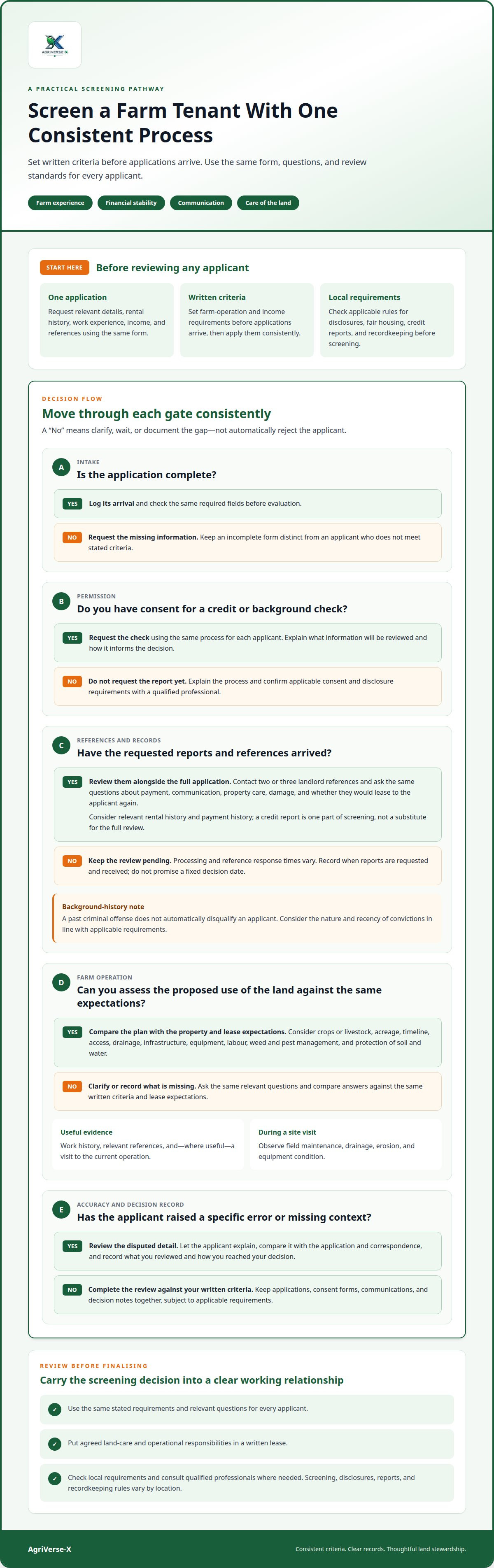
Setting consistent application requirements
Define qualification standards before advertising the lease, including financial, operational, and property-use requirements. Publish relevant minimums so applicants can assess whether the opportunity suits their operation.
- Set measurable requirements that relate directly to the proposed tenancy. These may include minimum income, acceptable credit criteria, rental history standards, permitted occupants, and policies on pets or smoking.
For farmland, state operational expectations separately, such as weed control or pest management. Avoid criteria that vary between applicants or depend on personal preference. A clear written standard gives each decision a defined basis.
-
Set Application Fees and Screening Costs
Decide whether an application fee will cover financial and criminal background-check costs. Explain its purpose and whether it’s refundable before collecting payment.
North Carolina property managers should disclose non-refundable application and hold or reservation fees in writing. Keep fee terms consistent across the advertisement, application materials, and payment instructions. Don’t describe a screening fee that covers checks as a refundable deposit.
- State minimum requirements in the property listing where practical. For example, identify the required income documentation, relevant farming experience, and lease expectations before applicants enquire.
Applicants can then decide whether to apply using the same published information available to everyone. Review the listing whenever requirements change, and update related forms before accepting applications under revised terms.
- Apply your screening standards without discrimination based on housing voucher status. An applicant using a Section 8 voucher should be assessed through the established process, not excluded because of the voucher.
Tie the assessment to relevant qualifications and applicable requirements. Record how each applicant meets the stated criteria, including applicable income documentation, rental history, and farm-operation standards.
-
Review and Approve Applications
Use a written decision record to connect the outcome to stated qualifications. If an application is unsuccessful, notify the applicant and retain the communication with the screening file.
In North Carolina, property managers should notify unsuccessful applicants. If an unsuccessful applicant is otherwise qualified, managers can suggest other available rental properties.
Before accepting an applicant, confirm that the proposed lease reflects the requirements used in your decision. This keeps the published opportunity, screening criteria, and final agreement aligned.
If you provide an explanation, tie it to the published qualifications and recorded assessment. Give every interested rental applicant the same application and ask each the same questions. Selecting who receives an application or using different forms may violate state and federal fair housing laws. Agree on tenant qualifications before screening, including policies on pets, smoking, and permitted occupants.
Landowners should consider stating minimum tenant requirements clearly in advertisements, including any minimum lease rate. Landlords can set application requirements such as minimum income levels, acceptable credit scores, and rental history standards. Use a standardised screening process for every applicant to support fairness and objectivity and reduce the risk of bias or discrimination claims.
Compliance with local tenant-screening laws
Before screening begins, verify the screening, disclosure, and recordkeeping obligations that apply where the farmland is located with a qualified professional. Requirements may vary by location, so keep a record of each step from disclosure to final decision.
- Prepare a written disclosure describing the information you’ll review and how it may affect selection. Ask a qualified professional to check that the disclosure is appropriate for the property’s location.
Include credit, criminal, employment, or rental-history checks only if they form part of your process. Keep the disclosure with the application and verify the applicable notice and screening obligations with a qualified professional.
- If a credit agency’s report informs a rejection, ask a qualified professional to review the relevant screening and disclosure obligations.
Keep a copy of the report and the notice sent to the applicant. Link the decision record to the specific report information relied upon, rather than leaving the file with only a general rejection note.
- Ask a qualified professional to verify what information a tenant-screening company must provide to applicants and how applicants can access it.
If an applicant questions an entry, record the disputed item and the date of the communication. Keep follow-up correspondence with the screening report so the file shows what information was considered and when.
- Retain a complete screening file for every applicant. Include the application form, background and credit reports, disclosures, correspondence, and interview notes. These records provide a chronological account of the process and its decision points.
Organise the file by applicant and property, then keep documents together in a consistent format. Limit access to people handling the application, and ask a qualified professional to verify the recordkeeping obligations that apply.
- Close the file by recording the selection outcome and any required communication.
Keep the notice and delivery record with the application. Before relying on a report entry, make sure the decision file identifies the information used and the relevant notice provided. A complete record helps explain the screening process if questions arise later.
Ask a qualified professional to verify the screening, disclosure, and recordkeeping obligations that apply to rental applications. Landlords should retain screening records for each applicant, including application forms, background checks, correspondence, and interview notes.
AgriVerse-X: Digital Agricultural Ecosystem
AgriVerse-X is developing connections for agricultural participants through digital profiles and listings for farmland, leases, storage, and equipment rentals. The availability of these features is subject to confirmation. If you’re preparing to lease land, planned listings may help connect your opportunity with prospective agricultural tenants.
Planned profiles may allow farmers and agribusinesses to showcase relevant skills and certifications. AgriVerse-X is also developing marketplace connections for agricultural inputs, machinery, technology, and services. Availability can vary by location and applicable requirements.
Use your written screening criteria and local legal requirements to assess applicants; a platform profile doesn’t replace your checks or lease agreement. For information about agricultural listings and connections, contact AgriVerse-X at [email protected].
Turn a Clear Screening Process Into a Stronger Lease
Tenant selection begins a working relationship; it isn’t the final decision. Use screening information to establish clear communication after selection. Agree how you’ll handle operational updates, access, maintenance concerns, and changes in land use. A consistent decision record can also help both parties understand their agreement as the season progresses.
A deliberate approach to how to screen potential farm tenants can do more than guide applicant selection. It can establish a professional foundation for the lease while giving the tenant room to explain their plans and raise practical questions before signing.
AgriVerse-X supports agricultural connections through verified profiles and listings for farmland and leases. If you’re considering how to present a leasing opportunity within a wider agricultural ecosystem, contact AgriVerse-X about farm leasing support. Take the next step with clear expectations and a considered plan.
Frequently Asked Questions
What financial documents should farm tenant applicants provide?
Documents relevant to a farm tenancy may vary depending on the circumstances and local requirements. Consult qualified professionals about which documents may be appropriate and how to handle them. Crop-insurance information or a bank reference may contain sensitive details, so consider privacy and relevance when discussing information with applicants.
How can I compare applicants for a farm tenancy fairly?
Look beyond one strong or difficult season and assess the applicant’s broader farming record. A single bad year doesn’t, by itself, disqualify a prospective tenant. Consider the context the applicant provides, including how they responded to setbacks and cared for the land. Compare proposed operating plans with the property’s needs, then identify which tenancy arrangement offers the clearest path to meeting both parties’ expectations.
What state and local laws affect farm tenant screening and farmland leases?
Rules depend on the property’s jurisdiction and may affect lease terms, notice for inspections, renewal, and how screening information is handled. Requirements for a written farmland lease and its terms can also vary. Consult qualified professionals about relevant documents and local requirements before signing.


