

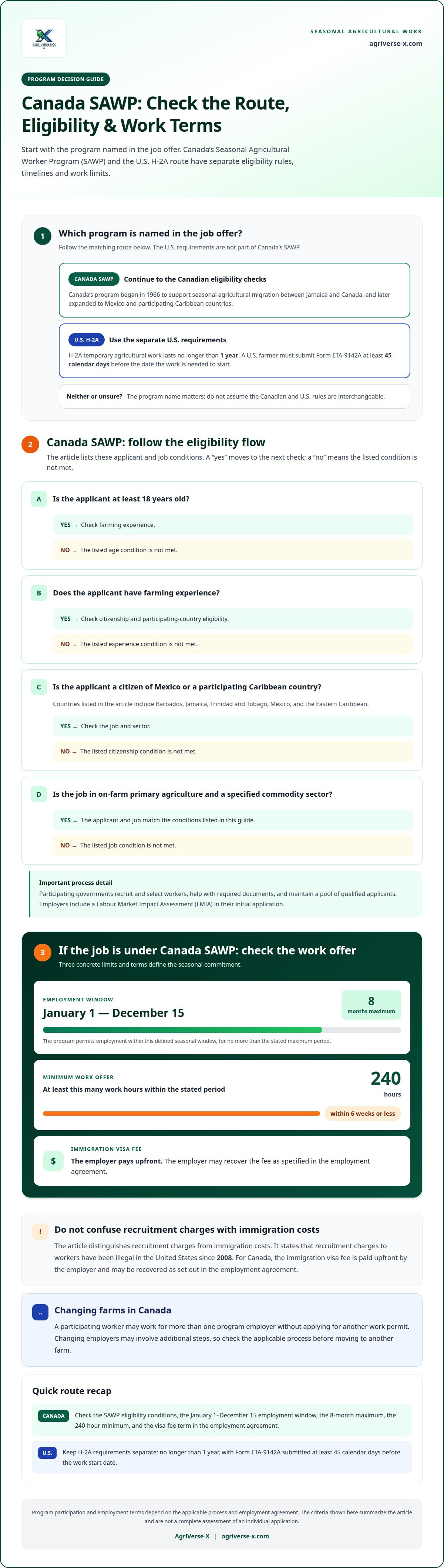
Canada’s Seasonal Agricultural Worker Program began in 1966 to support seasonal agricultural migration between Jamaica and Canada, and later expanded to Mexico and other Caribbean countries. The seasonal agricultural worker program now sets a defined work window: employment is permitted between January 1 and December 15, for a maximum period of 8 months.
For workers and employers, the offer matters as much as the season. Employers must provide at least 240 hours of work within a period of 6 weeks or less. The employer pays the immigration visa fee upfront and may recover it as specified in the employment agreement.
This guide explains why the Seasonal Agricultural Worker Program was established, who it serves, and how its work period and minimum offer shape an application. It also clarifies the difference between recruitment fees and immigration costs, what a job offer should cover, and what workers can expect as recruitment and hiring proceed.
Key Takeaways
- Understand why the Canadian program was created and how its seasonal employment framework shapes hiring.
- Learn how recruitment charges differ from immigration costs and what workers should understand about the employment agreement.
- Explore how verified digital profiles and an agricultural marketplace could help participants present their products, skills, and services if these features become available.
- Review illustrative listing examples, from seedlings and seeds to propagation materials and nursery supplies.
- Recognize why accurate product details, eligibility conditions, and applicable rules matter when preparing a listing or job offer.
Context and problem
Canada established its Seasonal Agricultural Worker Program in 1966 to support seasonal migration between Jamaica and Canada. It later expanded to Mexico and participating Caribbean countries. Today, the program forms part of Canada’s Temporary Foreign Worker Program, which brings temporary foreign workers into seasonal agricultural employment. Temporary foreign workers account for about 20 percent of Canada’s agricultural sector.
Eligibility is specific. Applicants must be at least 18 years old, have farming experience, and be citizens of Mexico or participating Caribbean countries. Participating countries include Barbados, Jamaica, Trinidad and Tobago, Mexico, and the Eastern Caribbean. The work must relate to on-farm primary agriculture and production in specified commodity sectors.
The foreign government application process plays a central role. Under bilateral agreements, participating governments recruit and select workers, help ensure they have the necessary documents, and maintain a pool of qualified applicants. They also appoint representatives in Canada to assist workers. Employers include a Labour Market Impact Assessment in their initial application as part of the federal temporary-worker process.
The work period and offer define the employment commitment. Under Canada’s program, employers may hire workers for a maximum period of 8 months, between January 1 and December 15. Each employer must offer at least 240 hours of work within a period of 6 weeks or less. These terms set a clear minimum even when crop cycles and farm duties vary.
A work permit does not automatically require a new application whenever an employer changes. A participating worker may work for more than one program employer without applying for another permit. Changing employers may involve additional steps, so workers should check the applicable process before moving to a new farm. Workers also pay Canadian income tax and may qualify for specified pension and employment insurance benefits.
Recruitment charges and immigration costs are different. For the Canadian program, the employer pays the immigration visa fee upfront and may recover it as specified in the employment agreement. In the United States, recruitment charges to workers have been illegal since 2008.
The U.S. H-2A route has its own timeline and limit. U.S. Citizenship and Immigration Services states that H-2A temporary agricultural work lasts no longer than 1 year. U.S. farmers must submit Form ETA-9142A at least 45 calendar days before the date H-2A work is needed to start, according to the U.S. Department of Labor. These U.S. requirements are separate from Canada’s program.
The AgriVerse-X approach
AgriVerse-X is designed to help agricultural participants present their work through digital profiles and an agricultural marketplace. Farmers, agribusinesses, cooperatives, and service providers could use profiles to share information about their activities with potential buyers and partners. Subject to platform availability and verification processes, profiles may feature products, services, skills, and certifications.
For example, a nursery could present vegetable seedlings, fruit-tree seedlings, grafted plants, or rooted cuttings. An illustrative listing might specify the variety, origin, quantity, planting season, and storage requirements. Where relevant, it could also include germination information, helping buyers assess planting materials and plan procurement.
An agricultural marketplace could also accommodate seeds, bulbs, tubers, rhizomes, corms, grafted scions, rootstock, and mushroom spawn. Sellers might state whether seeds are treated, organic, heirloom, hybrid, open-pollinated, or certified where legally permitted. Nursery trays, pots, propagation media, and greenhouse supplies are other possible listing categories. Clear descriptions can help buyers understand what an offer includes.
If available, a verified profile could bring listings together with relevant organizational details. For example, a cooperative might present its agricultural products and services in one profile, while an individual grower could focus on a particular nursery range. Verification may support confidence in profile information, but it does not replace independent certification or prove that every product meets a buyer’s requirements.
Other possible marketplace categories include agricultural goods, inputs, machinery, technology, and services. Illustrative grain listings could cover maize, rice, wheat, sorghum, millet, or other cereals. Sellers should distinguish grain for planting from products for human consumption, animal feed, processing, or industrial use. Stating the intended purpose helps buyers assess whether an offer suits their needs.
Crop-protection products require particular care. Depending on platform availability and local rules, potential listings could include legally approved pest-control products, monitoring devices, or integrated pest-management services. Requirements may cover registration, labelling, storage, handling, transport, worker safety, and application. Illegal, counterfeit, unregistered, or unsafe products should not be promoted.
Profiles and listings are most useful when they provide consistent, relevant information. Where these features are available, sellers could organize products by type and use, then link a listing to relevant skills or certifications on the profile. This structure can help buyers interpret an offer, while claims that require authorized or independent evidence remain subject to separate verification.
Practical benefits or steps
Farmers and agribusinesses can use a digital profile, where available, to present their operation’s products, services, skills, and certifications. Start with the business need: a grower may want to feature seasonal produce, while a nursery may focus on planting materials. A clear profile can help potential buyers and partners understand what the business offers and how its capabilities may fit their needs.
For a cooperative, a profile could organize public-facing information, while marketplace listings could describe individual goods if those functions are available. A cooperative handling maize, rice, or sorghum could specify whether each listing is for food, feed, processing, industrial use, or planting. That distinction gives buyers a more useful basis for evaluating the offer and discussing supply needs.
Where employer connections are available, employers may be able to use the platform to connect with agricultural workers. For example, a farm business preparing for seasonal labour needs could describe the opportunity and connect with workers through an employer function, if offered. This would support recruitment connections, but would not replace immigration applications, permits, employment agreements, or other requirements set by the relevant jurisdiction.
Service-provider profiles may be offered through the platform or its partners, depending on availability. An irrigation provider could present its services, while a logistics operator could describe relevant transport support. Providers working in processing, packaging, or value-addition could also showcase their capabilities where this function is available. These profiles are intended to help agricultural businesses identify services related to their supply-chain needs.
Training opportunities may be developed or delivered by partners, subject to availability. A cooperative, for example, could use a relevant course to build members’ practical knowledge, while an employer could identify learning needs for its workforce. Course participation does not replace qualifications or regulatory approvals required for particular jobs or services.
Resource categories, such as storage or equipment rentals, may be listed on the platform where available. A business could explore those listings, while a landowner could list farmland or leases if the relevant function is offered. Financial-access programmes, if available, are delivered by partners and remain subject to eligibility, applicable law, and each partner’s terms.
Digital traceability records may help organize information about agricultural activity and products where the relevant tools are available. Traceability means keeping records that help follow a product or activity through relevant stages. Such records may support documentation needs, but do not automatically establish product quality, ownership, or legal compliance. Those matters require their own evidence and authorized review.
For a practical start, match each profile or listing, if available, to a real operational purpose: present a product, describe a service, connect with workers, or find an agricultural resource. Keep descriptions accurate and focused. This can help people assess an opportunity and support clearer conversations across the agricultural value chain.
Relevant examples or use cases
The following scenarios are illustrative; they do not confirm that these services are currently available through AgriVerse-X. For example, an agricultural employer preparing for a busy harvest period could use a digital profile to describe its operation and connect with agricultural workers through a platform. A clear role description could help prospective workers understand the type of work, relevant experience, and skills sought before employment discussions proceed.
In an illustrative scenario, a worker experienced in crop handling could use a profile to present that skill alongside other relevant agricultural abilities. A technician or equipment operator could highlight different experience. These examples show how profiles could make workforce information easier to understand, but they do not replace applicable hiring, eligibility, or work authorization processes.
A training provider could, for example, offer a course related to farm safety or agricultural business skills. An employer considering seasonal recruitment could identify learning areas relevant to its operations, while workers could present relevant training in their profiles. Course details and a participant’s stated skills can support more informed discussions about role suitability.
In another illustrative scenario, a cooperative could present its organization and connect members’ skills or services with agricultural employers and other participants. For example, a cooperative coordinating members’ access to seasonal work could use profiles to describe worker capabilities more clearly, while each employment relationship remains between the relevant parties.
An agribusiness involved in several production activities could use profiles to describe distinct workforce needs. Roles in crop care, harvesting, packing, or machinery operation require different capabilities. Separating those needs in the employer’s information can make recruitment discussions more specific and reduce confusion about the work involved.
Service providers could also contribute to workforce readiness. For example, a logistics or storage provider could present relevant services to agricultural businesses coordinating seasonal operations. A training provider could describe courses related to workplace skills. These illustrative connections show how workforce planning can involve more than employers and workers alone.
For an individual worker, a digital profile could provide a place to organize skills, work experience, and relevant certifications. Clear details can help an employer understand a candidate’s background. A profile is still only a presentation of information, so employment decisions and credential checks remain the responsibility of the appropriate parties.
These illustrative examples show how digital profiles and workforce connections could support clearer communication about agricultural roles. Employers, workers, cooperatives, and training providers each contribute different information. The value is in making roles and capabilities easier to understand, while keeping hiring and programme decisions within the applicable employment process.
Risks, limitations, or eligibility conditions
A marketplace profile helps present information, but it does not replace product evidence, professional credentials, permits, or employment approvals. A seedling listing, for example, should identify the variety, origin, quantity, planting season, and storage requirements. Include germination information where relevant. State treatment and certification accurately, and describe any restrictions affecting sale or use.
Specific labels matter. “Certified,” “organic,” “treated,” “hybrid,” and “open-pollinated” describe distinct attributes, not interchangeable marketing terms. Use them only when they accurately describe the product and relevant documentation supports the claim. For grain seed, distinguish planting material from maize or rice intended for food, feed, processing, or industrial use. Misclassification can mislead buyers about a product’s purpose.
Before presenting a listing, make sure its details clearly explain the offer:
- Identify the plant, seed, or propagation material precisely, including variety where relevant.
- Describe quantity, origin, planting season, and storage requirements.
- State treatment and certification details accurately, along with restrictions.
- Separate planting seed from grain intended for other uses.
Plant materials may face legal restrictions related to species, origin, treatment, or movement between locations. List medicinal and aromatic plants only where lawful. Native or indigenous species, forestry seedlings, and exported plant materials may require permits or other documentation. A digital profile or listing does not provide those permissions or guarantee acceptance by a buyer or an authority.
Crop-protection products require stricter controls. Listings for herbicides, fungicides, insecticides, biological pest controls, or neem-based products must reflect applicable registration and labelling requirements. Storage, transport, handling, environmental protection, worker safety, and application rules also matter. Illegal, counterfeit, unregistered, or unsafe products should not be promoted. Integrated pest-management services and pest-monitoring devices also need accurate descriptions of the actual service or product.
Employment connections have limits too. An employer profile or worker connection does not authorize foreign employment, provide a work permit, or replace required recruitment and employment processes. Eligibility, job terms, immigration permissions, and worker protections depend on the programme and jurisdiction. In Canada, the Seasonal Agricultural Worker Program applies to eligible participants and specified on-farm primary agricultural work; platform information cannot replace government processes or employment agreements.
Regulated services require the same care. Drone operations, irrigation work, financial programmes, and professional agricultural services may involve permissions, qualified people, licensed partners, or local approvals. A profile can display skills and certifications, but it does not automatically validate them or establish regulatory compliance. Keep every claim within its supporting evidence, and treat platform records as documentation, not a substitute for decisions by authorized bodies.
Make the next decision part of a coordinated workforce plan. Map expected labour needs to the crop calendar, define the duties and skills each role requires, and align recruitment planning with the applicable employment process. A seasonal agricultural worker program is one route within a broader agricultural labour system, so clear planning helps employers distinguish workforce coordination from immigration and employment approvals.
For agricultural businesses, the next step may also be to strengthen how they present their operation, roles, and capabilities. Digital profiles and workforce connections can support broader planning, while programme eligibility and employment requirements remain subject to the rules in each jurisdiction. Keep worker information, job details, and operational needs organized so discussions can proceed clearly.
Contact AgriVerse-X about your options and explore practical ways to connect agricultural participants. A thoughtful plan can help you approach the next season with focus, stronger coordination, and a clearer path forward.
Frequently Asked Questions
Why was it started?
The program was created to help Canadian agricultural employers meet seasonal labour needs related to crop production. Farm work can intensify during planting and harvest, so a dedicated program connects temporary employment with changing workforce demands. For applicants, this purpose matters: the program is designed for seasonal agricultural jobs, not as a general route to temporary employment in Canada.


