

A W320 label describes a cashew kernel grade, not whether the product is raw or roasted, how it is packaged, or whether the order fits your needs. When comparing a W320 cashew nuts supplier, check those details separately. W320 generally refers to whole kernels, with roughly 300-320 kernels per pound.
This distinction matters because listings can use the same grade name for different product formats. Compare like with like, then review the stated order details that matter to your requirements.
This guide explains what W320 indicates, and what it does not; how to compare raw and roasted listings; and what to assess before a bulk purchase. AgriVerse-X supplies bulk W320 oven-roasted cashew nuts. Use the steps below to interpret the grade, distinguish product format from kernel size, and make a more informed sourcing decision.
Key Takeaways
- Separate kernel grade from processing description. W320 does not specify whether cashews are raw or roasted.
- Compare raw and oven-roasted listings according to your intended use. AgriVerse-X supplies bulk W320 oven-roasted cashews.
- Assess a W320 cashew nuts supplier using clear product attributes and stated order details, not promotional wording alone.
- Write down the grade and processing state you require before comparing offers.
- Use the same comparison fields for each listing, and mark missing information as unstated rather than assuming.
W320 Cashew Nuts: What the Grade Tells Bulk Buyers
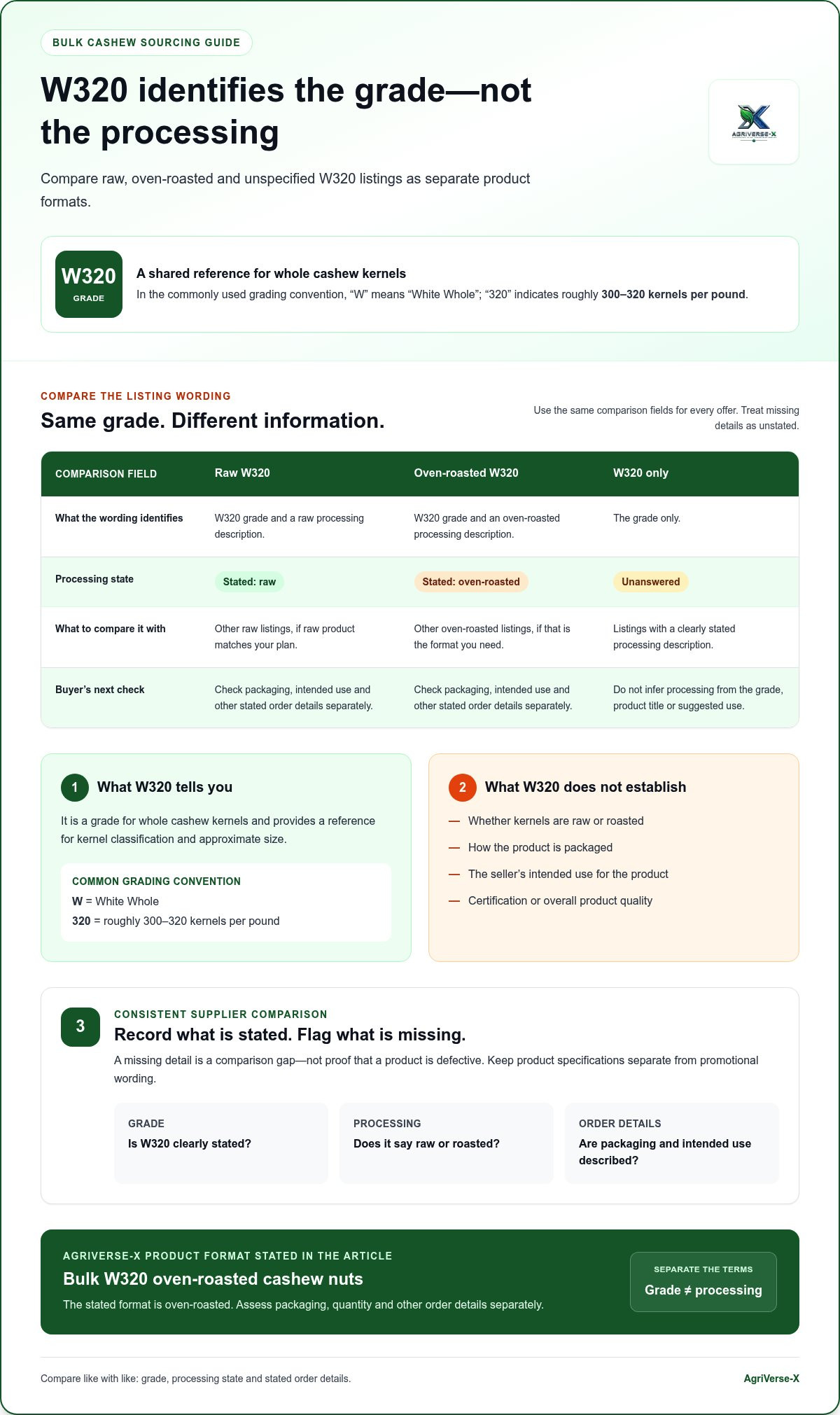
W320 is a grade for whole cashew kernels. In the commonly used grading convention, “W” means “White Whole,” while “320” indicates approximately 300-320 kernels per pound. The grade provides a reference for kernel classification and approximate size, but it does not describe every product attribute a buyer needs to assess.
Keep grade and processing separate. Grade identifies the kernel category and size; raw or roasted describes the processing state. A W320 listing could refer to different product formats, so read the full description rather than treating the grade as a complete specification. For general context on cashews, their cultivation, processing, and uses, see this overview of the cashew nut.
How to interpret W320 in a supplier listing
Read W320 as a grading term, not a complete product description. It gives buyers a shared reference for comparing whole kernels, but does not by itself establish taste, freshness, or suitability for a particular use. Assess the product details alongside the grade when choosing a W320 cashew nuts supplier.
Compare listings with the same grade and processing description before considering other details. A listing that says “W320” and another that says “W320 oven-roasted” do not describe the same processing state, even though both use the same grade label.
What the W320 label does not establish
W320 alone does not tell you whether kernels are raw or roasted, how they are packaged, or what use the seller intends. It is not, by itself, proof of certification or a guarantee of overall product quality. Treat those as separate details to assess in the listing.
Missing information is a comparison gap, not proof that a product is defective. Record what each description states and what it leaves unspecified. This makes differences visible without turning assumptions into facts.
- Grade: Is W320 clearly stated?
- Processing: Does the description identify the product as raw or roasted?
- Other details: Are packaging and intended use described?
Start with the grade, then check processing and the other product details relevant to your order. The label is a useful starting point, not the whole buying decision.
Raw or Oven-Roasted W320 Cashews: Choose the Right Product Format
W320 describes the grade; “raw” and “oven-roasted” describe processing state. Keep those details separate when comparing offers. Two listings can carry the same W320 label while describing different products, so the grade alone will not tell you whether the format matches your purchasing plan.
This distinction matters in procurement. A buyer sourcing cashews for further handling may assess a raw description differently from a buyer seeking an oven-roasted product. Check the stated processing state against your intended use and the next steps in your operation.
| Listing description | What it identifies | Buyer comparison point |
|---|---|---|
| Raw W320 | A W320 grade described as raw | Compare with other raw listings if raw product is what your plan calls for. |
| Oven-roasted W320 | A W320 grade described as oven-roasted | Compare with other oven-roasted listings if that is the format you need. |
| W320 only | The grade, without a clear processing description | Treat processing state as an unanswered comparison detail, not an assumption. |
When raw and roasted descriptions are not interchangeable
Listings may use terms such as “raw whole W320,” “roasted W320,” or simply “W320.” The first two include a processing description; the last states the grade only. Do not infer processing from a product title, suggested use, or other wording in the listing.
The International Nut and Dried Fruit Council outlines cashew grading standards. Use grading references to understand classification, then assess processing descriptions separately. This keeps your criteria clear without treating grade as a claim about taste, freshness, or a particular use.
Matching oven-roasted W320 cashews to buyer needs
Start with your planned use and the handling your operation expects to carry out. If your procurement specification calls for oven-roasted kernels, a listing that says only W320 leaves the processing state unclear. Write down the exact wording you require before comparing supplier offers, and assess packaging, order terms, and other listing details separately.
AgriVerse-X supplies bulk W320 oven-roasted cashew nuts. That is the stated product format. It gives buyers looking for oven-roasted W320 a clear starting point without implying that AgriVerse-X supplies raw W320 or making unsupported claims about packaging, quantity, or other product attributes. AgriVerse-X offers this product through its agricultural commodity and food products distribution.
For a practical next step, compare your required format with AgriVerse-X’s bulk oven-roasted cashew offering, and carry the same product description into your procurement notes. Clear wording makes it easier to distinguish format from the remaining order details.
Compare W320 Cashew Supplier Listings with a Consistent Framework
A comparison is useful when each offer is assessed against the same fields. Record what each listing actually states, separate product details from seller descriptions, and mark gaps as “not stated.” This prevents promotional wording from being mistaken for a product specification.
Align grade, processing state, intended use, and stated order details. This makes differences and unanswered questions easier to identify before you weigh the offers.
| Comparison field | What to record | How to treat missing or unclear details |
|---|---|---|
| Grade | The grade written in the listing, such as W320 | Record the exact wording; don’t infer a grade from a product title or image. |
| Processing state | Whether the listing says raw or oven-roasted | Mark “not stated” if the description gives a grade but no processing detail. |
| Intended use | Any use stated in the product description | Keep seller-suggested uses separate from confirmed product attributes. |
| Packaging | Packaging information explicitly provided | Leave blank or note “not stated” rather than assume a format. |
| Order details | Order quantity or other terms stated in the listing | Compare only details that are actually provided. |
| Seller wording | Subjective terms such as “premium” or “best” | Keep promotional language out of the factual comparison. |
Which listing details help distinguish comparable offers?
Begin with grade and processing. For example, a listing that states W320 and oven-roasted identifies its format more clearly than one that states W320 alone. Next, record intended use, packaging, and order information only when the listing explicitly includes them. If a field is unclear, mark it as unresolved rather than filling it with an assumption.
How to handle inconsistent supplier descriptions
Use the same comparison sheet for every offer. Terms such as “premium,” “top quality,” or “best” are seller wording, not measurable specifications on their own. Seller ratings also do not establish grade, processing state, or packaging. Treat each as a separate piece of information, and do not let promotional language substitute for product details.
For an illustrative comparison, Listing A might state “W320, oven-roasted” while Listing B states only “W320 cashews.” You can record the first listing’s stated processing format, while the second remains unspecified. That does not prove a defect or establish that either offer is better; it shows what can and cannot be compared from the descriptions provided.
Use a simple status for every field: stated, not stated, or ambiguous. Keep the exact listing language in your notes, especially if a term could be seller opinion rather than product information. This lets you compare documented details without blending assumptions, ratings, and claims into one score.
Once the comparison is complete, focus on the fields most important to your order. A clear record distinguishes what the offer says from what remains unanswered and helps you plan the next purchasing step.
Plan a Bulk W320 Cashew Purchase Without Guesswork
A clear purchase brief makes supplier listings easier to compare. Before reviewing offers, write down the grade and processing state you need, your intended use, and the order details that matter to your decision. Apply the same requirements to each listing and mark missing information instead of filling gaps with assumptions.
- Define the intended use. Describe how the cashews will be used in your operation. Decide whether oven-roasted product fits that plan or whether your specification calls for another processing state.
- Confirm the product format. Record the required processing description alongside the grade. For example, state “W320, oven-roasted” if both are necessary, rather than relying on “W320” alone.
- Compare listings on the same fields. Check each description against your brief. Separate stated attributes from seller language, and mark unclear details as unresolved.
- Review the stated order details. Compare packaging, order information, and other terms only where the listing provides them. Keep unstated details blank.
Set the purchase brief before comparing listings
Make the brief specific enough to screen out mismatched offers. Name W320 as the grade sought, state whether the required format is oven-roasted, and keep other grades out of the same comparison. Add the intended use and list the order or packaging details you need to assess. This gives each listing the same reference point.
For example, if your specification calls for oven-roasted W320, a listing that identifies W320 but does not state processing is not yet a like-for-like match. Record the difference without assuming what the seller means. A concise brief also gives colleagues involved in procurement a shared set of requirements.
Review the offer before making a decision
First check the grade and processing description against your written brief. Then review only order and packaging details stated in the specific listing. If information is absent or ambiguous, flag it as a gap before deciding. Do not assume a price, delivery arrangement, stock position, packaging format, or certification.
Use the same notes for every W320 cashew nuts supplier under consideration. A simple status such as “matches,” “doesn’t match,” or “unclear” helps keep the comparison factual and makes it easier to see whether the offer meets your requirements.
With the checklist complete, you can move from browsing to a structured sourcing decision. Explore AgriVerse-X to learn more about its agricultural marketplace and bulk W320 oven-roasted cashew nuts.
Source Bulk W320 Oven-Roasted Cashews Through AgriVerse-X
Move from comparison to a clear procurement decision. Once you have reviewed an offer against your requirements, record the basis for your decision and any order-specific details that remain unresolved. This gives the people involved in purchasing a shared reference for the next step.
What AgriVerse-X supplies
AgriVerse-X’s cashew offer is part of its agricultural commodity and food products distribution. Keep your review tied to the information stated for that offer. In your records, distinguish details taken directly from the product description from your assessment of how the offer fits your business requirements.
This distinction helps maintain a clear purchasing record. Do not fill gaps with assumptions or carry over details from another product listing. If a point matters to your decision but is not described, mark it as unresolved in your records.
Take the next step as a commercial buyer
Before progressing, make sure the relevant people in your purchasing process can see the same decision notes. Capture the offer reviewed, why it fits your requirements, and any open order details. This gives your team a concise reference for its next internal step without treating unstated terms as settled.
For a broader sourcing workflow, explore AgriVerse-X’s agricultural marketplace and consider how it fits your commercial purchasing process. Keep your decision grounded in documented information and your stated requirements.
Move from Product Review to a Clear Sourcing Brief
Turn your evaluation into a procurement brief your team can use. Record the product requirements, the information reviewed, and any details still awaiting a decision. A consistent record gives colleagues a shared reference as the purchase moves through internal review.
For future orders, keep the brief with your purchasing records and update it when your business requirements change. This creates a repeatable process for evaluating offers and carrying clear requirements into the next sourcing cycle.
Build that process around informed commercial decisions. Explore AgriVerse-X and develop a clear, practical approach to agricultural sourcing.
Frequently Asked Questions
What does W320 mean on a cashew supplier listing?
W320 is a commercial grade designation. In the commonly used convention, “W” means “White Whole,” and “320” indicates approximately 300-320 kernels per pound. For procurement records, quote the seller’s grade wording exactly and note the reference your team uses. This helps distinguish a stated grade from shorthand in a listing.
Are W320 cashews always roasted?
No. The grade label alone does not tell you whether kernels are raw or roasted. Make processing state an explicit line in your purchase brief, then check that the offer uses the wording you need. AgriVerse-X’s stated format is oven-roasted. Keep processing language clear in internal records so product reviewers and purchasing staff are working from the same description.
How is W320 different from SW320?
The available information here does not establish a complete, authoritative distinction between W320 and SW320. Do not assume one label can replace the other in a specification or purchasing record. Preserve the exact grade as written, note the source, and record uncertainty separately. This gives your team a clear record without turning an unexplained abbreviation into a product claim.
Does W320 describe the flavour of cashew nuts?
No. W320 is a grade designation, not a flavour guarantee. If sensory characteristics matter to your product development, define them separately from grade and processing. For example, list grade, format, and flavour expectations as distinct criteria in your product brief. This keeps the specification clear without assuming the grade predicts a particular eating experience.
Why do suppliers list raw and roasted W320 cashews separately?
Separate descriptions help buyers distinguish products for different procurement plans. A processor planning additional handling may have different requirements from a buyer seeking kernels already described as roasted. Write the processing state directly into the product brief, and keep any additional preparation requirements distinct. Do not infer a roasting method or other process details unless the listing states them.
Can W320 oven-roasted cashews suit a bulk food order?
They can suit an order if the buyer’s intended use and purchasing requirements align with the stated product format. AgriVerse-X’s described offering is oven-roasted, so assess it against your ingredient or product brief. Before finalising an internal request, document the intended application and the order details your team requires. Do not infer pack sizes, availability, or other specifications from the grade or format.
What should a buyer compare before choosing a W320 cashew offer?
Compare each offer against your written purchasing requirements, distinguishing stated details from promotional language. For a W320 cashew nuts supplier, record the exact description reviewed, the intended use, and any unresolved order questions. This makes the decision easier to explain internally and helps prevent seller wording from being mistaken for a specification your business requires.


