

Reliability is demonstrated through consistent quality, clear documentation, and dependable supply, not a supplier’s claims alone. To assess reliable agro commodity suppliers for oils and fats, match the product grade to its intended use, review quality and certification evidence, and determine whether the supplier can meet your volume and delivery requirements.
Expect suppliers to provide clear information about product specifications, safety practices, stock, and order status. This guide explains how to review quality assurance and certification claims, assess business credentials and supply capacity, and organise agreements and transaction records. It also covers practical ways to manage delays and supply interruptions, helping you make informed sourcing decisions.
Key Takeaways
- Match each oil or fat’s stated grade and intended use to your purchasing requirements before comparing offers.
- Assess quality assurance and certification claims through relevant product documentation and evidence of applicable safety practices.
- Review a supplier’s credentials, business history, warehousing, and record of meeting order volumes and requirements.
- Set clear expectations for stock updates, potential delays, contracts, payment terms, and delivery responsibilities.
- Learn about AgriVerse-X’s agricultural marketplace and its intended role in supporting connections between buyers and commodity listings, including oils and oilseeds.
Quality assurance and certification claims
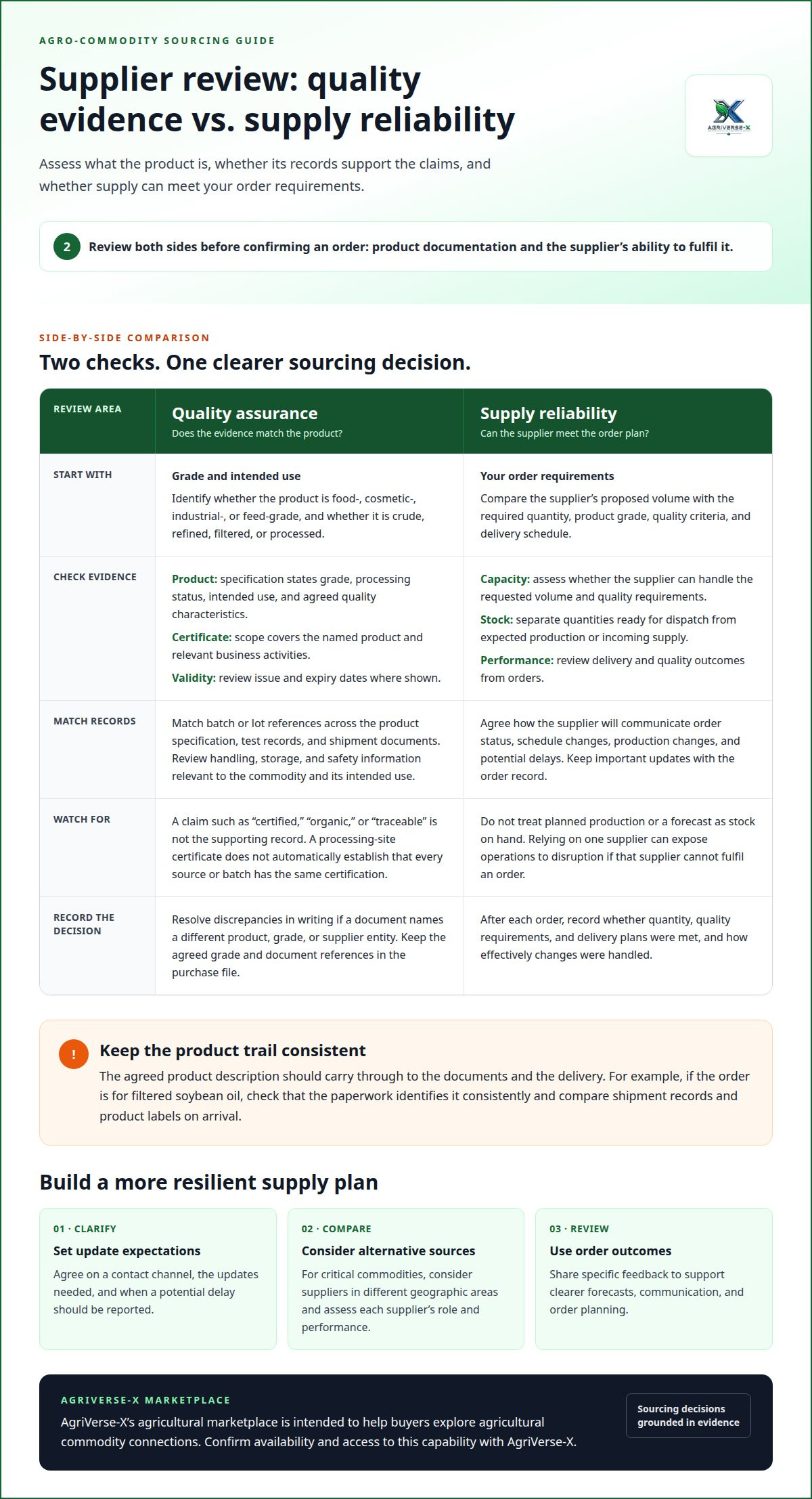
Start by defining the oil or fat’s grade and intended use. A listing should distinguish food-grade, cosmetic-grade, industrial-grade, and feed-grade products, and state whether the oil is crude, refined, filtered, or processed. For example, a buyer sourcing crude palm oil needs documentation that identifies it as crude oil, not a general claim about “premium oil.” Clear product identification helps prevent a grade mismatch before discussions progress.
Match the supplier’s quality documents to the specific commodity and transaction. Verify that the supplier meets safety requirements relevant to the agro-commodity being procured. Request documents identifying the product, producer or supplier, relevant batch, and date. A certificate bearing only the supplier’s name may not show that its scope covers the specific oil or shipment.
- Product specification: Confirm the stated grade, processing status, intended use, and any agreed quality characteristics.
- Certificate scope: Check that the named product and business activities fall within the certificate’s stated coverage.
- Validity: Review issue and expiry dates, where shown, and ensure the document applies to the relevant transaction period.
- Batch connection: Match batch or lot references across the product specification, test records, and shipment documents.
- Safety information: Review handling, storage, and safety documentation relevant to the commodity and its intended use.
Separate claims from evidence. “Certified,” “organic,” or “traceable” describes a claim, not the record that supports it. Request the relevant document and review its scope. For example, certification for a processing site does not automatically prove that every oilseed source or batch has the same certification.
For an unfamiliar product, agree on the required evidence before confirming an order. This may include a product specification, applicable certificates, and batch-linked test records. If a document names a different product, grade, or supplier entity, resolve the discrepancy in writing. A clear record gives purchasing, quality, and receiving teams a common reference when checking the delivery.
Connect documentation to the receiving process. Record the agreed grade and document references in the purchase file. On arrival, compare them with the shipment records and product labels. If the delivery is described as filtered soybean oil, for example, the paperwork should identify it consistently. This document trail supports faster review and clearer decisions when a shipment differs from the agreed description.
Supplier reliability and stock availability
Reliable supply takes more than a single statement about stock. Assess whether a supplier can consistently handle your order volume while meeting the agreed quality requirements. For soybean oil, for example, discuss the requested volume, product grade, delivery schedule, and how the supplier will communicate changes. These details show whether the proposed arrangement fits your operational needs.
Distinguish current stock from expected production. Ask which quantities are ready for dispatch and which depend on future production or incoming supply. For recurring orders, discuss the production schedule and how the supplier will manage competing commitments. This helps purchasing teams plan inventory without treating a forecast as stock on hand.
Set communication expectations before placing an order. Agree on a contact channel, the updates you need, and when the supplier should report a production change or potential delay. Regular updates help receiving teams adjust storage, processing, or production plans. Keep important messages with the order record so purchasing and operations staff share the same information.
- Capacity: Compare the supplier’s proposed volume with your order requirements and quality criteria.
- Stock status: Distinguish ready-to-ship quantities from planned production or future supply.
- Updates: Agree how order status, schedules, and potential delays will be communicated.
- Performance: Review delivery and quality outcomes after each order, then share specific feedback.
Review performance against the requirements agreed for each transaction. Record whether quantities arrived as planned, product requirements were met, and the supplier handled changes effectively. Constructive feedback gives both parties a practical basis for improving forecasts, communication, and order planning. Suppliers who consistently meet or exceed expectations may be considered for long-term contracts or preferred supplier status.
Build resilience into your sourcing plan. Relying on one supplier can expose operations to disruption if that provider cannot fulfil an order. Consider diversifying across geographic areas and identifying an alternative source for critical commodities. If one supplier cannot provide an agreed oilseed quantity, for example, another qualified supplier may help maintain continuity. Clarify each supplier’s role and assess performance across the network.
AgriVerse-X’s agricultural marketplace is intended to help buyers explore agricultural commodity connections. Availability and access to this capability should be confirmed with AgriVerse-X. Use supplier capacity, stock updates, communication, and delivery performance as practical measures when evaluating whether a sourcing relationship supports your requirements.
How to verify an agricultural commodity supplier's credentials and business history?
Begin by checking the supplier’s legal identity. Compare the registered business name with the name on its quotation, contract, invoice, and payment instructions. If it uses a trading name, identify the legal entity responsible for fulfilling the order. Consistent names across these records help distinguish the contracting business from a broker, agent, or unrelated payment recipient.
Review the supplier’s registration and stated business activities using the relevant business records for its jurisdiction. Confirm that the entity is active and its declared operations align with commodity trading or handling. Keep a dated record of the result and the details reviewed. For cross-border purchases, establish which entity is responsible for exporting, selling, or delivering the goods.
Past transactions can demonstrate operating experience. Ask for references from buyers who completed comparable commodity purchases, and review records showing the supplier’s role. A supplier with a history of soybean sales, for example, may provide more relevant evidence for a soybean purchase than one whose records cover only machinery. Focus on whether references describe completed transactions and consistent business identities.
- Entity identity: Match the registered business and trading names across commercial records.
- Operating history: Review relevant completed transactions and buyer references.
- Business capacity: Consider available financial records and the supplier’s documented operating arrangements.
- Storage connection: Establish which facility holds the goods and how it relates to the supplier.
Assess financial stability using available business information, such as financial statements, documented payment arrangements, and trade references. Consider these details alongside the proposed transaction structure rather than relying on sales assurances. A supplier who can clearly describe its business and provide consistent records helps buyers understand the commercial relationship before committing.
To verify a warehouse, establish the facility’s name, location, operator, and connection to the supplier. Where practical, arrange a site visit or independent inspection before dispatch. Compare warehouse records with the supplier’s transaction documents to confirm that the stated goods are held at the identified facility. An address alone does not establish who controls the inventory or is authorised to sell it.
Keep identity checks, reference notes, registration details, and warehouse information in one supplier file. Update it if the contracting entity, payment recipient, or storage arrangement changes. This creates a useful record for future procurement reviews and helps your team distinguish established business evidence from unsupported claims.
What contracts, payment terms, and Incoterms are common when buying agricultural commodities?
Put every key commercial agreement in a written contract or purchase order. Identify the contracting parties, commodity, grade, quantity, delivery schedule, destination, and agreed documents. For example, a soybean contract should state whether the goods are intended for food, feed, processing, or another use. Clear product and delivery details give both parties a shared transaction reference.
Make payment terms precise. State the payment method, currency, due date, and event that triggers payment. That trigger could be contract signing, dispatch, presentation of agreed documents, or receipt of goods. If payment is staged, describe each stage and its conditions. Avoid vague phrases such as “pay on delivery” without defining delivery and the records that demonstrate completion.
Incoterms identify agreed responsibilities for delivery, costs, and transport risk. State the chosen term alongside its named place or port and applicable edition. Without a precise location, the parties may be uncertain about where responsibilities change. Incoterms do not replace the commodity contract, payment schedule, product specification, or agreements on ownership and dispute handling.
- Commodity details: Name the product, grade, intended use, quantity, and quality documents.
- Delivery plan: Record the delivery window, destination, packaging, and transport responsibilities.
- Payment: Specify currency, payment method, due date, and each payment trigger.
- Documents: List records required for dispatch, delivery, payment, and receipt.
- Exceptions: Explain how the parties will communicate delays, shortages, or non-conforming goods.
For a sesame seed shipment, the contract could link the agreed quantity and grade to shipment records and receiving documentation. For edible oil, it could specify processing status and the records accompanying delivery. These are examples of clear drafting, not universal contract terms. Align each clause with the commodity, route, and transaction.
Keep the final contract, purchase order, amendments, invoices, payment confirmations, and delivery records together. File the supplier’s order updates with the same transaction documents. If the schedule or quantity changes, record the revised agreement and its date. This gives purchasing, finance, and receiving teams a usable record and reduces confusion about what the parties agreed.
Before signing, review the contract alongside the payment instructions and transport terms. Confirm that the buyer, seller, receiving location, and product description are consistent across documents. Clear written agreements help reliable agro commodity suppliers and buyers coordinate expectations, resolve discrepancies, and maintain an accessible transaction history.
Where can U.S. buyers find reputable suppliers for grains, oilseeds, pulses, and animal feed?
For oils and fats, U.S. buyers can explore oilseed processors, agricultural commodity traders, producer cooperatives, and food ingredient distributors. Each channel serves a different sourcing need. A processor may offer oil derived from specified seeds, while a cooperative can connect buyers with producer supply. Ingredient distributors may suit businesses seeking products prepared for particular commercial uses.
Start with the oil or fat category. Buyers seeking soybean, sunflower, sesame, or groundnut oil can look for suppliers focused on those oilseeds or their processed products. For palm oil, coconut oil, shea butter, or canola oil, relevant processors and commodity traders may be a more direct starting point. Match the supplier’s product focus to the material and its intended application.
Agricultural marketplaces offer another way to discover suppliers. Search listings by product type, processing status, intended grade, and seller profile. Use the description to distinguish crude, refined, filtered, or processed oils and identify whether a product is intended for food, cosmetic, industrial, or feed use. Treat marketplace search as a way to find potential commercial connections, not a substitute for assessing the specific transaction.
- Oilseed processors: Explore suppliers focused on converting oilseeds into edible oils or by-products.
- Producer cooperatives: Find connections to growers and groups handling oil-bearing crops.
- Commodity traders: Search for businesses dealing in oilseeds, crude oils, or refined products.
- Food ingredient distributors: Identify suppliers serving manufacturers with specified oil or fat categories.
- Agricultural marketplaces: Discover listings across products, seller profiles, and supply-chain participants.
Shape your search around the intended use. A food producer seeking refined sunflower oil needs a different listing from a manufacturer sourcing industrial-grade castor oil. A buyer looking for shea butter should search for that product directly rather than assume it appears under edible oils. Precise category terms help surface relevant suppliers and reduce mismatches between product names and intended use.
Use multiple discovery channels to build a sourcing pipeline. A processor, cooperative contact, and marketplace listing can offer different perspectives on origin and supply routes. Keep initial inquiries focused on product identity, intended grade, processing status, and required volume. This gives each potential supplier a clear basis for responding and helps buyers organise relevant opportunities.
For U.S. buyers, supplier discovery works best when the channel matches the oil or fat category and business use. Build a focused shortlist from processors, cooperatives, traders, distributors, and marketplace listings. Then apply the quality, capacity, and transaction criteria covered in this guide to each opportunity.
What Makes AgriVerse-X a Unique AgriTech Platform
AgriVerse-X is designed to connect agricultural buyers with marketplace listings and professional or technical service profiles. This could be a practical option when commodity sourcing also requires specialist support, such as laboratory testing, agronomy, or procurement services. Buyers may be able to explore relevant profiles and services within a broader agricultural ecosystem as these capabilities develop.
For example, a buyer assessing a crop supply may need laboratory testing, certification support, or export documentation alongside procurement services. A grower planning irrigation may seek irrigation design, soil science, or environmental assessment. The planned digital profiles are intended to let service providers showcase their skills, services, and certifications, helping buyers identify expertise relevant to their needs.
Potential professional and technical service listings could include:
- Crop and soil support: Agronomy, soil science, crop scouting, and agricultural research.
- Business operations: Farm accounting, farm auditing, business planning, market research, and cooperative management.
- Technical work: Irrigation design, machinery repair, drone operations, and laboratory testing.
- Specialist documentation: Certification support and export documentation.
- Animal and risk-related services: Veterinary services, animal nutrition, and agricultural insurance advice through licensed providers.
- Additional expertise: Environmental assessment, procurement services, agricultural legal services, and farm security and monitoring.
If developed as intended, the platform’s structure could help buyers connect a specific need with a relevant service profile. A cooperative organising procurement, for instance, could seek procurement support and cooperative management expertise. An agribusiness reviewing crop conditions could look for crop scouting or agronomy. These are illustrative uses, not confirmed current capabilities, guaranteed outcomes, or endorsements of individual providers.
Digital profiles, if available, would present service information but would not replace independent due diligence. Before engaging a provider, verify relevant professional qualifications, licences, insurance, and local authorisation. This is especially important for veterinary services, agricultural legal services, insurance advice, and drone operations, where work may require qualified professionals, licensed providers, or local permissions. Requirements vary by service and location.
As these capabilities develop, AgriVerse-X may be relevant when your sourcing process needs more than a commodity listing and you are looking for agricultural expertise. If marketplace connections or service listings become available, review the service category and provider profile against your project requirements, then establish the scope directly with the provider. Contact AgriVerse-X to discuss planned agricultural marketplace connections or professional and technical service listings.
Turn supplier assessment into a stronger sourcing process
Finding reliable agro commodity suppliers is only the beginning. Next, build a sourcing process that keeps product requirements, supplier communication, and purchasing decisions aligned as your business grows. Clear internal records help your team carry expectations from the first enquiry through an ongoing commercial relationship.
AgriVerse-X is developing an agricultural marketplace intended to help buyers and agricultural participants connect around commodity needs. If this capability becomes available, buyers may be able to use it as a starting point to explore sourcing connections for oils and fats. Keep your purchasing criteria clear, then apply an assessment process suited to the transaction and intended use.
For a direct next step, contact AgriVerse-X about sourcing. Bring your product category and business requirements into the conversation, and move forward with a more organised approach to agricultural procurement.
Frequently Asked Questions
What makes an agro commodity supplier reliable?
A reliable supplier supports a clear working relationship, not just a completed sale. Before regular purchasing begins, identify who manages the account, handles order changes, and escalates unresolved issues. Agree how substitutions will be approved so an alternative oil or processing type is not accepted without the buyer’s consent. These practical controls help teams manage repeat orders with fewer misunderstandings.
Which certifications and quality standards should agro commodity suppliers meet in the United States?
The appropriate standards depend on the oil or fat, its intended use, and the buyer’s requirements. Distinguish mandatory requirements for the transaction from voluntary certifications that support procurement goals. A buyer sourcing cosmetic-grade oil, for example, may have different criteria from a food manufacturer. Document the standards your organisation requires, then use qualified expertise to interpret those applicable to the product and transaction.
How can buyers check commodity quality, grade, origin, and traceability?
Ask suppliers to describe the product’s route from where it is produced through processing and distribution. Distinguish where an oilseed was grown from where it was pressed, refined, or blended. For blended products, request a clear account of the contributing sources. This origin map gives procurement teams a more useful picture than a single country name and helps align sourcing records with internal reporting needs.
What are the best ways to compare agricultural commodity suppliers, including delivery capacity and minimum order quantities?
Make supplier offers comparable by asking how the minimum order quantity is measured. It may apply to one product, one shipment, or a purchasing period, so define the basis before comparing. Also clarify whether different oil types or grades can be combined in an order. A buyer needing several oils, for example, should compare the supplier’s terms for each item rather than rely on one overall minimum.
How can buyers assess supplier risks such as fraud, contamination, price volatility, and supply disruption?
Build controls around specific risks. Confirm changes to payment instructions through a contact method already established with the supplier, not only through a new email. Ask how suspected contamination is isolated and affected lots communicated. For price changes, define in advance how adjustments will be calculated. Set substitution approval rules so a supply problem does not silently change the product your business receives.


