

Export buyers assess soybean quality by looking at moisture, purity, foreign material, size and uniformity, nutritional composition, storage condition, traceability, and required shipment documents. Soybean quality standards for export depend on the buyer’s specifications and the destination market, so a lot that meets one contract may not meet another. Clean, dry, well-documented beans are easier to assess and handle throughout the supply chain.
Quality is about more than appearance. Protein and oil content can matter to processors, while moisture, contamination, and storage conditions affect the beans during transit. Traceable sourcing and relevant certification can also help buyers understand how the soybeans were produced and documented.
This guide explains the physical and nutritional factors buyers assess, how storage and sampling affect quality checks, and what certification and traceability contribute to market access. You’ll get a clearer picture of the checks that help prepare a soybean shipment for buyer review.
Key Takeaways
- Assess moisture, cleanliness, size, and uniformity together to spot quality issues that can affect handling and buyer acceptance.
- Match nutritional testing to the intended use, since processors may weigh protein and oil content differently from other quality factors.
- Keep sourcing and shipment records connected so buyers can follow the lot from its farm origin through export.
- Understand how sampling, testing, and inspection work so quality results represent the shipment being prepared.
- Review destination-market documentation and certification needs early, as they shape market access alongside the beans’ physical condition.
Certification and international market access
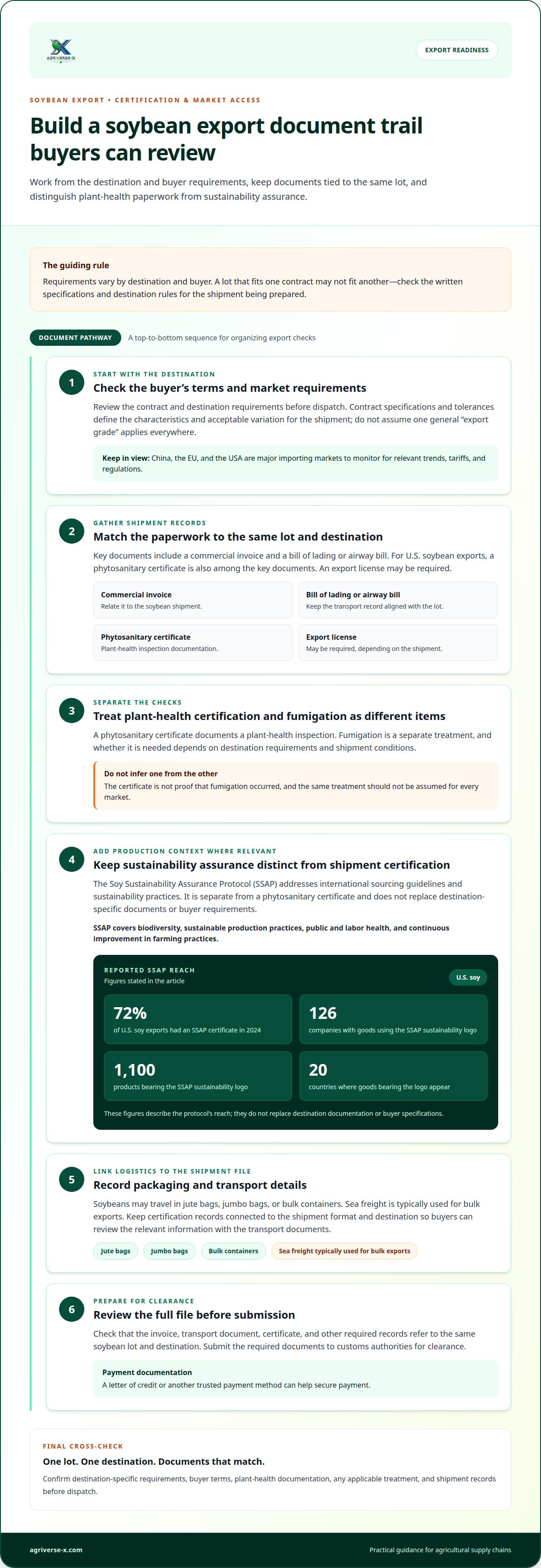
Export access depends on matching shipment documents and any buyer-requested assurance to the destination market. For U.S. soybean exports, a phytosanitary certificate is among the key documents. Fumigation requirements depend on the destination and shipment conditions.
Export Certification Requirements
Export certification documents record shipment details and provide evidence for buyer and border reviews. A commercial invoice and bill of lading or airway bill are also key documents. An export license may be required, while a letter of credit or another trusted payment method can help secure payment. Submit the required documents to customs authorities for clearance.
Keep every document aligned with the same shipment and destination. For example, the invoice, transport document, and certificate should relate to the soybean lot being exported. China, the EU, and the USA are major importing markets to monitor for relevant trends, tariffs, and regulations. Requirements vary by destination and buyer.
Phytosanitary and Fumigation Requirements
A phytosanitary certificate documents a plant-health inspection for an export shipment. For U.S. soybeans, include it among the key export documents. Fumigation is a separate treatment, and whether it is needed depends on destination requirements and shipment conditions. Do not treat the certificate as proof that fumigation occurred or assume the same treatment applies to every market.
Build the document check around the intended destination. Confirm which shipment records, plant-health documents, and treatments apply before dispatch. This helps prevent a paperwork gap from being mistaken for a product-quality problem.
Sustainability assurance is another market-access consideration, but it serves a different purpose from shipment certification. The Soy Sustainability Assurance Protocol, or SSAP, began in 2013 to address international sourcing guidelines. It verifies that U.S.-produced soybeans and soy products comply with sustainability and conservation laws and regulations, alongside farmer participation in the U.S. Farm Program, administered by the Farm Service Agency under the U.S. Department of Agriculture.
SSAP covers biodiversity, sustainable production practices, public and labor health, and continuous improvement in farming practices. Sustainability assurance can help give international buyers context about soybean production practices. SSAP is distinct from a phytosanitary certificate, which is a separate export document.
In 2024, 72% of U.S. soy exports had an SSAP certificate. The SSAP sustainability logo is used on goods from 126 companies, appears on 1,100 products, and marks goods in 20 countries. These figures show the protocol’s reach, but they do not replace destination-specific documentation or buyer requirements.
Plan packaging and transport as part of the export process. Soybeans may travel in jute bags, jumbo bags, or bulk containers, and sea freight is typically used for bulk exports. Keep certification records linked to the shipment format and destination so buyers can review the relevant information alongside transport documents.
Moisture, purity, seed uniformity, and storage
Export contracts define the condition a buyer expects and the variation they will accept. U.S. soybean export limits for moisture, damaged kernels, foreign material, and splits are contract-specific, not one universal set of figures. Read each term in the agreement before evaluating a lot.
Contract Specifications and Tolerances
Contract specifications state the required characteristics, while tolerances describe acceptable variation. Together, they give the exporter and buyer a shared basis for reviewing a shipment. Check whether the agreement treats moisture, damaged kernels, foreign material, and splits as separate measures. Interpret soybean quality standards for export against the written terms, not an assumed general grade.
Keep the agreed limits and reported results together in the lot file. For example, if the buyer sets separate requirements for moisture and splits, record each result against its own contract term. A broad label such as “export grade” does not show which criteria were assessed or whether each meets the agreed tolerance.
Moisture, Purity, and Seed Uniformity
Moisture describes water content, purity concerns unwanted material, and uniformity refers to consistency in seed size. Buyers may assess these characteristics separately because each affects how well a lot matches its specifications. Use the buyer’s terms to understand what each result means for the transaction.
Low moisture helps reduce the risk of mold and spoilage during storage. A warehouse should be free of moisture and pests, and storage conditions should protect the beans from dampness and infestation. When soybeans move between locations, keep the lot identified so its storage history remains linked to the beans under contract.
Purity checks focus on material that is not soybean, such as stones, chaff, or other foreign matter. Record the type of material and the affected lot. If cleaning is needed, document the handling and reassess the beans against the contract. This keeps a purity issue distinct from moisture concerns or size variation.
Uniform seed size can matter when buyers specify size or consistency. A lot that looks mixed may need closer assessment against those terms, but appearance alone cannot establish whether it meets the buyer’s requirement. Keep size results linked to the correct lot, especially if beans are sorted or combined before shipment.
Storage can change the condition of soybeans after an earlier assessment. Recheck the lot after storage and before loading, particularly if it has been transferred or consolidated. If separate batches are combined, maintain the link between the resulting lot and its source records. This supports an accurate comparison with the contract without assuming an earlier result represents every later handling stage.
Before dispatch, compare the current condition with the contract terms. If moisture, purity, or size raises a concern, keep the affected beans identifiable while you address it. Clear lot records show which material was assessed and how the final shipment relates to the agreed specifications.
Physical and nutritional soybean quality parameters
Physical condition and nutritional composition describe different aspects of soybean quality. If exported beans fail to meet specifications, the contract and inspection findings determine the next steps and who bears related costs. Cost allocation varies by shipment and depends on the agreed terms.
Physical assessment focuses on a lot’s condition and suitability for its intended use. Moisture, purity, and seed size are considered alongside nutritional results, but each measure answers a different question. For example, a protein result describes composition, while a purity result describes what is present in the lot.
Protein is a major nutritional measure for soybean buyers. Average soybean protein is approximately 36-40 g per 100 g, and beans can contain up to 40% protein. Soybeans also contain all nine essential amino acids. These figures help explain their nutritional value, but they do not establish that a particular export lot meets a buyer’s contract.
Oil content is another relevant composition measure. The average fat content is approximately 18-20 g per 100 g. Buyers considering beans for processing may assess this result alongside protein and physical condition. A reported average gives context, while a sample from the shipment provides information about the lot under review.
Other reported averages add useful context. Soybeans contain approximately 30 g of carbohydrates and 9 g of dietary fiber per 100 g, with approximately 446 kcal per 100 g. These values describe general nutritional composition. They should not be confused with shipment-specific test results or treated as quality limits unless the contract uses them.
Compare every laboratory result with the buyer’s stated specification. A practical review keeps each measurement separate:
- Protein: compare the lot result with the buyer’s protein requirement.
- Fat: review the oil-related result where relevant to the intended use.
- Carbohydrates and fiber: treat the average composition figures as context, not shipment measurements.
- Energy: use the reported average of approximately 446 kcal per 100 g as nutritional context.
Sampling connects these measures to a physical shipment. A result from one sample represents only the material sampled, so keep the sample’s lot identity clear. If separate lots are combined, their earlier results cannot automatically represent the combined shipment. Compare the buyer’s specifications with the shipment’s test records.
When a test falls outside an agreed specification, the written contract governs the response and cost allocation. It may explain how inspection results are handled and which party is responsible for an agreed remedy. Review those clauses alongside the relevant test report. Do not assume the exporter or buyer always bears every expense.
Nutritional figures support, but do not replace, contract-based grading. For example, protein near the reported average does not resolve a separate concern about a lot’s physical condition. Assess each measurement against its corresponding requirement, then link the findings to the correct lot and contract before shipment.
Soybean sourcing and traceability
A traceable soybean lot has a documented connection to its farm source. That link helps buyers understand where the beans originated and how separate batches became the shipment under review. A farm name is only a starting point; useful records also connect the source to a specific lot and its movement through handling.
Build the record around the physical flow of the beans. For example, note the farm or producer, lot identifier, collection point, and any transfer into storage. If soybeans from separate farms are combined, record which sources contributed to the new lot. Otherwise, the shipment may appear to have one origin when its contents came from several sources.
Use one consistent lot identifier across all records. A label such as “Lot A” should refer to the same beans in the source, storage, sample, and shipment records. If the lot is split, give each resulting batch a distinct identifier and preserve its link to the parent lot. This makes the chain easier to follow without confusing batches.
Useful traceability records can identify:
- Origin: the farm or producer associated with the soybeans.
- Lot: a unique identifier connecting the beans to their records.
- Handling: collection, transfer, storage, or consolidation events.
- Evidence: documents or entries supporting each recorded event.
- Shipment: the lot identifier carried into the export file.
For example, a cooperative collecting soybeans from several members can keep a source entry for each delivery. If those deliveries are later consolidated, the combined lot record can preserve the contributing farm sources. The same principle applies when a trader transfers beans to a warehouse: record the transfer against the relevant lot rather than creating an unconnected entry.
Traceability supports buyer review, but it is not the same as certification. A record showing a farm source does not by itself prove crop quality, sustainability, or compliance. Those conclusions require separate evidence and assessment. Keep origin records distinct from test results and certificates so each document supports the claim it actually addresses.
Digital agricultural records can make this chain easier to organize. A clear entry can connect a source, lot, handling event, and supporting document in one record trail. Use names consistently: “North field,” “North Farm,” and a producer’s formal name should not be treated as interchangeable without a clear link. Matching identifiers reduces ambiguity when buyers review shipment files.
Review the trail before export. Start with the farm source, follow each transfer, and confirm the shipment record refers to the same lot. If a source or movement entry breaks the chain, correct it using supporting evidence. A traceable farm source gives buyers a clearer view of origin and helps exporters answer questions about the shipment’s documented history.
How are soybean quality factors sampled, tested, and graded before export?
Before shipment, sampling links a test result to the cargo an inspector or buyer evaluates. Authorized agencies inspect soybeans before shipment to check compliance with the importing country’s quality and safety norms. Compare the results with destination requirements and the buyer’s contract, keeping regulatory inspection distinct from commercial grading.
Start with a defined lot. Assign the cargo an identifier and record which stored or assembled beans it covers. If the shipment includes separate lots, keep their identities distinct during sampling. If lots are combined, document the consolidation before taking a sample. This prevents a test result from being assigned to beans it did not represent.
Plan sampling around the cargo’s condition and presentation. Collect portions from across the lot rather than relying on one convenient spot. For bagged cargo, account for bags in different parts of the consignment. For bulk cargo, consider how the beans are positioned and loaded. The sampling plan should reflect the actual shipment, not an assumed uniform pile.
Keep the sample linked to its source throughout testing. Record the lot identifier, collection location, date, sampler, and relevant shipment reference. Place the sample in a clean, closed container and label it clearly. If you retain a sample for comparison, identify it separately. These records help distinguish one result from another lot or a later sample.
Testing should follow the agreed inspection or laboratory procedure. The report needs to identify the sample and show results in a form that can be compared with the contract. Keep it with the lot file, not only with general shipment paperwork. If the buyer and exporter receive different results, sample identifiers and collection records help establish whether both assessed the same cargo.
Grading applies the relevant specifications to test findings. Compare each result with its matching contract term, then record whether the lot meets the agreed grade or needs further review. Do not substitute a general description for this assessment. A written decision should identify the specification applied and the evidence used.
Timing matters. Complete the assessment close enough to shipment that the sample still represents the cargo being loaded. If the lot changes after sampling through movement, mixing, or replacement, reassess the affected shipment portion. This avoids relying on an earlier report for beans that no longer match its sample.
Finally, prepare the inspection record for the authorized agency’s review. Keep the lot description, sample identification, test report, grading decision, and shipment reference aligned. The agency’s inspection addresses the importing country’s quality and safety norms, while the buyer’s contract defines commercial terms. A clear sequence from lot identification to final grade makes the evidence easier to interpret.
AgriVerse-X: Verified Agricultural Digital Marketplace
AgriVerse-X helps soybean sellers present products and supporting records through verified digital profiles. Farmers, agribusinesses, and cooperatives can showcase products, services, skills, and certifications, while the platform supports agricultural marketplaces and digital traceability records.
For soybean exporters, connected records can help organize product information alongside its source and shipment history. They do not replace laboratory results, inspections, or destination-specific export documents. Use them as part of a broader recordkeeping process, with each entry clearly linked to the relevant lot.
Turn to AgriVerse-X when you want to present agricultural products and keep their supporting information organized digitally. Visit agriverse-x.com to learn more, or contact AgriVerse-X.
Make Export Readiness Part of Every Soybean Deal
Make export preparation a repeatable process, not a final check before loading. Set up a workflow linking each buyer’s expectations to the lot, its records, and the shipment plan. This gives your team a practical starting point when a new contract, destination, or sourcing arrangement changes the requirements. It also keeps commercial decisions grounded in the specifications that matter for the transaction.
The soybean quality standards for export are most useful when they guide decisions early, from sourcing through shipment preparation. If you’re exploring soybean sourcing or agricultural trade connections, learn how AgriVerse-X may fit your needs. Contact AgriVerse-X about soybean sourcing and discuss a practical next step for your business. Build a more organized export process, strengthen your records, and move forward with clarity.
Frequently Asked Questions
What Are Soybean Quality Parameters?
Soybean quality parameters are measurements and documented attributes used to compare a lot with its intended use and purchase terms. Read them as a quality profile, not a single pass-or-fail score. A processor may prioritize characteristics relevant to processing, while a buyer seeking identity-preserved soy may focus on source records. Keep measured test results separate from claims about origin or production method, as each requires different supporting evidence.
What are the U.S. soybean export limits for moisture, damaged kernels, foreign material, and splits?
Numerical limits for these factors depend on the governing contract and its stated grading basis. Read the relevant clauses together, including how the contract defines each factor and the allowed tolerance. If a term appears in an inspection report but not in the buyer’s agreed specifications, clarify how the parties will interpret it before shipment. The contract, not a general label, provides the basis for comparing results.
What export documentation and certifications are required for U.S. soybeans?
Required paperwork depends on the transaction and destination, so organize it as a shipment-specific file. Match the seller, buyer, product description, lot reference, and destination across the records. This consistency check can reveal mismatched details before submission. Keep certification evidence distinct from commercial paperwork, and ensure each record supports the claim or transaction detail for which it is used.
How do soybean quality standards differ by destination country and buyer contract?
Destination rules and buyer terms can set different acceptance conditions for the same type of beans. Compare the purchase agreement with the destination’s applicable import requirements, then identify any conflicting or additional conditions. For example, a buyer’s preferred grade may not address every border requirement. Keeping both sets of terms visible helps exporters plan documentation and avoid treating one buyer’s specifications as a universal market rule.
How do GMO, non-GMO, and organic requirements affect soybean export standards?
These designations can add identity and sourcing conditions to a soybean transaction. Buyers may require records linking the stated product status to the relevant lot, rather than relying on general supplier claims. Keep batches with different status claims identifiable during handling, and align product descriptions with supporting records. The exact evidence and terms depend on the buyer’s agreement and applicable destination requirements.


