

Yam flour is naturally gluten-free, making it suitable for many gluten-free diets, and choosing a yam flour bulk supplier can help you compare larger purchasing options with retail packs. For anyone avoiding gluten for medical reasons, the product’s ingredients and handling information matter alongside its main ingredient.
Bulk buying may suit regular cooking or food preparation, while retail packs let you purchase smaller quantities. Choose based on how often you use yam flour, how much you can store, and whether the product meets your needs.
This guide explains how to assess gluten-free suitability, compare yam flour, and weigh retail against bulk purchasing. It also covers varieties, storage, and practical steps for choosing a supply option.
Key Takeaways
- Assess gluten-free suitability by reviewing ingredients and handling information, not just the flour’s main ingredient.
- Compare retail packs with carton quantities against your usage rate and storage capacity before choosing a purchase size.
- Learn how white yam, water yam, and pounded yam flour differ so you can match the flour to your intended dish.
- Use supplier documentation and clear product details to evaluate food-safety practices and product traceability.
- Understand how dry storage conditions affect shelf life, including the one-year shelf-life figure listed for Nigerian yam flour.
Retail and bulk purchasing
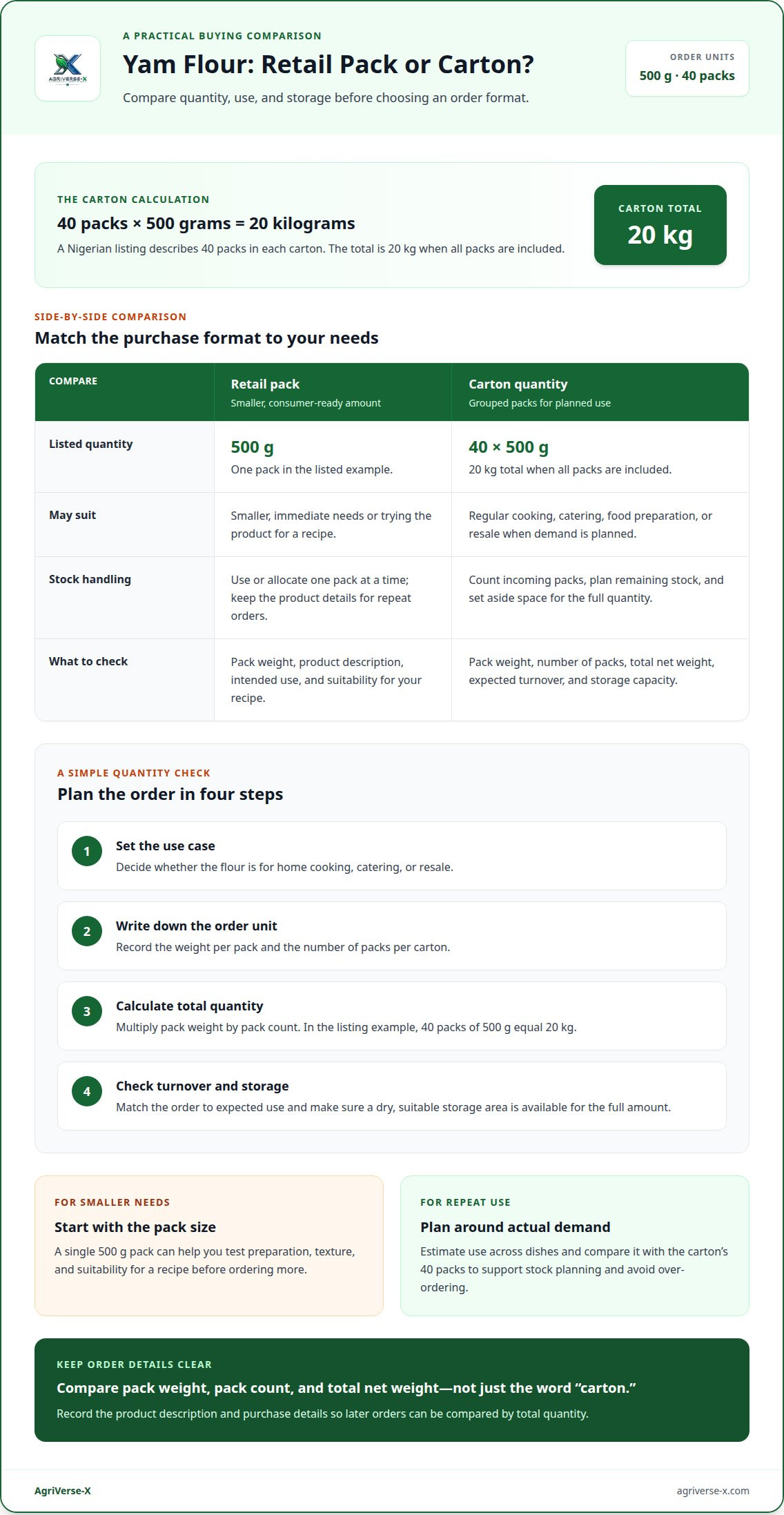
Retail purchasing means buying yam flour in a small, consumer-ready pack. Bulk purchasing means buying several packs together for regular use, food preparation, or resale. A Nigerian listing describes 500-gram packs, with 40 packs in each carton. That equals 20 kilograms of packaged flour when all packs are included.
Choose your buying format by matching quantity to actual use. A household preparing amala occasionally may prefer one 500-gram pack. A caterer serving the dish regularly could plan around a carton of 40 packs. A food business can estimate its usage across menu items before selecting a larger shipment.
Start with the unit, then compare the full order quantity. A 500-gram pack is easy to count and allocate. A 40-pack carton makes the total quantity clear, but it requires space for the full 20 kilograms. Record the pack size, pack count, and total net weight together when comparing offers.
Before buying a retail pack, define how you plan to use it. A single pack can help you test preparation, texture, and suitability for a recipe before ordering more. Keep the product details so you can match them when reordering.
For bulk purchasing, calculate demand before ordering. List the expected dishes, the number of servings, and how often each dish is prepared. Then compare that demand with the carton’s 40 packs. This simple estimate helps prevent over-ordering and makes stock planning easier for a restaurant or community kitchen.
A yam flour bulk supplier should make the order unit understandable. Compare whether an offer describes individual packs, a carton, or a larger shipment. For example, “40 packs of 500 grams” is clearer than “one carton” alone. Clear units help buyers calculate received quantity and plan storage without guessing.
Use these steps to compare retail and carton options:
- Set the use case. Decide whether the flour is for home cooking, catering, or resale.
- Write down the unit. Record pack weight and number of packs per carton.
- Calculate total weight. Multiply pack weight by pack count; 40 packs of 500 grams equal 20 kilograms.
- Estimate turnover. Match the order size to how quickly your household or business uses flour.
- Plan storage space. Set aside a dry, suitable area for the full quantity before ordering.
Packaging format also affects stock handling. Individual 500-gram packs can be distributed or used one at a time. A carton groups those packs into a single order unit. For a retailer, that format supports counting incoming stock; for a kitchen, it supports planning how many sealed packs remain.
Keep the purchase record with the package details. Note the product description, pack weight, carton count, and purchase date. If a later order uses a different unit, compare total quantities rather than relying on carton labels alone. This makes household, catering, and inventory decisions more consistent.
Retail suits smaller, immediate needs; cartons suit planned, repeat use. The practical choice follows your consumption, available storage, and preferred pack format. A 500-gram pack and a 40-pack carton provide clear comparison units for evaluating how much flour your next purchase should contain.
What types of yam flour are available, such as white yam, yellow yam, and pounded yam flour?
White yam flour is made from white yam tubers, commonly identified as Dioscorea rotundata. This botanical name is more specific than “yam flour” alone. Compare it with the stated variety and intended use, especially when matching a repeat purchase to a familiar recipe.
Water yam flour is made from water yam, identified as Dioscorea alata. White yam and water yam are distinct varieties, not interchangeable names. If the label gives the species, record it with the product description to help your kitchen or food business compare like with like.
Yellow yam flour is a common-name description for flour made from yellow yam. The name alone does not establish its botanical identity. Compare the label with the variety your recipe calls for. For example, don’t assume “yellow yam” means Dioscorea rotundata or Dioscorea alata.
Pounded yam flour is dried, milled yam flour used to prepare pounded-yam-style dishes. Nigerian yam flour is described as made entirely from dried yam tuber. It is sold as a fine, smooth powder for dishes such as pounded yam or amala. Read the product description to distinguish this use from other flour formats.
Product names can describe either the yam variety or the intended preparation, so compare both. One listing may identify white yam or water yam; another may specify pounded yam flour. The first names a yam type, while the second describes a preparation use. Keeping those details separate makes purchasing decisions clearer.
Product specifications can add another layer of comparison. One pounded-yam-flour listing gives a pH range of 6.0-6.5, moisture below 12%, ash below 1.5%, protein above 10%, fat below 2%, and viscosity above 10,000 cP. Treat those as that listing’s stated specifications, not universal values for every yam flour variety.
Use this short comparison process when reviewing product descriptions:
- Identify the name. Record whether the description says white yam, water yam, yellow yam, or pounded yam flour.
- Check the botanical term. Note Dioscorea rotundata for white yam or Dioscorea alata for water yam when included.
- Match the use. Choose a preparation description that fits your dish, such as amala or pounded yam.
- Compare specifications. Keep values such as moisture or viscosity tied to the specific listing that provides them.
For repeat orders, save the exact product wording and any stated variety or specifications. “Water yam flour, Dioscorea alata” is more precise than “yam flour.” If your recipe calls for pounded yam flour, keep that preparation name too. These details help you compare listings without assuming all yam flours are identical.
For repeat purchases, note the variety wording and any botanical term provided. Use these details to check whether a later listing matches the flour you bought before. If the description gives only a common name, don’t infer a botanical identity. When variety matters to your choice, look for a clearer description or ask the seller to confirm it.
Dioscorea rotundata (white yam) and Dioscorea alata (water yam) are identified as major yam flour varieties. Their names can distinguish products when listings use broad or familiar wording. Still, consider the intended preparation and read the product details as written. Keeping variety, use, and stated specifications separate helps you choose without assuming different labels mean the same product.
What certifications and food safety standards should I look for in a yam flour supplier?
A food safety certification is documented recognition that a defined business, site, or process meets specified requirements. Its value depends on its scope: a certificate covering an office does not automatically cover the milling site or product. Match the named organisation and activity to the yam flour being supplied.
A food safety system is a set of procedures for controlling hazards during handling, processing, packaging, and storage. For yam flour, look for clear procedures covering raw yam intake, drying, milling, packing, and finished-product storage. Written processes should explain how each stage is managed, not merely offer a general quality statement.
A batch record links a finished product lot to its production and handling details. Useful records identify the batch, production date, ingredient description, packaging, and storage instructions. For example, the carton label and batch document should refer to the same lot. This connection supports traceability if a product concern arises.
A product specification describes the flour’s identity and measurable characteristics. Compare the specification with the listing and label. One pounded-yam-flour listing gives moisture below 12%, ash below 1.5%, protein above 10%, fat below 2%, and viscosity above 10,000 cP. Those are listing-specific values, not universal limits for yam flour.
An allergen declaration identifies ingredients or handling details relevant to people managing food allergies or avoiding gluten. Yam flour is naturally gluten-free, but that alone does not establish how a specific product was processed or packed. Read the ingredient statement and any cross-contact information. A product claim and a certification are different forms of evidence.
Use this document review to compare suppliers consistently:
- Match the certificate to the site. Check the named business, production location, covered activity, and validity details.
- Read the product identity. Compare “yam flour” with any stated variety, ingredients, and intended food use.
- Review lot identification. Confirm that packaging and batch documents use matching lot references.
- Compare specifications. Keep each stated value linked to the particular product and lot it describes.
- Check label information. Review ingredients, storage directions, shelf-life details, and allergen statements.
Traceability means being able to follow a product through recorded supply and handling stages. For a carton of flour, useful records connect the product description with its production lot and packaging information. Traceability supports investigation, but it does not by itself prove product quality or gluten-free status.
Certification names and food rules vary by country. Assess the document’s issuer, scope, location, and covered process rather than relying on a logo alone. Keep the specification, label, and batch information together for each purchase. This creates a practical comparison file for future orders and separates documented product facts from broad marketing claims.
What are the shelf life and storage requirements for bulk yam flour?
Shelf life is the period a packaged food is expected to retain its intended quality under stated storage conditions. A Nigerian yam flour listing gives a shelf life of 1 year. Treat that as the listed product’s stated period, and use its package date and storage instructions when planning stock.
Moisture content describes the amount of water present in flour. One pounded-yam-flour listing gives moisture content below 12%. That value belongs to the product listing, not every yam flour. Moisture matters in storage because flour exposed to damp conditions can absorb water and change in texture.
Dry storage means keeping packaged flour away from water, damp surfaces, and wet handling areas. Choose a clean, dry storage space before accepting a bulk order. Keep cartons off floors where spills or cleaning water could reach them, and leave enough room to inspect packages.
Sealed packaging stays closed until the flour is needed, limiting exposure to air, moisture, and surrounding materials. Check cartons and individual packs when stock arrives. If a pack is torn or its seal is broken, separate it from intact stock and assess its condition before use.
Stock rotation means using older stock before newer stock. Mark each carton with its receipt date and the package’s stated shelf-life details. Place earlier-received cartons where staff can access them first. This simple routine helps a kitchen use its inventory in a planned order.
Use this receiving and storage routine for a bulk delivery:
- Review the package. Check the product description, seal, and date information on each pack.
- Inspect the carton. Look for tears, dampness, or visible damage before placing it in storage.
- Record the lot. Write down the batch or lot identifier where the packaging provides one.
- Choose the storage position. Keep cartons in a clean, dry place away from wet handling areas.
- Rotate stock. Put earlier-received flour ahead of later deliveries for orderly use.
Opened-pack handling protects flour after its original package is opened. Transfer the remaining flour to a clean, dry, tightly closed food container. Keep the package label or a copy of the product details with it. A catering kitchen, for example, can mark the container with the original product and batch information.
Plan order size around both consumption and storage capacity. A carton containing 40 packs of 500 grams totals 20 kilograms, so reserve suitable dry space before receiving it. If a household or food business uses flour slowly, smaller purchases can reduce the amount held in storage. If usage is regular, track packs as they are opened.
Use the stated 1-year shelf life as a planning reference for the Nigerian listing, not as a substitute for package directions. Keep flour dry, retain its identifying details, and rotate stock by receipt date. These steps support clear inventory management and help prevent older packages from being overlooked.
AgriVerse-X: Digital Agricultural Marketplace & Profiles
AgriVerse-X connects agricultural businesses and buyers through verified digital profiles and marketplace tools. For flour sellers, profiles can showcase products, services, skills, and certifications, while marketplace listings support agricultural goods and processed food products. Clear product descriptions help buyers compare flour type, pack format, and handling information alongside other listing details.
Use the platform to present agricultural products digitally or connect with participants across the supply chain. AgriVerse-X also supports digital traceability records for organising product and handling information. These records do not replace separate food-safety verification or product certification.
Explore AgriVerse-X’s agricultural marketplace or contact AgriVerse-X to learn more.
Make Your Next Yam Flour Purchase More Strategic
Make purchasing repeatable for your household, kitchen, or food business. A clear internal brief helps everyone work from the same priorities, compare options consistently, and record why a product format suits the operation. It also gives your team a practical reference for planning future orders instead of relying on memory or informal messages.
A yam flour bulk supplier is easier to assess when your purchasing brief explains how the product will be used. Bring your requirements together, identify the details that matter most, and match the process to your actual needs. This connects your product choice to a considered procurement plan.
AgriVerse-X supports agricultural marketplaces and digital profiles for agricultural participants. To discuss yam flour and your purchasing needs, contact AgriVerse-X about yam flour. Take the next step with a clear brief and build a more deliberate sourcing process.
Frequently Asked Questions
Where can I buy yam flour in bulk in the United States?
Use agricultural marketplaces and African grocery distribution channels to find bulk listings serving U.S. buyers. AgriVerse-X supplies yam flour and connects agricultural businesses with buyers through its marketplace. Compare each listing’s product description, pack format, origin details, and shipping terms for your destination. Before contacting a seller about a business order, note your expected quantity and intended use so your inquiry focuses on a workable format.
Which U.S. suppliers sell wholesale yam flour, including African grocery distributors?
AgriVerse-X is one identified yam flour supplier; African grocery distributors are another wholesale sourcing channel. Check whether the product listing specifies retail sales, business orders, or both. For a U.S. purchase, review the seller profile and listed fulfilment terms rather than assuming every supplier ships to every destination. Match a distributor to a specific product and order offer.
What are typical bulk prices for yam flour per pound, kilogram, or case?
There is no useful single price comparison across pounds, kilograms, and cases because package size, order volume, product description, and delivery terms affect the quote. Compare offers by equivalent net weight: calculate each case’s total product weight, then compare the unit price. Keep shipping and packaging terms separate from the flour price, and don’t treat a retail pack price as a wholesale rate.
What minimum order quantities and volume discounts do yam flour suppliers offer?
Minimum order quantity is the smallest purchase a seller accepts; volume discounts are reductions tied to order size. Both depend on the seller’s packaging format and wholesale terms. Compare the minimum with your expected use and storage capacity, then check how a discount applies to the full order. Request the discount structure in writing, including the applicable quantity tier and whether delivery charges are separate.
How can a business request samples, quotes, and wholesale terms from yam flour suppliers?
Send a focused inquiry that states your business use, destination, preferred product description, target order quantity, and required pack format. Request a written quote that separates product, packing, and delivery terms. If you need a sample for evaluation, ask whether sampling is available and how it is handled. Contact AgriVerse-X at [email protected] or +61 428 577 516 to discuss yam flour purchasing requirements.


